Have you ever wondered why there’s a specific celebration for Corpus Christi (Latin for “Body of Christ”)? Don’t we celebrate the Body and Blood of Christ at every Mass? Here are a few facts about this Holy Day. (We also created a handout with some of these details, below, that you can download and share at your parish.)
Date:
Officially the Thursday after Trinity Sunday. However, it’s most often celebrated on the Sunday after Trinity Sunday.
Established:
By Pope Urban IV on September 8, 1264
What we celebrate:
Corpus Christi is a feast day with the sole purpose of focusing on the Holy Eucharist.
History:
Saint Juliana of Liege (1193-1258), who had a great reverence for the Blessed Sacrament, began the cause for the feast day of Corpus Christi. She thought that the Eucharist deserved its own exclusive day of reverence and recognition. This day would be apart from Holy Thursday when the Church focuses on not only the Eucharist but the washing of the feet, ordained priesthood, and Jesus in agony in the Garden of Gethsemane. Saint Juliana was motivated by a recurring vision of the Church as a full moon with one dark spot, which she interpreted as the absence of a specific reverence to the Holy Eucharist. She worked more than 40 years for the cause until her death. In her later years, she gained the support of Jacques Pantaléon, at the time Archdeacon of Liège, and other Church leaders. Pantaléon was later elected Pope Urban IV and went on to establish the Feast of Corpus Christi.
How we celebrate:
There may be a procession of the Eucharist around your parish.
Eucharistic Adoration may be held after Mass. (Stick around and see what it’s all about!)
You might hear a traditional Catholic prayer called “Benediction of the Blessed Sacrament” at the end of Mass. There will also be songs about the Eucharist and lots of incense.
If you live in one of the countries where the Feast of Corpus Christi is a public holiday, you may see a Eucharist procession (sometimes by candlelight) happening in the streets.
Homework:
Spend some time in prayer today asking for a greater ability to see the face of Christ in others. (If you’re Catholic, spend that prayer time in front of the Blessed Sacrament of the Holy Eucharist). Then say a quick prayer for five random people that you pass throughout your day.
Here’s some inspiration for your prayers from Pope Francis: “The Eucharist affects the way we see others. In his life, Christ manifested his love by being with people, and by sharing their desires and problems. So, too, the Eucharist brings us together with others — young and old, poor and affluent, neighbors and visitors. The Eucharist calls us to see all of them as our brothers and sisters, and to see in them the face of Christ.”
My daughter is in second grade, which means it is the year of her First Communion. When she began her religious education classes at our parish this year, her dad and I were focused on preparing her for this milestone. We had prayers to practice, doctrines to discuss, and — as my daughter kept reminding me — a dress to dream about and purchase.
While the weekend of her First Communion was beautiful, what I found in the time leading up to it was that it was not that sacrament that my daughter was focused on most. It was the Sacrament of Reconciliation she was particularly curious about.
What would she tell the priest? My daughter wondered. Would she talk to our parish priest specifically, the one she knows, the one who plays the harmonica and likes chocolate? Would he dislike her after she told her sins to him?
At dinner, my daughter would pretend to whisper her sins to her older brother, and he would laugh. If you knew her, you would know that this was a sign of how nervous she was about the experience, joking to cover up her worries, playing pretend to imagine the experience.
As someone who converted to Catholicism at age 28, I felt as if I couldn’t always field my daughter’s questions or worries in the best way. I had never been a child participating in the Sacrament of Reconciliation, and children see the world through different lenses than adults. How was I to guide her and ease her nervousness?
I talked with her about my experience with First Reconciliation, which she joked must have been hours long because I was almost 30 when I went. Just think about all of those sins I had to recount, she jested. While I didn’t recount all of my sins with her as I did during my first Confession, what I did share with her was the feeling of relief I experienced after it.
I told her I was nervous like her when I went the first time, and I still get nervous, every time. Somehow, though, my soul always feels healed afterward. God’s grace, working through the priest, transforms my heart, and I feel lighter. The sacrament is a gift, and the nervousness we feel before we go to Confession is natural because, unlike Christ, we aren’t perfect. We sin, and so we try to reconcile ourselves and our hearts with him. This is how I tried to explain it to her at least, focusing on the feelings after the Confessional experience rather than what seemed to be the worries plaguing her heart before it.
On the day of her First Confession, my daughter dressed up, not in her communion dress, but in one of her other favorites. To her, that Saturday felt as momentous as the next day, the day of her First Communion, would be. After all, one could not happen without the other. We practiced her confessional prayer before we left. We also discussed how she didn’t need to share anything she divulged about her sins in the confessional with her parents, her brother, or even the family dog unless she wanted to.
When we arrived at the parish and waited in line with the other children, she hopped from one foot to the next. There was a palpable sense of nervousness in the air. Some of the kids remarked noisily about their feelings, others simply stared, wide-eyed. On the car ride over, my daughter had wondered aloud if her confession would be longer or shorter than others, which might explain why she had inquired so persistently about the length of my first one.
As she ventured into the booth during her turn, I thought about the times as a family we had gone together and she had waited on me. What must it be like, as a child, to know your parents are receiving forgiveness for their sins?
Throughout this year, my family has made it a point to go to confession together during each liturgical season, and I have been cognizant of my daughter’s eyes on me, searching and following, contemplating her own future steps in the Church as she grows up in it — and she sees her family growing up in it, too.
I speak with her often about how, as a child, she gets to experience the faith in a different way than I did because she receives many of the sacraments over time in her life (i.e. Baptism, Reconciliation, Communion, Confirmation), whereas I received them fairly close together in an RCIA setting. Through witnessing her journey, my faith deepens because I experience the sacraments anew, this time with a child’s gaze. We learn together, I tell her. She teaches me, as much as I do her.
With this said, God teaches us all through his sacraments, through these channels of God’s grace. I am reminded of Psalm, 32:8, which reads, “I will instruct you and teach you in the way you should go; I will counsel you with my loving eye on you.” Throughout this year, I have felt God’s loving eye on both my daughter and me. Our journey toward her Reconciliation has been one of growth and togetherness.
It is likely not a surprise that when my daughter came out of the confessional, she looked lighter. Her smile of relief mixed with joy is one I’ll never forget. We did her penance together.
On the way home, I saw she had grabbed my phone and had texted her dad who was working that day. “She was very nervous!” she wrote about herself. Imagine a few thousand cry/laugh emojis attached to this text.
After I took my phone back, I told her that while she may have been nervous, I was also a little nervous (to which she laughed), but that she did great.
“We both did great,” she responded.
In the end, preparing my daughter for the Sacrament of Reconciliation not only laid the groundwork for her to enter more fully into the Church, but also reconciled me closer to her, to God, and the sacraments that drew me to convert to the faith in the first place.
It deepened our connection to each other, and most importantly, to God’s love and his wondrous works in the world — in my family’s hearts.
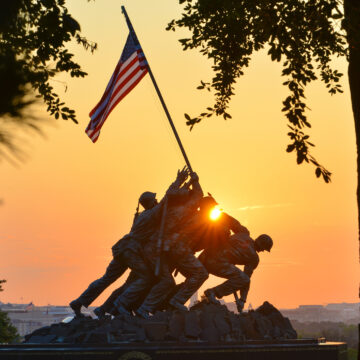
On Memorial Day weekend we dust off the grill, break out the lawn chairs, and head to watch the first parades of the year. But wait! Memorial Day isn’t just the unofficial start of summer. It’s a day to remember those who have made an extraordinary sacrifice in the service of their country and local community. Busted Halo’s Virtual Memorial Day Retreat guides you through moments of reflection and thanksgiving for the soldiers, police officers, and firefighters who have given their own lives in the service of others. To download a copy of this retreat, click here.
Getting started
Take a few moments to appreciate the rights and freedoms that are important to you:
Drive or walk around your town paying special attention to the police and fire stations, flags waving, and memorial ribbons for soldiers serving abroad
Reflect on having the right to vote, practice your own religion, and gain an education
Finally, remember that women and men have given their lives to defend these rights and freedoms
Now, settle into the moment…
Find a silent or peaceful place
Close your eyes and breathe deeply
Recognize that God is with you
Prayer
Loving God, Jesus told us, “No one has greater love than this, to lay down one’s life for one’s friends” (John 15:13). At times we take for granted the peace and freedoms afforded us through the sacrifices that soldiers, police officers, firefighters, and others before us have made. We do not always appreciate the privileges and comforts that others provide us. And more intimately, sometimes our own self-interest can become more important to us than loving and caring for our friends. Help us to be more mindful of the sacrifices that others have made for our own well-being and the ways we might give of ourselves for the good of others. Amen.
But the souls of the righteous are in the hand of God, and no torment will ever touch them. In the eyes of the foolish they seemed to have died, and their departure was thought to be a disaster, and their going from us to be their destruction; but they are at peace. For though in the sight of others they were punished, their hope is full of immortality. Having been disciplined a little, they will receive great good, because God tested them and found them worthy of himself; like gold in the furnace he tried them, and like a sacrificial burnt offering he accepted them. In the time of their visitation they will shine forth, and will run like sparks through the stubble. They will govern nations and rule over peoples, and the Lord will reign over them forever. Those who trust in him will understand truth, and the faithful will abide with him in love, because grace and mercy are upon his holy ones, and he watches over his elect.
Thoughts on the Reading
The reading from Wisdom, typically read at the funerals of the admired and inspiring, shows that God has neither overlooked the struggle of the brave women and men who have given their lives in defense of the freedoms we hold so dearly, nor their sacrifices for righteousness. We live in hope that our sisters and brothers now rest in the arms of the Lord, enjoying the peace, justice, and freedom that they fought so hard for us to enjoy. Memorial Day is an opportunity for our nation to remember, pray for, and mourn the loss of these women and men. We gather together in cemeteries, at flagpoles, on town greens, as well as in our churches, mosques, temples, and synagogues to pray, each in our own way, for the soldiers, police officers, and firefighters who have died in the line of duty. Encouraged by the hope of their eternal reward in the hands of God, we unite our prayers with those from all faith traditions as our whole nation prays in thanksgiving for the great sacrifice of the women and men upon whose shoulders we now stand, who have truly shown us all the greatest sort of love
Reflecting on the Reading
Take a few moments to think about (or even write down) your responses to the following:
Who do you know who serves her/his country as a soldier, police officer, or firefighter? How might you thank her/his for that service?
When you remember those who lost their lives defending our rights and freedoms, what does their legacy and sacrifice mean to you?
Name three ways you can more joyfully recall the memory of those who have died.
In what ways do you feel moved to help others? How might you become a servant to others in your community?
Praying for the Community
Adding our prayers to those across the nation, from a multitude of traditions, we give thanks for those who defend and care for us. Christ, we thank you for your saving sacrifice through which you welcome our fallen guardians into your kingdom. God, give us loving hearts so that we too may give of ourselves for others. Holy Spirit, bless all who serve and protect us. Add your own petitions perhaps for soldiers, police officers, and firefighters in your community: Christ, thank you… Father, give… Holy Spirit, bless…
Make a Commitment to Those Who Serve Others
Using your reflection responses as a guide, make a doable personal commitment that will help you to be more appreciative of those who put their lives on the line in service to our country. Ideas: Call or even visit your local police or fire station to thank the women and men there for their service. Invite a neighbor over for dinner who has a family member serving abroad with the military. Volunteer your time at a local veterans center or medical facility.
Conclusion
Christ, you taught us saying, “Blessed are the peacemakers, for they will be called children of God” (Matthew 5:9). We mourn the deaths of those who have paid the ultimate sacrifice in pursuit of peace. Still, we know that you gave your own life so that these women and men can find eternal peace in your kingdom. May we learn, through their example, to appreciate the joys of peace and freedom that we may sometimes take for granted. Amen
While I was growing up, my family emphasized that calling to mind those who gave their lives to sacrifice for our country is always necessary and important.
We visited the cemetery on all major holidays to spend time at my grandparents’ graves. We traveled there on Thanksgiving, the week of Christmas, and Easter Sunday. My parents, my three brothers, and I would climb into the car after Mass and head to the cemetery.
If we were at my paternal grandfather’s grave, we would all exit the car once we arrived and say a prayer at the tombstone. After a few minutes, my mom would bring us back to the car and my dad would stay behind at the grave of his father. If we were at my maternal grandmother’s grave, the opposite happened. Dad would usher us to the car and Mom would stay behind for a few extra minutes.
This was their intimate time alone with the parent they had lost. We honored their memory by going to the cemetery as a family, but I also remember that image of my mother or father spending one-on-one time with the grave as I peered out the car window looking at them. It was as if they were talking to their respective parent as if they were still alive and could hear them. They were remembering them by continuing their relationship with them. I was drawn into this moment because I witnessed my mom and dad love their own parent even beyond their death.
My maternal grandmother is buried at an armed services cemetery on Long Island because her husband served in the military. All the tombstones there are the same rectangle shape and the same color, white. The uniform aisles of tombstones evoke something inside of me that brings me to honor those who gave their lives and the family members of those who served. Every visit is like a miniature Memorial Day.
Today, we are called to remember and honor the sacrificial love of countless men and women who gave everything so we could live in our beautiful country. The challenge is to honor them even when it is not Memorial Day.
When I visited the cemetery as a child, I was so reflective of my grandparents’ lives as well as grateful for the love of my parents. I was more attentive to my relationship with them because I was reminded of how short and fragile life is.
But then, I would go back to my routine until the next holiday and forget how important it is to remember those who came before me so that I could live (literally in the case of my grandparents being my ancestors). On this Memorial Day, we are invited to take that focus towards those who died in service. How can we be more intentional about giving them honor and respect?
Our Catholic faith offers two great connections that are easy and powerful. One, pray for veterans, those who died in the line of duty, and those current service men and women at Mass on Memorial Day weekend. The Eucharist is the memorial of Christ’s suffering, death, and resurrection. We do not simply call to mind what Christ did; those mysteries are made to present to us. As the Son of God died so that we could live, we can pray especially for those who died for our country so that we could have the freedoms we do today.
Second, pray a decade of the Rosary or an entire Rosary for our veterans. We can pray for those who have died and those who have returned from the armed forces. We know that so many returning service people struggle to reacclimate into society. Pray that they may find work and know their value.
Memorial Day is always the last Monday in May, a month dedicated to honoring the Mother of God. Praying for Mary’s intercession allows us to call to mind the fact that she is guiding all of her children, wherever they find themselves.
Whatever you do for Memorial Day, make it something that serves as a powerful and lasting reminder of just how blessed we are to have people in our age and in our history who live out the sacrificial love of Christ. May we honor them by respecting that love and mirroring it in our own lives as best we can.
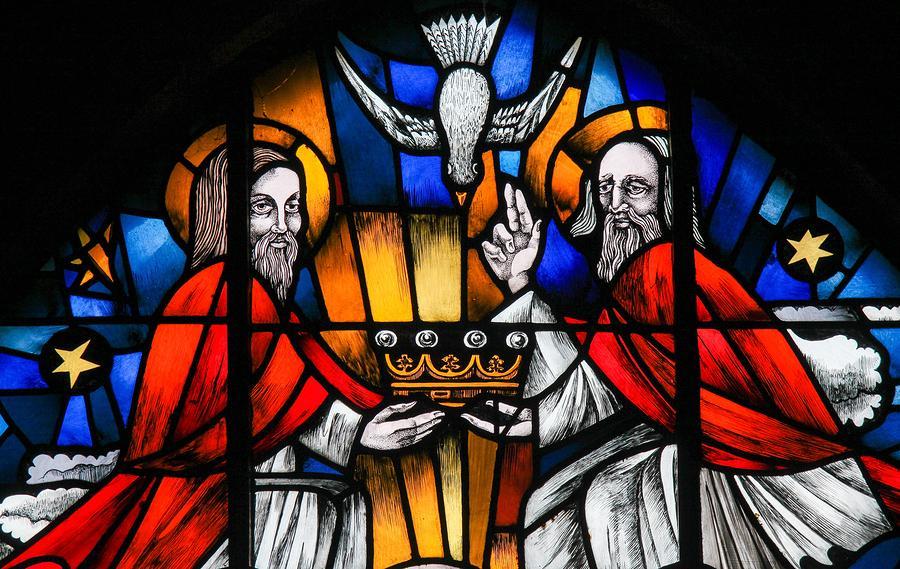
The Trinity is the manner in which Catholics believe God is revealed to the world. The Catechism of the Catholic Church tells us, “The mystery of the Holy Trinity is the central mystery of the Christian faith and of the Christian life.” (CCC, #261)
The Church shows that because God is “mystery,” meaning that we just can’t pin God down — we’re unable to know everything there is to know about God — God has tried to communicate to us just who He is. Traditionally, the Church expressed this as, God being revealed as Father, Son, and Holy Spirit, three expressions or “persons” of one divine essence. The Trinity is one. Catholics do not believe in three Gods but rather one God in a unity of three persons with one divine nature.
The church uses the image of the Father — the Creator from which everything flows and has its being — to express the first person of the Trinity. While the Son and the Holy Spirit are not “lesser gods” they do proceed from the Father as God’s own self-gift to humanity.
God the Son
The second person of the Trinity is the Son — Jesus himself, God become man. Catholics believe that God freely chooses to come into human history in the person of Jesus. God becomes like us and dies our human death for us. But because Jesus is God, He cannot be held by death and rises to a new life, supremely better than human experience.
God the Holy Spirit
The third person of the Trinity is the Holy Spirit, who proceeds from both the Father and the Son. Jesus announces that his Father will send the Holy Spirit to be with and in the disciples, to teach and guide them. The Spirit is God’s real presence living within all of us, which brings us inspiration (which literally means “to draw in the Spirit”).
God is three “persons” but one “essence.” The Father is just as much “God” as the Son and neither is “more God” than the Spirit.
Still confused? Let’s try thinking of these things in yet another way. Instead of “persons” let’s substitute the word “expressions” of God.
Expressions of God
The Trinity can be thought of in these three expressions:
God is “beyond us.”
We can never really fathom what God is, but we know that He is far beyond our limited human nature or anything we can come to know in that human experience. God is the ultimate mystery, the question that we never fully answer. This is God the Father — the creator, the one who is beyond all understanding.
God is also “among us.”
We come to know God in the person of Jesus. God takes on our human nature and becomes “one of us.” Catholics also believe that this human experience of God continues in the sacrament of the Eucharist. God the Son is among us.
God is also “within us.”
God is the “divine spark” that awakens us to the fact that we are alive. God imbues us with our creativity, our gifts and talents, and our limitations as well. As we come to know ourselves as people, we also come to know God — who knows us better than we know ourselves. This is the experience of God the Holy Spirit.
God is all these things and more. We don’t know all that God is but this is how God has been revealed to us throughout the course of our history — how we have come to best express God.
Question: What aspects of the seven sacraments are in the Bible? Are there any that are not?
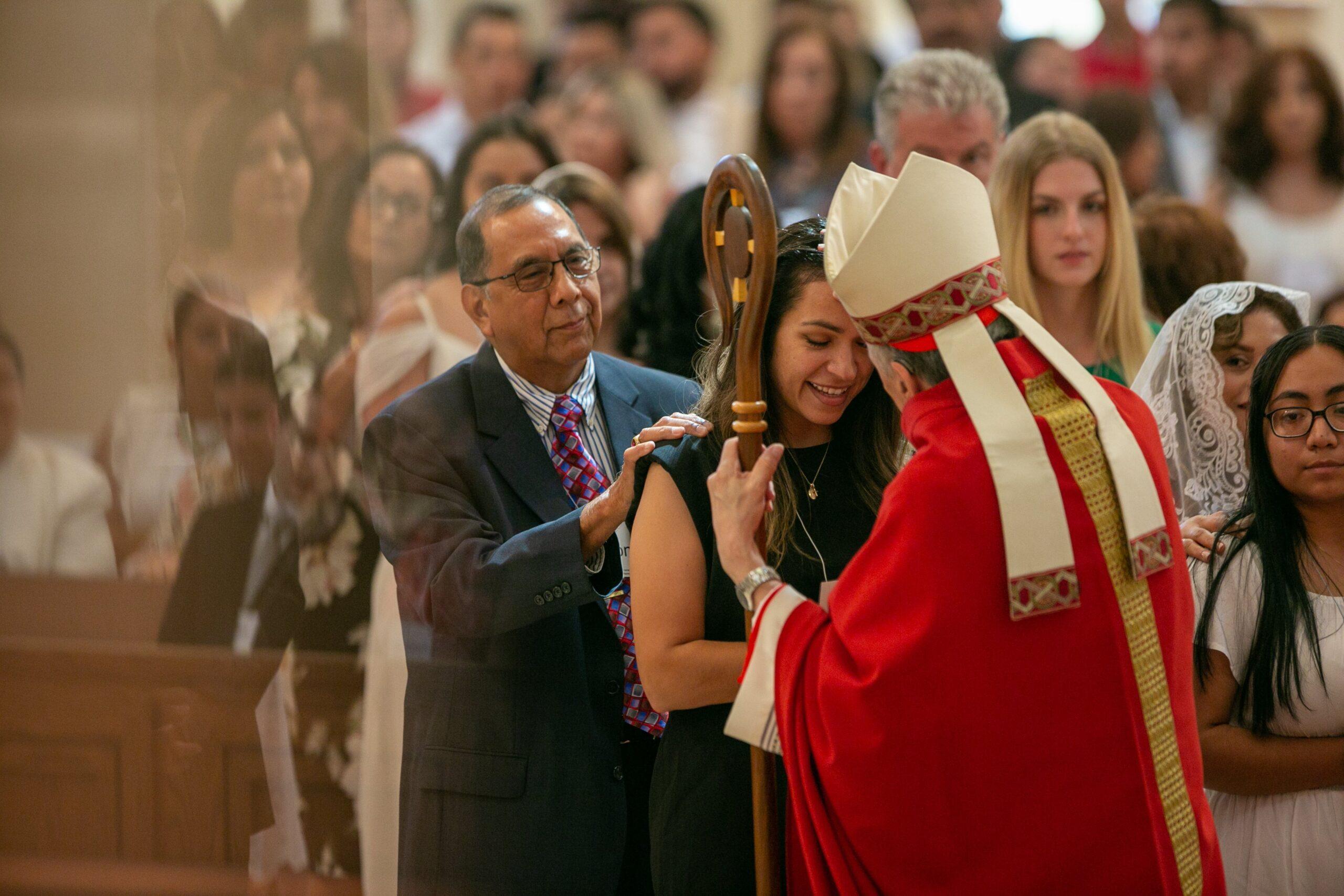
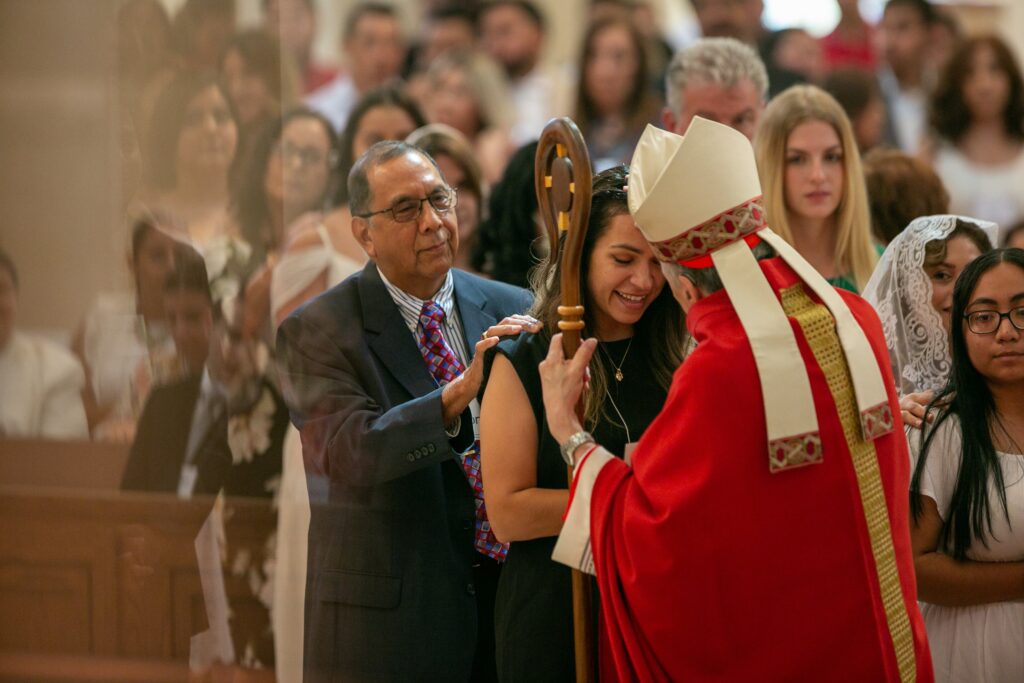
Cardinal Daniel N. DiNardo of Galveston-Houston anoints the head of a confirmation candidate at the Co-Cathedral of the Sacred Heart in Houston (CNS photo/James Ramos, Texas Catholic Herald)
The seven sacraments celebrated by Catholics all have their roots in Scripture, although some are featured more prominently than others. There are many references to Baptism, of course, beginning with Jesus’ Baptism by John. The Eucharist was instituted by Jesus at the Last Supper (Matthew 26:26-29). Confirmation, though not specifically named in the Bible, is traced back to the outpouring of the Holy Spirit on Jesus at his Baptism and on his followers after Jesus’ resurrection (see John 20:22 and Acts 2:1-4). The Sacrament of Reconciliation, while not practiced in the same way in biblical times as we know it now, is rooted in Jesus’ ministry of forgiving sins and proclaiming salvation to the lost. After his resurrection, he breathed on the disciples, imparting them with the Holy Spirit and stating, “If you forgive the sins of any, they are forgiven them” (John 20:23). The Sacrament of the Anointing of the Sick can be traced to the New Testament Letter of James (5:14): “Are any among you sick? They should call for the elders of the church and have them pray over them, anointing them with oil in the name of the Lord.”
Finally, the two Sacraments of Vocation — Marriage and Holy Orders — derive from Scripture, although the format of the liturgical celebrations has obviously evolved through the centuries. The Bible begins with the creation of man and woman in the image and likeness of God and very soon refers to them becoming “one flesh” (Genesis 1-2). Countless other passages refer to the covenant between married spouses, and Jesus himself defended the nature of marriage when he declared, “What God has joined together, let no one separate” (Matthew 19:6). Holy Orders take shape from Jesus’ appointment of the Apostles to extend his ministry of teaching, healing, and proclaiming salvation (Matthew 10:1-8). Later, those Apostles prayed and laid their hands on other “men of good standing, full of the Spirit and of wisdom” to share in the ministry (Acts 6:3-6). Thus the succession of the apostles began and with it the tradition of a pope or bishop laying hands on a man to ordain him as a bishop, priest, or deacon.
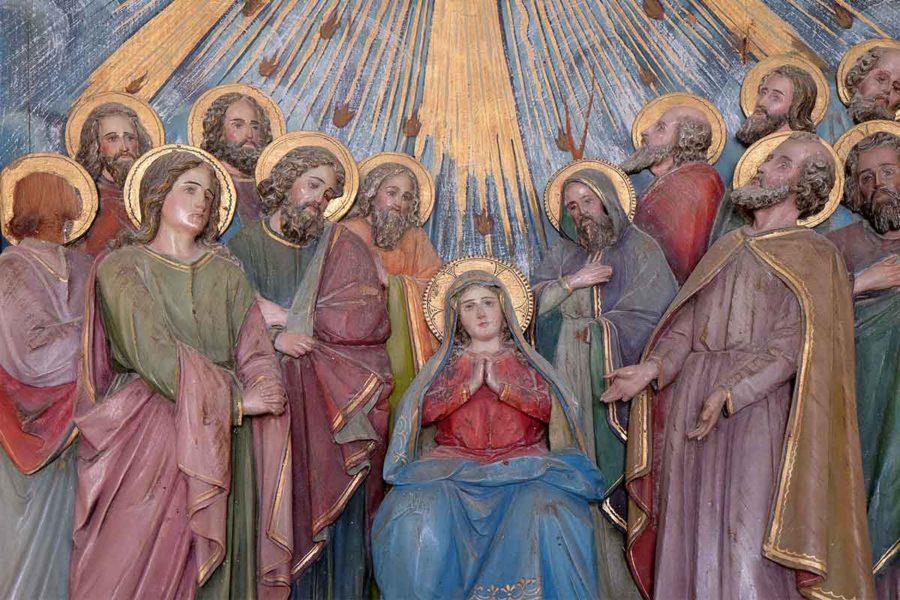
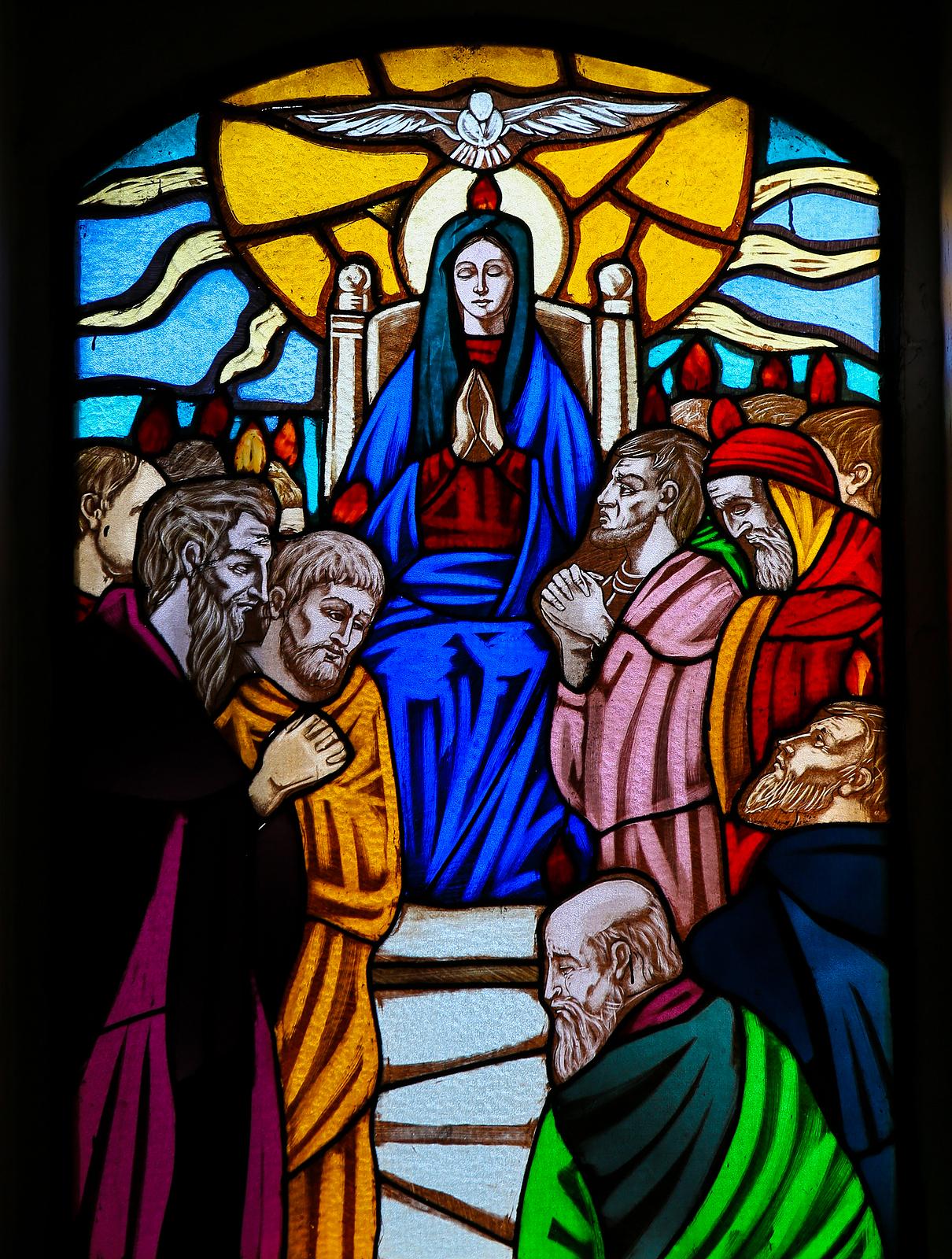
On May 19 this year, we’ll celebrate the birthday of the Catholic Church: Pentecost. Several thousand years ago, the third person of the Holy Trinity made its debut and gave the Apostles the strength, wisdom, and courage they needed to spread the Gospel to all nations. But if you’re anything like me, it can be easy to forget about this pivotal day in the Church’s history since it doesn’t come with a lot of pomp and circumstance. Easter has an entire three-hour ceremony which includes the induction of new Catholics to the Church, the four-week season of Advent builds the anticipation of Christmas, and every Ash Wednesday triggers a flood of Catholic memes about the various ash crosses on social media.
While it’s true that Pentecost may not be amplified by the same bells and whistles, this solemnity provides its own value, reminding us of the Holy Spirit’s inspiring presence in our lives. It’s easy to forget how active the Holy Spirit can be, but hearing the message of Peter’s courageous witness, the proclamation that changed the Church forever can draw attention to the Spirit’s activity in our own lives. For my part, I am reminded of the Holy Spirit’s good guidance in my own life.
I think back to when I was a senior in high school making the decision of where to attend college. Of course, choosing what school to attend is pivotal; so much prayer and discernment was needed. Many people gave me advice and promoted different schools (usually whichever one they went to), and as I witnessed schoolmate after schoolmate gleefully announce their choice of college, I felt stuck and frustrated. I looked at plenty of schools that offered practical majors such as business or computer science, but I wasn’t particularly compelled to attend them. The school I was most drawn to was Christendom College.
Christendom emphasized community and had an unflagging commitment to Catholic orthodoxy. Its curriculum was built on the Catholic liberal arts tradition, offering theology, philosophy, and classic works of literature in place of contemporary conventions such as engineering. Many friends and family members were skeptical about the school because of this and thought it was therefore less practical. However I connected with the school’s goal to expand its students’ minds in a broader sense, helping them achieve the ability to think and reason effectively. Though the school’s vision was unconventional, its fascinating curriculum and the prospect of spending four years engaging with passionately Catholic young people was impossible to overlook.
The writings of St. Ignatius of Loyola, a personal favorite of mine for many years, held the answer to my questions. St. Ignatius reminds us that the Holy Spirit’s movements in our souls take away sadness and disturbance and, in doing so, draw us to good action. The thought of attending Christendom brought peace and confidence that I would be well-prepared for the work of evangelization. After months of prayer, discernment, and exploration, I had my answer.
I finally decided to take the liberal arts route, choosing history as my major. By exploring the actions of the Catholic Church over the past centuries and learning about the multifaceted motivations of the men and women who shaped history, the Holy Spirit guided me to a greater understanding of his Church and the nature of the men and women who fill her pews.
Now that I’ve graduated, I can confidently say that during those four years, my life changed for the better. I made strong friendships with great people, grew both spiritually and emotionally, and became a better, stronger, wiser person because of the choices I made. But I didn’t make it alone. As we approach Pentecost, a solemnity to celebrate the Holy Spirit in a special way, I’m reminded of this and filled with gratitude for what the Spirit has done for me.
I think if we take a genuine look back at our lives, we’ll notice the care and precision with which we’re guided through this chaotic world. My experience with college was only one of many in which confusion and frustration gave way to gratitude as it became clear what the Spirit was doing. This Pentecost, I invite you to reflect upon the confusing moments in your own life. You might find there’s wisdom present there you may not have otherwise noticed.
Can’t remember what or when Pentecost is? Well for starters, it’s this Sunday; and if you want a little more info on this celebration of the Holy Spirit and the birthday of the Church, take a look at Busted Halo’s two-minute video.
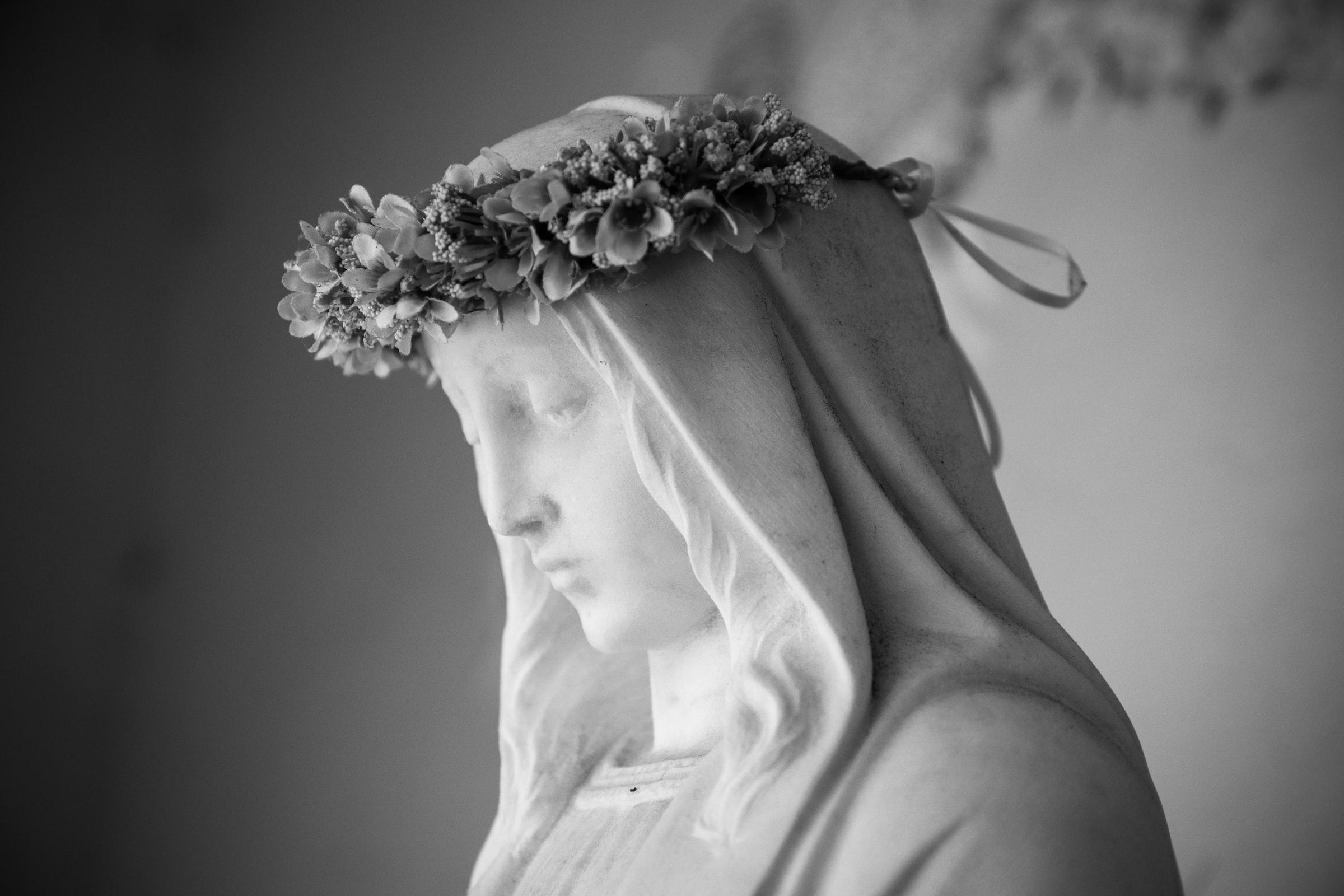
Marian consecration. Even for practicing Catholics who already know a thing or two about devotions to a saint, the phrase might stir up some confusion.
I get it, and I want to help clear up some of the mystery!
I myself stumbled across consecration at a time when I wanted to deepen my faith. I had chosen Mary for my Confirmation name and prayed the Rosary every once in a while, but I felt a call to form a more personal relationship with her. In 2016, I saw that a women’s fellowship group was leading a retreat for Marian consecration. I leapt at the promise that it would be a game-changer and decided to participate.
If to consecrate means “to set aside for a particular purpose,” what does it mean, exactly, when the term is applied to our relationship with Mary? Put simply, Marian consecration is an entrustment of oneself to Our Lady. But if that “simple” idea still sounds vague and mystical, know that consecration involves the following concrete steps:
A substantial period of prayerful preparation (typically 33 days). Often, parishes will host small groups that commit to making the consecration together over this time period, but you can also make it alone at any time.
A persistent spirit of trust in Mary’s motherly care and intercession, to endure for the rest of your life.
As Catholics, we recognize that when, from the Cross, Jesus gave Mary to the disciple John, and John, in turn, to Mary, Jesus made her our spiritual mother. As such, Mary’s equipped in a special way, over and above all the other saints in heaven, to lead us to holiness. “Mary’s task is to give spiritual birth to Christians, to feed and nurture them with grace, and to help them grow to full stature in Christ.” Fr. Michael Gaitley writes, in his popular guide to Marian consecration, “33 Days to Morning Glory,” “In short, Mary’s job is to help us grow in holiness. It’s her mission to form us into saints” (25).
Moreover, Fr. Gaitley explains that Mary is united to the will of God more closely than any other human being throughout all of time. If we want to know and follow the will of God in our own lives, there’s no better person to entrust the care of our souls to than Mary herself. A friend of mine once said, “The question isn’t really, ‘Why should you consecrate yourself to Mary?’ but, ‘Why shouldn’t you?’”
But does that mean that we’re making Mary more important than God Himself?
I can see why it might seem that way, especially to someone who’s new to the idea of consecration. But the answer is an emphatic no. Mary’s goal, while alive, was simply to live in union with God, and now that she’s in Heaven, she has the same goal for each of us. If we consecrate ourselves to Mary, it’s not with the intention of replacing God but rather, of allowing Mary to bring us closer to him, as other servants of the Lord, committed to doing his will in the world.
Okay, this sounds good, but where do I start?
Since there’s a particular kind of preparation associated with making a consecration to Mary, you’ll need some guidance through the process. If your parish hosts small groups for Marian consecration, you might find it helpful to join one, because of the benefit of being able to pray and process your reflections with others. But you can also make it by yourself!
Either way, you’ll need a book. If you want to go “old school,” you can use St. Louis de Montfort’s “True Devotion to Mary,” but I prefer Fr. Gaitley’s conversational, approachable style in “33 Days to Morning Glory”(which I’ve already cited above). He does a great job of breaking down consecration into related themes that build on one another, and offering short prayers to meditate with each day. Plus, he organizes each week of the retreat according to the theology of a particular Marian saint: Louis de Montfort, Maximilian Kolbe, Mother Teresa, and John Paul II.
At the heart of any Marian consecration, though, is a total gift of ourselves to Mary: an offering of all of our prayers, intentions, works, sacrifices, and gifts, for her to use as needed to help form us into saints.
I consecrated myself to Mary for the first time on the Feast of the Immaculate Conception in 2016, and have since re-consecrated myself (you can renew the offering as many times as you’d like!) twice more — in 2017, on the Feast of Our Lady of the Rosary (October 7) and in 2020, on the Feast of the Visitation, which also fell on Pentecost (talk about a perfect day for a consecration, combining a Marian feast day with the celebration of the Holy Spirit’s descent!). Each time, I’ve felt myself grow in my own understanding of how Mary wants to be a mother to me, and of how she leads me to her son. Most of all, I’ve grown in a spirit of trustful abandonment regarding God’s will for my life, as I’ve prayed to emulate Mary’s fiat. Last year, I purchased a bracelet to remind me of my consecration, and I wear it each day as a tangible reminder of the offering I’ve made and of Mary’s unceasing care for me.
If there’s one thing I recommend that you do for your faith life this May, particularly if you’re serious about becoming a saint (as we all should be!), it’s consecration to Mary. You won’t regret it.
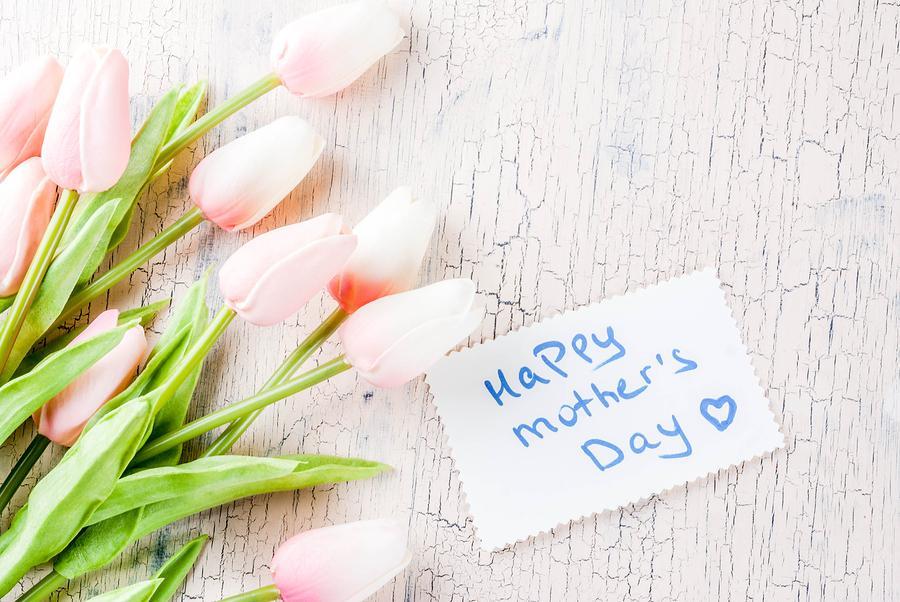
This Sunday is Mother’s Day — a day dedicated to honoring our mothers. As we go through life, our relationships with our mothers evolve and our perspectives shift. We might feel distanced from our mothers or even at odds with them. This virtual retreat focuses on our changing relationships with our mothers. You can do this retreat on your own or with your mom! Live far away? Email her the link then get on the phone, Facetime or Skype. So, in addition to a card or gift (don’t forget!), celebrate Mother’s Day with your mother in a unique way. Click here to download the PDF.
Getting Started
Find a comfortable place in your home or even outdoors for this retreat. Take a few minutes to think about your mother or other women who have been nurturing figures in your life. You might want to light a candle in memory of any nurturing figures that have passed away.
Now, settle into the moment …
Close your eyes and breathe deeply
Recognize that God is with you
Prayer
Loving God, we thank you for the gift of mothers who give us life. By their love and sacrifices, they have taught us how to love and make sacrifices for others. We are inspired by their faith and the way they have provided a foundation for knowing you. May you strengthen our mothers through your grace so that they can continue to grow as our examples of faith and love. And, may we, their sons and daughters, always honor them with a spirit of profound respect. Amen.
“On the third day, there was a wedding in Cana of Galilee, and the mother of Jesus was there. Jesus and his disciples had also been invited to the wedding. When the wine gave out, the mother of Jesus said to him, “They have no wine.” And Jesus said to her, “Woman, what concern is that to you and to me? My hour has not yet come.” His mother said to the servants, “Do whatever he tells you.” Now standing there were six stone water jars for the Jewish rites of purification, each holding twenty or thirty gallons. Jesus said to them, “Fill the jars with water.” And they filled them up to the brim. He said to them, “Now draw some out, and take it to the chief steward.” So they took it. When the steward tasted the water that had become wine, and did not know where it came from (though the servants who had drawn the water knew), the steward called the bridegroom and said to him, “Everyone serves the good wine first, and then the inferior wine after the guests have become drunk. But you have kept the good wine until now.” Jesus did this, the first of his signs, in Cana of Galilee, and revealed his glory; and his disciples believed in him.”
Thoughts on the Reading
This passage is most notable because it features the first recorded miracle of Jesus’ ministry. It also has a message for us about the changing relationship between a mother and a son. Mary has played a very special role in Jesus’ life. She carried the Son of God in her womb. She watched as her son grew in God’s wisdom and knowledge, and bore witness to Jesus’ life-giving ministry. No doubt the parent-child relationship of Mary and Jesus had its ups and downs. The changes in both mother and child over time transformed their relationship. So it is with us today as we grow older and our parent-child relationship and even our role in that relationship changes. These changes can lead to even deeper bonds – connections that can produce miraculous things if we let them.
Reflecting on the Reading
Take a few moments to think about (or even write down) your responses to the following. If you do this retreat with your mother, share your reflections with one another.
For children: What are 3 things about your mom for which you give thanks?
For mothers: Name 3 ways that your child/children has made you into the person you are today.
What are your hopes for your relationship with your mother/child at this time of your life?
What aspects of your current relationship challenge these hopes?
What can you offer to your mother/child to support them at this time in their lives?
What can you offer to your mother/child to help your relationship grow?
Praying for the Community
God, we lift up for prayer all of the mothers in our midst. May we especially remember mothers without mothers, mothers who have lost children, single mothers, widows who are mothers, mothers in prison, mothers who struggle to feed their families, mothers who suffer physical and emotional abuse, and all women who face injustice and rejection as they work to nurture and raise their children.
Add your own: God, we remember mothers who…
Make a Commitment to Nurture Relationships
Using your reflection responses as a guide, make a doable personal commitment to embrace the changing relationship you have with your mother as an opportunity to better communicate with one another and form an even stronger bond of mutual respect and love.
Conclusion
God of all mothers, we draw closer to you through the relationships we have with others. As we pay tribute to our mothers this Mother’s Day, help us to always honor all of our relationships with utmost care and compassion. Help us to be patient in difficult times and rejoice at the small miracles that happen in the midst of our relationships with our mothers. Amen.

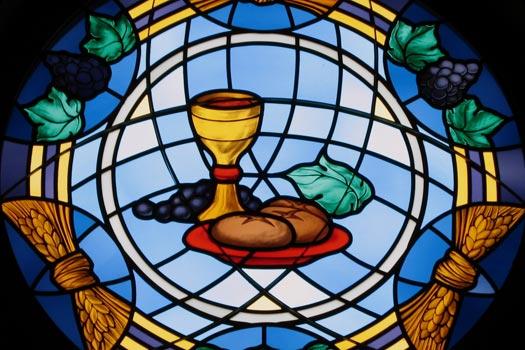
 Have you ever wondered why there’s a specific celebration for Corpus Christi (Latin for “Body of Christ”)? Don’t we celebrate the Body and Blood of Christ at every Mass? Here are a few facts about this Holy Day. (We also created a handout with some of these details, below, that you can download and share at your parish.)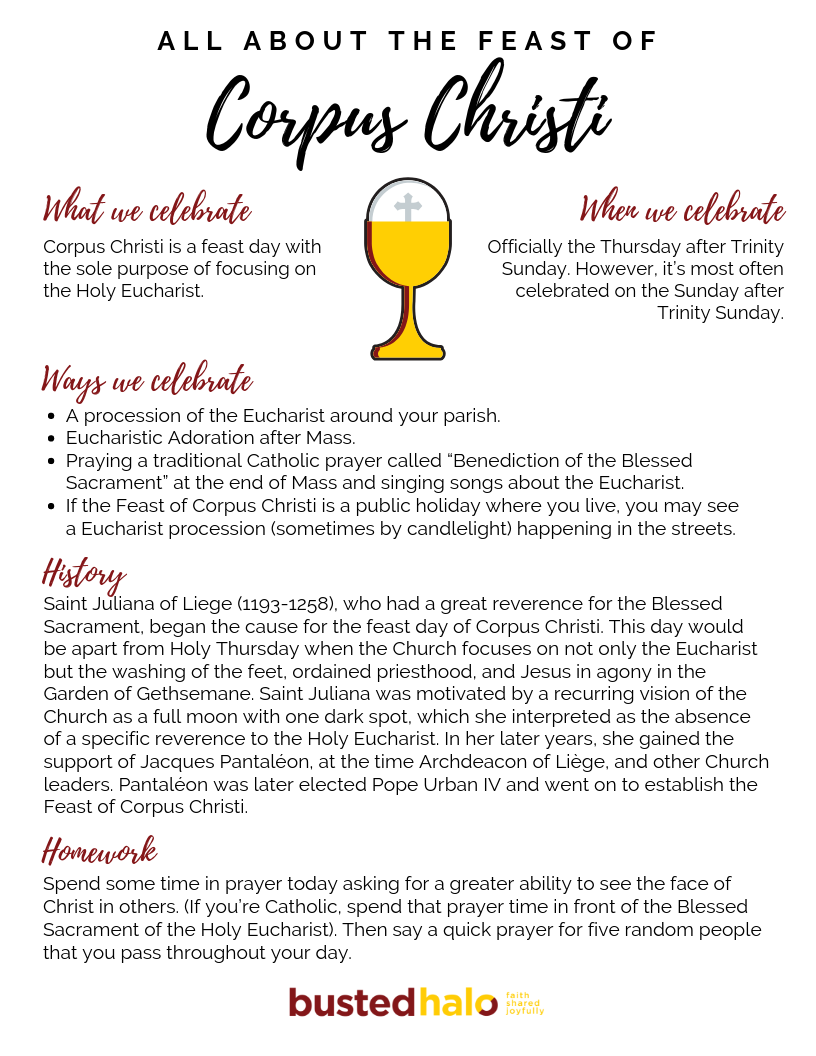
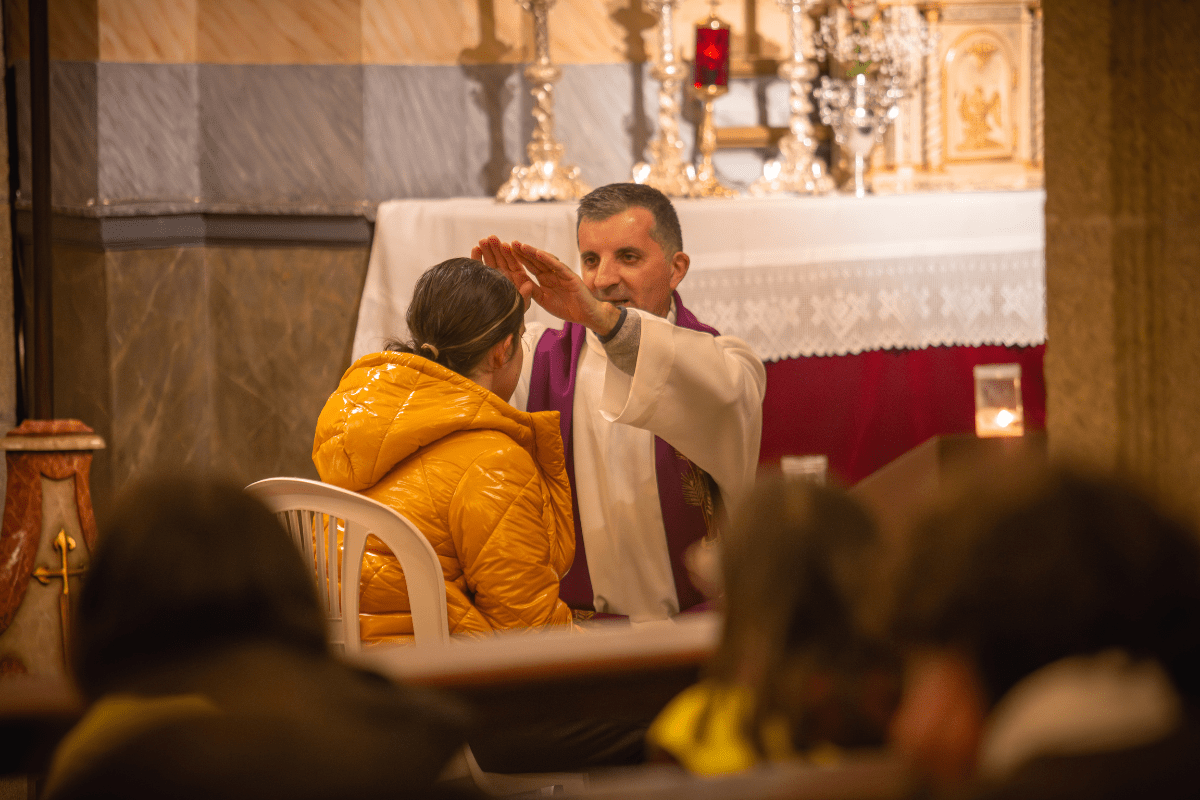
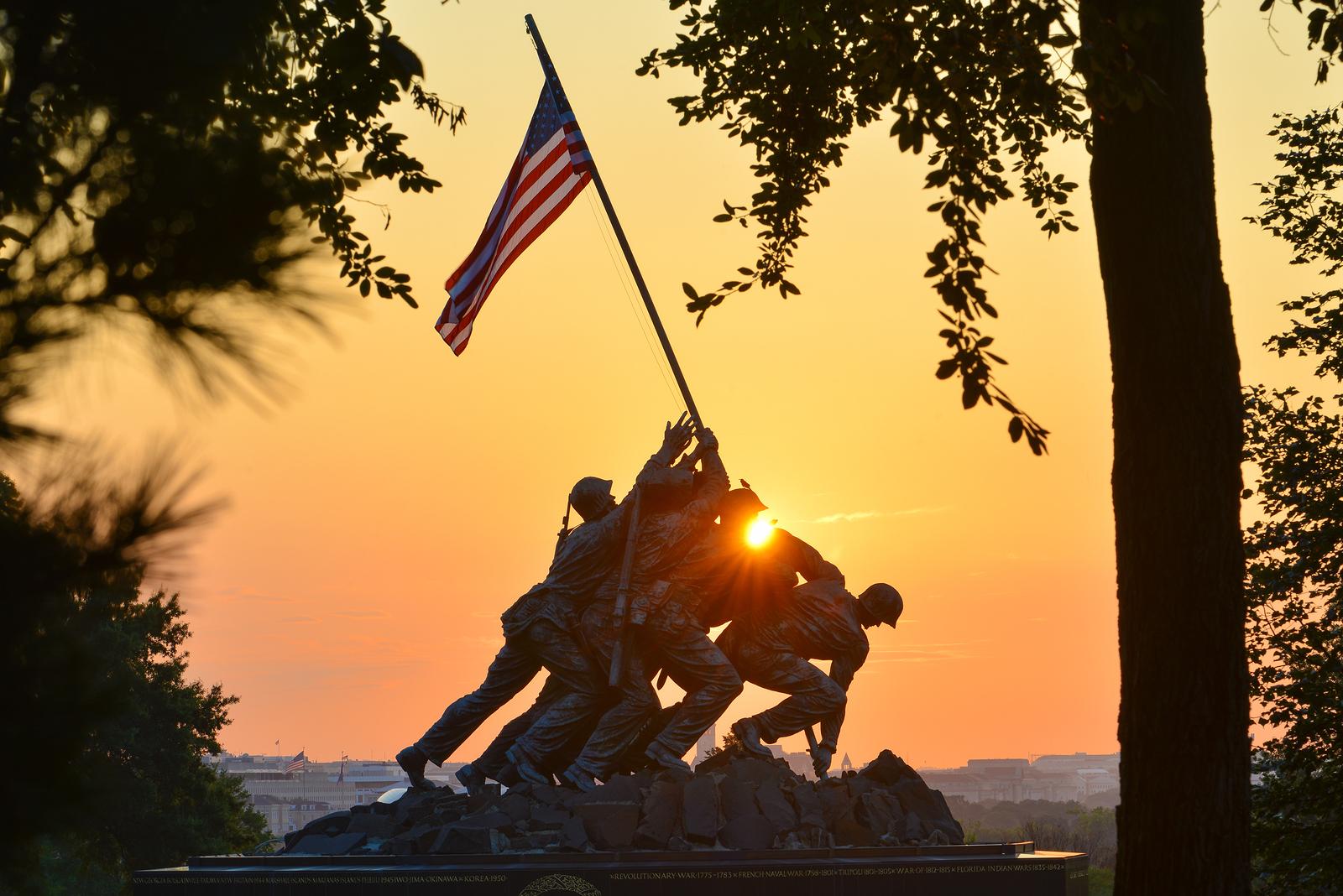
 On Memorial Day weekend we dust off the grill, break out the lawn chairs, and head to watch the first parades of the year. But wait! Memorial Day isn’t just the unofficial start of summer. It’s a day to remember those who have made an extraordinary sacrifice in the service of their country and local community. Busted Halo’s Virtual Memorial Day Retreat guides you through moments of reflection and thanksgiving for the soldiers, police officers, and firefighters who have given their own lives in the service of others. To download a copy of this retreat, click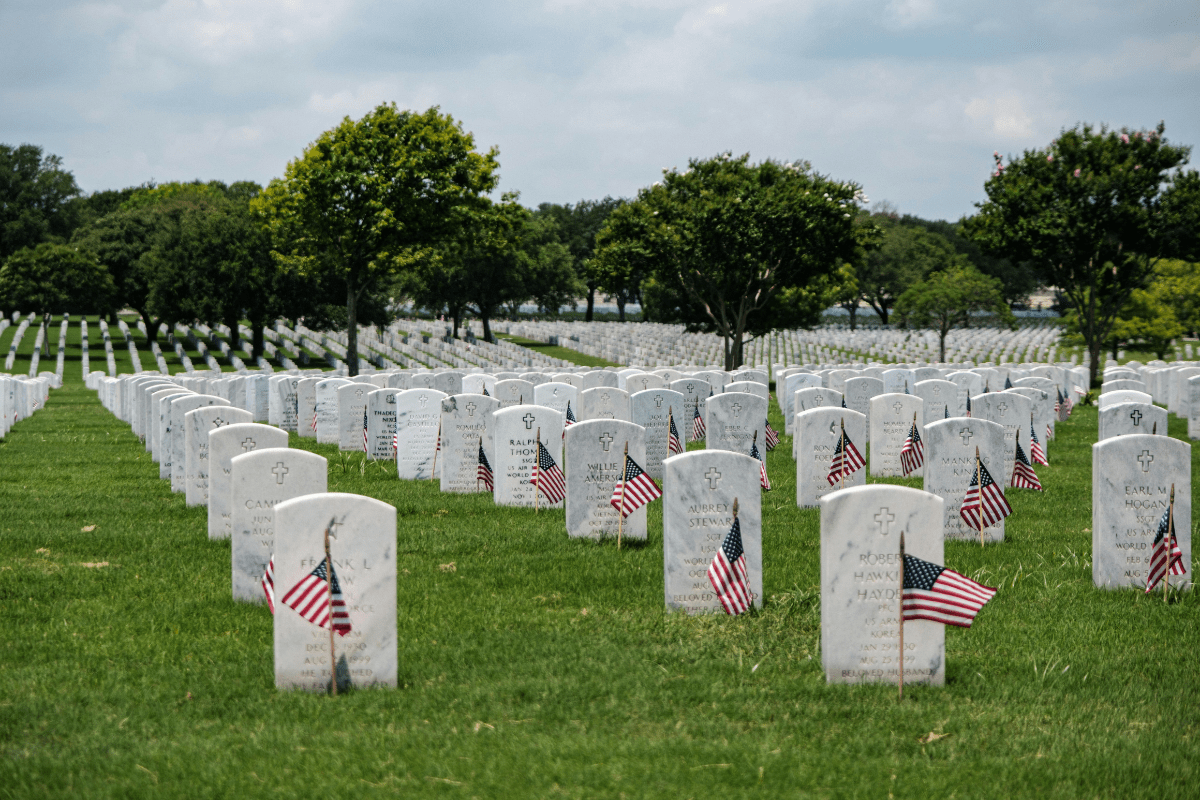
 On May 19 this year, we’ll celebrate the birthday of the Catholic Church: