Blog

  • Beyond the Pulpit: Unconventional Ways to Serve Your Church

    Beyond the Pulpit: Unconventional Ways to Serve Your Church

    Photo by Kelly Eliason on UnSplash

    As someone who serves on the “media ministry” team at my church, I’ve gained firsthand experience in the power of digital evangelism. Our team manages sound, lighting, and visual presentations during services, but more importantly, we broadcast sermons online to reach those unable to attend in person. It was only when I learned about homebound members, nursing home residents, and far-flung congregants tuning in that I truly grasped the importance of this ministry in spreading the Gospel and connecting with people.

    RELATED: Eccentric Evangelism: How I Use My Quirks to Spread the Gospel

    The evolution of church service roles reflects the changing landscape of how faith communities engage with their members and reach new audiences. While vocations to religious life remain vital, today’s Church also needs laypeople with diverse skill sets to minister effectively in our digital age.

    There are countless unexpected and creative ways individuals can contribute to their faith communities. Here are some lesser-known vocations and how they’re making a significant impact.

    1. Digital evangelists

    In our increasingly online world, the Church needs tech-savvy individuals to spread its message. Digital evangelists use social media, podcasting, and video production to reach new audiences. For example, Father Mike Schmitz’s “Bible in a Year” podcast became the #1 podcast in the US on Apple’s platform in 2021, demonstrating the power of digital ministry. Those interested in getting involved in digital evangelization could pitch an article, prayer, or podcast to a religious publication, or start a social media channel with a creative take on sharing the faith. 

    2. Environmental stewards

    Pope Francis’s encyclical “Laudato Si’” highlighted the importance of caring for our common home. This has led to a rise in faith-based environmental initiatives. Some churches now employ sustainability coordinators to reduce their carbon footprint and educate congregations on eco-friendly practices. Looking for helpful ways to get started? The United Nations and Earthday.org has plenty of resources for faith leaders across denominations to encourage more sustainable practice. 

    3. Sacred artists

    While religious art has a long history, modern sacred artists are finding new ways to express faith. From contemporary Christian music composers like Lauren Daigle or For King and Country to graphic designers creating faith-inspired merchandise like Not of This World or Elevated Faith, these creatives are making spirituality more accessible to younger generations through music and fashion. They blend contemporary styles with faith-based messages, appealing to a wide audience while maintaining their spiritual focus.

    RELATED: How Do I Serve the Church as a Layperson?

    4. Community garden coordinators

    Many churches are transforming unused land into community gardens. These spaces not only provide fresh produce for food banks but also serve as places of communion and education. Garden coordinators organize volunteers, plan harvests, and often integrate spiritual teachings into their work.

    5. Trauma-informed chaplains

    Specialized roles like trauma-informed care demonstrate how the Church is adapting to address contemporary challenges in serving communities. Trauma-informed chaplains combine theological knowledge with an understanding of psychological trauma, allowing them to provide more effective spiritual care in hospitals, prisons, or disaster relief situations. To pursue this career, one might start by obtaining a master’s degree in divinity or pastoral counseling, then seek additional training in trauma-informed care through organizations like the Trauma-Informed Care Project or the International Association of Trauma Professionals.

    6. Faith-based data analysts

    These professionals use data analytics to help churches better understand their congregations, measure the impact of outreach programs, and inform strategic decisions. Data experts can help churches gain valuable information about charitable giving, attendance patterns, parish demographics, volunteer engagement, and overall needs of the community. To enter this field, one could begin with a degree in data science, statistics, or a related field, and then seek opportunities to apply these skills within religious organizations. By leveraging these types of analyses, ministries can make more informed decisions, allocate resources more effectively, and ultimately grow their impact in their communities.

    7. Interfaith dialogue facilitators

    With increasing global interconnectedness, the ability to build bridges between different faiths is crucial. Some individuals dedicate themselves to organizing interfaith events, moderating discussions, and promoting understanding across religious boundaries.

    RELATED: Showing Up Imperfectly: What I Learned as a Hospital Chaplain

    8. Church archivists and historians

    Preserving the rich history of faith communities is vital. Church archivists and historians use modern technology to digitize records, create virtual tours of historic religious sites, and make centuries of wisdom accessible to new generations.

    9. Faith-based financial Advisors

    Stewardship of resources is an important aspect of many faiths. Some financial advisors specialize in helping individuals and religious organizations align their investments with their values, often focusing on socially responsible investing. Organizations like Compass Catholic teach practical financial discipleship and have programs for parishes and individuals alike. 

    10. Sports ministers

    Recognizing the power of sports to build community and character, some churches now employ sports ministers. These individuals organize leagues, coach teams, and use athletic activities as a platform for spiritual growth and outreach.

    11. Technology accessibility specialists

    As churches increasingly rely on technology for services and outreach, ensuring accessibility for all members is crucial. Specialists in this field work to make digital content accessible to those with visual, auditory, or other impairments.

    RELATED: 10 Ways to Serve Others When You Have Young Kids

    These unexpected vocations demonstrate that serving the Church is not limited to traditional roles. As society evolves, so do the ways individuals can contribute to their faith communities. Whether through technology, environmental stewardship, or creative arts, there are myriad opportunities for those feeling called to serve.

    By embracing these unexpected vocations, the Church demonstrates its ability to evolve and remain relevant in a rapidly changing world. Each of these roles, from digital evangelists to environmental stewards, creates new avenues for outreach and connection. They remind us that serving the Church isn’t confined to traditional roles or spaces, but can happen wherever people’s skills and passions intersect with the needs of their community.

    As we move forward, it’s exciting to imagine what new forms of ministry might emerge. The key is to remain open to new possibilities, recognizing that every skill and talent can be a powerful tool for sharing faith and building community. Contact your local parish to see if opportunities like these are available, or if your parish community would be open to starting a new program.

  • Who is Padre Pio of Pietrelcina? Examining His Inspiring Story of Faith and Trust

    Who is Padre Pio of Pietrelcina? Examining His Inspiring Story of Faith and Trust

    Photo by Maria Paula Campisi on Cathopic

    Padre Pio of Pietrelcina is one of the Catholic Church’s best-known saints and stigmatists whose life serves as a true testament to radical love of God and neighbor. While the majority of his time on this earth was characterized by intense illness and suffering, Padre Pio’s example reveals to us how much more God’s grace abounds in the midst of our troubles when we unite our suffering to Christ crucified. The Catholic Church celebrates this beloved Italian saint’s feast day on September 23. 

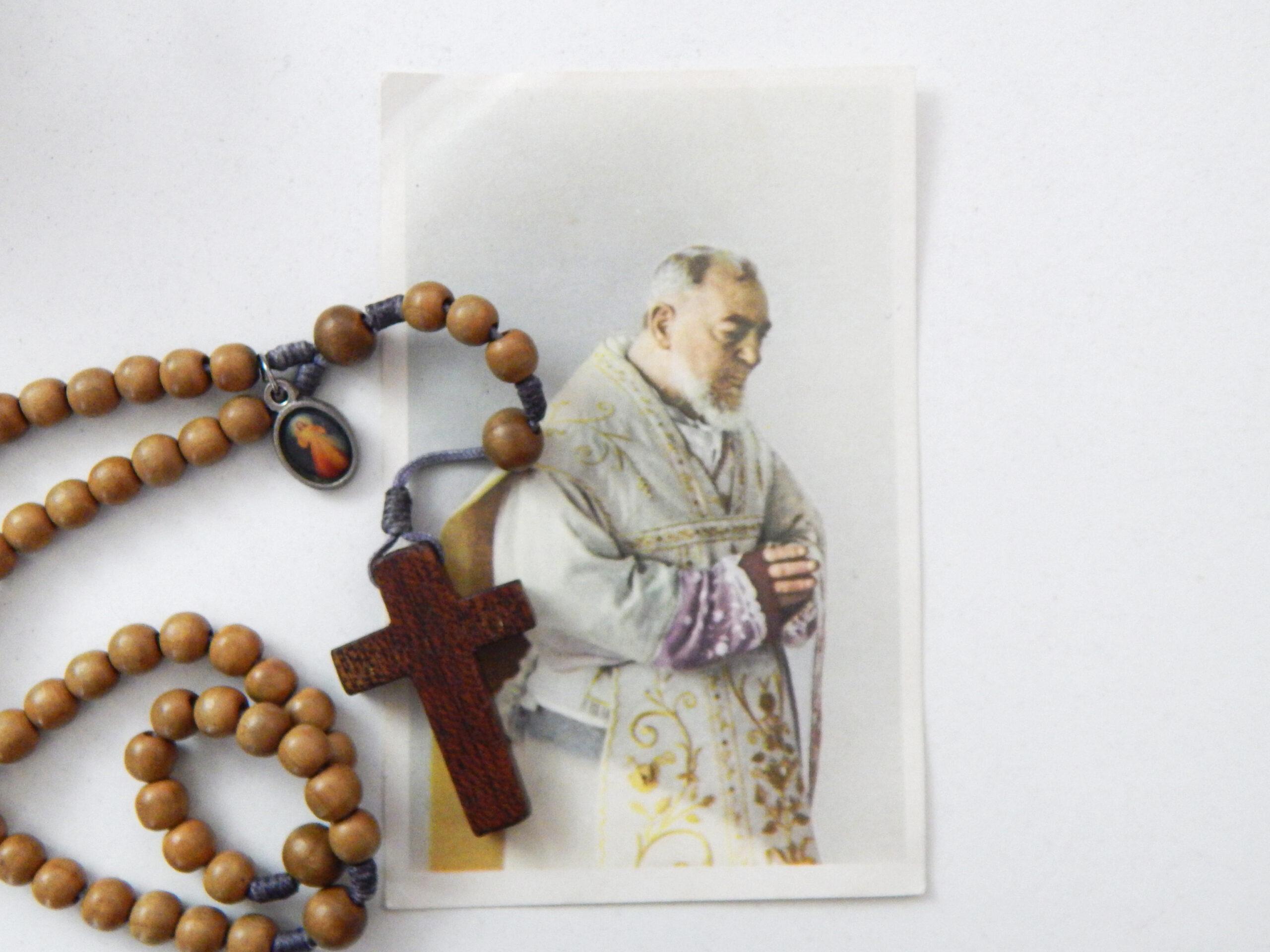
    As is probably the case for many young Catholics of Italian descent, I first encountered Padre Pio in the form of pictures and prayer cards that decorated the home of my grandparents – a tailor and seamstress who emigrated from the Southern Italian region of Puglia. My nonno and nonna often told me stories about this holy man, instilling in me a deep admiration for his devotion to prayer and his profound love for Jesus. Now my favorite saint and intercessor (after the Blessed Virgin Mother, of course), Padre Pio continues to inspire me as a role model in faith and courage as I navigate my own spiritual journey. 

    RELATED: Pray, Hope, and Don’t Worry: Learning From Padre Pio’s Words of Wisdom

    Born Francesco Forgione to poor Southern Italian farmers on May 25, 1887, Saint Pio’s life of faith had an extraordinary beginning in that he consecrated himself to Jesus at just 5 years old. Young Francesco was gifted with the ability to see and speak to his guardian angel and innocently believed everyone enjoyed the same privilege.

    At the age of 10, Francesco informed his parents of his wish to become a Capuchin friar, and five years later, he was accepted into the order’s novitiate, where he would prepare to enter religious life. It was at this point that he took the name Pio in honor of the second-century bishop of Rome, Pope Pius I. After completing his training, he was ordained to the priesthood at 23 years old.

    Padre Pio’s special grace as a young priest was clear to all those who encountered him. He was known to spend the majority of his day praying and holding confessions. The friar often entered into silent contemplation of Christ’s Passion during his celebration of the Holy Mass, so it was not uncommon for his Masses to last several hours. News of Padre Pio’s mystifying spirituality quickly spread, drawing pilgrims from around the world to seek his spiritual guidance, confessions, and the powerful experience of his Mass. 

    Having endured markedly poor health since the time he was a child, the Capuchin priest understood his suffering as a God-given opportunity for sanctification, offering it to Christ for the conversion of sinners and as expiation for the souls in purgatory. Padre Pio expressed his ever-growing passion for this penitential sacrifice to his spiritual father in a letter, demonstrating his total surrender to the will of God in the words, “It seems to me that Jesus wants this.” 

    LISTEN: Discussing Heaven and Purgatory With Leonard DeLorenzo

    Inspired by his example, I strive to emulate the radical love of neighbor that Padre Pio embodied by offering up my own sufferings for the holy souls in purgatory just as he did. In doing so, I have learned to recognize the unique grace spoken about by many Catholic saints that is experienced when one embraces suffering with humility and gratitude. 

    At the age of 31, Pio received the stigmata – the real, bleeding wounds of Christ in his hands, feet, side, and shoulder – as he was praying before a crucifix. United to Christ’s Passion, Padre Pio bore these painful wounds for 50 years, and from them emanated the distinct aroma of violets that followed Pio wherever he went. When asked on one occasion if the wounds caused him pain, he smiled and replied, “Do you think the Lord gave them to me for decoration?” The wounds miraculously healed without a trace upon his death.

    The extraordinary life of Padre Pio serves as a guiding light to the faithful on how we can deepen our devotion to loving and serving our neighbors. For us laypeople who do not physically bear the wounds of Christ and cannot administer the sacrament of Reconciliation, what we can do is take seriously the need to pray for one another, especially the souls in purgatory who can no longer atone for their past sins. “We must empty purgatory with our prayers,” was one of Saint Pio’s oft-repeated phrases. Like the Capuchin priest, we are called to do all that we can with whatever graces God has given us to work selflessly for the salvation of our brothers and sisters, remembering that each and every soul is infinitely precious to our God. One of my personal favorite prayers for the souls in purgatory can be found here

    RELATED: 7 Ways to Pray for the Holy Souls in Purgatory This November 

    We can also look to Saint Pio as a shining example of complete and constant trust in the Lord when we find ourselves in challenging times. In fact, this saint’s story attests that it is through our suffering, rather than in spite of it, that we are brought closer to Jesus. As he carried the agonizing wounds of Christ’s Passion for 50 long years, Pio willingly embraced his affliction because he understood that suffering endured out of love for Christ brings sanctification. Like Padre Pio, we too can learn to recognize God in the midst of our hardships and take comfort in knowing that He faithfully sustains us through it all. In his own words, Saint Pio reassures us that “When we suffer, Jesus is closer to us.” I hold these words dear when I encounter difficult moments, confident that we are never abandoned in our suffering, but instead drawn nearer to the Lord who came into this world to suffer for our sake so that we may be redeemed. 

    With the same confidence in our Lord as the humble priest from Pietrelcina, let us always be guided by Padre Pio’s simple, yet beautiful profession of faith: “Pray, hope, and don’t worry.”

  • How Do I Overcome Anger?

    How Do I Overcome Anger?


    Photo by Drew Hays on Unsplash

    Overcoming anger is no easy task, especially when one has been hurt. It is possible, however. Our first task to understand is that anger is an emotion. Emotions are normal and not at all sinful. However, we cannot allow our emotions to rule our decisions. The evil one would like nothing more than for us to fall into what St. Ignatius of Loyola calls desolation–thinking that all is lost or hopeless and that nothing really matters anymore.

    Recovering from anger takes time and when we are thrust into desolate times it is important not to make any decisions or take any actions towards others when we aren’t thinking clearly. Only after we heal and can begin to see the light again can we actually make a good, discerned decision.

    So if you are angry about something, notice where your anger comes from and work on healing from that hurt. Talk to a trusted mentor, a counselor, a spiritual director or a priest from your parish or that you trust about your anger and work towards healing. Healing will involve feeling that emotion, but not allowing that emotion to rule your heart.

    Originally published 2014

  • God Never Gives Up on Us: Lessons From My Journey of Meeting My Fiancée

    God Never Gives Up on Us: Lessons From My Journey of Meeting My Fiancée

    A woman's hands are resting on a table with a wooden crucifix and a Bible.Sometimes, it feels like God abandons us. The disciples might have felt this way after the Crucifixion. Or, at least, they felt downcast, their hopes dashed; the prospect of building the kingdom without their leader seemed bleak and pointless. Their whole world had been shaken and flipped upside down. Jesus, their point of reference and the truth by which they viewed existence lay in a tomb.



    In my own prayer life, I’ve faced issues that seemed hopeless. I have prayed for certain blessings for a while, but, growing impatient when my prayers go unanswered, I stop asking for those petitions. I get in the lazy habit of assuming my desire is not in accord with God’s will.

    However, I’ve found that even if I give up on my prayers and my dreams, God doesn’t. Those prayers that I let peter out after I grow tired of asking for the same thing time and again are prayers that God nevertheless uses for my benefit and his glory.

    RELATED: Try These Unique Forms of Prayer When You’re in a Spiritual Rut

    For years, I prayed to God to send me a spouse and to make me a good husband and father along the way. I joined a local Bible study where our leader introduced us to a St. Raphael prayer for singles in search of a spouse. For months, I prayed this devotedly almost every night. But eventually, the consistency slackened, and I stopped altogether.

    Time went by, and I hadn’t gone to Bible study for several weeks. Then, during a pilgrimage to some beautiful Chicago churches, I bumped into our group leader. She wanted to know why I hadn’t been coming; I had no legitimate excuse. She also said there was a new woman who had joined Bible study. I had nothing else better going on Thursday nights. So God brought me back to the group. 

    That summer, I got acquainted with Ellen, our new member, who came to the study in search of a friend group (and, just possibly, a significant other). 

    RELATED: A Pathway to Holiness: A Single Man’s Search for Vocation

    Summer passed, autumn came, and after midnight following a Halloween party, I asked Ellen out on a date. She graciously accepted, and since then, she has listened, cared for, comforted, and loved me, which, as a certain aged Hobbit might observe, “is better than I deserve.” Her desire for a family, the intention to raise children in the faith, her spontaneity, genius, and sharing of herself when she knows I need consolation are part of what makes her the perfect partner.

    Now here I sit, a few weeks out from our wedding. After I proposed, Ellen revealed she also prayed to find someone to share her life with. God, in his design and timing, made us the answer to each other’s prayers. It gives me real Tobiah and Sarah vibes! As the Scripture reveals, St. Raphael played the matchmaker in their lives too.

    I have no doubt Raphael interceded on my behalf. Reflecting back on that time of spiritual dismay before meeting Ellen, I realized I had given up on God, thinking that he didn’t want what I so strongly felt drawn to — marriage. But that’s not how vocations work. God had a plan.

    RELATED: Looking for a Sign From God? Try These Prayer Practices Instead

    The same was true after Jesus’ death. The Apostles had also given up: If Jesus really was who he said he was, why was he dead? In response, they returned to their former lives. In John: 21, St. Peter says he’s going fishing. Jesus, who had called him to be a fisher of men, appears on the scene and draws Peter back to land. When the disciples get ashore, they find Jesus relaxing by a charcoal fire, and they share a simple breakfast of baked fish.

    It’s a cozy, calming scene. That’s the soothing effect of Jesus in our lives. Yet, we so quickly lose hope. In the same way he ridiculed Peter elsewhere, Jesus could also complain of us: “You of little faith!” (Matthew 14:31).

    What God taught me, as he taught Peter too, is that no matter the weakness of our faith and hope in him, Jesus never gives up on us. It’s his all-powerful determination that brought him to the Cross. It’s his grace that will bring me and Ellen to the altar and the rest of our lives together.

  • 7 Steps for Navigating Challenging Conversations

    7 Steps for Navigating Challenging Conversations

    Photo by Nathan Dumlao on Unsplash

    From the time I was young, I was taught that there are two subjects that should never be discussed in mixed company: religion and politics. The last thing my parents wanted spoiling a nice evening with friends or relatives was a heated debate over contentious issues. As kids, my sister and I learned to limit our topics of conversation to what we were learning in school and the movies we had recently seen.

    What was a successful strategy for managing dinner parties, though, may not be an ideal goal in other contexts. Simply avoiding a difficult topic doesn’t make it go away. But talking about controversial subjects in the usual I’m-right-and-you’re-stupid manner we see every time we turn on the TV or open the newspaper doesn’t either. The unrest over racial justice we’ve witnessed during the past several months and the divisive, mean-spirited rhetoric that characterizes our political discourse today make it painfully clear that we have a long way to go in “loving our neighbors” if we can’t even talk with them.    

    LISTEN: Handling Post-Election Family Arguments

    But it doesn’t have to be that way. Like anything else that’s challenging, talking with people who are different from us – in terms of race, religion, socioeconomic status, political views – requires the careful use of specific skills to be successful. The book, Crucial Conversations, outlines several of these important skills. At work, I was part of a group of managers who were trained on these skills in a corporate setting to help us have the tough conversations we needed to have with employees we supervise. Through that experience, I began to realize that my parents’ approach to talking with guests is not the way to understand and connect with someone who is important to me whose views are very different from my own.  

    1. Know when it’s crucial

    A “crucial conversation” involves three key elements: differing opinions, strong emotions, and high stakes. Certainly, conversations involving differing views on race and politics can be considered “crucial.” Others include things like ending a relationship or addressing someone who has hurt us. The authors argue that whenever we find ourselves “stuck,” there is a crucial conversation that we are either doing poorly or avoiding altogether.  

    2. Be clear on motive

    To be successful, both parties need to share the same goal. If my goal in talking with you is to “win a debate” or to “prove that I’m right,” then I’m not ready to have a crucial conversation. If, on the other hand, I truly want to understand your point of view and want you to understand mine and if we both want to find a solution that works for each of us, then we are ready.

    3. Start with observable facts

    The best way to open the conversation is with indisputable facts. If I tell my boss, “I think you are prejudiced against the black females in our department,” I have begun with a negative opinion that will put him or her immediately on the defensive. Instead, if I start with, “I see that the last five people promoted in our department were all white and four of them were male,” then there is nothing to dispute.  Starting with verifiable facts gets the conversation going in the right direction.

    LISTEN: Mary Ann Steutermann Talks About How to Have Crucial Conversations

    4. Then, tell your story

    The authors argue that every issue has two components: the facts and “the story we tell ourselves about the facts.” Therefore, I should follow my fact-sharing with, “The story I tell myself about those promotions is that black females in our department don’t have the same shot at advancement as white males do. Is that how you interpret the situation or is there another way to look at it?” This allows me to put forward my viewpoint but in a way that leaves the door to other interpretations. It’s important to ask for the other person’s “story” too, not just advance our own.

    5. Beware of “silence” and “violence”

    The key to a productive conversation is for each person to feel “safe” throughout, meaning that each person feels respected, and both parties share a common goal. When people start to feel unsafe, they either become “silent” by holding back or “violent” by resorting to insults or accusations. If I see any of these signs, I must pull back from the conversation to get it back to a place of safety for both of us.

    6. Restore mutual respect

    If I have created an unsafe environment by being disrespectful, then the only way to fix it is to sincerely apologize with something like, “I’m sorry. I should not have said that you are biased. Really, you are a very fair boss which is evident by the way you manage the vacation schedule and holiday hours.” When we are wrong, we need to own it. 

    But sometimes we haven’t done anything wrong; we’ve just been misinterpreted. In these instances, the skill to use is “contrasting,” where we make it clear what we are NOT trying to say. If my boss thinks I have judged him as a poor leader, he will feel unsafe and not want to continue the conversation. But I can avoid this by saying, “I don’t mean to suggest that you are not a great manager. Our department has been at least twice as productive since you have been in the role, and I am happy to come to work each day. I just think that we may need to look at how promotions are decided with an eye toward race and gender.”  

    7. Restore mutual purpose

    Another way that people begin to feel unsafe in a crucial conversation is when it starts to appear that we no longer share the same purpose.  Continually affirming the common goal can help avoid the fear of hidden agendas. When we take a step back to remember where we do agree, it’s easier to address the areas where we don’t.

    My parents probably had the right idea in teaching me not to bring up difficult topics at parties with their friends. But what works at the dinner table in mixed company does not work to help us heal some of the brokenness among us. True, having crucial conversations with those we care about can be very challenging.  But by using these skills, we can “love our neighbor” in positive, practical ways that unite rather than divide. 


    Originally published on Nov 4, 2020.

  • Breaking the Cycle: How I Stopped Worshipping My Phone

    Breaking the Cycle: How I Stopped Worshipping My Phone

    Dad using smartphone while toddler son playsA few weeks ago, my wife and I were running errands with our 1-year-old and 3-year-old. Since they were tired and a little cranky, she ran into the grocery store to get bread while I waited in the car with the boys.

    I pulled out my phone and started to answer emails and scroll through social media. 

    My older son, Benedict, began to ask me questions about random things — and I continued to scroll on my phone as I answered him. After about two minutes, Ben said, “Daddy, get off your phone. I’m talking to you.” He wasn’t stating it angrily. His tone was more sad that his father was not paying attention to him. At that moment, I felt like I was choosing my phone over my son. I was ashamed, but I felt something else: convicted to love him more. So, I put my phone down in the car, and I pledged to put it down more often. 

    LISTEN: Father Dave Talks Mental Health and Social Media

    We all know that people of all ages have become addicted to their phones. They have become an extension of our bodies. According to Consumer Affairs, “on average, cell phone users look at their phones 144 times a day,” and the average American spends 4 hours and 39 minutes on their phone every day. That means we spend almost 70 days staring at that small rectangular device in our pockets over the course of a year. 

    In many ways, I worshipped my phone. What we worship is what we spend the most time thinking about and what we care most about. Worship is what orients our time, energy, and attention. 

    When Ben called me out about my phone, it didn’t feel good, but choosing to separate myself from my phone certainly did. I realized that my phone was keeping me from loving my family more and distracting me from opportunities to pray more often. So, I began to place my phone in my room when I got home from work until the kids went to bed. This freed me to be so much more attentive to my kids and my wife. I was looking them in the eyes; I was more willing to simply play on the floor with my sons. 

    RELATED: God First: Discerning Where Idols Are in Our Lives

    I also found myself freer from the worries of that particular workday and more present with my family, rather than thinking about what others were saying on social media or the score of the sports game. I became more concerned with the person in front of me rather than a screen, and, quite frankly, more happy because I wasn’t living through my device; I was living for my loved ones. 

    I also began to charge my phone on my dresser rather than my nightstand to avoid numbingly scrolling through social media or the internet at night. This made me more eager to speak to my wife about our day or to pray for an extended period before bed. The unproductive time I would have spent on my phone became a time for true worship. 

    The combination of healthier relationships in my family and more intimate prayer time has allowed me to further appreciate the need to be detached from my phone. It also helped me understand that by loving God first, along with my family, I was placing the one who is to be worshipped alone in his proper place. 

    This week, consider your phone habits. Look up your screen time and reflect on if those around you would claim that you occasionally choose your phone over conversation with them. If so, make a commitment to put it down. Then watch and see how your worship of God and relationships can flourish.

  • What are the Seven Sorrows of Mary?

    What are the Seven Sorrows of Mary?

    The “Seven Sorrows of Mary” refers to the seven feats of “spiritual martyrdom” (suffering spiritually through experiences) endured by the Mother of God in loving solidarity with her Son. They are:

    1) Mary’s sorrow at the prophecy of Simeon
    2) The flight into Egypt
    3) Having lost the Holy Child in Jerusalem
    4) Meeting Jesus on his way to Calvary
    5) Standing at the foot of the Cross
    6) Jesus being taken from the Cross (Depicted in art as The Pieta)
    7) The burial of Christ.

    The Seven Sorrows are all rooted in Scripture. Devotion to the Seven Sorrows of Mary stems primarily from the Order of Servites (The Servants of Mary) and has given rise to the Seven Sorrows Rosary as well as many other devotions to the sorrows (or dolors) of Our Lady. The Feast of the Seven Sorrows of Mary falls on September 15 and was first celebrated by the Servites before becoming part of the liturgical calendar of the Church Universal.

    Originally published April 2013.

  • Keeping the Faith After Loss: Catholic Resources for Those Affected by Suicide

    Keeping the Faith After Loss: Catholic Resources for Those Affected by Suicide

    for an article on suicide awareness, an empty bench with autumn leaves on the ground behind itAhead of this year’s World Suicide Prevention Day, we at Busted Halo prayerfully remember and pray for the souls of those who have died by suicide, for people who are vulnerable to suicide, and for those who are impacted by loss. As Catholics, we believe in the sanctity and dignity of every human life, no matter the struggles they face. We are called to support those who are struggling with compassion, empathy, and well-informed action and awareness efforts. 

    We hope these articles and podcasts on suicide and resources for those impacted by it, enlighten, offer consolation, and inspire hope. 

    What Happens to the Soul of Someone Who Commits Suicide? 

    “Many people were raised thinking that the soul of a person who commits suicide can never be redeemed. Father Dave addresses these concerns and misconceptions, making specific reference to the Catechism, which says, ‘We should not despair of the eternal salvation of persons who have taken their own lives. By ways known to him alone, God can provide the opportunity for salutary repentance. The Church prays for persons who have taken their own lives.’ 

    Father Dave continues, ‘We pray for people who have committed suicide in the same way we pray for anyone who has died. We pray for their soul.’”

    Do People Who Commit Suicide Go to Hell? 

    “In today’s times, we know much more about mental illness than ever before. We now know that anyone who commits suicide is not in control over their own actions. For something to be sinful, by definition, it needs to be done willfully, meaning, we need to be free to make the choice to commit the act in the first place and we have to know that the act is sinful.

    So therefore, if one is not in control over their own actions, they cannot be held responsible for what they have done, suicide included.”

    9 Ways to Help a Grieving Friend (That Aren’t Bringing a Meal) 

    “From my own experiences, I’ve learned that while the standard ‘Please let me know if there’s anything I can do’ means well, concrete action provides so much more assistance. When you know a friend is laid low in the mire of grief or despair, don’t wait for their call. Take action. Step in. Show up. Whether it’s bringing a meal or doing something less orthodox, any practical help will be welcomed with immense gratitude.”

    Grieving a Loved One’s Loss to Suicide

    “What we hope is that these books can bring comfort and healing to people who are in such terrible grief. Heaped on top of losing someone is the stigma and even discrimination that goes along with suicide. Losing a loved one is always hard. When it’s by suicide, it can sadly it can make it even harder.”

    Approaching Mental Health Through a Catholic Lens With Deacon Ed Shoener

    Deacon Ed Shoener is the president of the Association of Catholic Mental Health Ministers, and the co-author of two books with Bishop John Dolan of the Diocese of Phoenix, called “When a Loved One Dies by Suicide” and “Responding to Suicide: A Pastoral Handbook for Catholic Leaders.”

    Deacon Ed discusses mental health ministry in the Church. “We’re recognizing the need to do something about [mental health] and the need for God to be in the midst of this.”

    Experiencing Suicide Bereavement With the Help of the Sacraments

    “Every time I went to Mass after my sister’s death, I brought something with me. Often, it was anger against people I felt had contributed to my sister’s mental illness or had failed to help her. … During Mass, I acknowledged I did not know the whole picture and asked for the grace to forgive. I prayed for people I did not want to pray for, and gradually the anger eased.

    I am a Catholic convert. The sacraments have been a great support since my conversion, and especially now.” 

    Fr. Chris Alar on Finding Hope After a Loved One’s Suicide 

    “Fr. Chris explains that years after his grandmother’s death, a priest told him he can still pray for her, ‘I said “Father, how? She’s already been judged.”’ And he told me that God is outside of time. There’s no past. There’s no future. Everything is present eternally at one moment to God. … God will take my prayer into account for my grandmother at the moment of her death years ago.” 

    Discussion About Suicide from the Busted Halo Show

    Father Dave and Brett talk to a listener who recently lost his son by suicide. Father Dave explains that platitudes from well-wishers aren’t helpful to many who are grieving, and Brett opens up about his experience as someone who has friends who died by suicide. 

    My Daughter Committed Suicide. What Prayer Do I Say So That She Can Go To Heaven? 

    “Dearest Lord,

    We entrust (name) to your undying mercy and love.

    While in this life, they felt much pain and found life difficult.

    May you enfold them now with your love where no pain can find them, but rather your love can heal them.

    Make them Guardian Angels for those who struggle with life, for those who struggle to see you and the love that is around them.

    Give them Lord, kind admittance to your Kingdom and bring comfort to their families.

    We ask this, as we ask all things, through Christ our Lord. Amen.”

    Book: ‘The Catholic Guide to Depression: How the Saints, the Sacraments, and Psychiatry Can Help You Break Its Grip and Find Happiness Again’

    Extensive clinical experience treating patients with depression has shown author Dr. Kheriaty that the confessional can’t cure neuroses, nor can the couch forgive sin. Healing comes only when we integrate the legitimate discoveries of modern psychology and pharmacology with spiritual direction and the Sacraments, giving particular attention to the wisdom of the Church Fathers and the saints.

    Other Resources

    To Write Love On Her Arms

    To Write Love on Her Arms is a non-profit movement dedicated to presenting hope and finding help for people struggling with depression, addiction, self-injury, and suicide. TWLOHA exists to encourage, inform, inspire, and also to invest directly into treatment and recovery.

    The Dougy Center for Grieving Children & Families 

    Whether you’re grieving, or you’re helping someone who is grieving, Dougy Center is here for you. Find tip sheets, activities, podcasts, and more resources.

    The Trevor Project 

    The Trevor Project is the leading national organization providing crisis intervention and suicide prevention services to lesbian, gay, bisexual, transgender, queer & questioning (LGBTQ) young people under 25.

    Mental health resources for underrepresented communities (American Foundation for Suicide Prevention)

    From the American Foundation for Suicide Prevention, find mental health resources for minority and underrepresented communities, grouped by community.

    Suicide prevention resources (American Foundation for Suicide Prevention)  

    From the American Foundation for Suicide Prevention, find a list of resources for crisis situations, mental health care, and resources grouped by mental health conditions.

    If you or a loved one is ever experiencing suicidal thoughts, please call the National Suicide Prevention Line at 988. And consult Suicide Prevention Hotline if you are concerned for yourself or another.

  • Understanding Christian Hope for a New School Year

    Understanding Christian Hope for a New School Year

    A group of college students sitting on steps laughingEvery new school year brings its own set of expectations for the future. I have a privileged position to reflect on this reality, as I teach senior theology, which includes a course on vocations. This opportunity inspires me to consider the Christian theological virtue of hope and its effect on the life to which Christians are called. 

    Many seniors at Catholic high schools come from families with means, whose hopes for the future involve attending a prestigious college, achieving professional success, and solidifying their legacy. One finds these hopes imparted well onto these young people. Every year I overhear the usual questions of “Where will you be attending school next year?” and “What will you be studying?” 

    LISTEN: Saints for the School Year: Holy Men and Women to Accompany Teachers

    Instilling hope for a successful college and professional career is a necessary step in procuring that future. These are noble goals that should offer opportunities for deeper growth in virtue. But hope for these things is a little different when considered through the lens of faith.

    In Spe Salvi, an encyclical which provides Pope Benedict’s treatment of the virtue of hope, he describes “one who has hope” as one who “lives differently” (2). Benedict sees hope through the lens of the Resurrection of Jesus. 

    Because hope is understood in light of the Resurrection, one’s death, but also one’s life, is viewed differently, particularly when it comes to God’s call for our lives. The early Christian martyrs died with hope for their resurrections because they had faith in the Resurrection of Jesus, but they also lived with hope before their martyrdom. This belief did not invalidate the deaths they faced; their individual lives and, more importantly, life itself were just more real. It was in the face of these seemingly hopeless circumstances that God’s purpose for them became clear. 

    RELATED: The Road to Emmaus: A Journey Toward Hope

    A common movie trope involves the hero realizing his weapon cannot pierce the monster’s scales from the outside, so he must be swallowed by it in order to defeat it. It appears as though the monster has won and hope seems lost, until the hero cuts himself out of the monster from the inside, both freeing himself and killing the monster. It was by initially relinquishing his power but maintaining the small strand of hope that success was possible. 

    There is a powerful metaphor here for the way Christ conquered death and established hope in the Resurrection. In the same way that God worked on humanity intrinsically: Allowing himself to be swallowed up by creation, by time, and ultimately by death, he could then cut his way out by the double-edged sword of his Word (cf. Heb 4:12). This is referred to as the kenosis, or self-emptying, of Jesus highlighted by St. Paul in Philippians 2:7.

    Kenosis is not only a foundational idea to historical orthodox Christology, but a foundation of Christian spirituality and an essential element to fostering hope. Through kenosis, we can see the proper way of viewing hope: How Christians are called to “live differently,” including how they see their vocations. One discovers a vocation through kenosis in recognizing their relationship to the whole. There is a misguided notion that discerning one’s next steps in life is a realization of one’s individuality by rejection of community. For those raised in a Catholic environment, this often requires a shedding of one’s Catholic “identity.” This is misguided not only because of the rejection of Catholic practice, but also because it asserts the self above the community that formed it. Worse than St. Paul’s eye in 1 Corinthians 12:21 saying to his hand “I don’t need you!” it’s saying it to the whole body. The discerning young person, in recognizing oneself as one member of the Body of Christ, finds a calling in relation to the Body. This is why many high schools and colleges, including the ones where I teach, have built-in service days and organizations to help young people see themselves as connected to their local community.

    RELATED: Pope Francis’ Advice for College Students

    Every school year is a continued preparation for students to become who God has called them to be. I implore that we not only preach kenosis to do this but also live it and model it. One way I have tried to model this practice is to be a little vulnerable, professionally and personally. Being willing to risk at least a small humiliation can begin to empty one of pride. Admit to a time you were unfair to a friend or a jerk to a stranger and had to ask forgiveness. Tell an embarrassing story not just to connect, but to show you can live through it. Humility is the vehicle for kenosis; it empties our ego quickly, which is the only way our hope is no longer in the “I,” but like St. Paul, it is now in “Christ who lives in me” (Gal. 2:20). 

    Humility and kenosis are the tools for students to realize their vocation, which gives them hope when it is understood in light of the Resurrection of Jesus, leading them to live differently. Their time in school should foster hope that “does not disappoint” (Rom. 5:5) because it is in he who does not disappoint. 

  • Salt of the Earth: Engaging Hearts and Minds With Jesus’ Metaphors

    Salt of the Earth: Engaging Hearts and Minds With Jesus’ Metaphors

    Wooden spoon full of salt
    Photo by Jason Tuinstra on Unsplash

    “Why didn’t Jesus talk plainly? Why didn’t he just say what he meant?” The student asked. “What is, ‘You are the salt of the world’ supposed to mean? I use salt on my eggs!” The quip got a big laugh. 

    My freshman-year student was genuinely puzzled over Jesus’ parables and metaphors. “How are we supposed to understand what he is saying?”

    “Good questions,” I encouraged, impressed by her candor. 

    “Metaphors are a mercy of God for us,” I told the class. He wanted to transform his disciples – and us. Jesus hoped to change our views of our world, ourselves, and him. He wanted us to feel what he feels, to love others as he loves others. 

    I was not surprised by this question. After all, Jesus’ disciples asked him this. Jesus had answered, “Because knowledge of the mysteries of the kingdom of heaven has been granted to you…” (Matthew 13:11). Christ offered us his divine metaphors as a different kind of language to draw us into his very different kind of kingdom. 

    LISTEN: Why Do Jesus’ Parables Vary So Much in Tone?

    Metaphors, similes, and parables are essentially comparisons between two very different things or acts. They use familiar comparisons to expand our experience with less familiar acts of God’s presence. In the well-known metaphor that my student asked about, for example, Jesus said that those who know and do his word are the “salt” of the earth. What is not well-known, however, is the way metaphors open us up to new ways of knowing and experiencing Christ.  

    Metaphors offer us intuitive, “feeling” words to talk about his kingdom. As any religious teacher knows, we cannot describe and analyze God’s kingdom the same way a science teacher might talk about a chemical reaction. It degrades the kingdom of God to define it “clinically,” as if it were just another physical location. Metaphors liberate the kingdom from everyday definitions and develop expansive ways to understand and experience God’s presence. Metaphors engage our affect and intellect in ways that allow us to wrestle with ambiguities, challenge our worldviews, and help us to feel what others feel.

    To engage with us more intimately, Jesus chose the metaphorical logic embedded in the heart’s mind. “The National Directory for Catechesis” encourages educators to continue using metaphors just as Christ did. 

    Jesus used metaphors and parables for our salvation. Metaphors link different ideas that normally do not connect. Who would have thought to connect “salt” and “God’s Kingdom”? These links pave pathways to new ideas, new perceptions, and more complete ways of knowing and experiencing God.

    LISTEN: What Should Be Taken Literally in the Bible?

    When we consider the different metaphors of Christ, we can explore new ways of understanding God’s Kingdom — our feelings and our thinking, our imaginations, and our ability to relate to others’ feelings. These qualities invite us further into God’s kingdom — to “feel it” as well as understand it. 

    Jesus knew that the very process of pondering metaphors is what produces new ways of understanding. The main task in teaching merciful metaphors and parables is to help students meditate upon them. In this way, educators offer valuable “sparks” to students’ brains that allow students to relate to Christ with their full minds and hearts.

    How to accomplish this?  

    First, educators can introduce the “salt” metaphor by reading the passage in Matthew 5. Ask for any initial responses. Then reread the passage. Show a salt shaker and invite them to describe its function. 

    Second, the educator can ask students how they use salt today. The more ways students can relate to salt, the better. For example, do any students use electrolyte-restoring liquids when exercising? Has anyone gargled with salt water when they had a sore throat? How does salt enhance the taste of food? 

    LISTEN: Top 10 Tips for Catechists With Joe Paprocki 

    Third, the educator may offer insights about salt during Jesus’ time. For example, sometimes Roman soldiers were paid in salt because it was so valuable; even as valuable as gold. Teachers might note how salt is crucial for a proper diet and that salt was used to preserve meat. Some cultures rubbed salt in wounds to sterilize them. 

    After expanding their understanding of salt, return to the question of how Christians are like salt, as Jesus said. How can we act like salt’s healing or life-preserving qualities?  

    Fourth, ask “How can we all become even more ‘salty’ Christians?” 

    Fifth, ask students to suggest other metaphors for Christians or the kingdom of God. What other more modern metaphors could describe the healing, health-giving, sustaining, or life-giving acts of Christians?  

    In teaching by metaphors and parables, Christ used common images to draw his listeners into his uncommon life. Let’s continue that tradition.