Blog

  • Encouragement for Caregivers: 6 Bible Verses to Give You Strength for Your Care Giving Journey

    Encouragement for Caregivers: 6 Bible Verses to Give You Strength for Your Care Giving Journey

    In the year 2001, my father was diagnosed with progressive supranuclear palsy, (a degenerative condition similar to ALS), and my mother became his caregiver until he passed away seven years later. Although she did it lovingly and willingly, caregiving was also emotionally and physically demanding. Recently, I’ve taken on more of a caring role with my mother, and I now understand the difficulties even better.

    When a caregiving situation continues for weeks, months, or even years, it’s challenging.

    I’ve become very aware that I don’t feel strong enough to handle the physical and especially the emotional demands of caregiving. I’d like to say I’ve always stayed positive and full of faith, but in reality, I’ve sometimes found it hard to keep going. I realized that I needed to learn to rely more fully on God to help me cope.

    So, I’ve taken intentional steps to encourage myself and to keep communication lines with God open. Specific verses in my daily Bible reading sometimes jump out at me. Verses that remind me how much God loves me or promises that he will strengthen and protect me whatever the circumstances are hugely encouraging. But in the rush of everyday life, it’s easy to forget, so I’ve been exploring ways to bring them to mind when I’m busy or feeling overwhelmed.

    RELATED: 5 Creative Ways to Pray for Others

    I organize uplifting worship songs into playlists so I can listen to them while I’m cleaning or doing the laundry. I draw or stitch Bible verses onto bookmarks, so I see them when I’m reading. Sometimes, I write out reassuring scripture on small cards or sticky notes and carry them round in my pocket to take out and read throughout the day.

    It’s not about telling myself how I should feel, but more about acknowledging my true feelings to God and looking to him to help me find a way through the difficult times. I hope you find these verses encouraging too.

    1. When things feel overwhelming

    When your loved one gets a serious diagnosis and you don’t know what the future holds, it’s easy to feel overwhelmed. But sometimes it’s just the myriad of day-to-day tasks that seem overwhelming, so it helps to remember that God is our strength. When I’m in this situation, one of my favorite verses is Psalm 3:3 “For You, O Lord, are a shield about me, my glory and the lifter of my head.” Listen to this uplifting song based on Psalm 3:3 by the Brooklyn Tabernacle Choir.

    2. When you’re afraid

    When you’re faced with the suffering of a loved one, or the possibility of living life without them, the future can seem very dark. We all prefer to know that things will be OK, but God never promised us that life would be easy, only that he would always be with us. I’ve taken great comfort from Isaiah 41:10: “Do not fear: I am with you; do not be anxious: I am your God. I will strengthen you, I will help you, I will uphold you with my victorious right hand.”

    3. When you’re worrying about the future

    Perhaps you’ve got a hospital appointment tomorrow, or you’re wondering who will look after your disabled child when you’re gone? You’re not sure how life is going to pan out. At times like this, I try to remember that God has already gone before me and has promised to be with me — no matter what. Deuteronomy 31:8 tells us “It is the Lord who goes before you; he will be with you and will never fail you or forsake you. So do not fear or be dismayed.”

    4. When you’re feeling lonely

    Caregiving can be lonely. You may be confined to the house with little opportunity to go out or spend time with others. If like my father, your loved one becomes unable to speak or respond to you, it’s easy to feel terribly alone. But God is omnipresent – with us every moment of the day and night (and sometimes nights are the most difficult). We only need to reach out and God’s there. This sentiment is affirmed in Psalm 46:2: “God is our refuge and our strength, an ever-present help in distress.”

    5. When you’re experiencing doubt

    There may be moments in the midst of caregiving when we begin to doubt that God loves us and wants the best for us. In troubling situations, it can be easy to focus on the circumstances around us and not on God’s faithfulness to us. But Jesus was kind to those who doubted and didn’t accuse or blame them. When Thomas doubted the truth of his resurrection, Jesus allowed him to touch the wounds and see for himself (John 20:24-29).

    When I’m feeling full of doubt, I remind myself not to rely on my own understanding but to trust in God: “Trust in the Lord with all your heart and lean not on your own understanding. In all your ways submit to him and he will make your paths straight.” (Proverbs 3:5-6)

    6. When you are weary

    Caregiving is physically demanding – you may be nursing someone who’s sick or disabled,  or lifting a child constantly. Just staying on top of the cooking, cleaning, and laundry can feel totally exhausting, in addition to the emotional stress you’re experiencing. Sometimes, it’s not easy to get as much rest as we need, and at times like these, I rely on God to give me strength. In Matthew 11:28-30, Jesus urges us to come to him when we feel weary. I also love the image of an eagle rising above the storm in Isaiah 40:29-31: “They that hope in the Lord will renew their strength, they will soar on eagles’ wings.”

    Caregiving can feel all-consuming, and at times, we may feel inadequate for the task. But placing daily reminders in my path reassures me of God’s presence and helps make the task feel less daunting.

    (Originally published November 15th, 2017)
  • On Everlasting Life: 6 Bible Verses to Comfort the Grieving

    On Everlasting Life: 6 Bible Verses to Comfort the Grieving

    Many lit candles underneath a dark backdrop
    Photo by user ponchogallardo on Cathopic.com

    My family had the difficult task of informing my grandmother that my grandfather, her husband, had passed away. Together with our close relatives, we gathered at her house to share with her the sad news. We knew it wouldn’t be easy, considering that they had been together for 50 years, so we did our best to explain to her that he wasn’t really gone. We emphasized that it was just the physical body that died, but his soul lives on. To our surprise, however, she exclaimed, “But it’s his body that I want!”

    While we couldn’t help but laugh a little, there was truth to her longing. She wanted to see him, touch him, and hold him like she did before. It’s good to know that the soul lives on, but there are so many things you can’t do with an invisible soul.

    RELATED: A Prayer Journey Through Grief

    I knew that I would also miss my grandfather in a similar way. I would long to hear his laughter again. I would miss seeing him embracing and loving my grandmother. 

    Would we ever see him like that again?

    As someone raised in a Catholic family, I knew that I would find comfort and hope in my faith. Looking towards the Bible for answers about the next life, I found consolation in various verses about the resurrection of the dead. Just like Jesus’ resurrection, we hope to see our departed loved ones again in both body and soul.

    I found comfort in these Bible verses that either foreshadow our resurrected life, or tell us about the kind of life God will one day impart to believers.

    “But our citizenship is in heaven, and from it we also await a savior, the Lord Jesus Christ. He will change our lowly body to conform with his glorified body by the power that enables him also to bring all things into subjection to himself.” (Philippians 3:20-21)

    Our current physical body was called lowly compared to the glorified one God will one day bestow upon us. This body gets sick, grows old, and dies. But the one that the blessed will possess is a body that will never die.

    This means that we will not only get to see my grandfather again. But we will see him young, strong, and full of life!

    RELATED: Memento Mori: How Remembering Our Death Can Inspire Our Lives

    “Look at my hands and my feet, that it is I myself. Touch me and see, because a ghost does not have flesh and bones as you can see I have.” (Luke 24:39)

    Jesus clearly distinguished his resurrected body from ghosts. We can hope for a body that we can touch and feel, not an invisible soul that cannot be touched.

    When that time comes, my grandmother would finally get to embrace her dear husband once again. She would not talk to a mere spirit but to a man with both body and soul.

    “While they were still incredulous for joy and were amazed, he asked them, ‘Have you anything here to eat?’ They gave him a piece of baked fish; he took it and ate it in front of them.” (Luke 24:41-43)

    The glorious body that the saints will have will not only be able to be seen and touched. It can also eat! Jesus knew our fears, and he made himself an example to give us a glimpse of what our resurrected body would be like.

    How wonderful it would be to enjoy a meal again with our departed loved ones! It would be a day of true joy and celebration.

    “‘Put your finger here and see my hands, and bring your hand and put it into my side, and do not be unbelieving, but believe.’ Thomas answered and said to him, ‘My Lord and my God!’” (John 20:27-28)

    As though it were not enough for his disciples to see him eat, Jesus even consoled Thomas by letting him see his wounds. The resurrected body of Jesus is his own flesh but healed and glorified. It was not another person’s body.

    I can’t imagine the joy we will have someday when we can embrace and kiss our grandfather again!

    LISTEN: You Can’t Do It Alone: Maria Quiban Whitesell on Grief

    “As for me, I know that my vindicator lives, and that he will at last stand forth upon the dust. This will happen when my skin has been stripped off, and from my flesh I will see God: I will see for myself, my own eyes, not another’s, will behold him…” (Job 19:25-27)

    This same truth can be found in Job when he clarifies that he will see God with his own eyes, even repeating it! 

    We can still identify each other in the new heaven that God will make. This means that my grandfather will not be in another human body. The same eyes that looked at us with so much love will look at us again and words would never be enough to express our joy!

    “…creation itself would be set free from slavery to corruption and share in the glorious freedom of the children of God. We know that all creation is groaning in labor pains even until now; and not only that, but we ourselves, who have the firstfruits of the Spirit, we also groan within ourselves as we wait for adoption, the redemption of our bodies.” (Romans 8:21-23)

    St. Paul specifically mentioned the redemption of our bodies. He even compared our current state to the state of corruption and decay we see in nature today. One day, God will deliver us and even our physical bodies will be redeemed.

    Jesus suffered in his physical body and rose again with the same body to show us that we need not fear being another person, forgetting who our loved ones were, or floating like ghosts who can neither touch nor hold each other’s hands.

    It doesn’t mean that we will no longer grieve. In the case of my family, we will continue to miss our grandfather so much, yearning for his warm presence and voice of wisdom. But with this assurance, we can have hope. Death will never have the final say. For in Christ, we can hope to rise again and embrace each other with the warmth of his redeeming love.

  • How Prayer Cards Help Me Honor the Holy Souls That Have Gone Before Me

    How Prayer Cards Help Me Honor the Holy Souls That Have Gone Before Me

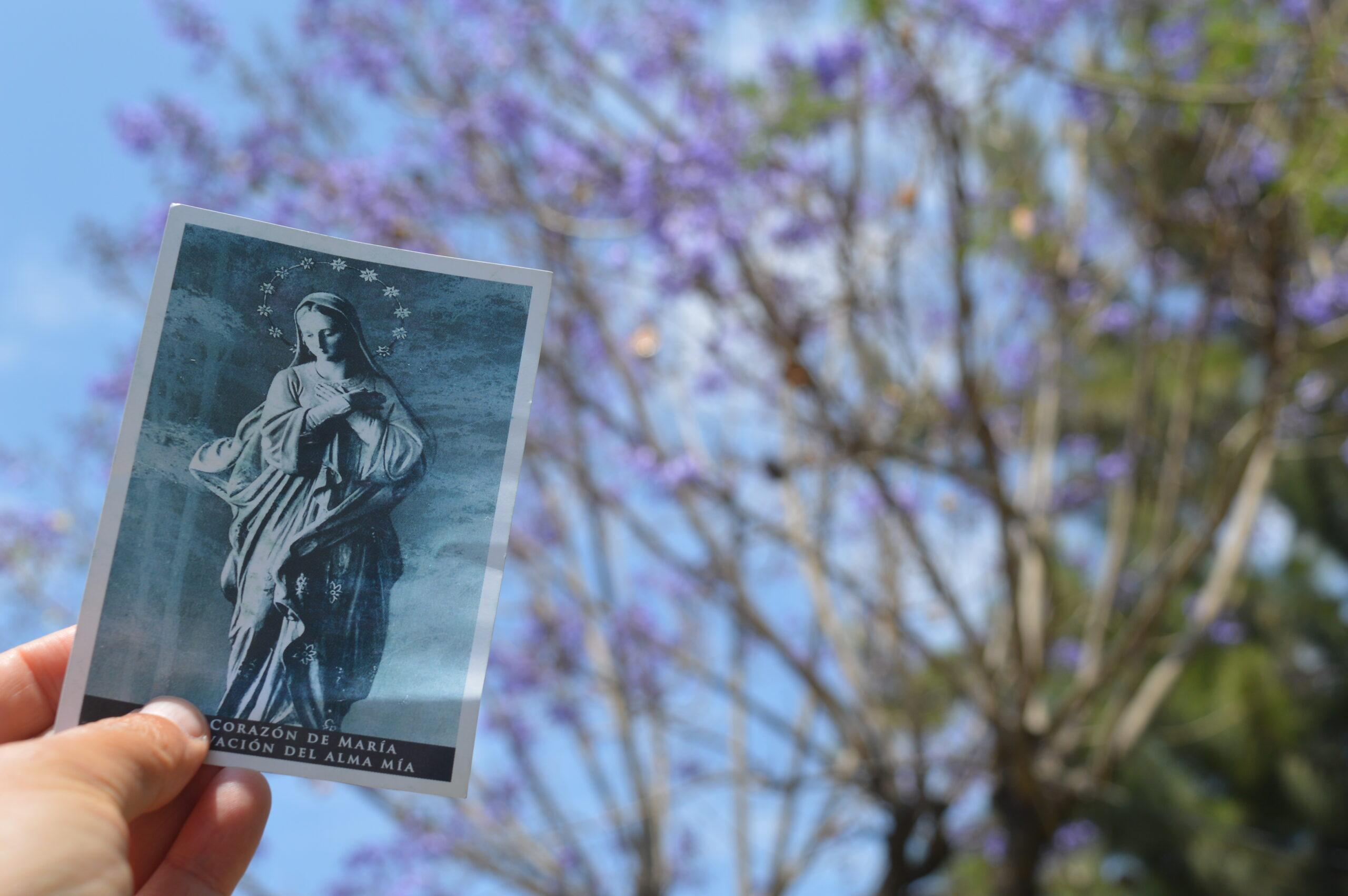
    The cover photo consists of the Virgin Mary on a prayer card held up towards the sky.

    A few years ago, some bedroom repair work forced me to move piles of stuff around. As I was rearranging the room, I happened to notice a novelty box in which I have kept memorial cards of the deceased for many years.

    As I looked through the cards, there were surprises – people I had forgotten about who had shown acts of kindness to me: a friend’s sister, a woman I volunteered with at a pregnancy resource center, great aunts and uncles, holy priests. Cards of relatives who had died before I was born had been passed down to me — like my grandfather, who I never knew (except through stories from my Mom and grandmother).

    RELATED: Grateful to Our Beloved Dead: Remembering Lessons From My Late Grandparents

    As I went through the remembrances, I said the prayers on the backs of them. I noticed connections – this person died on the same day as that person, years later. I thought about these women and men, all of whom had an effect on my life in little or big ways, in ways that I will never know; I realized, we really are “the communion of saints.”

    Since I work in communications, my thoughts often focus on the tools we use to communicate. Those memorial cards communicate! They communicate a life of a man or woman made in the image and likeness of God with a unique story of love and pain and joy and suffering – of God’s plan lived out.

    In November, we pray for the Holy Souls so they can share in the Beatific Vision of our Lord Jesus Christ who sacrificed his life and death for us and loves every single soul.

     LISTEN: Can the Souls in Purgatory Pray for Us?

    A friend of mine puts praying for the Holy Souls in action by keeping a running prayer list with names of the deceased, going back generations. Similar to keeping memorial cards, it is a tangible reminder of those who have been before us and our need to pray for them. It also makes me think of the tradition of Native Americans that I learned about in the Knights of Columbus documentary, “Enduring Faith: The Story of Native American Catholics,” aired on EWTN prior to the Holy Father’s visit to Canada in the summer of 2022.

    Harold Compton, the Deputy Director of Policy and Research for the Rosebud Reservation talked about how they believe in the sacredness of the number seven, and aim to look at how their actions as a tribe will affect seven generations forward. They encourage thinking about how one sits in the middle of those seven generations: “Looking back three generations – what did you learn from those three generations; what have they given you? And the three generations coming after you, and looking at what you, as the middle of that seven generations, can do, sharing that knowledge from the past with the future.”

    As I think back three generations, I recall a story about how a great-grandfather (who of course I did not know) would open the door of his home after Mass to provide food for the homeless. My grandmother carried that story forward to me and I can share it with my nieces and nephews.

    RELATED: Why Do Catholics Pray for the Dead?  

    So, if you are in a desperate fit when cleaning, do not throw out those memorial cards. This November, pray for the departed, ponder something you know about him or her, and how you might carry that lesson forward. Ask the Holy Souls to pray for you.

    When we were children, we were taught to pray for “the most abandoned soul in purgatory.” It is a spiritual work of mercy. Saint Stanislaus Papczyński said: “There is no greater act than to pray for the holy souls in Purgatory because unlike us on earth, they can no longer pray for themselves.”

    My box of memorial cards is overflowing. Soon I will need a new one. And someday there will be a dusty card with my name on it (I sure hope they don’t go all digital). I hope one November, decades from now, some great-great niece or nephew picks up that card and prays for me. That, indeed, will be a work of mercy.

    Originally published Nov. 3 2023.

  • Holy Friends: 4 Saints to Turn to  This All Saints’ Day

    Holy Friends: 4 Saints to Turn to This All Saints’ Day

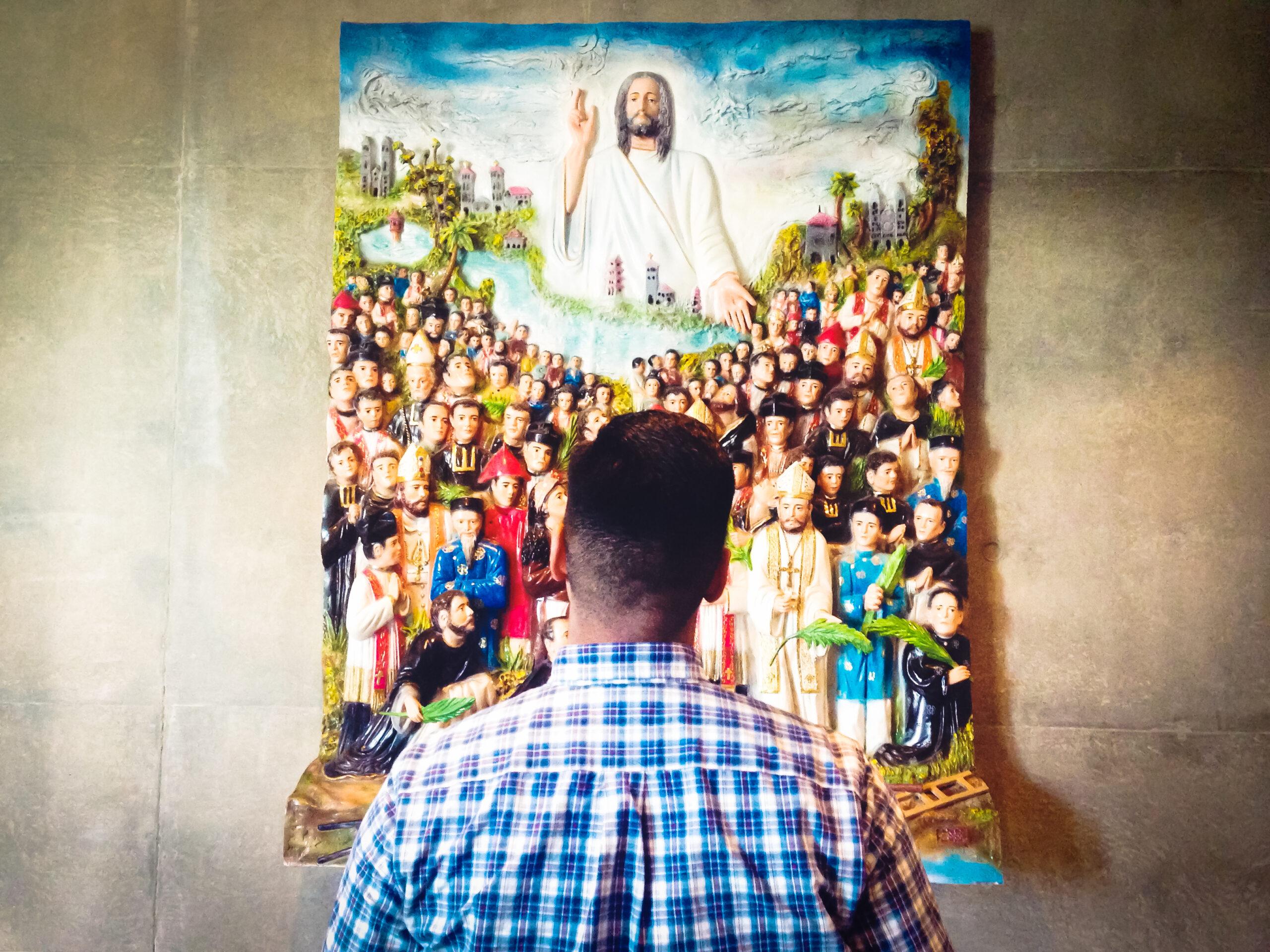
    Man in flannel shirt looking at a painting of Jesus and several saints.
    Photo by Angie Menes on Cathopic.

    As a convert to Catholicism, I’ve found that the veneration of the saints is a part of the faith that has taken me a little while to get used to. Having children has transformed that experience. Perhaps because they grew up with the idea of saints in their midst, my 9-year-old and 10-year-old bring up saints frequently. They love reading, watching, and listening to stories about the saints, celebrating feast days, and asking certain saints to intercede for our family at particular times.

    In this way — and perhaps this is normal for most Catholic families — I have realized that my family has “befriended” certain saints. Or maybe those saints have been kind enough to befriend us.

    RELATED: Want to Raise Little Saints? Tell the Saints’ Stories

    Throughout the day, we’ll talk to saints who have become part of the fabric of our lives, joking about what this saint might think of this or that daily task we’re doing. Would St. Thomas Aquinas, the patron saint of students, approve of my daughter deciding to watch another episode of “Bluey” instead of studying? Is St. Christopher, the patron saint of travelers, tired of seeing those Doritos bags strewn all over the car, and would he prefer a nicer ride, maybe?

    It probably won’t surprise you to learn that All Saints’ Day has become one of my family’s favorite holy days in the liturgical calendar. Here are a few of the saints that our family turns to frequently, and whom we’re happy to share with others looking for new family friends:

    1. St. Elizabeth Ann Seton (1774-1821)

    This new school year has been a test for my daughter. Third-grade math and social studies have been more challenging than she anticipated, and her grades have suffered. She prefers “girl saints,” so we’ve studied St.  Elizabeth Ann Seton together. St. Elizabeth Ann Seton, the first American-born Catholic saint, is perhaps best known as the founder of our parochial school system. 

    In reading a recent biography, I discovered that when she was younger, St. Elizabeth loved to dance and was fond of the fancy cream-colored slippers she wore to one of George Washington’s birthday parties. My daughter, who is a ballet enthusiast, found this anecdote inspiring. We often talk to St. Elizabeth about dancing and school—about how young women need to focus on both to be well-rounded. 

    Because Elizabeth Ann Seton also founded and led the Sisters of Charity, the first community for women religious in the United States, she’s an excellent role model for female leadership. As a teacher, I often turn to her myself! Before big test days, my daughter and I pray for St. Elizabeth Ann Seton’s intercession for her and her classmates, and she wears a St. Elizabeth medal around her neck daily.

    RELATED: How to Make Friends With a Saint

    2. St. Augustine of Hippo (354-430)

    If you’ve ever heard that old quip about kids who ask “why” constantly, then you’re actually talking about my fifth-grade son — who asks “why” about everything, including our Catholic faith. This cool kid spends most of his spare time reading books: You can’t catch him without a “Harry Potter” tome in his hands recently. He also has allergies and often rubs his eyes. 

    Last year, as his dad and I read Augustine’s “Confessions” together, we determined that this patron saint of theologians and sore eyes might be a good fit for our son to learn more about because we loved how Augustine transformed himself from a public thinker and speaker, or rhetorician, to a devoted intellectual and spiritual servant of God. 

    Every year, our parish hosts a fall festival, where children dress up as saints and participate in a costume contest. One of our family traditions is that our kids read a book about the saint they choose to emulate. When he was 8, our son flew through a biography about Augustine by Simonetta Carr, enjoying learning about the saint’s many travels. 

    St. Augustine is pretty inspiring for a child who loves facts and asking the “whys” of life, and I’m already looking forward to when my son’s old enough for us to read some of Augustine’s original writings together. (Plus, I always remind him that St. Augustine was a fan of another Catholic saint — his mom, St. Monica — who helped lead this beloved saint to his eventual conversion.)

    LISTEN: What Are the Benefits of Praying to Saints?

    3. St. Jude Thaddeus (between 1-80)

    I doubt there’s a Catholic household with children during cold and flu season where St. Jude — one of Christ’s 12 Apostles — isn’t often invoked. As a child, my husband caught pneumonia a few times, and because he also has asthma, he became extremely ill. St. Jude has always been a favorite friend of my spouse due to the saint’s association with sick children, mainly because of the famous children’s hospital that bears his name. 

    This fall, my father-in-law has been ill and hospitalized. He is currently in a rehabilitation center, but his case has been up and down for weeks. Some days, our family has been unsure if he will make it. Throughout this period, St. Jude, the patron saint of the “lost causes,” has been our family’s rock. We know we are not alone in this devotion. 

    St. Jude’s popularity rose in the United States during the Great Depression when many felt as if they were going through hopeless times. It was during this tumultuous period that Fr. John Tort felt called to found The National Shrine of St. Jude in Chicago: The saint’s popularity soon spread throughout the country and has since provided solace to many going through difficult times, whether due to illness or other challenges. St. Jude, who wears green in his iconography as a symbol of hope and renewal, is one of those saints whose name often rolls off the tongues of everyone in my family when we pray together during Mass or Adoration. Simply hearing his name tends to bring us a sense of peace.

    RELATED: How Do the Saints Hear Our Prayers?

    4. St. Hildegard of Bingen (1098-1179)

    As a convert, I often feel behind in my faith — and it might seem funny that I’ve found inspiration this past year in St. Hildegard — a German Benedictine abbess, writer, poet, composer, mystic, and theologian. If her résumé isn’t intimidating, I don’t know whose would be! St. Hildegard wrote nine books and at least 155 musical compositions, including a musical morality play, “Ordo Virtutum.” This only scratches the surface of her accomplishments! What I find most inspirational is that she didn’t begin writing until she was 42. In other words, there’s still hope for those of us who haven’t achieved all we would have liked yet. 

    Her first theological book, “Scivias (Know the Ways),” discusses the difficulties of balancing her spiritual experiences with intellectual reasoning. While we may not all have visions like Hildegard, many of us still struggle with balancing faith and reason and articulating our reconciled ideas to others with moral courage. Often, when I struggle in my professional life as a faith-filled teacher and writer, I think of Hildegard’s example and ask for her to intercede on my behalf, putting my fears to rest.

    By turning to these saints regularly — along with others I haven’t mentioned here and feel guilty about not including (please forgive me, St. Francis Xavier, St. Hedwig of Silesia, St. Sigismund of Burgundy, and St. Frances Cabrini, among others) — I’ve come to realize these figures aren’t distant at all. As St. Elizabeth Ann Seton reminds us, “We must pray without ceasing, in every occurrence and employment of our lives,” and that’s exactly what my family strives to do now, with her help and the help of our other saintly friends. These saints have become companions, offering guidance, humor, and solace during life’s inevitable ups and downs. 

    As my family prepares to celebrate All Saints’ Day, I’m heartened by how much richer our lives have become by welcoming these holy friends — not just as inspirations but as faithful intercessors walking alongside us. And yes, one day, I pray my family will be counted among them, too.

  • Boo! 5 More Spooky Saints to Help You Celebrate Halloween

    Boo! 5 More Spooky Saints to Help You Celebrate Halloween

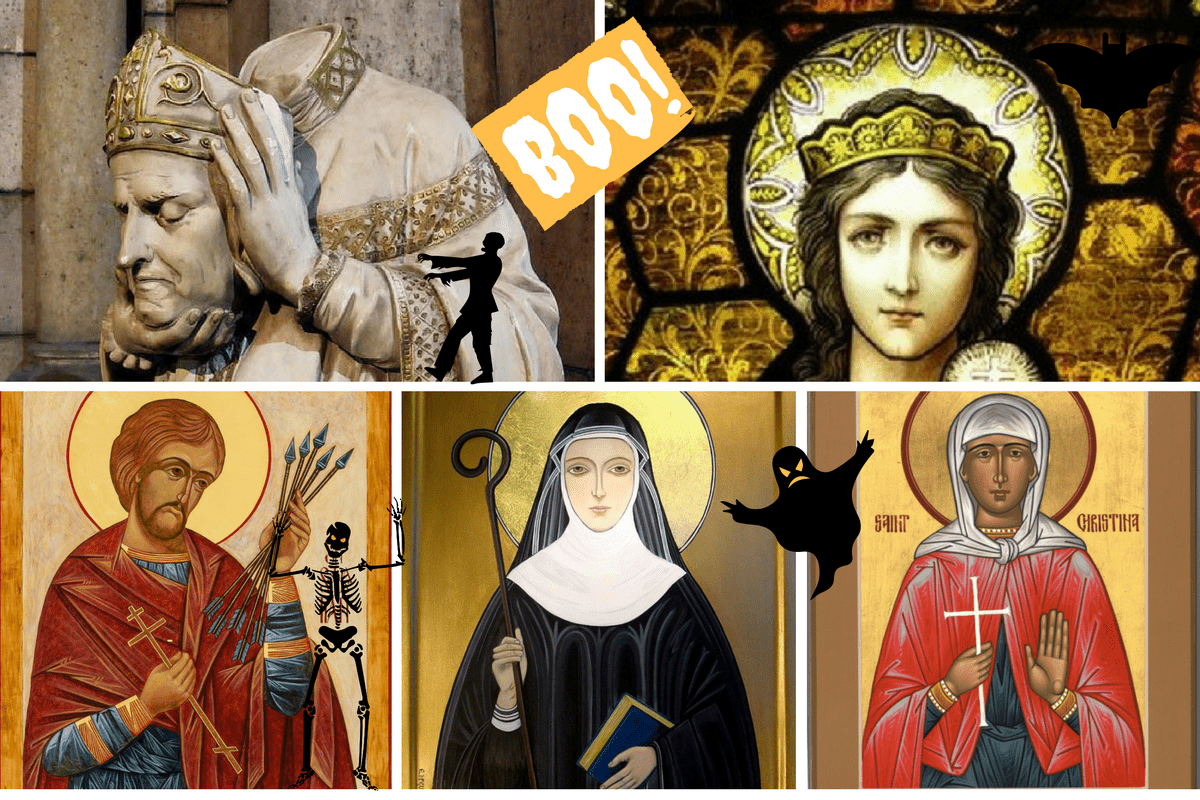
    Halloween is just around the corner! Usually, we associate this time of year with costumes, haunted houses, and trick-or-treating, but there are other sources of spook! Since Halloween comes just before All Saints’ Day, let’s get to know a little more about five saints with stories that contain a bit of faith and a bit of fright.

    RELATED: 5 Spooky Saints to Help You Celebrate Halloween

    saint-christina

    1. Saint Christina the Astonishing

    It’s probably safe to say that you’ve never had a travel experience anything quite like Saint Christina. She died at age 21 after a fatal seizure. At her own funeral, she levitated out of her coffin and condemned the people for their sinful ways. As she put it, an angel carried her away to Hell and Purgatory so that she could see what awaited the sinners on Earth. God gave her a choice: either remain in Heaven or return to Earth to live a life of simplicity and charity. Christina chose the latter, but even with her explanation, people still thought that she was a crazy woman.

    Christina would pray high above the trees, pray in the cold river during the winter time, and she would even set herself on fire during fits of agony. Yet she remained unharmed by all the stunts she pulled because of her faith. Truly astonishing.

    saint-barbara

    2. Saint Barbara

    The daughter of a rich pagan named Dioscorus, Barbara spent most of her life locked in a tower by her overprotective father. In protest, Barbara secretly converted to Christianity. Enraged by her choice, Dioscorus decided to let his sword do the talking. But before he could kill her, Barbara was saved by a prayer for salvation and a magical portal that transported her out of the tower.

    But Dioscorus caught up with her, and Barbara was captured and tortured. Because of her faith, her wounds would miraculously disappear. Dioscorus eventually had enough of her trickery. Barbara was beheaded. Dioscorus thought that he had the last laugh, but he was struck by lightning and consumed by flames. This legend led to Barbara becoming the patron saint of fire and explosives.

    hi-res-saint-denis

    3. Saint Denis

    Saint Denis was the Bishop of Paris in the third century and tasked with converting people throughout the region. Denis was exceptionally good at his job, which annoyed the local pagans who saw him as a threat. They called for the arrest (and the heads) of Denis and his missionaries.

    Beheadings tend to put an end to most people’s ambitions (See Saint Barbara), yet like any good workaholic knows, there is always more work to be done. After being decapitated, Denis reportedly picked up his own head and walked six miles, delivering a sermon the entire way. Ironically, Saint Denis is now known as the patron saint of headaches.

    saint-sebastian

    4. Saint Sebastian

    Is there such a thing as a zombie saint? Consider the case of Saint Sebastian, a Roman Christian in the third century with an impressive record of converting almost anyone who encountered him — from a mute woman who regained her ability to talk after she became a Christian to a young man named Tiburtius who would later become a saint himself.

    But not everyone was impressed with Sebastian, and he was sentenced to death by firing squad. After archers left Sebastian for dead, one of his followers went to find his body and discovered that he was still alive. When he recovered, Sebastian appeared before the emperor and condemned him for his treatment of Christians. Sebastian was then beaten to death by the emperor’s guards and thrown into the sewer. Afterward, one of Sebastian’s followers had a vision of Sebastian telling her the location of his body. Talk about a ghost story.

    saint-scholastica

    5. Saint Scholastica

    We’ve all had those great conversations with people that we just didn’t want to end. Saint Scholastica took it to the next level. She enjoyed having long talks about sacred texts with her twin brother, Saint Benedict. One day, they had supper together and when Benedict was ready to leave, Scholastica asked him to stay so they could continue to talk. Benedict refused, insisting that he needed to go. At that point, Scholastica closed her hands in prayer, and out of nowhere, a wild storm occurred outside of the house. Benedict asked, “What have you done?” to which she replied, “I asked you and you would not listen; so I asked my God and he did listen. So now go off, if you can, leave me and return to your monastery.” Benedict was out of luck that evening and had no choice but to stay with his sister. Better luck next time, Benedict.

    These spooky stories are strange enough to give Stephen King a run for his money, so be sure to add them to your list of essential Halloween tales.

    Originally published October 30, 2019.

  • Faith and Politics: Navigating an Election Season as a Catholic

    Faith and Politics: Navigating an Election Season as a Catholic

    With the 2024 Presidential election just around the corner and political tensions higher than ever, Busted Halo acknowledges that this can be a difficult time for Catholics as they decide on a presidential candidate. As Catholics, our faith helps us sort out the many complicated issues we face during an election and leads us to an informed decision about which candidate to vote for. 
    We hope these resources might prove helpful for you and your loved ones during this time, and we’ll keep all of you in our prayers as you seek to inform your conscience, discern, and cast your ballot. 

    Voting Catholic (Video)

    Father Dave reflects on the core principles of Catholic Social Teaching that should serve to inform the consciences of Catholic voters before they head to the polls.

    Practicing “Civic Discipleship” This Election Season With Fr. Bryan Massingale (Podcast)

    When forming our consciences this election season, Father Bryan notes, “I think sometimes we have this understanding, even among Catholics, that politics and faith should not meet at all; that is not at all what we believe as Catholics. But as I tell people, when Catholics enter the political arena, we don’t bring partisan values to the conversation – we bring Gospel values to the conversation.”

    Can a Priest Tell Me Who to Vote for? (Podcast) 

    Father Dave discusses the difference between a priest informing his congregation on relevant issues and the outright endorsement of a political candidate, as well as the guidelines that priests are called to follow during the election season.

    Dr. Charlie Camosy: Pro-Life Voters Are Politically Homeless (Podcast)

    For those feeling anxious about voting or the outcome of this election, Dr. Camosy says, “These political decisions are not without weight and gravity. They are important, but at the end of the day, our ability to be authentically Catholic and to say, ‘I’m a Catholic first, and a political actor second. I don’t filter my faith through my politics, but rather the other way around.’ That becomes way more important, especially if we have our ultimate home [of heaven] in mind.”

    How To Talk to Those Who Disagree with You—and Still Love Them (Article)

    “Our nation is deeply divided. But having conversations – no matter how small – can help narrow the divide, bring healing through understanding, and make our communities and country stronger. And that’s a real win.”

    Fatherly Advice: Dealing With Political Division (Podcast)

    Political division is prominent in our country today, but maintaining one’s dignity as a Catholic is of the utmost importance. Father Dave shares how to navigate this tense time with patience and compassion for others, especially those with whom we disagree.

    Voting as a Catholic (Podcast)

    Catholic voters must carefully consider a number of issues before deciding which political candidate would be best for the country. Father Dave reflects on these issues…

    Bishop John Stowe on Catholic Voting (Video and Podcast)

    Bishop John Stowe joins the Busted Halo Show to discuss the “womb to tomb” approach to being pro-life and the implications it might have on voting as a Catholic.

    Keeping the Faith during Election Season (Facebook Live)

    Father Dave discusses how you can make important faith-based decisions about voting and relationships during the election season.

    More Resources: 

    Forming Consciences for Faithful Citizenship (USCCB) 

    The United States Conference of Catholic Bishops offers a number of resources on how Catholics can engage in politics responsibly “by offering the best of themselves so that the leader can govern,” in the words of Pope Francis.

    Prayer Before an Election (USCCB)

    This prayer published by the United States Conference of Catholic Bishops asks God for the guidance and discernment to navigate the challenges of this election season while staying true to the Catholic faith.

    Originally published October 15, 2020.

  • Looking to the Saints This Halloween

    Looking to the Saints This Halloween

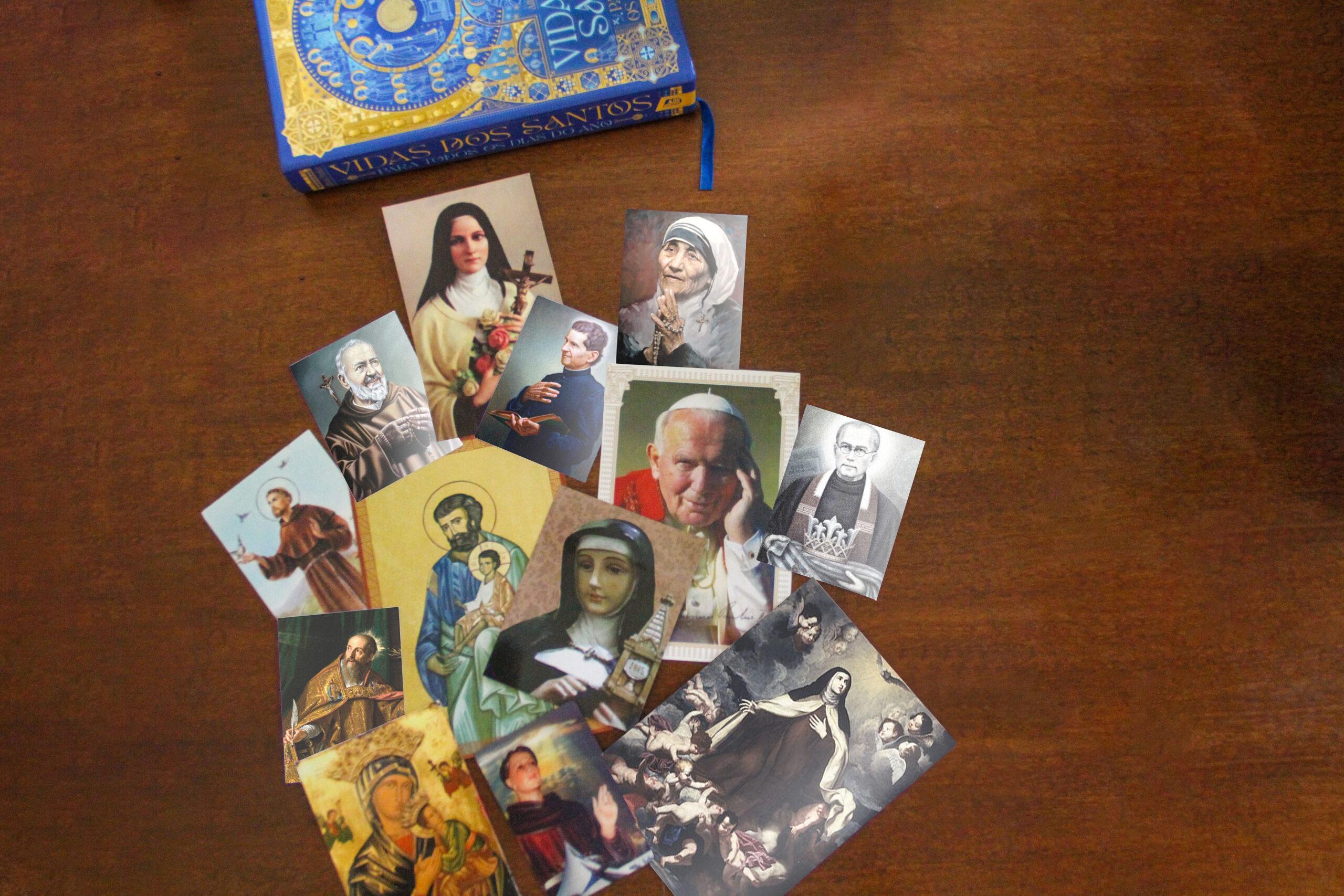
    Pictures of several different Catholic Saints underneath a book detailing the Saints livesI have so many great memories of trick-or-treating in my neighborhood as a child, just like so many other generations. And a core part of those Halloween nights was, of course, the costumes. I had many costumes over the years, from a cowboy, to a Power Ranger, to a ninja, to the Phantom of the Opera. I was also blessed that my mother would lovingly make the costumes by hand with her sewing machine.

    Like other kids, most of my costumes were picked based on the media I was consuming at the time. The characters I dressed as were often heroes, characters I looked up to for their fight against evil. Others were chosen because they were “cool” to me as a kid, not always being the most noble or upright figures (see the aforementioned Phantom).

    RELATED: 5 Spooky Saints to Help You Celebrate Halloween

    As I grew older and less frequently went trick-or-treating or donned new costumes each year, my connection to Halloween faded. However, reminiscing on the past got me thinking about what sort of costumes I might pick now as an adult if I were to make one. And given the connection between Halloween and All Saints’ Day, I started thinking: What saints I might pick to dress up as and why? 

    What if we turned to the saints with that same childlike wonder as we might have with heroes? We can look to the saints as great models of virtue, love, and wisdom and seek to be like them in our lives, to emulate them.

    In many ways, we pick saints in this manner if we choose to take on a saint name at the time of our Confirmation or are given one at Baptism. My confirmation name is Saint Ferdinand. I chose him as he is the patron saint of engineers, which is what I had desired to do with my life when I was being confirmed. Another saint I look up to and desire to emulate is St. Philip Neri, a patron of comedians among other things. He had a great way of diffusing tension with joy and humor that warms my heart. 

    WATCH: You Don’t Know Jack About Halloween

    Finally, St. Hildegard von Bingen’s curiosity is another saintly example in my life. She had a gifted scientific mind and would catalog all sorts of flora and fauna. All of this came from a curiosity to know what God had made in the world and to see God’s goodness in it.

    So which saint or saints would you pick? Who do you wish to emulate in your life and “put on” in a certain way? Not only as a costume (though if you dress as a saint this Halloween, please send photos), but also in living up to an example we admire, an example that helps us to seek our own journeys of holiness. 

    In our lives with Christ, we are all called to holiness, to strive to be saints, and so we have their examples to help us. But we also do it in a way that is unique to each of us. So we have the saints as “costumes” to help us in emulating sainthood, but underneath is us, seeking to be a saint in our unique lives and our unique ways. And in striving to do this, we ourselves become examples to others, signs of love and holiness, just as my mother is a sign of love to me whenever she made a costume (and in so many other ways).

  • Praying for Presence: How the Examen Helps Me Focus

    Praying for Presence: How the Examen Helps Me Focus

    When I was a kid, there were nights at the dinner table when my dad would get quiet and start staring off into the distance. My sisters and I would joke, “Dad’s thinking about work again!” and the chorus of giggles would break him out of his trance and bring him back to dinner. 

    Now, at 41, I’m the one who’s prone to the “thinking about work” face at dinner and many other times as I try to shift from employee to father at the end of the workday. 

    As a civil defense attorney, I’ll regularly handle 200 or more cases at any given time, each with its own facts, medical records, litigation status, and hearing schedule. 

    As a father, I have four kids who are growing up way too fast — each with their own interests, likes/dislikes, friends, school assignments, extracurriculars, etc. 

    As a husband, I have an incredible wife who has kept me around for 12 years and counting, but we’re no longer carefree 20-somethings with little responsibility and an excess of free time. It’s frighteningly easy to lose track of each other amidst our sea of responsibilities and commitments. 

    RELATED: How I Use Ignatian Discernment to Make Decisions Big and Small

    Alternating between those three main roles in my life, it can be difficult to be fully engaged in the present moment. There are dinners and vacations where I have replayed court hearings in my head, pondering how I could have performed better. There are file reviews at work where I continually think of kids’ sports schedules or weekend plans. There are times at work and with the family when I’m thinking of household repairs. 

    One thing that’s helped me with this is the Examen, a prayer formulated by St. Ignatius Loyola.  I first came across the prayer when I was a teenager considering a Jesuit vocation. The whole of Ignatian spirituality, with its emphasis on finding God in all things, was such a revelation to my young mind, but this prayer made an impression and I recently resumed the practice of praying it at night. The basic outline of the prayer is a 5-step process:

    1. Be aware you’re in God’s presence. 
    2. Ask for grace to see God’s work in your life.
    3. Review the day in detail. 
    4. Reflect on specific actions and see whether they brought you closer to or farther away from God. 
    5. Make a resolution for tomorrow.

    When a priest gives a homily at Mass, he takes the Gospel message and makes it applicable to the general congregation. When I pray the Examen, I try to feel I take it one step further and make it applicable directly to my life — my wife, my errands, my kids, my schedule, my work, my supervisor, my commute, and all of the nitty-gritty that makes up my life. 

    I think hidden within my lack of focus is the false belief that whatever I’m focused on is the most important, most pressing matter. Praying the Examen gently corrects this warped way of thinking by reminding me that everything is important, because everything relates back to God. 

    RELATED: Growing in Gratitude, Thanks to the Examen

    The process of he fourth step, reflecting on my actions and whether they brought me closer to or farther from God, changes every day, but I’ll sometimes ask:

    • Was I short with someone on a work call where I was just trying to get another task off the to-do list?
    • Were my “blinders” on while I tried to go through my work day, missing opportunities to hear and see those souls that work alongside me?  
    • Should I have stopped by the desk of a colleague who was widowed last year and seen how she’s holding up? 
    • Did I pay attention to my kids when I came home? 
    • Did I focus on the stories they so eagerly conveyed to me, treasuring them as the gifts they are?
    • Did I miss an opportunity to show more initiative, to ask questions, to be silly, to initiate play? 
    • Have I taken active steps today to work on my marriage?
    • Have I listened to things my wife has expressed frustration over and given her empathy, as well as whatever support I could?
    • Have I made efforts to connect with my wife and share myself, and not just go through the day on our parallel routes?

    For me, the biggest benefit of the Examen is not just the act of praying it towards the end of the day, but rather the way it shapes my mind throughout the day. Getting in the habit of praying it has “trained” my brain to start considering those questions as I am going about my day. As I live in the present moment, I know that God is there and I know that the only way I can respond to him is by being present in that moment, noticing what he is offering me in that moment, and responding with love. 

    With regularly praying the Examen, my “thinking about work” face pops up less often. When I’m with my wife and kids, I’m with them — attuned to all the beautiful intricacies of the present moment. 

  • In Pursuit of Wisdom: How I’m Following Solomon’s Lead

    In Pursuit of Wisdom: How I’m Following Solomon’s Lead

    Hands holding glasses over an old bookWhen my hair first began to turn gray, I hated to look in the mirror.

    How could I already be so old? Gray hair was for grandparents or, at the least, retirees. I was only in my late 30s! I briefly considered coloring my hair. I knew guys a decade older than me who did so, and hiding their gray definitely made them appear younger. Regardless of appearance, though, they could never truly escape the aging process.

    I know I couldn’t. My two arm surgeries, painful plantar fasciitis, and frequent memory lapses reminded me daily that, no matter what I did to stave off Father Time, I was getting older.

    I’ve noticed that older folks in my community often walked a bit slower, partied a bit less, and took longer to answer questions. But their answers, along with most of their words, were more thoughtful. Thorough. Logical. Wise.

    I realized that, when I took the time to pay close attention to their words, the gray-haired or other older people with whom I interacted possessed and readily shared wisdom. 

    RELATED: What Is Wisdom Literature? 

    Bill, a retired Naval Captain with whom I once worked, shared his wisdom on a daily basis. He never overreacted, even after we were both laid off by our employer. Instead, he spent time helping me and other co-workers find new jobs. Wisdom at work.

    Another gray-haired co-worker named Bill, this one my boss, shared his wisdom through short phrases. “When you walk through the brambles, you’re gonna get scraped” was one of his go-tos. I kept a list of his wise sayings, and I learned a lot about life while doing so.

    In today’s world of overstimulation, I’m often tempted to listen to the talking heads who speak earliest and loudest. In the past, doing so has caused me to trust in political and religious leaders who lacked both wisdom and a clear consciences. My actions and my beliefs suffered accordingly.

    I’ve tried to convert unbelievers by spouting half-baked arguments for Christianity that I’d read online. Unsurprisingly, they effortlessly demolished each of my points.

    LISTEN: Wisdom From Sister Jean of Loyola University

    During a high school religion class, I cheated on daily quizzes simply because it was easy to do. Sure, it led to an A in the class, but when I think about what I did, the guilt of cheating still hurts. I couldn’t care less about the A.

    If only I had met the two Bills when I was younger. Or perhaps I should’ve just listened to the wise voices already in my life.

    Either way, I could’ve avoided guilt, heartache, and pain if I’d listened to the wisdom of others. And, as I raise my kids and mentor younger co-workers, I’ve learned that I have a bit of wisdom to share, too.

    A wise guy

    In a fourth-grade production, I played King Solomon, son of Israel’s great King David. In my two-foot-long beard and baby blue bathrobe, I’d argue my Solomon impression was spot on.

    Solomon knew the importance of wisdom. And when God gave him the opportunity to request one gift that might help him as he took over for his father, he knew exactly what to ask for:

    “Give me, therefore, wisdom and knowledge to govern this people, for otherwise who could rule this vast people of yours?” (2 Chronicles 1:10)

    Solomon didn’t ask for power, riches, or fame. Instead, he asked God for wisdom — the ability to see the world through God’s lens and, in doing so, the discernment to know right from wrong.

    RELATED: Why We Should Listen More Than We Talk

    So often we don’t care about right or wrong…or at least we don’t prioritize it. I know I don’t. I speed because I want to get home faster. I don’t consider how doing so might impact the drivers around me. I want a promotion. I don’t think about my coworker who deserves it more. I’m selfish. I’m sinful. And I lack judgment. I’m unwise.

    But aren’t we all?

    I’ve heard it said that we should live with an eternal perspective. In other words, we should live life on earth knowing that what we think, believe, and do will impact our eternal destiny. But that’s often not easy, especially while struggling through daily deadlines, financial shortfalls, and with the people in our lives.

    Follow Solomon’s lead

    So how do we become wiser? James, in just the second paragraph of the introduction to his epistle, tells us.

    “But if any of you lacks wisdom, he should ask God who gives to all generously and ungrudgingly, and he will be given it.” (James 1:5)

    That’s what Solomon did, and that’s what we should do, too.

    Pray for wisdom. Ask God and the saints for guidance. Read the wise words of Scripture, particularly the Proverbs; many of which were penned by wise King Solomon himself. Without wisdom, we’ll never be able to see things the way God sees them.

    You may be asking what any of this has to do with age. If we can ask God for wisdom, why would older folks be wiser than their younger counterparts?

    While God can certainly grant wisdom, experience plays its part, too. If we suffer the consequences of our dumb choices — or see others do so — our future decisions will likely be wiser. The same applies to the good choices we make or observe.

    RELATED: How I Gained Fatherly Wisdom From Our Blessed Mother

    I’ve observed family members whose work and finances stressed them so much that they drank half a dozen cans of beer a night to cope. As a result of my observations, I’ve accepted jobs that have manageable stress levels, as well as hours that allow me to spend plenty of time with my family.

    I’ve also, on occasion, spent so much time caring for my family that I’ve neglected to care for my own needs. This has caused me to feel bitter toward my family even though it’s my fault. As a result, I’m learning that it’s okay to occasionally take some time for myself. A few hours on the lake with a fishing rod in hand does wonders for my sanity.

    While I would in no way consider myself wise, I guarantee I’m much wiser than I was even a year or two ago. 

    I’m sure the same is true for you, too. And asking God to refine your wisdom even further will provide you with the tools you’ll need to navigate life’s biggest challenges. Your experiences plus God’s guidance will work together to provide you the insight you didn’t realize you needed.

    Instead of trusting the loudest voices, seek God’s wisdom. And instead of yearning for your younger days, thank God for your experiences and embrace the gray.

  • The Harvest Is Abundant: Encountering God’s Laborers in Unexpected Places

    The Harvest Is Abundant: Encountering God’s Laborers in Unexpected Places

    Distant person walking through a fall foliage-lined path
    Photo by Masood Aslami on Pexels

    I went out for a jog recently on a beautiful early autumn afternoon. I have jogged this route often enough that I know what to expect on every street and what lies around each corner. But on this particular sunny afternoon towards the end of my run, on a sleepy side street by the beach, I encountered someone I had never seen before. 

    When I first caught sight of him, he was still a ways off, walking straight towards me down the street. He appeared to be a middle-aged man who looked rather disheveled. He had long scraggly hair and dirty old clothes. He was dressed for the middle of winter – even though it was barely fall. It looked like he was carrying something very heavy; the closer we got, I noticed it was a large black trash bag that he had slung over his shoulder. I also noticed that he was staring straight at me. Then, all of a sudden, he dropped his bag on the street and just stood there, watching me jog closer and closer. 

    RELATED: Fall: A Time of Endings and Beginnings

    Warning bells went off in my head – lessons learned as a child of “Stranger danger! Stranger danger!” – and I hustled across the street to pass him at the maximum possible distance. I tried to avoid eye contact as I drew parallel to him. As I approached, he didn’t whistle at me, shout obscenities, or do any of the other things my mind caused me to fear he might do. 

    Instead, he simply started clapping. “You go girl!” he said with a smile as I finally passed by. “You can do it! You’re almost there!” I recovered from my shock in time to turn around and see him once again shoulder his heavy bag. “Thank you!” I shouted back in his direction. He turned and waved. 

    My jog felt unusually easy after this chance encounter, like it was all downhill with the wind at my back. And I couldn’t stop smiling. I think it’s because I wasn’t at all expecting God to use this particular moment and this particular person to teach me a lesson. If the mysterious stranger I had encountered was homeless, then I should have been the one helping him. Yet there he was, cheering me on with a smile, and quietly teaching me an invaluable lesson about how my fears can prevent me from recognizing others as children of God and connecting with them in a meaningful way.

    As I reflected on the beautiful fall day, combined with the joy of an unexpected connection, I called to mind Matthew 9:37-38, when Jesus says to his disciples, “The harvest is abundant, but the laborers are few; so ask the master of the harvest to send out laborers for his harvest.” Jesus’s observation about the scarcity of laborers is the last thing he says to his closest followers before commissioning them as Apostles in Matthew 10, thereby giving them the power to share in his saving mission. Today, the work of the harvest continues, a sacred duty passed on from the Apostles down to us. 

    RELATED: How I’m Learning From the Holy and Humble

    Laborers in God’s harvest are as needed as ever. I can’t help but believe that the stranger I encountered on that autumn afternoon jog had been sent out by God, a laborer in God’s harvest. This man reminded me that it’s the little things we do every day that tend to have the biggest impact in building God’s Kingdom. 

    Saint Teresa of Calcutta told us, “There are many people who can do big things, but there are very few people who will do the small things.” During my jog that day, I didn’t do the small things; instead, I assumed the worst about a fellow human being and tried my best to avoid him. Fortunately, he didn’t let this stop him. He took the time to stop, look me in the eye, and extend joy and encouragement to someone who must have looked like she could use it. He did the small things. Isn’t this at the heart of what we are called to do as Christ’s disciples? Isn’t this the everyday work of a laborer in God’s harvest? 

    Now, on my runs, walks, or hikes, I try to make eye contact with everyone I meet, smile, and extend a greeting, even if it’s just a word or two. Following the stranger’s example, when I see someone approaching in the distance, particularly someone in need of help, I try to ask myself what I can do – however small – to offer help and hope. St. Therese of Lisieux encouraged us to “Miss no single opportunity of making some small sacrifice, here by a smiling look, there by a kindly word; always doing the smallest right and doing it all for love.” 

    My encounter with the stranger has taught me that to labor in God’s harvest means to choose others, to make connections, to reach out across whatever may separate us. To be a laborer is to invite and welcome others to share in God’s harvest. It is a labor of love, and it starts with the seemingly small things: smiles, greetings, kind words, and offers of help.

    RELATED: 5 Fun Fall Adventures

    During this fall season, as I find myself admiring homes, schools, stores, and workplaces wonderfully decorated in harvest themes – as I join in secular harvest-time rituals like visiting apple orchards, pumpkin patches, and parish harvest fairs – my encounter with the stranger continues to lead me to see God’s harvest with new eyes. I find myself noticing and reflecting on the work being done all around us to make the harvest ever more abundant. 

    I have committed myself to the practice of slowing down and really seeing the people around me: the young boy who happily handed three dandelions he had just picked to an elderly woman walking past him on the sidewalk, the teenagers in Massachusetts who raised thousands of dollars for hurricane victims in Florida, the mom with very little free time who offers to chair a big fundraiser at her children’s school… I have discovered that I am surrounded by people who are doing the small things with love, who are visible signs of the abundance of God’s blessings in our world. 

    Sometimes God’s laborers might not look the way we expect them to. They might work at times and in places we wouldn’t expect to see them. Nonetheless, they are there, along with the Master of the Harvest, quietly and humbly going about the mission, joyfully beckoning us, too, to join in the work.