Tag: Personal Growth

  • Breaking the Cycle: How I Stopped Worshipping My Phone

    Breaking the Cycle: How I Stopped Worshipping My Phone

    Dad using smartphone while toddler son playsA few weeks ago, my wife and I were running errands with our 1-year-old and 3-year-old. Since they were tired and a little cranky, she ran into the grocery store to get bread while I waited in the car with the boys.

    I pulled out my phone and started to answer emails and scroll through social media. 

    My older son, Benedict, began to ask me questions about random things — and I continued to scroll on my phone as I answered him. After about two minutes, Ben said, “Daddy, get off your phone. I’m talking to you.” He wasn’t stating it angrily. His tone was more sad that his father was not paying attention to him. At that moment, I felt like I was choosing my phone over my son. I was ashamed, but I felt something else: convicted to love him more. So, I put my phone down in the car, and I pledged to put it down more often. 

    LISTEN: Father Dave Talks Mental Health and Social Media

    We all know that people of all ages have become addicted to their phones. They have become an extension of our bodies. According to Consumer Affairs, “on average, cell phone users look at their phones 144 times a day,” and the average American spends 4 hours and 39 minutes on their phone every day. That means we spend almost 70 days staring at that small rectangular device in our pockets over the course of a year. 

    In many ways, I worshipped my phone. What we worship is what we spend the most time thinking about and what we care most about. Worship is what orients our time, energy, and attention. 

    When Ben called me out about my phone, it didn’t feel good, but choosing to separate myself from my phone certainly did. I realized that my phone was keeping me from loving my family more and distracting me from opportunities to pray more often. So, I began to place my phone in my room when I got home from work until the kids went to bed. This freed me to be so much more attentive to my kids and my wife. I was looking them in the eyes; I was more willing to simply play on the floor with my sons. 

    RELATED: God First: Discerning Where Idols Are in Our Lives

    I also found myself freer from the worries of that particular workday and more present with my family, rather than thinking about what others were saying on social media or the score of the sports game. I became more concerned with the person in front of me rather than a screen, and, quite frankly, more happy because I wasn’t living through my device; I was living for my loved ones. 

    I also began to charge my phone on my dresser rather than my nightstand to avoid numbingly scrolling through social media or the internet at night. This made me more eager to speak to my wife about our day or to pray for an extended period before bed. The unproductive time I would have spent on my phone became a time for true worship. 

    The combination of healthier relationships in my family and more intimate prayer time has allowed me to further appreciate the need to be detached from my phone. It also helped me understand that by loving God first, along with my family, I was placing the one who is to be worshipped alone in his proper place. 

    This week, consider your phone habits. Look up your screen time and reflect on if those around you would claim that you occasionally choose your phone over conversation with them. If so, make a commitment to put it down. Then watch and see how your worship of God and relationships can flourish.


  • Four Tips for Keeping Your Semester Holy

    Four Tips for Keeping Your Semester Holy

    Close up of college student carrying books to school
    Photo by Element5 Digital on UnSplash

    I’m a college English professor with two children, ages 6 and 8. As a new school semester begins for our family, new routines automatically emerge. My son Jack will start playing basketball. My daughter Emmeline will start dance classes. I’ll begin teaching a new set of courses. A new semester automatically ushers in new ways of ordering our lives. My husband and I will arrange carline pickups and meal plans. College students will begin to schedule cardio classes with friends and other extracurricular activities. 

    As academics and activities increase for parents and students alike, so does joy – and stress. We need God in all of these moments, big and small. In the midst of school planning over the years, I’ve learned that an active spiritual life can sometimes get the short shift: There is no “back to school” meeting or college orientation that God plans for worship. Here are some tips I’ve learned over the years, so my family’s relationship with God remains at the center of every academic semester.

    RELATED: 3 Ways to Keep the Faith This School Year

    1. Take a few minutes to read or listen to the Daily Readings 

    Growing up, my mother always told me to “begin the day with Jesus,” and this advice has never left me. I remember seeing her in the mornings with her Bible and coffee in hand. Today, I often read Scripture during my morning routine, while blow-drying my hair, or I’ll listen to the Laudate app on the way to work. This five-minute check-in provides spiritual guidance, helping me ponder how God’s word relates to the events of my day. As I’m teaching or learning about new subjects or simply out with friends, I can think about how the daily reading intersects.

    2. Create or find a sacred space that you visit

    This summer, my daughter attended vacation Bible school and created a rosary with pipe cleaner and multicolored beads. She asked to hang it on her wall, so she could look at it and take it down to use. At work, I have a crucifix hanging and a poem by Mother Teresa that I reflect on when needed. Creating a sacred space doesn’t require a large area; all you need are small reminders that help bring you to prayerful time with Jesus. The side of your desk can hold a prayer card, as can your laptop. If you feel your environment isn’t conducive to creating a sacred space, find a space that helps you feel close to God that is easily accessible during your week. Don’t be afraid to visit your parish, your college’s Newman center, or the sanctuary at your school if there is one! Even a beloved tree will do in a pinch. Schedule this quiet time with God the same way you would a visit to the gym or a study group session. Just 10-15 minutes in prayer, away from the bustle of everything you have to do during the week, can help recenter your mind and bring a quiet peace to an otherwise packed day.  

    RELATED: 9-Day Back-to-School Challenge

    3. Befriend a saint for the semester or school year 

    Last year, because of the pandemic, I got to know Julian of Norwich, someone I’d always found inspirational but never had time to discover more about. I spent time asking for her intercession and read a little about her, often sharing her devotional writings at the start of my classes. She lived in isolation during a pandemic and has a famous prayer: “All shall be well” that has always given me comfort. Spending dedicated time with her helped me not only grow in knowledge but also deepened my faith. If you’re interested in literature like many of my students, you might choose to spend time with Saint George—the patron saint of reading. Or, if you’re interested in medicine, Saint Raphael or Saint Gianna Molla might be for you. Perhaps when creating a sacred space, you keep your saint for that semester or even school year in mind, knowing that they’ll be praying for your spiritual and academic success. 

    4. Set aside time for Mass 

    This one you probably expected to see on this list—but sticking to it is harder than it sounds during a busy semester. On my semester calendars and syllabi, I mark off religious observations and holy days. God may not require you to attend an orientation like I mentioned above, but we should be sure to schedule Mass into our lives just as we do anything else (or ideally before we do anything else). In the same way you’ve befriended a saint for the semester, you might try to find a friend to attend Mass with. If you’re in college, Newman centers or campus ministries are excellent places to start to find like-minded Catholic students. Or simply start showing up, and you’ll find familiar, friendly faces with similar values. 

    Mass is like beginning the day with Scripture: it infuses the week with love. Receiving the Eucharist. Offering peace to your fellow Catholics. Praying together in communion. This is what being Catholic is about, so it’s important to make this time with God a must—even and especially when we’re the busiest. This is one way we bring peace and joy to ourselves, and to the world around us. 

    RELATED: Back to School: Staying Connected to What Matters

    It feels fitting to end with one of my favorite Bible verses, Philippians 4:8, which reads:Finally, brothers and sisters, whatever is true, whatever is noble, whatever is right, whatever is pure, whatever is lovely, whatever is admirable—if anything is excellent or praiseworthy—think about such things.” 

    A busy semester will pull us all in a multitude of directions, and busier schedules will likewise have us contemplating a range of different “things.” Setting aside time to read what is “right” and “pure,” spending time in sacred spaces that are “lovely,” getting to know a “noble” saint one “admires,” and attending Mass where “truth” is spoken and felt are all ways to create a holier semester. I’ve learned over the years that none of the practices I’ve suggested take much time from my everyday life, but each of them has transformed it in a different way. Incorporating these ideas into your calendar at the beginning of the semester – as my family will be ours – will help ensure not only that your spiritual life feels attended to, but also that your whole life might be infused with a sense of calm because you’ll know that God will be a fixture in the patterns of your life no matter what the semester may bring.

    Originally published August 31, 2022.

  • Lessons From Saint Benedict: Creating Community in the Classroom

    Lessons From Saint Benedict: Creating Community in the Classroom

    A teacher holds a paper and is pointing at it while showing a young girl, her student, the paper. To her right a young boy, another student, writing something down.
    Photo by Wavebreak Media on Bigstock

    The first day of school can be scary, and it’s especially scary when you’re the teacher. The first time I stood in front of a classroom, I was apprehensive, if not terrified. I wanted to engage students academically, form them in community, and assure them of God’s loving plans for their lives. But, I was daunted by the challenges of diverse student needs, apathy, and classroom management. In the face of these obstacles, I sought to respond with both excellent pedagogy and Christocentric formation.

    Several years into my teaching career, I had made some progress but was still searching for inspiration. During a conference on formation, a colleague gifted me a small red booklet that would unlock a plethora of wisdom for my classroom: “The Rule of Saint Benedict.

    St. Benedict lived in Italy during the sixth century. He faced a multitude of challenges, including violence, economic instability, and a licentious culture. He wrote “The Rule” as a guide to community life in the Lord’s service. It includes instructions for prayers, meals, discipline, and work. As I read, I saw ways that St. Benedict’s wisdom could be applied in my classroom.

    LISTEN: Saints of Our Lives: Saints Benedict and Scholastica

    Classroom management

    On my first day as a teacher, I was terrified that my students would not respect me. My solution was to assign a large amount of work and enforce scrupulous rules. I thought if students were stressed about their grades and detentions, they wouldn’t have time to be disobedient. However, it only made my students anxious and left me exhausted. 

    St. Benedict suggests a different approach. He insists that boundaries and rules be put in place to protect the community and help people become holy. He writes, ”In drawing up its regulations, we hope to set down nothing harsh, nothing burdensome. The good of all concerned, however, may prompt us to a little strictness in order to amend faults and to safeguard love” (Prologue 45-47). 

    Following St. Benedict’s advice, I started assigning work from a place of purpose, not fear. I didn’t forbid bathroom privileges but limited the pass to one student at a time. This meant that if someone abused that privilege, they were taking an opportunity from someone else: Students challenged their peers to think about the needs of others. I allowed students to work in groups, but they had to rotate working roles, ensuring a shared effort. I also dedicated 25 minutes each week to community conversations, where we discussed and argued theology, school policies, or preferred ice cream flavors. 

    These changes took some energy and management on my part, but the students and I became galvanized and enlivened by just a few adjustments. 

    RELATED: How I Instill Enthusiasm for Faith in My 10th Grade Students

    Leading by example

    Students need to see that teachers believe what they say, and that is done by deeds, not words.  Benedict understood this to be true in the monastery, and it’s just as true in the classroom. He directs leaders to, “Point out to them all that is good and holy more by example than by words” (2.11). Whether I set an example by following the dress code, praying earnestly, or putting away my cell phone, students respond to direction well when they know that I do not expect anything from them which I do not demand of myself. 

    Meeting student needs

    Instructing a classroom of diverse learners is a challenge. Students learn and respond to direction differently, which has led to the rise of differentiated instruction — an understanding that education needs to be tailored to individual students. 

    While differentiation is relatively new to education, St. Benedict employed the idea over a century ago. He says, “With the undisciplined and restless, he will use firm argument; with the obedient and docile and patient, he will appeal for greater virtue; but as for the negligent and disdainful, we charge him to use reproof and rebuke” (2:24-26). Basically, form people in the way that will be most effective for them.

    I have high expectations for students, but leave room for charity. I allowed a student an afternoon snack break because medication suppressed his appetite in the morning. One of my students was exceptionally bright and needed more challenging reading, so I gave her a copy of a novel when the rest of the class only read a short selection. I added art analysis to my class and quizzes, since several students were captivated by pictures more than words. When we know our students and seek their well-being, we can lovingly differentiate. 

    RELATED: Four Tips for Keeping Your Semester Holy

    Lesson plans, interrupted

    I may craft excellent lessons and assessments, but there are days that students don’t need my lesson plan. Sometimes they need to ask new questions, catch up on work, or have time to pray. St. Benedict teaches, “Never give a hollow greeting of peace or turn away when someone needs your love” (4:20). We must never turn away someone who needs our love, which sometimes means putting aside my plans for the sake of the people in the classroom. 

    Love is patient

    I sometimes forget that my students are students! They may not know how to stay focused, compose a sentence, or work with others. They need to be taught math equations, grammatical terms, or how to say sorry when they’ve done something wrong. St. Benedict reminds teachers to have perspective. He says, “He should realize that he has undertaken care of the sick, not tyranny over the healthy” (27:6). When I find myself frustrated by student behaviors or deficits, St. Benedict reminds me of my task—to instruct with patience and love. 

    As the new school year approaches, I feel both optimism and the onus of teaching. St. Benedict writes, “anyone undertaking the charge of souls must be ready to account for them” (2:37). Every teacher will be held accountable for their effort to form their students. When I open the doors to my classrooms this fall, I will not forget to open my heart, and allow Jesus and the saints, like St. Benedict, to form my classroom beyond education and towards formation in love.

  • What St. Philip Neri Can Teach Us About the Sabbath

    What St. Philip Neri Can Teach Us About the Sabbath

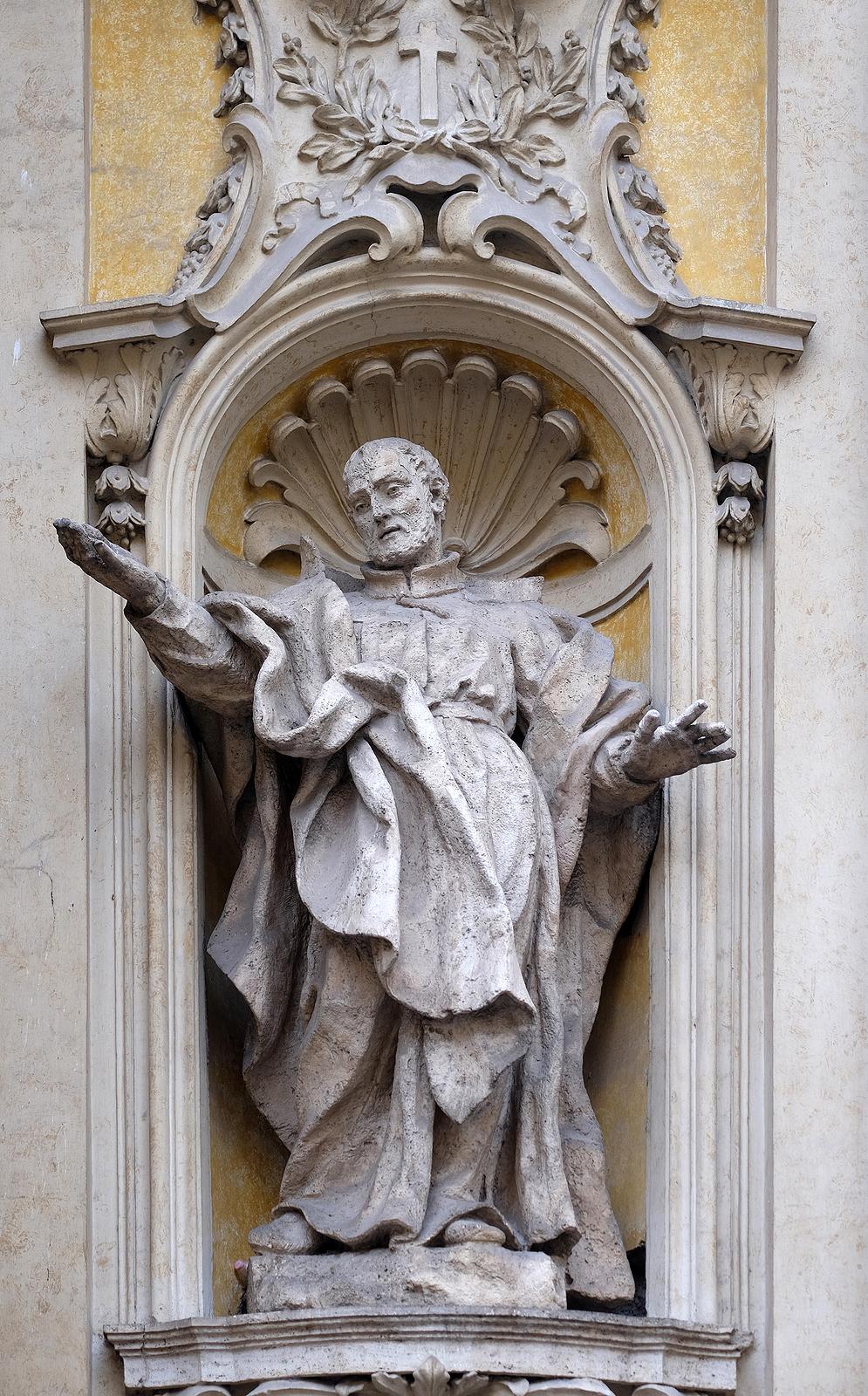
    A statue of Saint Philip Neri. His arms are outstretched. One hand faces upwards towards the sky, the other hand is facing down. His head is slightly tilted down. He wears a long robe. Above this statue is a cross carved into stone.
    Photo by zatletic on Bigstock

    If you’re anything like me, then the call to keep holy the Sabbath is something of a challenge, thanks to a constant struggle to maintain work-life balance. Whether you find it easy to overwork without respite or struggle to get started, hitting that happy medium can be difficult. 

    Honoring the Sabbath reminds us of the need for this balance: six days for work, and the seventh for worship, self-care, and spiritual and physical restoration. But when it proves difficult to actually live this out, what do we do?

    To live properly and pray sincerely, we have to avoid exhaustion. We need time for fun and joy, as these rejuvenate our souls. One saint strongly associated with joy is St. Philip Neri, whom I’ve been inspired by. He uniquely blended holiness and joy throughout his life, earning him the nickname “The Laughing Saint.” Philip Neri’s spirit beautifully encapsulates the Sabbath: a celebration of joyful life unmistakably connected to God.

    RELATED: How to Read Like the Saints

    The saints, as we know, are meant to be our exemplars, so how do we emulate Philip Neri? Well, I can give you an example of what not to do. It’s crucial to be intentional and avoid letting Sunday become overwhelmed with mundane tasks (yard work, for instance), or, for the readers in my age group, schoolwork. So many times I would walk into my college’s library on a Sunday and witness row after row of students hunkered over their studies. Though it is good for students to work, I wished we’d chosen another day to put our noses to the grindstone.

    Philip Neri was a very hardworking man, but also one who knew how to balance his duties with fun. Philip’s mission was to restore Rome, which had fallen into spiritual disarray during the early 16th century, to a passionate love of the faith. He accomplished this by establishing authentically human connections with those around him, which sometimes involved deep conversations, but oftentimes did not. He played practical jokes and took part in wine-drinking contests to make himself more approachable to those around him. After Philip’s death, doctors discovered that his heart had grown noticeably larger, to the point of damaging two of his ribs — a true testament to this great man’s jubilant heart.

    RELATED: Are We Allowed to Work on Sunday? 

    Everything Philip Neri did, regardless of how frivolous it may have seemed on the surface, had a purpose indisputably connected to God. His entire ministry was treated as one continuous Sabbath, vividly showcasing his blend of holiness and joy. This is why I’ve found him so inspiring personally — the mindset we’re called to emulate on the Sabbath, he exemplified throughout his whole life.

    Inspired by his love, passion, and charity, we can bring this saintly approach to the Sabbath into our own lives. Despite the importance of work, Philip knew how to incorporate joy into every day of his life, and so should we. His example reminds me that we aren’t made exclusively for work; we’re meant to live complete and fulfilling lives, with diverse interests and passions. Establishing boundaries between our work lives and the Sabbath, and engaging in the kind of Christ-centered fun Philip loved to partake in so much, is a valuable step in the right direction for us if we struggle to embrace the Lord’s Day.

    RELATED: How to Intentionally Plan a Day of Rest

    My Sundays might involve fun projects. I incorporate prayer into these activities— ora et labora, as St. Benedict would say. But boundaries are important, and I always make sure to never miss out on time for my important relationships, and for prayer. For others, take the day to relax, read, enjoy nature, or have a casual phone call with a friend. But without question, time for God must come first, especially on the Sabbath.

    Being mindful and intentional about observing Sabbath lets us capture the spirit of Philip Neri, that spirit of joy that helps us learn how to incorporate family, friendship, and fun into the Lord’s Day. As Phillip himself puts it, “A joyful heart is more easily made perfect than a downcast one.”

  • Our Lady of the Assumption: Her Importance and Influence in Everyday Life

    Our Lady of the Assumption: Her Importance and Influence in Everyday Life

    Statue of the Virgin Mary holding the Infant Jesus overlooking a schoolyard.
    Photo by jlopez on Cathopic

    One day, I asked students at the school where I work, “What’s the name of our school?” They responded in chorus with the expected exuberance of 23 first graders, “OLA!” 

    “What does OLA stand for?”

    This response wasn’t quite as resounding as the first, “Our Lady of the Assumption!” Their eyes shone bright with proud enthusiasm.

    “On what date do we celebrate Our Lady of the Assumption?” 

    Blank stares… then

    “Wednesday!”

    “Christmas!”

    “New Year’s!”

    One clever set of eyes darted about for clues and found a hint on a plaque hanging on the brick facade near where we stood outdoors, on our way inside from recess. She confidently blurted out “1952,” the only numbers on the plaque (the year the school was founded). Other parroting voices trailed in echo. 

    From that day on, the first graders could recall August 15 as Our Lady’s Day of Assumption as readily as they recalled their own birthdays. Whenever they did, I felt an inner joy and a renewed connection to Our Lady. 

    RELATED: Understanding and Celebrating the Feast of the Assumption

    In addition to the date, the children would eventually learn the Church’s teaching on the Assumption: “The Most Blessed Virgin Mary, when the course of her life was completed, was taken up body and soul into the glory of heaven…” (Catechism of the Catholic Church 974).

    Of Our Lady’s devotions and prayers, there are the Rosary, seven sorrows of Our Lady, Our Lady of the Miraculous Medal, etc. Similar to their attractions to certain of her apparitions, many Marian devotees are partial to specific feast days. Often, one chooses a particular devotion because of an experience where Jesus opens a door, and his mother appears from behind it. That was the case for me and my devotion to Our Lady of the Assumption. 

    A few years ago, I felt a nudge from God that it was time to seek employment outside the home after a hiatus to raise my children. To take the guesswork out of where God was calling me, I prayed the Lord would open one and only one door for my employment. Eventually one opportunity arose and the Blessed Mother seemed to confirm it in a dream. 

    WATCH: Mary in 2 Minutes

    In the beginning of employment at OLA, the name of where I worked held no significance for me. But when I had a hard time adjusting to my job, I found solace when my eyes landed on the sign that announced Our Lady of the Assumption, as I drove into the parking lot to start the day. In solid block letters announcing her title, I found consolation on difficult days and the comfort in knowing she had chosen this place for me. 

    There was a time, just after I converted to the Catholic faith as an adult, I didn’t know a thing about the Blessed Mother. After some buds of our relationship began to blossom, I attempted to keep Marian dates straight to honor her. Once, I mixed up the dates of the Immaculate Conception — December 8 — and Assumption — August 15 — by mistakenly combining the two days into one and confidently marking December 15 on my calendar as an important feast day.

    While my family teases me for my inability to recall anything verbatim, not even a single lyric of a beloved song, I somehow memorized all the mysteries of the Rosary practically overnight. Through the Rosary, and the maternal mentors God has placed in my life, Our Lady weaves threads of her care. From guiding me to a counselor during the rocky times of marriage to selecting our children’s high school – titled after another of Mother Mary’s namesakes  – her gentle presence in my life became palpable.

    Last year, on August 15, as I attended the Solemnity of the Assumption Mass at the church and school that both bear her name, I marveled at how a last minute schedule change had brought me to this landmark Mass. Mother Mary indeed wanted me there to reassure me of her call for me to this place of employment. 

    RELATED: Why Does Mary Have So Many Different Feast Days and Names? 

    I randomly recalled that when my children were in elementary school, I would attend this Mass at their school every year to pour out all my hopes for the new school year to Our Lady. One year, after the August 15 Mass, my then-13-year-old daughter had announced that she was going to teach religious education classes. I immediately knew this was a grace from Our Lady. The fruit of Mother Mary’s intercession continued as my daughter taught catechism and Vacation Bible school classes the following years; she went on to obtain a college minor in teaching, and took a gap year after graduation to volunteer as a teacher. Our Lady of the Assumption’s intercession continues to bear great fruit in my family’s lives.

    My new place of employment was her nod to me as my mother, and yet another thread confirming she claimed me as her own. At the place that bears her name, this mother of all mothers is schooling me in true discipleship. Lesson plans in love, sacrifice, and humility often shine a mirror on warts I never saw before; some days the virtues she’s trying to instill in me scratch against my pride and leave scrapes that feel like cuts. But when I look at my paycheck, I’m reminded that of all the places to work, I labor for Our Lady, and there is no one kinder and gentler to tutor me in the virtues.

    One chooses a saint as his/her own because of an experience of his/her intercession. It’s a mystical, reciprocal companionship. A devotion to Our Lady’s feast day is similar. Of her feast days, I have to say Our Lady of the Assumption, where she schools me in lessons in love, is my favorite. Wherever I go, whenever I see a church or school named Our Lady’s Assumption. I feel the warmth of a mother’s arms; I’ll always honor her on this and other special occasions.

    Our Lady of the Assumption, pray for us!

    Originally published August 14, 2023.

  • ‘Backyard Baseball’ and the Saints: Building Teams That Help Us Grow

    ‘Backyard Baseball’ and the Saints: Building Teams That Help Us Grow

    Baseball in green grass
    Photo by nytumbleweeds on Bigstock

    Pablo Sanchez, Pete Wheeler, Luanne Lui . . . Do these names strike any memories? If so, you may have invested more hours than you can count playing “Backyard Baseball” in the late ’90s and early 2000s. Perhaps you learned about “Backyard Baseball” recently, when fans of the original PC/Mac computer game launched an online server mimicking the features of the discontinued classic back in 2021.

    Whether I had just come home from school or had been stuck inside during a snowstorm, I loved assembling a fictional team of neighborhood kids to play baseball in varying environments, such as Sandy Flats and Tin Can City — Playground Commons was my first choice. My favorite part was testing the unique cast of characters in different groups to create the most advantageous team. I laughed hard at their punchlines — “Slick, you made the right decision!” — and I admired their headstrong eagerness to help me, the player, win the game.

    Recently, the cast of “Backyard Baseball” reminded me of another group of like-minded individuals who work together for the same purpose — the saints!

    RELATED: What Are the Benefits of Praying to Saints? 

    Choosing a saint to pray to is a lot like choosing a player to join my team on “Backyard Baseball.” Once I select a team name, the characters all line up on the bleachers, eager to be picked — some even waving to get my attention. When I click on a player to learn more, I hear their pitch to join my team and see their skill ratings, which show the areas where they excel and falter. This is not much different from looking at the communion of saints and praying to one who catches my eye!

    When looking to recruit players for batting, I may consider Achmed Khan, a strong hitter, or Vicki Kawaguchi, a fast runner. Similarly, when I need guidance in specific areas of my life, I think of certain saints right away — St. Joseph when I’m considering a career change or St. Maria Goretti when I’m pursuing a romantic relationship.

    If I check out the rest of Khan’s stats, though, I’ll see he’s not the best pitcher. In fact, his skill rating is so low, I wonder if he’s ever thrown a ball straight in his life. Likewise, the saints, while living on earth, had their challenges. Although St. Therese of Lisieux had a strong prayer life, she struggled with mental health.

    RELATED: How Video Games Helped Me Level Up My Faith

    However, St. Paul advised in his second letter to the Corinthians that God’s grace “is made perfect in weakness” (12:9), meaning that God gives us more help and guidance to be like him and the saints because of our weaknesses. Much like a player from “Backyard Baseball,” the saints contribute to my team. When I fear that my anxiety and depression are clouding my mind and the voice of God, I pray to St. Therese for guidance, because she made it to heaven despite these obstacles.

    Some characters like Sally Dobbs and Stephanie Morgan are evenly skilled across the scoreboard, not particularly talented in one specific area but reliable when placed in any position on the field. These characters remind me most of saints like St. Anthony of Padua, St. Paul, and St. Francis of Assisi, who are the patron saints of many areas. Many know St. Anthony as the patron saint of lost items, but he also guides me in improving ministries at my parish — he’s the patron of my local church!

    No matter who’s on my baseball team, all these characters care about is winning the game for me, the player, just like the saints root for me to win salvation. In real life, our souls are at stake, and the saints so eagerly want to extend grace from God so that we can achieve eternal life.

    We’re still on earth, and the saints are in Heaven in full communion with God. So why not ask for their help?

    In case you’re wondering, here are the saints on my team!

    • Maria Goretti — chastity and forgiveness
    • Francis de Sales — writing
    • Mother Cabrini — courage
    • Pope John Paul II — evangelization
    • Anthony of Padua — parish life
    • Joseph the Worker — career life
    • John of the Cross — dark times/spiritual desolation
    • Therese of Lisieux — humility/mental health
    • Mother Teresa — conviction
  • Finding Christ Worldwide: Embracing the Universal Celebration of Mass

    Finding Christ Worldwide: Embracing the Universal Celebration of Mass

    The author in front of Burgos Cathedral in Spain. (Photo courtesy of Sheila DeBoer)

    Going to weekly Mass at St. Vincent de Paul – my large home parish in Washington State – was just another part of my routine growing up. I could count on sliding into a pew each Sunday with my parents and younger brother and sister, and I might even altar serve on a given weekend. 

    Mass was something I enjoyed, but it wasn’t something I connected to on a deeper level. To me, Mass was just what we did as a family, something very regular and earthly, like going to the grocery store or the park. I paid attention, enjoyed the music, and looked around at all those gathered, but I didn’t understand much of what was happening. Afterward, our family would head out for a meal or run errands, and the Mass we had attended would take its place as a pleasant memory.  

    As I entered high school, received the Sacrament of Confirmation, and began lectoring, my interest in discovering a deeper-than-surface-level understanding of the Mass began to grow. Then, when I experienced Mass in other Catholic Churches besides my home parish — a midwestern parish in North Dakota while visiting my sister, a beautiful basilica in Spain on pilgrimage, or Galway’s cathedral in Ireland on a trip with my mom all in my early 20s—  I began to notice the uniqueness of liturgical worship in a new way. 

    RELATED: Attending Mass in a Different Language Taught Me About the Universality of the Church

    I began to recognize that the Mass I was part of in my home parish each week was being celebrated universally around the world, in different languages and cultures — and the same Christ was present through the words of the priest in each act of consecration at the altar. This realization broadened my view of the Mass from something ordinary to something extraordinary. 

    As my appreciation for the Mass grew, I came across an even more profound reality: The Mass is a celebration where both the living and dead are in attendance. I discovered this truth only a year or two ago when listening to the Catechism in a Year podcast with Fr. Mike Schmitz. According to the Catechism of the Catholic Church in article #1354 regarding the Mass: “The Church indicates that the Eucharist is celebrated in communion with the whole Church in heaven and on earth, the living and the dead, and in communion with the pastors of the Church, the pope, the diocesan bishop, his presbyterium and his deacons, and all the bishops of the whole world together with their Churches.” 

    It is out-of-this-world (literally!) to realize that the Mass is more than a universal celebration across lands and peoples on earth, but that at each and every Mass, heaven literally touches earth. In the Lord’s Prayer, we ask that God’s will be “done on earth as it is in heaven,” and the Mass is a foretaste of heaven. In the book of Revelation, the apostle John has a vision of heavenly worship. He writes: “Day and night without ceasing they sing, ‘Holy, Holy, Holy, is the Lord God Almighty, who was and is and is to come.’” 

    It is fitting, then, that at Mass, we echo these words on earth in the Sanctus, a Latin Eucharistic prayer, or prayer of the angels, offering our praise and thanksgiving to God: “Holy, Holy, Holy, Lord God of hosts, heaven and earth are full of your glory. Hosanna in the highest.” At every Mass, we are in attendance with the angels, as well as those loved ones who have gone before us — participating personally with a great cloud of heavenly witnesses singing and glorifying God. 

    RELATED: 7 Ways to Connect More Deeply With Sunday Mass

    St. John Chrysostom, an early father of the Church, once said: “When Mass is being celebrated, the sanctuary is filled with countless angels who adore the Divine Victim [sacrificed] on the altar. Do we consider the presence of angelic hosts with us at Mass as we remember and represent the one and only sacrifice of Christ on the cross upon the altar? Whenever I attend Mass, I enter into worship of the creator with those in heaven and those on earth. What I have come to believe is that the Mass is anything but ordinary. The Mass is an extraordinary gathering not just of persons around the world from different languages and cultures, but a unity of persons and angelic hosts spanning time and era, life and death.   

    Now when I attend Mass, whether at my home parish or elsewhere around the world, I take a moment to appreciate and acknowledge the ways the heavenly worship is part of my earthly worship. Instead of only looking around at the other parishioners, I remember loved ones who have gone before me, and I praise and thank God while at Mass as they do at every moment in heaven, imagining they are sitting beside me in the pew. When I listen to the music, I also gaze at the altar or smell the sweet aroma of incense, imagining a choir of angels around the priest at the table of the Lord. These small adjustments help me to view Mass not only as something earthly but also as something deeply and profoundly heavenly.    

  • ‘Inside Out 2’ and the Journey of Self-Acceptance and Reconciliation

    ‘Inside Out 2’ and the Journey of Self-Acceptance and Reconciliation

    “Inside Out 2” (Courtesy of Walt Disney Pictures)

    As a rising kindergartener, my 5-year-old feels our summer schedule should encompass all things big-kid-related. One of her ideas for a rite of passage: movie theaters. I was hesitant at first, but after she saw a trailer for “Inside Out 2,” there was no stopping the flood of requests to see the new movie. 

    We attended a sensory-friendly screening where the lights are merely dimmed and the volume plays a tad softer. Overall, it was a success. My 2-and-a-half-year-old lost interest midway through, but discovered the joys of popcorn and was placated, while my big kid was utterly mesmerized.

    RELATED: A Good Dog: How ‘Bluey’ Inspires Goodness for the Whole Family

    For those unfamiliar with the “Inside Out” movies, the plots center on the Emotions that reside in our heads: Joy, Sadness, Fear, Anger, and Envy. These Emotions control the console of our feelings while creating and storing memories. The mind in which most of the plot’s action takes place belongs to Riley, a lovable young lady who is 11 in the first movie and 13 in the sequel. The first film is a favorite at our house and focuses on the important roles of both Joy and Sadness in our life and growth.

    The writers of Pixar’s “Inside Out 2” succeeded again in crafting a film that not only appeals to youngsters, but also speaks with a nuanced wisdom to tweens, teens, and adults. While the new emotions in Riley’s head, led by Anxiety, have received a great deal of attention, an aspect of the movie that fascinated me was the Belief System. 

    The Belief System is a curated set of memories that create Riley’s continually forming Sense of Self. At the start of “Inside Out 2,” the audience witnesses Joy carefully choosing good memories to add to Riley’s Belief System; thereby forming a string of light that fuels and develops the Sense of Self. Joy also creates a launching device for all painful or embarrassing memories; they are sent flying to the back of the mind. The emotions express pride in Riley’s Sense of Self as it intones beliefs like “I am a good person” and “I am a good friend.” Then, puberty begins and Anxiety usurps the console of Emotions. 

    Anxiety destroys Riley’s Sense of Self and begins to form a new Sense of Self based on anxious beliefs; this new Belief System crackles and pops while shining a scalding orange. Riley acts out of character, ignoring her friends in favor of popularity, lying for clout, and appearing altogether lost internally. The Emotions are faced with a tough choice as they struggle to fight Anxiety and restore Riley’s Sense of Self: Do they release the bad memories to influence the Belief System in order to incorporate the good ones as well?

    RELATED: Spiritual Streaming: 5 Faith-Themed Films for Your Next Movie Night

    The Emotions realize that clinging to the Belief that we are all good, without the nuance of our flaws, isn’t a realistic or healthy way to live. The floodgate of memories is unleashed and Riley copes with the influx of new threads to her Belief System: She is a good person, but she makes mistakes and bad choices. Riley doesn’t accept her faults, but instead acknowledges them, and attempts to repair the damage she’s done. She finds a way to grow and move forward with a more holistic view of who she is.

    As I sat in the theater with my daughters cuddled on either side of me, I couldn’t help but think about how we as Christians take this idea of acknowledging our faults to an even more fulfilling conclusion.

    Rather than being left with the emotions in our head waging war against our poor choices and their effects on our Sense of Self, we are offered a beautiful example of love and forgiveness through God’s offer of Reconciliation. When we bring our whole selves, mistakes and all, vulnerably before God, He offers us grace. We are reminded in Romans 5:8 that, “God proves his love for us in that while we were still sinners Christ died for us.” Our faults do not have to become entrenched in our Sense of Self; we recognize our sinfulness and we bring it to him who loves us nonetheless. 

    When we acknowledge before God our failings, mistakes, and sins, we move into a relationship of love; for as C.S. Lewis writes “to love at all is to be vulnerable.” This vulnerability and willingness to confess our sins before God allows us to accept his love and grace. As Riley has to come to understand her Sense of Self as a fluctuating core, capable of good and bad choices, we too have the chance to humbly admit our failures and embrace our deep need for God.

    LISTEN: Co-Creator of ‘Blue’s Clues’ and ‘Daniel Tiger’s Neighborhood’ Offers Life Lessons for All Ages

    My 5-year-old tends to be hard on herself when she makes a mistake – a reaction I understand all too well. We often talk through how a poor choice does not indicate that you are a mean or bad person; in fact, feeling regret and disappointment in your actions shows that you know what is right, good, and true. The key is to make amends for our bad decisions. I appreciated how the movie showed Riley’s realization of her unkind behavior towards her friends, and her willingness to apologize and patiently build back their trust. When Riley makes amends with the friends whom she has hurt, she has to admit that she was wrong, but she moves towards a wholeness within herself.

    Reconciliation restores not only our relationship with God, but also our relationship with ourselves. Acknowledging our need for God’s grace creates an opportunity for our Sense of Self to broaden from internal musings to external appreciation for what God tells us about ourselves. He reminds us that we are fearfully and wonderfully made (Psalm 139), we are precious, honored, (Isaiah 43), chosen (Ephesians 1), created in God’s own image (Genesis 1:27), forgiven (1 John 1:9), and loved (Romans 8:38). When our Sense of Self wavers, as “Inside Out 2” reminds us it is prone to do, we can lean back on the truth of what God tells us about ourselves.

    I think the concept that our feelings about ourselves will change over time is an important one for both young and mature audiences. There are days of soaring pride and dark disappointment. However, when our Sense of Self relies not on our own fluctuating emotions, but on the steady promises of God, we can rest in the peace of his gaze. This is my hope and prayer for my girls, that movies like “Inside Out 2” remind them that everyone struggles with identity and belonging, yet their worth is not measured by feelings or validation from their peers. Their significance and Sense of Self is guaranteed and beautifully crafted by a God who loves them and welcomes them with open arms.

  • Faith and Fitness: 3 Spiritual Lessons I Learned From CrossFit

    Faith and Fitness: 3 Spiritual Lessons I Learned From CrossFit

    Woman drinking from a water bottle in the gym. She is wearing a CrossFit tank top.
    The author, at her CrossFit gym, taking a well-deserved water break.

    When I came to my first CrossFit class three years ago, I arrived to prove to my sister how much I would not enjoy it. As someone who identified as “not a gym person,” I could not lift an empty barbell, did not know how to use a rowing machine, and could not do one push-up (even from my knees). Today, I can lift (power clean) 125 pounds, use the rower like I know how to walk, and perform 15 regular pushups. And I really have no clue how this happened. The physical gains in CrossFit have been immense because of the methodology. And, the more I think about it, this methodology very naturally transfers to spiritual life. Here are three spiritual lessons I’ve garnered from my CrossFit experience.

    RELATED: Running the Path of Faith: What I Learned From Incorporating Spirituality into My Exercise Routine

    Your spiritual fitness regimen can be programmed to include a variety of repetitive prayer practices

    In CrossFit, workouts are programmed by the staff. So when you arrive at the gym, your workout will be detailed on the whiteboard, and the movements (for example push-ups, pull-ups, deadlifts, box jumps, etc.) are chosen for you based on a system that repeats certain movements in a cycle to holistically build your overall fitness. This varied structure keeps me engaged and lowers the risk of injury. Similarly, I benefit from discipline in the spiritual life but need to vary my prayer practices. When I expect myself to stay statically consistent (i.e. “I’m going to pray the Examen every night forever!”) I end up giving it up when I skip one night. Instead, I make the goals shorter and vary them. (“This week I’m going to try centering prayer for 10 min/day at lunch.”)

    RELATED: A Prayer for Every Mile: How My Prayer Bracelet Helped Me Finish a Half Marathon

    All prayer practices are infinitely scalable according to your spiritual fitness

    All of the movements in a CrossFit workout can be scaled. Every movement has degrees of difficulty according to the athlete’s body on the particular day they’re showing up. If the workout calls for “pull-ups” and you can’t even hang from a bar, a scaled option includes pulling yourself up using gymnastics rings, or pulling a light dumbbell to your chest as you angle your body forward. Similarly with spiritual practices, sometimes you have to scale according to your bandwidth and time or other factors. My prescribed 10 minutes of centering prayer could be scaled to three minutes if I’m running late for work or maxed out at the end of the day. My nightly Examen could be scaled to lighting a candle and saying a couple of gratitude prayers. The point of scaling is to allow myself to build consistency without burning out.

    RELATED: Biking and Praying: How a 7-Day Ride Reenergized My Faith

    Community carries you

    If I show up to the gym, I know the workout will be completed because everyone will be doing it and I’m a part of the whole moving organism. My body will just kind of kick into gear even if my mind is thinking of other things— at some point, something shifts and I’m entirely present. Calories have been burned, and the workout counts even if I did not consciously decide to make each movement happen. Similarly, when I show up for Mass, it is likely that I might not be “in the mood” to go when the time comes around, but good old obligation and being witnessed in my practice subconsciously motivates me. And, even if I’m “going through the motions”— standing, kneeling, sitting, saying repetitive prayers—my mind could be elsewhere but the prayers still “count.”

    RELATED: 6 Bible Passages for Runners

    CrossFit spirituality is one of consistent effort in community with adjustments according to your daily need. Over time, the method begins to take, and you will find yourself on a whole new level of spiritual fitness you never knew possible.

    Originally published August 18, 2023.

  • 3 Ways to Practice the Art of Listening

    3 Ways to Practice the Art of Listening

    Photo courtesy of Cathopic

    Anyone who knows me well can tell you that I’m a very opinionated person. While I pride myself on being open to considering different points of view, the truth is, I still struggle mightily with listening to other people. However, I was recently reading the book by Mother Mary Francis, P.C.C.,But I Have Called You Friends: Reflections on the Art of Christian Friendship and I came across the following passage, which made an immediate impression on me: 

    “The person of intelligently strong convictions is ready to have them modified, expanded, or changed according to the counterevidence presented. Any persons of opposite convictions are friends to be listened to, not enemies to be warded off.”

    As I read and reread that paragraph several times, I became decidedly uncomfortable. I began to ponder how often my convictions have gotten in the way of treating people with charity, even family members. My parents enjoy watching cable news. I do not. “Hot button” political issues tend to get my hackles up, so if I’m in the room when the talking heads happen to be on the TV, arguments too often break out. The question of student loan forgiveness, for example, has provoked more than a few heated exchanges. My immediate impulse when contradicted, is to get defensive or go on a counterattack. 

    RELATED: Two Ears and One Mouth: Why We Should Listen More Than We Talk

    In our 21st-century outrage culture, the art of listening is so important but is rarely practiced. Sadly, none of us is immune to the temptation to scapegoat people, whether family members or total strangers. It can be too easy for me to label people who don’t share my political convictions, religious beliefs, or cultural presuppositions as “enemies.” When I fail to treat the opinions of others with respect, empathy is quickly lost. 

    There’s nothing wrong with holding strong convictions or defending your principles. Respectful listening doesn’t mean that you remain passive or completely disengage from a debate. Authentic dialogue is a form of active listening. True respectful conversation can be learned by doing it, through patient practice. I’ve found three simple and practical strategies that have been immensely helpful in keeping me mindful of my biases and of the respect owed to those who don’t share my opinions.

    LISTEN: How to Have a Crucial Conversation

    1. Be present

    The first step in learning to listen is to eliminate distractions and simply be present. I can’t count how many times I’ve failed to be truly present in a conversation or debate. We’re all addicted to our smartphones these days, and when someone else is speaking, I can be sorely tempted to take out my phone and scroll through my social media feed or check my email. Not only is this an incredibly rude thing to do, but also I’m robbing myself of the chance to learn — to truly understand a different perspective from my own.

    2. Don’t interrupt

    “A fool takes no pleasure in understanding, but only in expressing personal opinion” (Proverbs 18:2). Ouch! Personally, this biblical one-liner hits a little too close to home. I’m a self-identified chatterbox and I know quite well that I have a bad habit of interrupting during conversations, trying to finish other people’s sentences or jumping in early with my counterarguments. This is disrespectful and a form of pride — many of us like to hear ourselves talk! Respectful silence shows that you value your discussion partner and are truly interested in what they have to say. 

    3. Ask questions

    Unless you ask questions, you’re not making enough of an effort to understand someone else’s position. If someone puts forth an argument or an assertion that makes my blood boil, my habitual reaction is to go on the attack. But when I began to slow down and ask questions (“Why do you believe that?” or “Could you please tell me more about your feelings on this?”) I found it easier to keep my emotions in check. I’ve even tried to rephrase my counterarguments in the form of questions. (“Have you considered this perspective?”) This kind of measured response signals respect for the opposing point of view. 

    RELATED: Learning and Listening: Identifying My Blind Spots and Committing to Growth

    True understanding

    If, while the other person is speaking, you’re preoccupied with coming up with a witty rejoinder, or if you start interrupting, or if you retaliate without asking any questions, then you’re not making the effort to listen or cultivate genuine mutual understanding. Listening to understand rather than to respond is difficult, but it’s worth it. The epistle of St. James admonishes Christians to remain modest and restrained in speech: “You must understand this, my beloved: let everyone be quick to listen, slow to speak, slow to anger” (James 1:19). 

    Honestly, I’m still a work in progress when it comes to keeping my temper during intense discussions. But I have begun to notice changes for the better. My family in particular, have commended me for the fact that I now make a point of keeping my cell phone in my pocket during conversations. They’ve noticed that I interrupt less and ask more questions. Our talks about current events have become more engaging and mutually fruitful, as we try to understand one another rather than simply “win” an argument.

    Also, as I’ve made an effort to understand perspectives other than my own, my worldview has started to become less cramped and insular. I’ve learned to stop labeling people of different beliefs as “enemies” (or worse “sinners”) whose views can be easily discounted. After all, they are fellow children of God with infinite dignity who should be respected and loved. 

    As the scribe correctly responds in Mark’s Gospel, “‘to love [God] with all your heart, with all your understanding, with all your strength, and to love your neighbor as yourself’ is worth more than all burnt offerings and sacrifices” (Mark 12:33).