Tag: Personal Growth

  • Advent Reflection: Simple Devotional Practices to Bring Peace Amidst Holiday Fatigue

    Advent Reflection: Simple Devotional Practices to Bring Peace Amidst Holiday Fatigue

    It seems that every year, the unofficial start of the secular Christmas season creeps up earlier and earlier. Just after Halloween, my husband shared with me how one of his coworkers had already set up their tree and décor because they wanted to “get the most out of the season.” While I often feel the urge to blast my favorite Christmas tunes and pull out the cheerful decorations when I see neighbors and local businesses doing so, my Catholic instincts tell me otherwise

    The Church has given us the season of Advent to awaken ourselves to Christ’s coming and turn our minds from the world’s distractions. When I was younger, before Advent began, my parents encouraged my siblings and me to reflect on what spiritual gifts we could give to the Christ child on his birthday. Through their instruction and the Church’s guidance, I came to see Advent as a time to focus on spiritual treasures rather than earthly ones, helping me understand how these weeks leading up to Christmas are meant to gradually lead us to the birth of Christ. 

    RELATED: 10 Meaningful Advent Traditions to Try This Year

    Though it is difficult to refrain from merrymaking, and sometimes feels Scroogelike to resist, I’ve found great merit in celebrating the Advent season before Christmastide. While the world tells us to indulge in early celebration, the Church invites us to prepare during Advent.

    The Catechism urges us to gird ourselves with a spirit of anticipation, reminding us that, “The coming of God’s Son to earth is an event of such immensity that God willed to prepare for it over centuries” (Catechism of the Catholic Church, 522). The Advent season stands apart as a time to recall the ache and hope of the world for a Savior and look forward to his second coming (Catechism of the Catholic Church, 524). There is a saying that goes, “The greater the fast, the greater the feast,” indicating that sacrifice bears meaning, allowing us to create space for the joy of redemption. By keeping the weeks before Christmas simple, prayerful, and full of hopeful longing, we bear witness to the magnificence of this feast. 

    If you have struggled this year to keep Advent quiet and preparatory, the season is not over. Here are a few ways you can still partake in the preparation during these final weeks.

    Pray the St. Andrew Novena

    While the St. Andrew Novena begins on the feast of St. Andrew, November 30, and ends on Christmas Eve, there’s no reason why you can’t jump into it right now. The beautiful prayer emphasizes the humble reality of Christ’s arrival into the world on a cold dark night in Bethlehem, inviting us to unite our personal petitions to the hour of Christ’s arrival. Here is a link to the full prayer, along with instructions on how to pray the novena. 

    Meditate on the O Antiphons 

    The O Antiphons are verses sung during vespers in the Liturgy of the Hours between Dec. 17 and Dec. 24. Each verse introduces a title of Christ, which can also be found in the well-known Advent Hymn, “O Come O Come Emmanuel.” They give voice to the longing for Christ which Advent ought to rouse, allowing us to declare our need for a Savior. If you don’t have access to the full Vesper prayers, pray and meditate on the O Antiphons themselves and consider singing the appropriate verse from “O Come O Come Emmanuel.” You can find the antiphons, along with relevant Scripture verses and suggestions for meditation here.  

    RELATED: Why I’m Fasting for Peace During Advent

    Fast before Christmas 

    While Lent is often seen as the liturgical season for fasting, the Church traditionally observed another 40-day fasting period beginning after Nov. 11, or Martinmas (the feast of St. Martin), to prepare for Christmastide. While fasting and abstinence aren’t required for Catholics during Advent, they are effective ways to create space in our hearts for Christ’s arrival at Christmas. Whether you choose to abstain from meat on certain days of the week, give up TV, social media or some other pleasure, disciplining our bodies alerts our spirits to Christ’s voice calling us to prepare room for him in our lives. 

    When I was young, one way my family celebrated Advent was to prepare a bed of straw for Jesus. Any time we made a personal sacrifice or did a good deed for another, we cut a piece of yellow yarn to place in the center of our Advent wreath so that by Christmas Eve, Jesus had a warm cradle of “straw” in which to rest. While there is no harm in attending holiday parties or tuning into some Christmas music, let us strive this Advent to embrace a spirit of anticipation rather than indulgence, so that we might fully enter into the joy of salvific redemption during the Christmas season. 

  • Why I’m Fasting for Peace During Advent

    Why I’m Fasting for Peace During Advent

    In 2023, Advent arrived at a time when violence in Gaza was often on my mind. Harrowing news and calls for a ceasefire filled my Instagram feed, forcing me to consider what it would mean to respond authentically to the reality of such suffering. As a Catholic, I knew prayerful self-denial was an option, but I had resisted the idea. What good would a manufactured drop of my own suffering do amid the ocean already in existence? Compared to the suffering that war brings, though, that concern felt selfish. “Effective” or not, it is certainly fitting to offer proof of love through sacrifice, and as Lenten as that sentiment feels to me, Advent can be a time of “offering up” as well. 

    I’ll admit that I didn’t choose Advent for purely spiritual reasons. The liturgical season is shorter than Lent, and at 22 days, Advent 2023 was the shortest possible duration. I also knew that the short winter days would be a help: I’d decided to go without food from sunrise to sunset. I was particularly inspired by the fasting practices of Islam. In addition to it being the faith of those who bore the brunt of the violence, my fast was inspired by Ismatu Gwendolyn, a Muslim public scholar and activist, who had engaged in a 40-day fast in response to the violence in Palestine and shared about the experience.  

    RELATED: Fasting From Injustice

    Our Muslim siblings go without food and drink from sunrise to sunset during their holy month of Ramadan as a practice of devotion and spiritual discipline. As you can imagine, this is a far more intensive manner of fasting than the standard two small meals and one large meal that constitutes a standard day of Catholic fasting, especially when considering our reduced consumption is only required on Ash Wednesday and Good Friday. Despite softening the practice for myself (in addition to a shorter fasting period, I did not prohibit myself from drinking liquids during daylight hours), I still very much felt the deprivation of nourishment. What began as a fast for peace became an opportunity to better understand how more than a day of hunger feels.  

    What surprised me the most was how the lack of nutrients manifested itself. I didn’t often feel my stomach rumbling or find myself wanting food to combat the sensation of an empty stomach. What I did feel were the cognitive effects. This wasn’t a matter of being distracted by hunger; operating on less fuel, my brain simply couldn’t function as well as it normally did. I wasn’t as present. It was harder to communicate. It was harder to think. As an aspiring graduate student, I was alarmed by the brain fog I felt, knowing that clear thinking and eloquent expression are fundamental in academic environments. 

    RELATED: The Fast I Choose: No Matter the Season

    I found myself thinking of all the children who sit hungry at school, struggling to focus and learn. According to the USDA, in 2023, “7.2 million children lived in food-insecure households in which children, along with adults, were food insecure.” I thought about how these children may be met with punishment, rather than compassion, for living the effects of hunger. I thought about the long-term effects of that response. 

    How difficult it must be to struggle through elementary school when hunger prevents you from reaching your full potential. How difficult to live through any of the indignities of poverty – homelessness, insecurity, exploitation – with a diminished mental strength. How difficult to not only live under the constant threat of death from bombs or bullets, but also to starve through it. 

    RELATED: Swords into Plowshares: Finding Peace in Advent Today

    I want to emphasize that what I did is not novel: Muslims undergo their Ramadan fast yearly. Christian history reveals more extensive traditions of fasting as well, including during Quadragesima Sancti Martini, or the Forty Days’ Fast of Saint Martin’s, which took place during the weeks leading up to Christmas. Additionally, it feels odd to write about my experience when there are so many people for whom hunger is a daily experience and its effects a constant threat to livelihood. To choose to be hungry is, as a spiritual practice, a privilege. Nonetheless, experience is a powerful teacher: I’m not sure I would’ve understood the mental effects of hunger without experiencing them first-hand. This fast broadened my understanding of hunger and consequently deepened my compassion for those who have no choice but to go without their daily bread. 

    During Advent, we remember the arrival of a God who humbled Himself to live among us, who came to proclaim good news to the poor. If you, like me, have always been blessed with food security, I invite you – provided, of course, that it is healthy and safe for you to do so – to seek out hunger this Advent. Offer your sacrifice up for an intention. Consider donating the money saved on food to your neighbors in need. Prepare for the coming of a Savior who said “I was hungry and you gave me food” (Matt. 25:35) by sharing in and learning from his reality.

  • 6 Resolutions I’m Making for the Liturgical New Year

    6 Resolutions I’m Making for the Liturgical New Year

    A couple of years ago, a friend told me that she and her partner were hosting a Liturgical New Year’s party on the Saturday night leading into the first Sunday of Advent. Fan of New Year’s energy and keeper of the liturgical year that I am, hearing about this party delighted me to no end. 

    What a fun way to celebrate an important communal transition from one liturgical year to the next, which happens with the commencement of Advent, the season representing the time in history before Christ was known to humans. During Advent, we anticipate and prepare for God entering this world through the person of Jesus, whose life we then follow throughout the rest of the liturgical year. 

    RELATED: Before Making a Resolution, Make a Confession

    I didn’t go to the party (heck, I wasn’t even invited, given that we live on opposite sides of the country!), but imagining my friends’ festive gathering planted the seed in me to mark the onset of a new liturgical year more intentionally. 

    Cue: liturgical New Year’s resolutions. 

    Now, it doesn’t take ordination to know that the self-improvement-new-year-new-me energy of January 1 isn’t a part of the liturgical new year vibe, which has much more to do with organizing the Scriptural readings, feast days, and seasons of the Church than it does with any individual’s agenda or goals. 

    That said, as the liturgical year walks us through the mystery of Christ, it also, according to the USCCB, “calls us to live his mystery in our own lives.” It makes sense to me, then, to make the liturgical year personal as well as communal, and to use this special time as an opportunity to think about the ways that I might strengthen, grow, and deepen my faith in the year ahead. 

    If this thought resonates with you, here are some ideas for liturgical New Year’s resolutions:

    Read a spiritual classic

    We have so much to gain from the saints who have gone before us, and one way to take in their wisdom is by reading their works. However, because books like “Dark Night of The Soul” and “The Confessions” are a heavier mental lift than your average beach read, it might take a resolution to make reading them actually happen. For instance, I had to psych myself up to read St. Teresa of Avila’s “Interior Castle” a couple of years ago, but I’m so glad that I did, as the book played (and continues to play) an influential role in my spiritual development. 

    WATCH: Advent in 2 Minutes

    Commit to going on a retreat or pilgrimage

    If going on a retreat or pilgrimage is something that you’ve long considered doing, make this year the year! 2025 is a Catholic jubilee year with the theme “Pilgrims of Hope;” if you have the time and the means, you might consider joining Catholics from all over the world as they make pilgrimages to Rome and other holy sites of significance. Check in with your local diocese to see if they have jubilee celebrations planned, or go your own way by planning to spend a day in prayer and rest at a place that nourishes your soul, like a state park or cathedral in your city. 

    Focus on a particular commandment

    Maybe you’ve noticed an area of thinking or behavior that has been a struggle for you lately – a tendency to tell white lies, or a pattern of using Sundays to catch up on your work email, for instance. Consider the commandment with which your habits most clash, and decide to go all-in on that commandment this year. Read about it, pray about it, talk to a spiritual director or trusted friend about it, and reflect on how you can better live out the commandment in your life. 

    Pick a patron saint for the year

    If you are looking for more of a vibe than a specific goal or two, choosing a patron saint for the year can help you get there. For instance, St. Monica is the patron saint of mothers, so if you are interested in deepening your role as a parent, son, or daughter, she might be a good choice. As part of this resolution, you can learn about your saint, pray to them for intercession, and consider practical ways that you can integrate their example into your life. Check out this extensive patron saint list to get started. 

    I’m thinking of choosing St. Dymphna, the patron saint of therapists, as my saint for the year, as I’m not only hoping to grow in my knowledge and skill as a psychotherapist this year, but am also planning to take my clinical licensure exam and will take all the help I can get in the process! 

    RELATED: Why I Choose a Word of the Year in Lieu of a Resolution

    Perform the Corporal Works of Mercy

    You can’t go wrong with a resolution that positions you to imitate the ways of Jesus. Choose one or more of the Corporal Works of Mercy – feed the hungry, give drink to the thirsty, shelter the homeless, visit the sick, visit the prisoners, bury the dead, give alms to the poor – to devote some of your time to in the year ahead. 

    Lean into Advent

    There’s a trope that most New Year’s resolutions are abandoned by February 1, and if you get the sense that this might be the case for you, it’s fine to let go of making a resolution for the whole liturgical year and instead focus on the season ahead. Consider how you can fill the four weeks of Advent with expectant waiting, hopeful anticipation, and joyful preparation – perhaps by attending Advent vespers at your parish, reading an Advent devotional daily, or volunteering at a local soup kitchen. 

    There’s a saying that fruit grows where you plant and water seeds. As we transition from one liturgical year to the next, take time to nourish the seeds of your spiritual life. Intentionality about setting goals is a good place to start. 

  • Holy Friends: 4 Saints to Turn to  This All Saints’ Day

    Holy Friends: 4 Saints to Turn to This All Saints’ Day

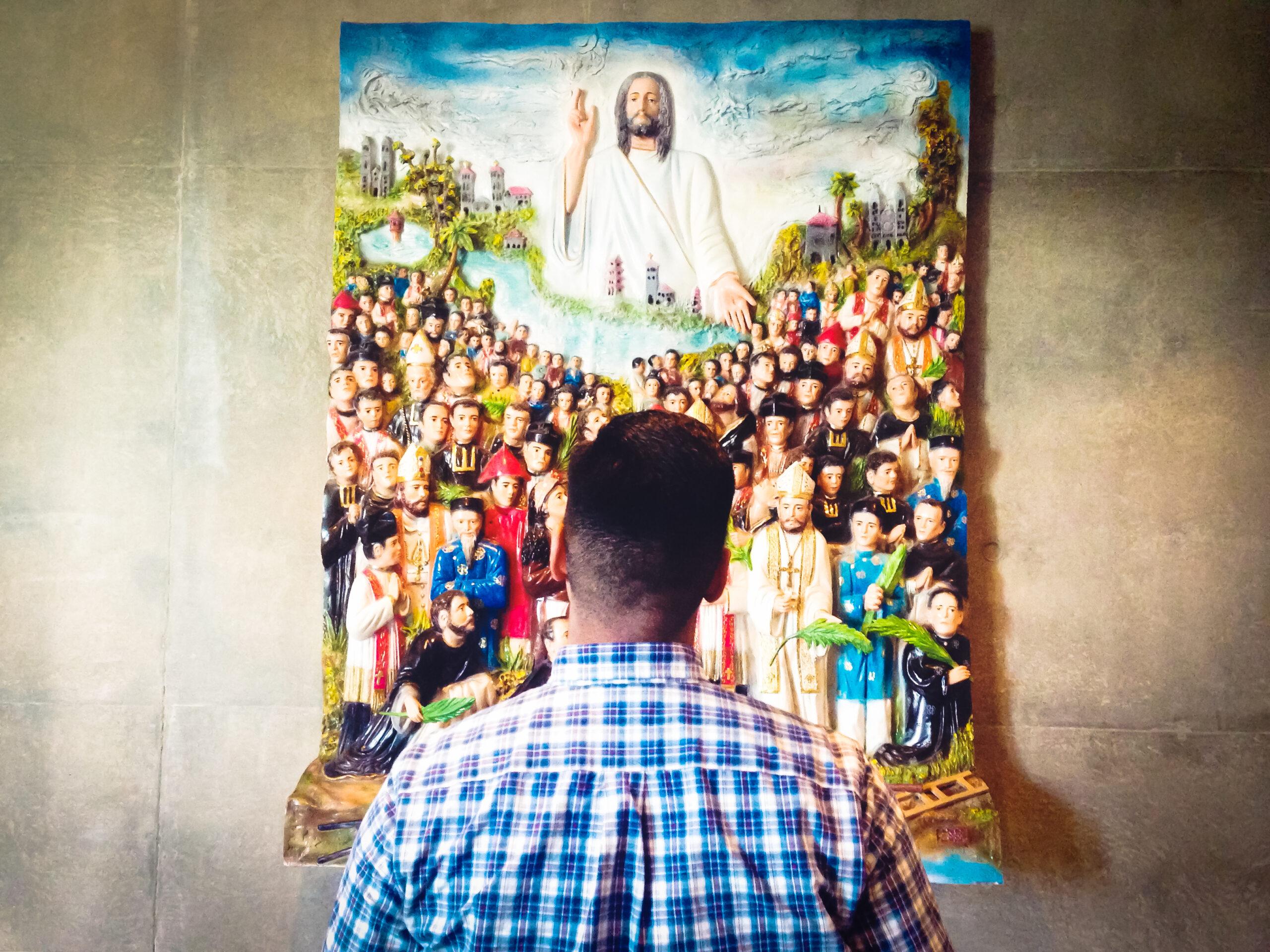
    Man in flannel shirt looking at a painting of Jesus and several saints.
    Photo by Angie Menes on Cathopic.

    As a convert to Catholicism, I’ve found that the veneration of the saints is a part of the faith that has taken me a little while to get used to. Having children has transformed that experience. Perhaps because they grew up with the idea of saints in their midst, my 9-year-old and 10-year-old bring up saints frequently. They love reading, watching, and listening to stories about the saints, celebrating feast days, and asking certain saints to intercede for our family at particular times.

    In this way — and perhaps this is normal for most Catholic families — I have realized that my family has “befriended” certain saints. Or maybe those saints have been kind enough to befriend us.

    RELATED: Want to Raise Little Saints? Tell the Saints’ Stories

    Throughout the day, we’ll talk to saints who have become part of the fabric of our lives, joking about what this saint might think of this or that daily task we’re doing. Would St. Thomas Aquinas, the patron saint of students, approve of my daughter deciding to watch another episode of “Bluey” instead of studying? Is St. Christopher, the patron saint of travelers, tired of seeing those Doritos bags strewn all over the car, and would he prefer a nicer ride, maybe?

    It probably won’t surprise you to learn that All Saints’ Day has become one of my family’s favorite holy days in the liturgical calendar. Here are a few of the saints that our family turns to frequently, and whom we’re happy to share with others looking for new family friends:

    1. St. Elizabeth Ann Seton (1774-1821)

    This new school year has been a test for my daughter. Third-grade math and social studies have been more challenging than she anticipated, and her grades have suffered. She prefers “girl saints,” so we’ve studied St.  Elizabeth Ann Seton together. St. Elizabeth Ann Seton, the first American-born Catholic saint, is perhaps best known as the founder of our parochial school system. 

    In reading a recent biography, I discovered that when she was younger, St. Elizabeth loved to dance and was fond of the fancy cream-colored slippers she wore to one of George Washington’s birthday parties. My daughter, who is a ballet enthusiast, found this anecdote inspiring. We often talk to St. Elizabeth about dancing and school—about how young women need to focus on both to be well-rounded. 

    Because Elizabeth Ann Seton also founded and led the Sisters of Charity, the first community for women religious in the United States, she’s an excellent role model for female leadership. As a teacher, I often turn to her myself! Before big test days, my daughter and I pray for St. Elizabeth Ann Seton’s intercession for her and her classmates, and she wears a St. Elizabeth medal around her neck daily.

    RELATED: How to Make Friends With a Saint

    2. St. Augustine of Hippo (354-430)

    If you’ve ever heard that old quip about kids who ask “why” constantly, then you’re actually talking about my fifth-grade son — who asks “why” about everything, including our Catholic faith. This cool kid spends most of his spare time reading books: You can’t catch him without a “Harry Potter” tome in his hands recently. He also has allergies and often rubs his eyes. 

    Last year, as his dad and I read Augustine’s “Confessions” together, we determined that this patron saint of theologians and sore eyes might be a good fit for our son to learn more about because we loved how Augustine transformed himself from a public thinker and speaker, or rhetorician, to a devoted intellectual and spiritual servant of God. 

    Every year, our parish hosts a fall festival, where children dress up as saints and participate in a costume contest. One of our family traditions is that our kids read a book about the saint they choose to emulate. When he was 8, our son flew through a biography about Augustine by Simonetta Carr, enjoying learning about the saint’s many travels. 

    St. Augustine is pretty inspiring for a child who loves facts and asking the “whys” of life, and I’m already looking forward to when my son’s old enough for us to read some of Augustine’s original writings together. (Plus, I always remind him that St. Augustine was a fan of another Catholic saint — his mom, St. Monica — who helped lead this beloved saint to his eventual conversion.)

    LISTEN: What Are the Benefits of Praying to Saints?

    3. St. Jude Thaddeus (between 1-80)

    I doubt there’s a Catholic household with children during cold and flu season where St. Jude — one of Christ’s 12 Apostles — isn’t often invoked. As a child, my husband caught pneumonia a few times, and because he also has asthma, he became extremely ill. St. Jude has always been a favorite friend of my spouse due to the saint’s association with sick children, mainly because of the famous children’s hospital that bears his name. 

    This fall, my father-in-law has been ill and hospitalized. He is currently in a rehabilitation center, but his case has been up and down for weeks. Some days, our family has been unsure if he will make it. Throughout this period, St. Jude, the patron saint of the “lost causes,” has been our family’s rock. We know we are not alone in this devotion. 

    St. Jude’s popularity rose in the United States during the Great Depression when many felt as if they were going through hopeless times. It was during this tumultuous period that Fr. John Tort felt called to found The National Shrine of St. Jude in Chicago: The saint’s popularity soon spread throughout the country and has since provided solace to many going through difficult times, whether due to illness or other challenges. St. Jude, who wears green in his iconography as a symbol of hope and renewal, is one of those saints whose name often rolls off the tongues of everyone in my family when we pray together during Mass or Adoration. Simply hearing his name tends to bring us a sense of peace.

    RELATED: How Do the Saints Hear Our Prayers?

    4. St. Hildegard of Bingen (1098-1179)

    As a convert, I often feel behind in my faith — and it might seem funny that I’ve found inspiration this past year in St. Hildegard — a German Benedictine abbess, writer, poet, composer, mystic, and theologian. If her résumé isn’t intimidating, I don’t know whose would be! St. Hildegard wrote nine books and at least 155 musical compositions, including a musical morality play, “Ordo Virtutum.” This only scratches the surface of her accomplishments! What I find most inspirational is that she didn’t begin writing until she was 42. In other words, there’s still hope for those of us who haven’t achieved all we would have liked yet. 

    Her first theological book, “Scivias (Know the Ways),” discusses the difficulties of balancing her spiritual experiences with intellectual reasoning. While we may not all have visions like Hildegard, many of us still struggle with balancing faith and reason and articulating our reconciled ideas to others with moral courage. Often, when I struggle in my professional life as a faith-filled teacher and writer, I think of Hildegard’s example and ask for her to intercede on my behalf, putting my fears to rest.

    By turning to these saints regularly — along with others I haven’t mentioned here and feel guilty about not including (please forgive me, St. Francis Xavier, St. Hedwig of Silesia, St. Sigismund of Burgundy, and St. Frances Cabrini, among others) — I’ve come to realize these figures aren’t distant at all. As St. Elizabeth Ann Seton reminds us, “We must pray without ceasing, in every occurrence and employment of our lives,” and that’s exactly what my family strives to do now, with her help and the help of our other saintly friends. These saints have become companions, offering guidance, humor, and solace during life’s inevitable ups and downs. 

    As my family prepares to celebrate All Saints’ Day, I’m heartened by how much richer our lives have become by welcoming these holy friends — not just as inspirations but as faithful intercessors walking alongside us. And yes, one day, I pray my family will be counted among them, too.

  • In Pursuit of Wisdom: How I’m Following Solomon’s Lead

    In Pursuit of Wisdom: How I’m Following Solomon’s Lead

    Hands holding glasses over an old bookWhen my hair first began to turn gray, I hated to look in the mirror.

    How could I already be so old? Gray hair was for grandparents or, at the least, retirees. I was only in my late 30s! I briefly considered coloring my hair. I knew guys a decade older than me who did so, and hiding their gray definitely made them appear younger. Regardless of appearance, though, they could never truly escape the aging process.

    I know I couldn’t. My two arm surgeries, painful plantar fasciitis, and frequent memory lapses reminded me daily that, no matter what I did to stave off Father Time, I was getting older.

    I’ve noticed that older folks in my community often walked a bit slower, partied a bit less, and took longer to answer questions. But their answers, along with most of their words, were more thoughtful. Thorough. Logical. Wise.

    I realized that, when I took the time to pay close attention to their words, the gray-haired or other older people with whom I interacted possessed and readily shared wisdom. 

    RELATED: What Is Wisdom Literature? 

    Bill, a retired Naval Captain with whom I once worked, shared his wisdom on a daily basis. He never overreacted, even after we were both laid off by our employer. Instead, he spent time helping me and other co-workers find new jobs. Wisdom at work.

    Another gray-haired co-worker named Bill, this one my boss, shared his wisdom through short phrases. “When you walk through the brambles, you’re gonna get scraped” was one of his go-tos. I kept a list of his wise sayings, and I learned a lot about life while doing so.

    In today’s world of overstimulation, I’m often tempted to listen to the talking heads who speak earliest and loudest. In the past, doing so has caused me to trust in political and religious leaders who lacked both wisdom and a clear consciences. My actions and my beliefs suffered accordingly.

    I’ve tried to convert unbelievers by spouting half-baked arguments for Christianity that I’d read online. Unsurprisingly, they effortlessly demolished each of my points.

    LISTEN: Wisdom From Sister Jean of Loyola University

    During a high school religion class, I cheated on daily quizzes simply because it was easy to do. Sure, it led to an A in the class, but when I think about what I did, the guilt of cheating still hurts. I couldn’t care less about the A.

    If only I had met the two Bills when I was younger. Or perhaps I should’ve just listened to the wise voices already in my life.

    Either way, I could’ve avoided guilt, heartache, and pain if I’d listened to the wisdom of others. And, as I raise my kids and mentor younger co-workers, I’ve learned that I have a bit of wisdom to share, too.

    A wise guy

    In a fourth-grade production, I played King Solomon, son of Israel’s great King David. In my two-foot-long beard and baby blue bathrobe, I’d argue my Solomon impression was spot on.

    Solomon knew the importance of wisdom. And when God gave him the opportunity to request one gift that might help him as he took over for his father, he knew exactly what to ask for:

    “Give me, therefore, wisdom and knowledge to govern this people, for otherwise who could rule this vast people of yours?” (2 Chronicles 1:10)

    Solomon didn’t ask for power, riches, or fame. Instead, he asked God for wisdom — the ability to see the world through God’s lens and, in doing so, the discernment to know right from wrong.

    RELATED: Why We Should Listen More Than We Talk

    So often we don’t care about right or wrong…or at least we don’t prioritize it. I know I don’t. I speed because I want to get home faster. I don’t consider how doing so might impact the drivers around me. I want a promotion. I don’t think about my coworker who deserves it more. I’m selfish. I’m sinful. And I lack judgment. I’m unwise.

    But aren’t we all?

    I’ve heard it said that we should live with an eternal perspective. In other words, we should live life on earth knowing that what we think, believe, and do will impact our eternal destiny. But that’s often not easy, especially while struggling through daily deadlines, financial shortfalls, and with the people in our lives.

    Follow Solomon’s lead

    So how do we become wiser? James, in just the second paragraph of the introduction to his epistle, tells us.

    “But if any of you lacks wisdom, he should ask God who gives to all generously and ungrudgingly, and he will be given it.” (James 1:5)

    That’s what Solomon did, and that’s what we should do, too.

    Pray for wisdom. Ask God and the saints for guidance. Read the wise words of Scripture, particularly the Proverbs; many of which were penned by wise King Solomon himself. Without wisdom, we’ll never be able to see things the way God sees them.

    You may be asking what any of this has to do with age. If we can ask God for wisdom, why would older folks be wiser than their younger counterparts?

    While God can certainly grant wisdom, experience plays its part, too. If we suffer the consequences of our dumb choices — or see others do so — our future decisions will likely be wiser. The same applies to the good choices we make or observe.

    RELATED: How I Gained Fatherly Wisdom From Our Blessed Mother

    I’ve observed family members whose work and finances stressed them so much that they drank half a dozen cans of beer a night to cope. As a result of my observations, I’ve accepted jobs that have manageable stress levels, as well as hours that allow me to spend plenty of time with my family.

    I’ve also, on occasion, spent so much time caring for my family that I’ve neglected to care for my own needs. This has caused me to feel bitter toward my family even though it’s my fault. As a result, I’m learning that it’s okay to occasionally take some time for myself. A few hours on the lake with a fishing rod in hand does wonders for my sanity.

    While I would in no way consider myself wise, I guarantee I’m much wiser than I was even a year or two ago. 

    I’m sure the same is true for you, too. And asking God to refine your wisdom even further will provide you with the tools you’ll need to navigate life’s biggest challenges. Your experiences plus God’s guidance will work together to provide you the insight you didn’t realize you needed.

    Instead of trusting the loudest voices, seek God’s wisdom. And instead of yearning for your younger days, thank God for your experiences and embrace the gray.

  • The Harvest Is Abundant: Encountering God’s Laborers in Unexpected Places

    The Harvest Is Abundant: Encountering God’s Laborers in Unexpected Places

    Distant person walking through a fall foliage-lined path
    Photo by Masood Aslami on Pexels

    I went out for a jog recently on a beautiful early autumn afternoon. I have jogged this route often enough that I know what to expect on every street and what lies around each corner. But on this particular sunny afternoon towards the end of my run, on a sleepy side street by the beach, I encountered someone I had never seen before. 

    When I first caught sight of him, he was still a ways off, walking straight towards me down the street. He appeared to be a middle-aged man who looked rather disheveled. He had long scraggly hair and dirty old clothes. He was dressed for the middle of winter – even though it was barely fall. It looked like he was carrying something very heavy; the closer we got, I noticed it was a large black trash bag that he had slung over his shoulder. I also noticed that he was staring straight at me. Then, all of a sudden, he dropped his bag on the street and just stood there, watching me jog closer and closer. 

    RELATED: Fall: A Time of Endings and Beginnings

    Warning bells went off in my head – lessons learned as a child of “Stranger danger! Stranger danger!” – and I hustled across the street to pass him at the maximum possible distance. I tried to avoid eye contact as I drew parallel to him. As I approached, he didn’t whistle at me, shout obscenities, or do any of the other things my mind caused me to fear he might do. 

    Instead, he simply started clapping. “You go girl!” he said with a smile as I finally passed by. “You can do it! You’re almost there!” I recovered from my shock in time to turn around and see him once again shoulder his heavy bag. “Thank you!” I shouted back in his direction. He turned and waved. 

    My jog felt unusually easy after this chance encounter, like it was all downhill with the wind at my back. And I couldn’t stop smiling. I think it’s because I wasn’t at all expecting God to use this particular moment and this particular person to teach me a lesson. If the mysterious stranger I had encountered was homeless, then I should have been the one helping him. Yet there he was, cheering me on with a smile, and quietly teaching me an invaluable lesson about how my fears can prevent me from recognizing others as children of God and connecting with them in a meaningful way.

    As I reflected on the beautiful fall day, combined with the joy of an unexpected connection, I called to mind Matthew 9:37-38, when Jesus says to his disciples, “The harvest is abundant, but the laborers are few; so ask the master of the harvest to send out laborers for his harvest.” Jesus’s observation about the scarcity of laborers is the last thing he says to his closest followers before commissioning them as Apostles in Matthew 10, thereby giving them the power to share in his saving mission. Today, the work of the harvest continues, a sacred duty passed on from the Apostles down to us. 

    RELATED: How I’m Learning From the Holy and Humble

    Laborers in God’s harvest are as needed as ever. I can’t help but believe that the stranger I encountered on that autumn afternoon jog had been sent out by God, a laborer in God’s harvest. This man reminded me that it’s the little things we do every day that tend to have the biggest impact in building God’s Kingdom. 

    Saint Teresa of Calcutta told us, “There are many people who can do big things, but there are very few people who will do the small things.” During my jog that day, I didn’t do the small things; instead, I assumed the worst about a fellow human being and tried my best to avoid him. Fortunately, he didn’t let this stop him. He took the time to stop, look me in the eye, and extend joy and encouragement to someone who must have looked like she could use it. He did the small things. Isn’t this at the heart of what we are called to do as Christ’s disciples? Isn’t this the everyday work of a laborer in God’s harvest? 

    Now, on my runs, walks, or hikes, I try to make eye contact with everyone I meet, smile, and extend a greeting, even if it’s just a word or two. Following the stranger’s example, when I see someone approaching in the distance, particularly someone in need of help, I try to ask myself what I can do – however small – to offer help and hope. St. Therese of Lisieux encouraged us to “Miss no single opportunity of making some small sacrifice, here by a smiling look, there by a kindly word; always doing the smallest right and doing it all for love.” 

    My encounter with the stranger has taught me that to labor in God’s harvest means to choose others, to make connections, to reach out across whatever may separate us. To be a laborer is to invite and welcome others to share in God’s harvest. It is a labor of love, and it starts with the seemingly small things: smiles, greetings, kind words, and offers of help.

    RELATED: 5 Fun Fall Adventures

    During this fall season, as I find myself admiring homes, schools, stores, and workplaces wonderfully decorated in harvest themes – as I join in secular harvest-time rituals like visiting apple orchards, pumpkin patches, and parish harvest fairs – my encounter with the stranger continues to lead me to see God’s harvest with new eyes. I find myself noticing and reflecting on the work being done all around us to make the harvest ever more abundant. 

    I have committed myself to the practice of slowing down and really seeing the people around me: the young boy who happily handed three dandelions he had just picked to an elderly woman walking past him on the sidewalk, the teenagers in Massachusetts who raised thousands of dollars for hurricane victims in Florida, the mom with very little free time who offers to chair a big fundraiser at her children’s school… I have discovered that I am surrounded by people who are doing the small things with love, who are visible signs of the abundance of God’s blessings in our world. 

    Sometimes God’s laborers might not look the way we expect them to. They might work at times and in places we wouldn’t expect to see them. Nonetheless, they are there, along with the Master of the Harvest, quietly and humbly going about the mission, joyfully beckoning us, too, to join in the work.

  • 6 Bible Verses That Shepherd My Parenting

    6 Bible Verses That Shepherd My Parenting

    Parents and a toddler preparing food togetherWhen I became a Christian, I felt like God was inviting me to come to him for parenting support, through prayer and reading his word. 

    When I first looked at what the Bible said, I didn’t see much advice for parents. Apart from the often-quoted Proverbs 22:6 “train up a child in the way he should go,” there doesn’t seem to be a lot of advice that directly speaks to our parenting challenges. However, a deeper look reveals that many verses can support parents raising their children. 

    RELATED: How Memorizing Prayers Brought My Family Closer to God

    Loving our children is a reflection, on the micro level, of how Jesus loves us. As imperfect humans with a tendency to sin, it’s a lot to live up to, but thankfully God gave us his Holy Spirit to be with us. 

    Here are six Bible verses to meditate on and memorize to help us along our parenting journey. I try to read and reread these as often as I can so that when I’m in a sticky parenting situation, God’s words of advice remind me to parent in the spirit and not in the flesh. 

    1. Remember the fruit

    But the fruit of the Spirit is love, joy, peace, patience, kindness, goodness, faithfulness, gentleness, self-control; against such things there is no law (Galatians 5:22-23).

    There are many parenting moments where I don’t feel peaceful or patient, when my words aren’t kind or gentle. Having this verse at the forefront of my mind can interrupt any negative patterns of thinking. It’s so easy to forget, which is why I like to read this one often; I even spent a week meditating on it. You could put it in a prominent place like your bathroom mirror, or on the fridge. 

    2. Pray without ceasing

    Cast all your anxieties on him, because he cares for you (1 Peter 5:7).

    When I first became a Christian three years ago, I gave up new-age practices after God showed me to rely solely on him. However, my parenting actually deteriorated for a while as I did not share my problems with him! It felt much harder to rely on a God I could not see. It took an inspiring sermon on the power of prayer to really make me sit down every day, and make sure I gave every anxiety to God. After that, I felt much calmer as a parent. 

    It can be all too easy to get caught up in my worries and not involve God. The Bible is full of reminders such as; “pray without ceasing” (1 Thessalonians 5:16) and “do not be anxious about anything but in everything by prayer and supplication with thanksgiving let your requests be made known to God.” (Philippians 4:6)

    3. Speak gently

    A soft answer turns back wrath: but a harsh word stirs up anger (Prov. 15:1).

    When I want to make a request or set a limit with my kids, it can be easy to let my own emotions come out in my tone of voice. Sometimes I get frustrated about the state of the kitchen or my irritation rises as a simple request is met with complaints or arguing. Nevertheless, using a gentle, loving tone, even when we need to hold a firm limit can help to build the sense of connection children need to cooperate with us. 

    LISTEN: Tackling Kids’ Tough Questions of Faith

    4. Stay quiet

    No human being can tame the tongue. It is a restless evil, full of deadly poison (James 3.8).

    I have found this particularly helpful as my daughter has gotten older and more prone to debating or questioning me. Sometimes rising irritation can lead me to say things that I may regret later. In those moments, I try to remember the book of James which has many reminders about staying quiet. 

    5. Stop complaining

    Do all things without grumbling or disputing, that you may be blameless and innocent, children of God without blemish in the midst of a crooked and twisted generation, among whom you shine as lights in the world (Philippians 2:14-15).

    Before coming to Christ, I must admit I complained a lot, often about the state of the house and the amount of items on my to-do list. I thought of it as a healthy expression of my feelings, but in reality, there were times when my moaning just created a bad atmosphere. This verse helps me, as it acknowledges that yes, this world is fallen and broken, so there will be many struggles. But we are servants of Christ so it’s our job to shine.

    6. God makes the impossible possible

    With man this is impossible, but with God all things are possible (Matthew 19.26).

    There have been moments when things seem impossibly hard, and I feel there is no hope. When I find myself caught thinking I’m not a good enough parent, or this is never going to change, I just remember that I’m not doing it alone.

  • How To Talk to Those Who Disagree with You—and Still Love Them

    How To Talk to Those Who Disagree with You—and Still Love Them

    Two people having a conversation at a table.
    Photo by Christina Morillo on Pexels.

    A few years ago, during a Saturday session of my doctoral class called “Critical Issues in Educational Leadership,” we compared charter versus public schools, a controversial topic in the education sphere. Our conversation sparked a heated debate between two students, one of whom was the principal of a public school in Harlem and the other an assistant principal of a charter school in the Bronx. 

    I watched the debate with rapt attention, on the edge of my seat. The verbal sparring was elegant. Back and forth I moved my head, as if I were witnessing two seasoned tennis players duking it out in the U.S. Open finals.

    I don’t remember the exact arguments they made. But what I do remember is that right after the class broke for lunch, one of the debaters said to the other, “Do you want a burger and fries or pizza?” The other replied, “How about we each get something different and split?” And off they went to enjoy lunch as if nothing ever happened between them.

    The ease with which they switched from debaters to friends made me realize how desperately we need to revive congenial civility at a minimum and open-hearted, deep discussions at best. It’s okay if our loved ones don’t think like we do. But, instead of ignoring “taboo” topics, we should be able to talk about them without getting into shouting matches or arguments.  

    So, how can we disagree with others and still love them?

    Normalize discussions where we disagree by approaching each person as a child of God

    Growing up, my parents frequently hosted dinner parties for their friends. At every gathering, without fail, they would eventually tread into what we now consider stormy waters: religion, current events, history, and politics. And every gathering, they would engage in an all-out heated debate. After they aired their opinions, they would laugh and happily accept my mom’s offer of “Who wants cake?”

    Reminiscing on my childhood makes me long for a time when political or other serious discussions could be just another topic of conversation like books, movies, and the weather. I think we can open ourselves to serious topics — and actually enjoy discussing them — by practicing having candid, calm conversations without getting our hackles up. In this way, we are not only hearing each other out respectfully but learning about other points of view, which is at the heart of being a good citizen and a good person.

    A positive start to entertaining sticky conversations is to approach others the way God sees them: as his own precious children whom he knew even before birth (Jeremiah 1:5). If we look at someone we disagree with through the eyes of our loving Father, how can we not be moved to open our hearts? We can let our guard down and be a little more patient, kind, and merciful. 

    In high school, my friends and I would gather daily at a cafeteria lunch table and hash out various controversial topics: abortion, gun control, euthanasia, the Iraq War, and more. Sometimes, things got heated (and sometimes we were nerdy enough to prepare research for our discussions), but I can never recall a time when we crossed a boundary into personal attacks or made anyone feel lesser for thinking differently. In fact, we celebrated that we all disagreed because it made the conversation more stimulating and lunchtime more fun.

    I think today sometimes we forget to separate the perspective from the person. Everyone has a right to their own opinion, even if it differs from ours. 

    When our loved ones think differently about an important issue, it may feel like a personal affront. We want them to believe what we do, especially if what they believe appears antithetical to our Christian beliefs. But more likely than not, they aren’t disagreeing with us because they want to harm us. They have reasons for believing what they believe, and we need to be open-minded to hear them out. Trying to convince someone without listening to them is like shouting down a well: We only hear our own voice echoing back at us.  

    We can approach difficult conversations more calmly when we view each other as human beings who deserve decency and dignity. As children of God, God loves each one of us and invites us to his heart – no matter where we are or what we think. 

    Replace rage masquerading as passion with patience

    Oftentimes, the issues we are passionate about stem from deeper personal experiences, struggles, or trauma in our lives. As such, it can make us feel angry when others don’t see things our way. Channeled appropriately, anger can drive us to positive action. Anger is a normal emotional response that can be healthy when handled well. But if we masquerade our rage as “passion,” then we’re in trouble. Because it’s one thing to be deeply involved and concerned about something. It’s another thing to be belligerent or derogatory about it.

    For example, my mom and I once stood in line to take the East River Ferry to Manhattan. We were speaking in Polish. A man in back of us, angry at the state of immigration, said loudly to his friend, “These Polaks should go back to their own country” and proceeded to expand on the various reasons why immigrants, in his worldview, were detrimental to our country.

    Now, it’s one thing to hold the opinion that immigration systemically weakens a nation. But it’s another to insult or denigrate others because of this view.

    My mom and I decided the best course of action for us was to ignore him. We wouldn’t let him ruin a perfectly beautiful summer day, and arguing with a stranger would hardly be productive. I secretly wanted to wallop him, but, thank God, I had the restraint not to do so. 

    There are some practical things we can do to catch ourselves before our passion turns into proverbial road rage. Take a deep breath. Pause. Say a little prayer. Maybe not every conversation has to come to a close. Maybe we can pick up later when we’ve had time to breathe, especially if someone says something that’s offensive to us. If we feel comfortable, we can pause and tell the person how we feel or wait for another day to do so calmly. More often than not, if they are our friends or loved ones, they will hear us out. 

    At the end of the day, we should remember:

    It’s okay not to have the last word.

    It’s okay not to persuade someone to your point of view. 

    It’s okay not to “win.” 

    Because if all we try to do is “win,” then we lose the greatest thing of all: our capacity for kindness. Patience. Mercy. Love. 

    Our nation is deeply divided. But having conversations – no matter how small – can help narrow the divide, bring healing through understanding, and make our communities and country stronger. And that’s a real win.

  • How Do I Overcome Anger?

    How Do I Overcome Anger?


    Photo by Drew Hays on Unsplash

    Overcoming anger is no easy task, especially when one has been hurt. It is possible, however. Our first task to understand is that anger is an emotion. Emotions are normal and not at all sinful. However, we cannot allow our emotions to rule our decisions. The evil one would like nothing more than for us to fall into what St. Ignatius of Loyola calls desolation–thinking that all is lost or hopeless and that nothing really matters anymore.

    Recovering from anger takes time and when we are thrust into desolate times it is important not to make any decisions or take any actions towards others when we aren’t thinking clearly. Only after we heal and can begin to see the light again can we actually make a good, discerned decision.

    So if you are angry about something, notice where your anger comes from and work on healing from that hurt. Talk to a trusted mentor, a counselor, a spiritual director or a priest from your parish or that you trust about your anger and work towards healing. Healing will involve feeling that emotion, but not allowing that emotion to rule your heart.

    Originally published 2014

  • 7 Steps for Navigating Challenging Conversations

    7 Steps for Navigating Challenging Conversations

    Photo by Nathan Dumlao on Unsplash

    From the time I was young, I was taught that there are two subjects that should never be discussed in mixed company: religion and politics. The last thing my parents wanted spoiling a nice evening with friends or relatives was a heated debate over contentious issues. As kids, my sister and I learned to limit our topics of conversation to what we were learning in school and the movies we had recently seen.

    What was a successful strategy for managing dinner parties, though, may not be an ideal goal in other contexts. Simply avoiding a difficult topic doesn’t make it go away. But talking about controversial subjects in the usual I’m-right-and-you’re-stupid manner we see every time we turn on the TV or open the newspaper doesn’t either. The unrest over racial justice we’ve witnessed during the past several months and the divisive, mean-spirited rhetoric that characterizes our political discourse today make it painfully clear that we have a long way to go in “loving our neighbors” if we can’t even talk with them.    

    LISTEN: Handling Post-Election Family Arguments

    But it doesn’t have to be that way. Like anything else that’s challenging, talking with people who are different from us – in terms of race, religion, socioeconomic status, political views – requires the careful use of specific skills to be successful. The book, Crucial Conversations, outlines several of these important skills. At work, I was part of a group of managers who were trained on these skills in a corporate setting to help us have the tough conversations we needed to have with employees we supervise. Through that experience, I began to realize that my parents’ approach to talking with guests is not the way to understand and connect with someone who is important to me whose views are very different from my own.  

    1. Know when it’s crucial

    A “crucial conversation” involves three key elements: differing opinions, strong emotions, and high stakes. Certainly, conversations involving differing views on race and politics can be considered “crucial.” Others include things like ending a relationship or addressing someone who has hurt us. The authors argue that whenever we find ourselves “stuck,” there is a crucial conversation that we are either doing poorly or avoiding altogether.  

    2. Be clear on motive

    To be successful, both parties need to share the same goal. If my goal in talking with you is to “win a debate” or to “prove that I’m right,” then I’m not ready to have a crucial conversation. If, on the other hand, I truly want to understand your point of view and want you to understand mine and if we both want to find a solution that works for each of us, then we are ready.

    3. Start with observable facts

    The best way to open the conversation is with indisputable facts. If I tell my boss, “I think you are prejudiced against the black females in our department,” I have begun with a negative opinion that will put him or her immediately on the defensive. Instead, if I start with, “I see that the last five people promoted in our department were all white and four of them were male,” then there is nothing to dispute.  Starting with verifiable facts gets the conversation going in the right direction.

    LISTEN: Mary Ann Steutermann Talks About How to Have Crucial Conversations

    4. Then, tell your story

    The authors argue that every issue has two components: the facts and “the story we tell ourselves about the facts.” Therefore, I should follow my fact-sharing with, “The story I tell myself about those promotions is that black females in our department don’t have the same shot at advancement as white males do. Is that how you interpret the situation or is there another way to look at it?” This allows me to put forward my viewpoint but in a way that leaves the door to other interpretations. It’s important to ask for the other person’s “story” too, not just advance our own.

    5. Beware of “silence” and “violence”

    The key to a productive conversation is for each person to feel “safe” throughout, meaning that each person feels respected, and both parties share a common goal. When people start to feel unsafe, they either become “silent” by holding back or “violent” by resorting to insults or accusations. If I see any of these signs, I must pull back from the conversation to get it back to a place of safety for both of us.

    6. Restore mutual respect

    If I have created an unsafe environment by being disrespectful, then the only way to fix it is to sincerely apologize with something like, “I’m sorry. I should not have said that you are biased. Really, you are a very fair boss which is evident by the way you manage the vacation schedule and holiday hours.” When we are wrong, we need to own it. 

    But sometimes we haven’t done anything wrong; we’ve just been misinterpreted. In these instances, the skill to use is “contrasting,” where we make it clear what we are NOT trying to say. If my boss thinks I have judged him as a poor leader, he will feel unsafe and not want to continue the conversation. But I can avoid this by saying, “I don’t mean to suggest that you are not a great manager. Our department has been at least twice as productive since you have been in the role, and I am happy to come to work each day. I just think that we may need to look at how promotions are decided with an eye toward race and gender.”  

    7. Restore mutual purpose

    Another way that people begin to feel unsafe in a crucial conversation is when it starts to appear that we no longer share the same purpose.  Continually affirming the common goal can help avoid the fear of hidden agendas. When we take a step back to remember where we do agree, it’s easier to address the areas where we don’t.

    My parents probably had the right idea in teaching me not to bring up difficult topics at parties with their friends. But what works at the dinner table in mixed company does not work to help us heal some of the brokenness among us. True, having crucial conversations with those we care about can be very challenging.  But by using these skills, we can “love our neighbor” in positive, practical ways that unite rather than divide. 


    Originally published on Nov 4, 2020.