The Old Testament has (almost) never been read at the Eucharist during the Easter season. St. Augustine of Hippo in the fourth century started this based on earlier practices by Cyril of Jerusalem.
Instead, the Hebrew Scriptures are replaced by the Acts of the Apostles. The logic is based on the practice of looking forward from the Resurrection and balances the Easter Vigil’s looking back on our salvation history. (At the Easter Vigil, we draw out the history of our salvation in one night from creation, through Abraham, through Moses, etc.)
On weekdays in the Easter season, in fact, the Acts of the Apostles are read in pretty much a continuous way, with the whole book completed by the end of the season. The Second Readings on Sundays come from I Peter, I John, and the unusual Book of Revelation, during Years A, B, and C, respectively. The Gospel readings are almost exclusively from John.
All of this is to center us on the celebration of the Resurrection and to keep us looking forward from that event into today’s time.
We all have our favorite saints, and I’m no different. I have a few I turn to frequently whose stories have spoken to my heart. When my husband was deployed to the Gulf of Aden in the Middle East, I would ask for the intercession of St. Michael to keep him safe. Since my husband is a pilot, I also find myself turning to St. Joseph (aka “The Flying Friar”) with my prayers. I often feel a kinship with St. Elizabeth Ann Seton, who would worry about her son who was in the Navy. I know we experienced similar anxieties while having loved ones out to sea. I’ve chosen these saints because I know they’ve experienced the same challenges that I’m facing. They’ve been through it and come out on the other side.
Life hands us many challenges to overcome. Just like us, many (now) saints earned money, spent money, and had to overcome financial challenges. If you’re feeling overwhelmed about your debts, you’re not alone. Millions of people are dealing with all sorts of financial stress. Often, getting ahead may feel unreachable. Asking for the intercession of the saints doesn’t negate the necessity of hard work, but we’re encouraged in Matthew 7:7-8 to ask for help when he says, “Ask and it will be given to you; seek and you will find; knock and the door will be opened to you.” Here are a few saints you can turn to next time you’re feeling a financial pinch.
St. Anthony is known for being the patron saint of lost items, but he’s also known for advocating on behalf of debtors. In 1231, St. Anthony petitioned the Council of Padua to pass law to benefit the debtors who could not pay their obligations. At that time, money lenders were loaning money at excessive interest, so only desperate people would consult a money lender. St. Anthony was known to advocate for them and campaigned for change to this predatory system. We usually think of St. Anthony when we can’t find our keys, but consider asking for his intercession next time you’re dealing with a debt load.
2. St. Edwiges
St. Edwiges was the wife of a rich businessman who lived in the 13th century. She was known for visiting debtors in jail and helping them find jobs once they were released. Her fortunate life was challenged when her husband was arrested and died from a disease he contracted while in prison, leaving her to enter a convent to which her daughter already belonged. Despite her poverty, she remained faithful and charitable. She personally reminds me that generosity isn’t a luxury. We are called to have open hearts, no matter our financial circumstances.
St. Matthew was a tax collector and was even sitting in a tax booth when Jesus called him to become one of his apostles. It may strike you as odd to reach out to a tax collector like Matthew when you’re dealing with debt, but he was a financial wiz. The Gospel of Matthew is full of insight on how to keep our finances in perspective. For instance, Matthew 6:21 tells us, “For where your treasure is, there also will your heart be.” And in Matthew 6:24, Jesus said, “No one can serve two masters. He will either hate one and love the other, or be devoted to one and despise the other. You cannot serve God and mammon.” He tells us to be concerned with things of heaven and less concerned with worldly affairs. St. Matthew encourages me because he was actually “good” with money by the world’s standards. Financial stress isn’t limited to those with debt. The Gospel of Matthew can be helpful to those who struggle honoring God as their master rather than money.
4. St. Jude
Handling a debt load may sometimes cause us to feel desperate and hopeless. St. Jude, the patron saint of desperate situations, may be the perfect saint for those days of anxiety. St. Jude is known for helping Danny Thomas, the founder of St. Jude’s Children’s Research Hospital. Danny was in desperate need of financial help and a job. He prayed for the intercession of St. Jude and now the research hospital is now named for the saint of lost causes.
Combining an action plan, some hard work, and prayer to these helpful patron saints may help you pay off your debts. When I’m faced with money matters, they always help me remember, “Be strong and courageous. Do not fear or be in dread of them, for it is the Lord your God who goes with you. He will not leave you or forsake you.” (Deuteronomy 31:6)
During the height of the COVID-19 pandemic, I began to suffer a deep depression, unlike anything I had known previously. I’m a professor, and during the first months of the pandemic I was undergoing a difficult tenure and promotion process at my institution. Moreover, like many others during the pandemic — my workload increased simultaneously. I was working full-time remotely while taking care of my two young children at home. I remember thinking, Of course this hardship begins during Lent. I prayed, I fasted, and I gave. Yet when Easter came, I didn’t feel the joy I thought I should have. Don’t get me wrong: My family celebrated Easter and went to Mass, but this season didn’t feel fitting to my heart. We celebrated for a day, took pictures, and then I would argue that my soul receded back into a Lenten modality. I felt I needed to do more, to work harder, to be worthy of the joy that Eastertide as a season brings with it.
As we moved farther afield from the earliest stages of COVID-19, my depression slowly abated. I ultimately received tenure, yet I still struggled with the mixed emotions I had from the process. Eventually, I was diagnosed with clinical depression and sought therapy. Through this process – and through friends, family, and the Church – I began to discover new ways to instill meaning behind my suffering. Contemplating how much my identity was tied to my profession led me to seek ways to rely more on my faith and renew my sense of identity as an image-bearer of God rather than a worker only. I began to lean into the liturgical calendar rather than the academic one to define not only my life but also my family’s life, including fostering joy during a time when I didn’t necessarily feel joyful.
Easter isn’t just one day; it is the second-longest liturgical season in our calendar, lasting 50 days for Catholics. We are to practice 50 days of joy in the knowledge of the resurrection. Keeping joy, as I learned while I was suffering from depression, isn’t an easy task. While suffering may mark the first part of the Easter story, it isn’t the last part that is essential for all of us faithful to remember. 1 Peter 1:3 reminds us to praise God and to recognize that “In his great mercy he has given us new birth into a living hope through the resurrection of Jesus Christ from the dead.” Easter is about a “living hope,” not one that is gone in a day, but one that lives in us.
Lenten practice, in my experience, feels like work on the soul, and I would argue that Easter practice ought to, as well. It simply ought to feel like a different kind of work, a work toward proclaiming joy — and resting in it — for 50, long, well-earned days.
Now, my family celebrates Eastertide with intention, just as we do Lent. Here are a few practices we’ve adopted that have lightened my soul and altered our family culture around the Easter season:
We practice gratitude daily.
In a personal journal, I write down at least two things that I’m grateful for each day. These can be as small as walking the dog or enjoying the sunshine. When I pick my children up from school, I ask them to practice this with me. “What brought you joy today?” I inquire. Because I have elementary-age schoolchildren, I delight in their stories of races won and lost at recess, of learning new science facts in school, and of lunchtime antics between their many friends.
We create an Eastertide family calendar.
We began this practice with Advent, and we’ve learned that liturgical calendars based around the Easter season help us partake in at least one joyful, praising activity each day. For Eastertide, some of these activities include: reading a Catholic book together, singing worship songs, dancing, celebrating Saints with Feast Days during the season like Saint Catherine of Siena, finding and planting flowers, serving others in the community, and praying. We build these calendars around what works in our home, and each day the children mark off what we’ve accomplished. “We can’t go to bed without dancing!” they’ll exclaim, and they’ll be right.
Even on days when I don’t feel ready to praise, the calendar reminds me — and my family — that Easter is the season of joy, of living and sharing in the happiness that is Christ’s resurrection.
We go to Adoration.
My parish has scheduled times for Eucharistic Adoration, and our family goes together. Being inside the Church, praying there, basking in the beauty of the Eucharist and the prayerful community that gathers together reminds us that we are not alone in maintaining and celebrating the joy of Easter. We pray in the car before going into the Church, and then we pray inside. I allow my children to walk quietly around and appreciate the stained glass windows in our parish. Every time we’re there, we leave with our spirits lifted, knowing that we chose to spend time with God. It isn’t always quiet, or perfect, but it is joyful — and the questions they ask (such as “Why would Jesus suffer?) remind me of all that I have to be grateful for as a Catholic.
Lent is a time of spiritual growth, yet so, too, is Eastertide. For those like myself who have suffered, and still deal with the ramifications of depression, Eastertide as a practice may even be more difficult than Lent. Yet as Pope Francis reminds us in Evangelii Gaudium, “The joy of the Gospel fills the hearts and lives of all who encounter Jesus. Those who accept his offer of salvation are set free from sin, sorrow, inner emptiness, and loneliness.”
In celebrating the full 50 days of the Easter season, we accept the offer salvation provides us. Moreover, we evangelize to others the joy of the Gospel because they see us living, and practicing daily, a sustained encounter with Jesus. As humans, we all suffer, yet we all also experience moments of joy. For me, especially when experiencing the worst parts of my depression, Eastertide helped me remember Jesus’ love and cultivate his promise fulfilled in my life — even on those days when I least wanted to do so. Indeed, in the midst of one of my most salient times of isolation and despair, joy found root in my soul again — and it occurred because of committed and renewed Eastertide devotional practice. Psalm 32:11, one of my favorites, echoes this joyful message: “Be glad in the Lord, and rejoice, O righteous, and shout for joy, all you upright in heart!”
Mary said, “Behold, I am the handmaid of the Lord. May it be done to me according to your word.” Then the angel departed from her (Luke 1:38).
I have always struggled with control. Ever since I can remember, wondering how others perceive me in my relationships, personal appearance, career, and even my vocation has consumed my thoughts, placing the way others see me at the forefront of my mind. My desire to appear a certain way — whether that was humorous and lighthearted around my friends, overachieving and disciplined in school, or completely put together at work — always seemed to come first, leaving my soul weak and my confidence fragile. As control in all of these areas of my life became impossible to maintain, I realized that worrying about what others thought of me made it impossible to experience joy. My identity relied completely on certainty.
On a morning when I was feeling particularly overwhelmed, I turned to Scripture in the hopes that I would find solace in Jesus’ words — something I had not done for quite some time. I have always been drawn to passages about the Blessed Mother, and remember flipping through the pages to find her Annunciation. Although I was familiar with the final verse of Chapter One of Luke’s Gospel, I had never framed Mary’s humble response to the Annunciation within the need for control in my own life. Mary’s fiat, or acceptance of God’s will for her life, is the first decade of the joyful mysteries, and yet each moment within them is bound up in uncertainty. From the Annunciation to the Finding of Jesus in the Temple, every instance hinges upon Mary’s surrender to the unknown. Her initial encounter with the angel presents her with a choice between hope and despair, and her resounding “yes” to his message, despite her fear of the unknown, allows her to remain in the present and know peace. As I continued to read through the passage, I was filled with a new desire to say “yes” to my own crosses, particularly my worry over how people viewed me and surrender to God’s will in moments of uncertainty.
Reading the passage of the Annunciation inspired me to put myself in Mary’s shoes, allowing me to delve further and further into the mystery of her fiat. Following the Annunciation, the rest of the joyful mysteries continue to test Mary’s willingness to surrender to God’s will. Immediately upon hearing her cousin Elizabeth is pregnant, Mary sets aside her own needs and desires to visit her cousin. She gives birth to Jesus in a foreign place, unaware that her new family will have to flee shortly after. When Jesus is a boy, her trust is tested when she loses her only child in the Temple. Even after he is found, Mary hears from Simeon that a sword will pierce her heart seven times, a reminder that she will suffer as her son fulfills God’s will. Again, her acceptance of sorrow gives way to trust, instilling within her an even deeper sense of joy.
As a young woman, it is easy to question my identity in moments of uncertainty. There have been many times when I have felt the weight of the unknown and been unafraid of the surrender it would require of me — whether I was feeling complacent in a particular job, afraid to leave an unhealthy friendship, or struggling to embrace my current state of life. In moments of fear, I have been tempted to pity myself, and allow shame to creep in. In my hesitancy to embrace the uncertain, I allow my need for security to rob me of joy of the present. I forget that hope in uncertainty is the antithesis of fear in the unknown; in striving to practice that hope, I can imitate Mary in the joyful mysteries and draw closer to Christ, her son.
My vocation as a young person is not something I must patiently wait to begin at a certain time. It is not something I must intricately plan out of a need for control or security. My vocation, rather, is to say “yes” in the midst of uncertainty and respond to wherever God needs me in the present moment, and to surrender to the needs of those around me with a spirit of joy and hope. Regardless of our particular circumstances, God has a plan for us amidst the uncertainty; he may not give us all that we want, but he will surely give us all that we need if we have the courage to ask.
I never learned to rely on Divine Mercy as much as I did during the year I taught fourth grade. A newly minted Master of Arts in English, I had planned to teach middle school language arts or high school literature, but, as so often happens, the Lord had other plans and called me to interview for a fourth grade position instead. Drawn by the school’s classic Catholic approach to education and the opportunity to guide students toward truth, beauty, and goodness, I was willing to overlook my utter lack of experience in elementary education to accept the position.
With plenty of perfectionism to spare, however, as a first-year teacher, I held myself and my students to unreasonable standards. Most often, I expected to override their natural propensity to talk with my stimulating lesson plans, and I hoped to make it through entire mornings without losing any of my carefully planned activities to endless side conversations or botched transitions between classes. When we inevitably fell short, I became irritated with them and with myself. The picture of a merciful educator I was not — just someone who felt consistently burned out by the mental and emotional toll of the first year of teaching.
I confided in a colleague and dear friend of mine at lunch one day last October, certain that eight weeks of school should have made me a professional at classroom management, and dismayed when they had not. I had shouted at my students too much earlier that day; once again, I hadn’t been able to love them the way God loves me, and I was sure he was upset with me for it, because I was upset with myself.
She responded to my concerns with an excerpt from St. Thérèse’s writings:
“And if the good God wants you weak and helpless like a child… do you believe that you will have less merit? …. Agree to stumble at every step therefore, even to fall, to carry your cross weakly, to love your helplessness. Your soul will draw more profit from it than if, carried by grace, you would accomplish with enthusiasm heroic actions that would fill your soul with personal satisfaction and pride.”
Thérèse knew that our weakness is not a reason to hide our faces in shame, but rather, to rejoice. Our littleness invites God close to us when we offer it up in trustful surrender, rather than pity ourselves. And God delights in taking his little children over and over again into his loving arms. Instead of beating myself up for my next mistake, I could ask God to meet me right there in his tender mercy, and imagine him smiling gently at me as he did so. And then, I could extend his mercy to my students in turn. I felt enormously comforted and encouraged by this realization.
In short, this is what Divine Mercy is: God’s promise that he will be there to embrace us every time we fall. God’s response to our failings is always, only, and forever mercy. In response, I am called to place complete and confident trust in his goodness — but this is something I am always working on, always learning how to do.
So this year, to celebrate the anniversary of my reintroduction to and adoption of Divine Mercy as a guiding principle of faith in my own life, I’d like to consecrate — to set aside or devote — the entire month of October to Divine Mercy, and I’d recommend that you do it, too! Luckily, there are three saints associated with it whose feast days give us the perfect opportunity to celebrate all month long:
St. Thérèse: October 1
St. Thérèse learned to revel in her littleness as a gift from the Father. In celebration of her feast day, enjoy a favorite childhood pastime to recall your own smallness, and continue to cultivate a childlike heart. For me, the day will probably involve coloring books and a favorite childhood novel or film (and also probably cookies — because nothing evokes warm childhood memories like the smell of fresh-baked chocolate chip cookies).
St. Faustina: October 5
Jesus revealed his merciful heart to St. Faustina just prior to World War II, and she kept a record of these encounters in her diary. Today would be the perfect day to begin a new habit of praying the Divine Mercy chaplet daily, for peace in our world today. The chaplet is especially powerful if prayed at 3 p.m., during the Hour of Mercy, and I’ve found that setting a daily reminder on my phone for that time offers a helpful way to get in the habit of praying it.
St. John Paul the Great: October 22
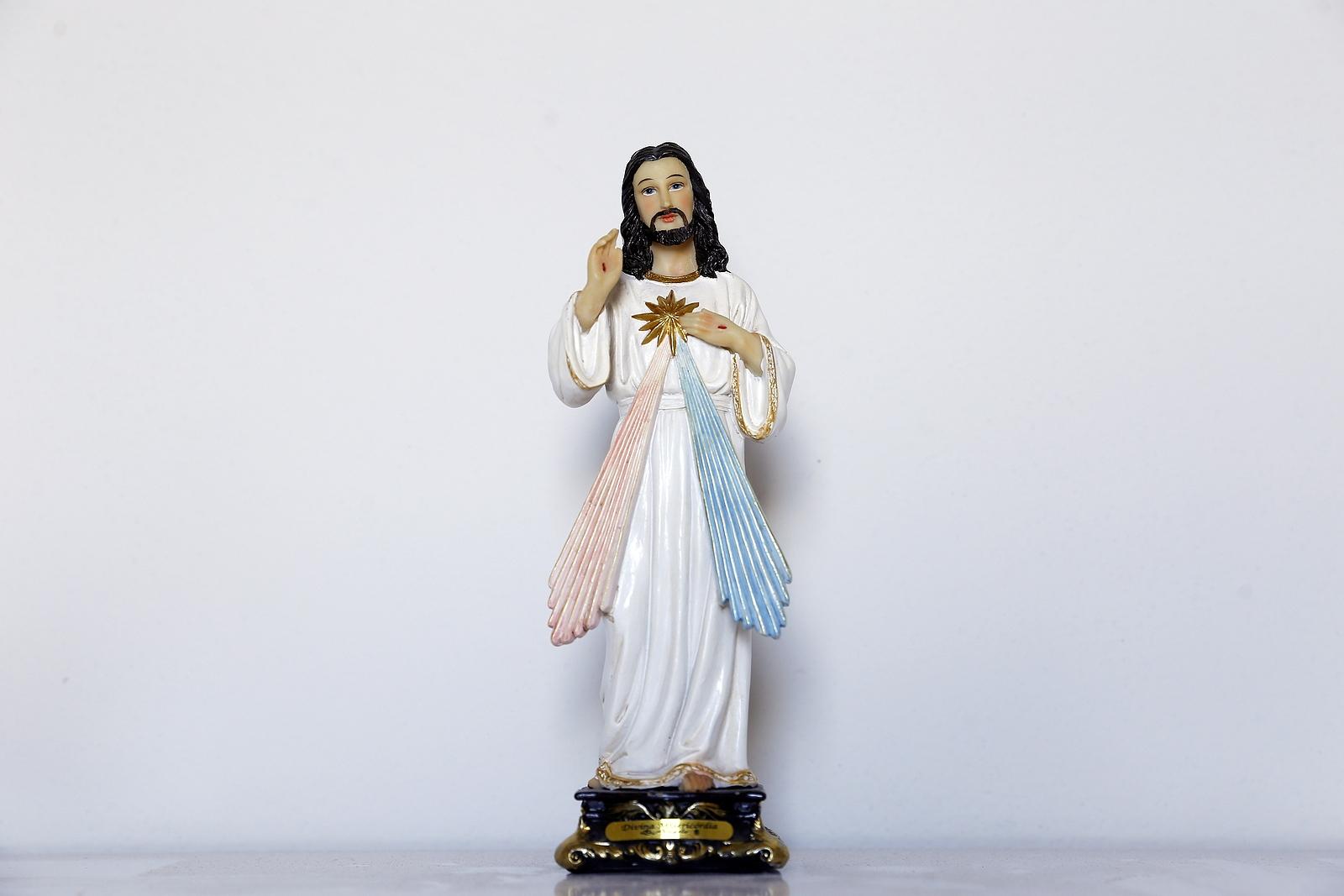
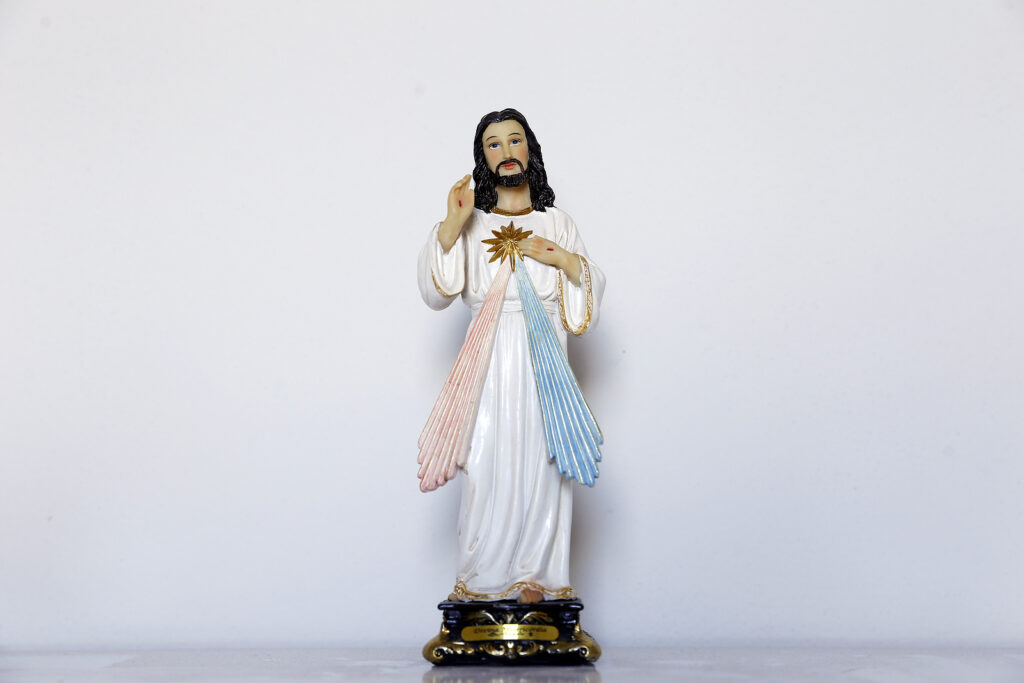
John Paul II knew that a deep understanding of Divine Mercy is the remedy for all of our ills: “There is nothing that man needs more than Divine Mercy… Anyone can look at this image of the merciful Jesus, his heart radiating grace, and hear in the depths of his own soul what Blessed Faustina heard: ‘Fear nothing; I am with you always.’ And if this person responds with a sincere heart: ‘Jesus, I trust in you,’ he will find comfort in all his anxieties and fears.” Procure an image of Divine Mercy to display in your own home, and turn to it whenever you need a reminder of God’s infinite mercy. Mine is placed above my nightstand, so it’s one of the last things I see before I go to sleep, and among the first things to greet me in the morning. It’s a lovely reminder that God’s mercy is with me and holding me always!
“Then the [women] went away quickly from the tomb, fearful yet overjoyed.” (Matthew 28:8)
“Fearful yet overjoyed”? Aren’t those emotions opposites? Reading this passage from Matthew, I never understood that description of how the women felt. We read in Matthew’s Gospel that the women go to the tomb, see an angel, and are told the great news of Jesus’ resurrection. Why, then, would they go away fearful? I had always found the combination of fear and joy puzzling … that is, until I became a mother.
In fact, this Easter is my very first Easter as a mother, and as I read that familiar passage in Matthew’s Gospel this year, the emotions of the women began to make sense. When my son was born, I was excited to meet him, to hold him, and take him home. When the nurses weighed him and examined him in my labor and delivery room, I remember I could not take my eyes off of him. I was simply mesmerized! And I was anxious. I was waiting for an answer – “Is he alright? Is he healthy?” I had been a mother for less than an hour, and I was already afraid he might be hurt. I knew right away that I wanted to protect him from every single instance of pain and suffering, and I also knew shielding him from every inconvenience was not within my power.
Recognizing my powerlessness led me to fear. I imagine my mix of emotions when I became a parent is like the women’s reaction to Jesus’ resurrection. They were excited to see Jesus again, and yet they probably had a flurry of questions and anxieties rolling around in their heads, too. They probably wondered, “How did this happen?” “Is Jesus okay?” I imagine they were likely wondering about Jesus’ future. After all, Jesus had just been executed a few days before. “What would the Jews do to Jesus when they find out he’s alive again?”
In the midst of all my questions and mixed emotions, I eventually learned two very important things in that labor and delivery room. First, when it comes to worries — logical or not — we essentially have two choices. We can remain paralyzed with fear like the guards at the tomb (Mt 28:4) and ponder all the terrible things that could happen, focused on our powerlessness to protect our loved ones from every illness and injury. Or, we can turn to the one who does have control — God. I knew in meeting my son I had to surrender myself and my child into the arms of God, trusting him to take care of us in this life and the next. We can thank God endlessly for every joy-filled moment we have with our loved ones. We can be like the women at the tomb who do still encounter fear, but they do not remain in fear. Instead, they let celebration and happiness overshadow their fears.
While I was in the hospital, and even after being discharged, I could have focused on the pain and suffering I was enduring or the sleepless nights caring for a newborn. In fact, for a while, I did focus on the negatives. I complained a lot. And after some time, I realized I did not want to complain any more. My baby would only be this tiny for a short time, and I wanted to soak in every cuddle and coo. I chose to move my thoughts from complaining to prayers of thanksgiving. When I noticed myself venting about having to feed my newborn again or begging my baby to please go back to sleep, I started listing off my thank you’s to God instead. Thank you God for my health. Thank you God for keeping my baby safe. Thank you God for my husband and his generous heart. … On and on I’d thank God until that “glass half empty” thinking faded away and my complaints seemed insignificant. Shifting our thoughts from worries to gratitude is not easy, but as this new mom can attest, it is definitely worth it.
May we all, this Easter season, find the strength to trust our loving Father every day, and give thanks even in times of trial for every good gift.
The tomb is empty. The stone has been rolled away. Jesus is not there. A vacant grave appears in the dim light of morning. This is the height and summit of the story of Jesus the Nazarene.
Except it’s not.
This year’s Easter reading from the Gospel of John gives us the account of a grief-stricken Mary Magdalene seeking the tomb of her Rabbi, Master, and friend. It is early. The sun has yet to rise. She finds the tomb empty and — with anguish and horror — runs to tell the disciples that someone has taken the body of her Lord. This Jesus (her Jesus), who was all mercy, all truth, all gentle and fierce and holy power — must he suffer the indignity of being stolen in the night? Was not the pain and humiliation of the cross enough? Where have they taken him? Simon Peter and John tear through the quiet streets of Jerusalem and arrive at the tomb. It is just as Mary has reported. Empty. They are left with questions and vague hope.
Jesus did not come to give us vague hope. The empty tomb is not the end of the story. Jesus is not gone. He lives. Really and truly lives. Not figuratively. Not in some hyper-spiritualized, otherworldly sense. He is alive.
In the days following the Resurrection, the disciples see him, touch him, and eat with him. His body — the same body knit together in the womb of his mother and nourished lovingly at her breast. The same body slick and gritty with hard work at the side of his foster-father. The same body constantly reaching out to touch, heal, forgive, comfort, and feed. The same body subject to torture, degradation, and death has been raised from the dead. Jesus has conquered death. By his Passion and Resurrection, he has made our humanity resplendent. Jesus came to give us hope that is resplendent. He knows intimately the depth of the darkness we face. If we are brave enough and trusting enough and reckless enough to hope in him, it cannot overcome us.
This week during what the Church calls the Octave of Easter we will hear stories of the Risen Jesus walking and talking and eating and being touched by his friends. We will meet people stumbling in doubt and confusion and grasping at vague hope. We will watch the Risen One set their hearts ablaze with what is glorious and piercing and true. Easter is not over. It is still unfolding. Like the crocuses bravely pushing their way up from my snow-covered garden, the Resurrection has broken the canceling grip of what is cold and cruel and final. This week, the Resurrection will unfurl itself.
Attend or watch daily Mass this week to hear the Risen Christ proclaimed. Hear how day-by-day the Resurrection blossoms and reveals itself and receive a share of the resplendent hope that is yours … for you. Really and truly for you. The empty tomb is not the end of the story. It is the beginning of a new and glorious and forever unfurling story. It is your story. It is a story of hope. It is hopeful indeed.
Though Good Friday is the most solemn day on the liturgical calendar, for much of my early life it was difficult for me to connect to Jesus and his experience, until my brother was diagnosed with cancer back when I was 19. My faith went through a wringer. All I could ask God was, why? I could no longer pray. Every time I tried, I would just cry. Through the wisdom of my spiritual director at the time, I was able to see that my tears, being the expression of my inner anguish, were probably the most honest prayer that I had yet uttered. I was in touch with my pain, and I was sharing it with God.
This experience helped me realize that where I can connect most intimately with Jesus is through my own human experience. I do not know his experience. But I know my own. And that is where I can meet Jesus, who also went through the experience of anguish — whose sweat in the Garden of Gethsemane and the few words he managed to gasp out were the way he shared what he was going through with his father. Because Jesus, as God and man, experienced the gamut of human experience and emotion, I can meet him there. It is common ground.
Jesus’ cry from the cross, “I thirst,” captures the divine and human pathos of Good Friday. All of us know what thirst is. When I imagine the scene, I recall a thought that has haunted me over and over again from seeing images of tremendously malnourished women holding their babies: What must it be like for a mother to hear the cries of her hungry baby, and be unable to provide food for her child? This is what Mary is going through at the foot of the cross. This is what the Father is experiencing as well — he, too, is unable to meet the needs of his own son at this moment. These words declare that Jesus, the Son of God, had so completely been stripped of everything, even the help of his father and mother, that his thirst could not be alleviated.
Did Jesus’ cry stop here? Did Jesus only mean that he longed for something to drink? Or was he thirsting for something much more? If we can hear Jesus’ cry and allow these two words to reverberate in the hollow of our being, we might be able to hear in the echo an invitation that might lead us to that reality that we all long for: connection with God.
I thirst. Most of us tend to avoid admitting how empty we feel. It’s too painful to go into the depths of our being and be with ourselves for any length of time. Most of our life is filled with distractions that defend us from the emptiness. If for a moment we reflect on our reality, we might have to admit that all our telling ourselves we are in control is just a way of drowning out the fact that life is very insecure. The “security” of our lives is based on so many variables that can crumble at any moment. Beneath our public veneer is an unconscious terror that we keep at bay with a tremendous amount of psychic effort.
Jesus’ ability to cry out “I thirst,” tells us that he was in touch at a very profound level with his emptiness. He may have been expressing the thirst he felt for the restoration of the ruptured relationship between his Father and us. He may have been thirsting to taste once more the food of the kingdom of heaven, where he would enjoy the presence of his Father — and ours.
Can I hear these words and allow them to become my own as well? I thirst … At first, we might feel helpless because we don’t know what Jesus means. I might be able to discover what he means by getting in touch with my own thirst. Simply repeating the phrase, I thirst, over and over again helps me begin to feel what it is that I thirst for. And that is where Good Friday becomes a shared experience between us and Jesus, which can lead to communion.
What will my response be to Jesus’ cry? How will I try to alleviate Jesus’ thirst? The litmus test of my response will not be an abstract internal affair. Rather, it must take flesh in the way I respond to the cry of thirst from those in my life, a cry that is often suffocated. If I can hear the undertones of Jesus’ cry of thirst, I may be able to hear my own and others’ unspoken thirst — a thirst that all of us, including God, have — that can only be satiated by one gift: love.
(Previously published March 2010.)
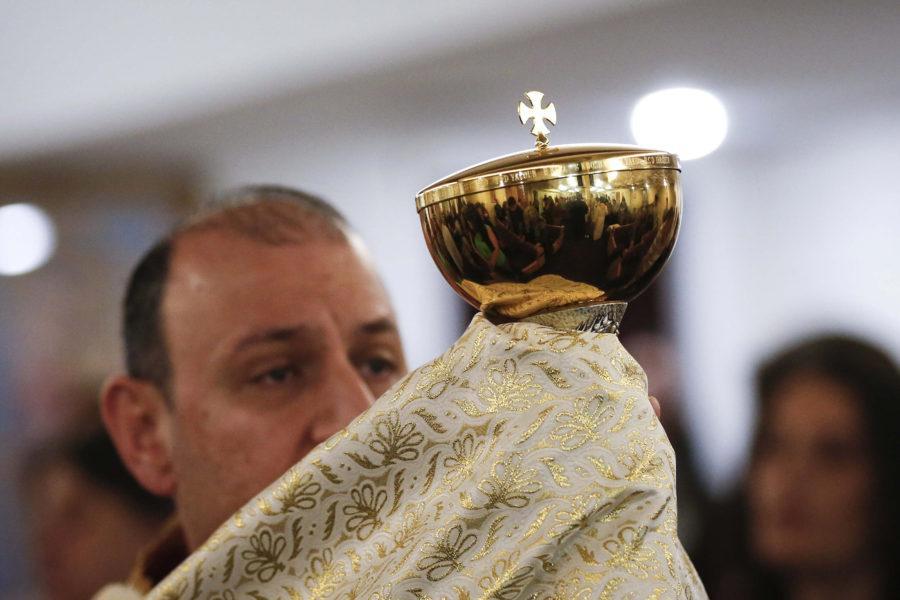
Msgr. Felix Shabi carries a chalice containing the Eucharist to a place of repose following Holy Thursday Mass of the Lord’s Supper at Mar Abraham Chaldean Catholic Church in Scottsdale, Arizona. (CNS photo/Nancy Wiechec)
Dating back to my preteen altar server days, I’ve always had a deep connection to the Triduum. Every year, when the volunteer ministry schedule for Holy Week came out, I was the first to sign up. Back then, the novelty of the unique rituals intrigued me; it’s not every day that you see your priest kneeling down to wash parishioners feet in imitation of Christ.
Through the years, I still find myself just as connected to the observances of Holy Week. Now, though, instead of having my curiosity piqued by different liturgical traditions like it was during my youth, these blessed holy days signify a deep, spiritual time of reverence, thanksgiving, and self-reflection. Looking back over the season of Lent, I’m reminded how the emptiness I’ve experienced signifies my dependence on the Holy Spirit.
Our Catholic faith is full of so many beautiful traditions, but one that leaves me speechless every time I witness it is the procession of the Blessed Sacrament on Holy Thursday. When the Mass of the Lord’s Supper has ended, the consecrated Hosts are solemnly carried over to a special repository, commonly referred to as the altar of repose. Many churches use their chapels for this occasion. The Blessed Sacrament remains in this location until the Communion Service on Good Friday.
I was attending the Holy Thursday service at St. Joseph’s Cathedral in San Diego when I first felt the magnitude of this procession. The priest had just finished reciting the post-Communion prayer, the incense was being prepared, and I was gazing around trying to find where the altar of repose was located. The cathedral was packed full of congregants, yet the air hung perfectly silent. Without the rays of the bright Southern California sun shining in, the dark, wooden fixtures set a somber tone. The sanctuary was mostly illuminated by candles burning on the main altar.
I expected the choir to begin playing a quiet melody or to start a soft chant as the procession of the Blessed Sacrament commenced. Instead, the priest invited us all to follow behind him. Parishioners were encouraged to join the Blessed Sacrament as the procession trickled outside, down to the sidewalks that circled the cathedral, before ultimately resting at the temporary altar set up in the social hall. As the priest began to walk, the only sounds to break the silence were from Luke 23:42: “Jesus, remember me when you come into your kingdom.” These sweet, somber words, quietly sung, echoed throughout the remainder of the procession.
“Jesus, remember me when you come into your kingdom.”
This humble plea sits heavily on my chest every time I hear it. These words serve as a meaningful reminder to me that we’re all invited to partake in the kingdom of God by actively participating in our Catholic faith through the sacraments. Remembering the importance of the sacraments inspires me to regularly receive the Eucharist and nudges me to go to Confession.
On Holy Thursday, we commemorate the night that Jesus made a gift of himself for the human race. This year, before you head out for Holy Thursday Mass, remind yourself of what you are celebrating when you remember the Last Supper. You are about to stand witness to the body and blood of Christ.
If you don’t usually participate in Adoration, spend some extra time with Jesus on the eve of his crucifixion. Allow yourself to remain open to hearing God’s message. How can you follow in Jesus’ footsteps by serving others? What are the blessings in your life that you take for granted? What might be holding you back from picking up your cross and following in Christ’s footsteps?
As I reflect upon the beautiful procession of the Blessed Sacrament, I find myself praying, “Jesus, remember me when you come into your kingdom.” My soul takes comfort in knowing that we all have an open invitation to live in eternity with God.
2015 Easter Vigil at St. Paul Church in Wilmington, Delaware (CNS photo/Octavio Duran)
The Triduum (TRIH-du-um) is the time of the Church year when we celebrate the passion, death, and resurrection of Jesus Christ. This three-day celebration begins with the Holy Thursday Mass and continues on Good Friday with the Liturgy of the Lord’s Passion. At the end of this liturgy, we leave the church in silence, waiting to celebrate the glory of our Lord’s resurrection. Then, on Saturday at sundown, the Church re-gathers to celebrate the final, and most grand moment of the Triduum: the Resurrection of our Lord.
The Triduum is somewhat like a three-day prayer marathon, and if you are a novice there may be some rituals that are unfamiliar to you. This guide will help you walk and pray through the liturgies of the Triduum.
The Mass on Holy Thursday is commonly known as the Feast of the Lord’s Supper. This Mass is a time for Catholics to remember the Last Supper where Jesus and his apostles gathered to celebrate Passover. In the Holy Thursday celebration, two ritual actions stand out among the rest:
The Washing of the Feet
At the Last Supper, Jesus took a basin and a towel, got down on his hands and knees and washed the feet of all of his apostles. After this action, he commanded the apostles, “I have given you a model to follow, so that as I have done for you, you should also do” (John 13:15). This is Jesus’ commandment: Just as Jesus has been a servant to his apostles, so the apostles must go out into the world and be servants to everyone around them.
We are called to do the same in our daily lives. Well, we are not called literally to wash each other’s feet (though sometimes that may be the case). The action of washing one another’s feet reminds us of the call to humble servitude. Foot washing is not a re-enactment or re-creation of a past event, but rather, it is a commemorative action that reminds us that God calls us first and foremost to be servants to others in our daily lives.
The ritual washing of the feet can take place in many ways. Some churches choose to have 12 people, who represent the apostles, have their feet washed by the priest presiding over the celebration. Other churches invite the entire gathered community to have its feet washed (this particular tradition is very powerful because everyone is invited to come and have their feet washed by someone else in their community). However the ritual takes shape, foot washing should always be a reminder that Christ has called us to be servants to the entire world.
The Celebration of the Eucharist and the Eucharistic Procession
At the very first Last Supper, Jesus also instituted the Eucharist for the Church. At this Holy Thursday celebration, we are reminded of who we are in Jesus Christ and that, through the sacrament of the Eucharist, we are and we become even more the Body of Christ together.
At the conclusion of the Holy Thursday celebration, there is no concluding prayer. Once the celebration of the Eucharist is completed, there is a Eucharistic Procession (where the Eucharist that is left from Communion is processed to a Chapel of Reservation). This procession to the Chapel of Reservation reminds us of Jesus’ time in the garden of Gethsemane when he prayed so fervently through the night. The entire community is invited to join in this procession and then join in the silent prayer and adoration until night prayer is prayed and the Eucharist is put in the Tabernacle. The gathered community leaves in silence only to return in prayer the next day for the Good Friday celebration.
Reflection questions for Holy Thursday:
Who are those people who need our help the most?
Am I willing to get down on my own hands and knees and help those who are unable to help themselves?
What does the sacrament of the Eucharist mean to me?
In this solemn celebration, we remember the Passion and Death of Our Lord. The service is marked by several important rituals including the proclaiming of the Passion according to John, the Veneration of the Cross, an extended form of General Intercessions, and finally, the distribution of Communion (reserved from the Holy Thursday celebration of the Eucharist).
The Veneration of the Cross
It seems strange that in the Good Friday liturgy Catholics choose to venerate, or show reverence to, the very instrument that was used to crucify Jesus. The Veneration of the Cross reminds us that through this Cross, the Glory of the resurrection emerges. So, on Good Friday, we come forward to show our great reverence and respect for the Cross. People have various traditions when they approach the Cross. Sometimes they kiss the Cross, kneel before the Cross, or even just touch it in some fashion. As you participate in this ritual, venerate the Cross in whatever way feels most normal. And most of all, just take in the experience of the gathered community coming so close to such a tragic, but integral, event in our faith.
The General Intercessions
If you enjoy spiritual aerobics, then this ritual is for you! In this expanded form of General Intercessions, the presider and the deacon work together to pray 10 intercessions. These intercessions are the same intercessions the entire Church prays on Good Friday, and they include praying for the Holy Church, praying for the unity of all Christians, praying for the Jewish people, praying for people who do not believe in Christ or in God, praying for people in public office, and praying for people who are suffering or facing difficult times. These prayers recognize how universal our Church is and that we should be aware of all of the faiths and traditions in the world that are different from our own.
Reflection questions for Good Friday:
What does the death of Jesus mean to me?
What does it mean to “Glory in the Cross”?
The celebration of the Easter Vigil tells the whole story of our salvation — from creation to resurrection and beyond. Because of all the ritual moments, this service tends to be on the lengthy side (an average Easter Vigil will last at least 2-2 1/2 hours). But don’t let the length of the celebration detract you from participating. The Easter Vigil includes the lighting of the Easter Fire and Paschal Candle (the large candle that we will use throughout the year), the singing of the Exsultet (the Easter Proclamation), the expanded Liturgy of the Word that traces time through Salvation History (the story of our Salvation), the Liturgy of Initiation (where new people come into the Church), and the celebration of the Holy Eucharist. All these rituals come together for one purpose: to remember and recall the saving deeds of our God on our behalf. Here’s an explanation of two moments from the celebration.
The Singing of the Exsultet
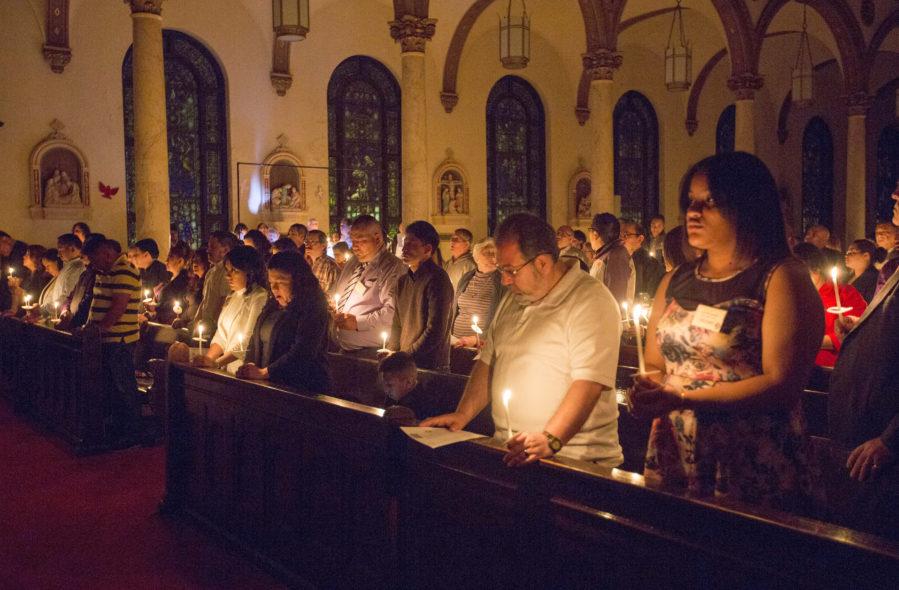
The Exsultet, or the Easter Proclamation, is a hymn that is sung by a deacon, priest, or cantor. This hymn speaks of how God has interceded in our lives on our behalf. The Exsultet especially recalls the Holy Night when Jesus Christ rose from the dead. What makes this moment particularly dramatic is that the Exsultet is sung in a church lit only with the light of the Paschal Candle and other smaller candles, which people are holding. In order to pray this hymn along with the deacon, priest, or cantor, try reflecting on the words of the hymn throughout Holy Saturday.
The Liturgy of the Word
The Liturgy of the Word for the Easter Vigil is comprised of nine readings and seven responsorial psalms. The first reading begins with the story of Creation and then, each subsequent reading recounts the story of our faith lives through history. You’ll hear the story of Issac and Abraham, the story of Moses and the Exodus, and more. All of these readings lead up to the singing of the Gloria when all the lights come on in the church, and then the final reading, the Resurrection of Christ, is proclaimed. Why so many readings? Again, like the singing of the Exsultet, the readings recount the many ways in which God has interceded on our behalf throughout history.
Most churches do not do the entire set of nine readings (for time’s sake). But keep in mind that the point is to recall how God has interceded on humanity’s behalf from the very beginning of time and that through this Easter Vigil we celebrate that God is present and always working in our lives, even still today.
Reflection questions for the Easter Vigil:
How has God interceded in my life?
After hearing the Resurrection story, what events do I see in my own life that are in need of new life, in need of resurrection?
How can I carry on the story of the resurrection to others?
Easter
Throughout these three days, we experience the highs and lows in our faith, ending with the ultimate high — the new life of the resurrection. The Easter Season begins with the Easter Vigil, and we enter a time (50 days) when endless “Alleluias” will ring out throughout all of our liturgical celebrations. May you experience the joy of new life in your own way this Easter Season. Have a happy and blessed Easter!

 The Old Testament has (almost) never been read at the Eucharist during the Easter season. St. Augustine of Hippo in the fourth century started this based on earlier practices by Cyril of Jerusalem.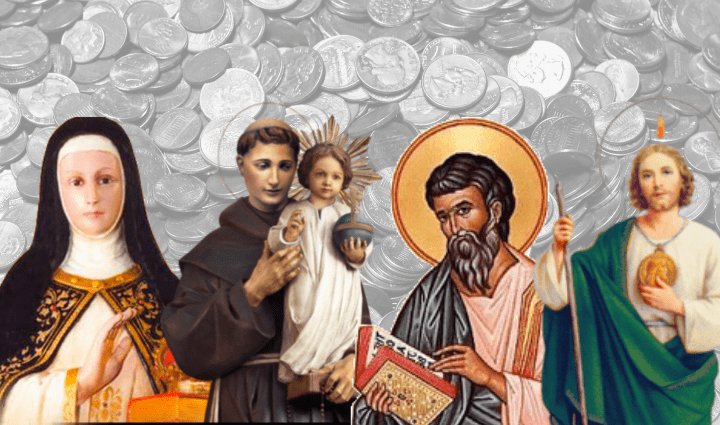
 W
W


 “Then the [women] went away quickly from the tomb, fearful yet overjoyed.” (