Tag: TV

  • A Good Dog: How ‘Bluey’ Inspires Goodness for the Whole Family

    A Good Dog: How ‘Bluey’ Inspires Goodness for the Whole Family

    Image Courtesy of Disney+

    A red dog gently bunts a cricket ball to his younger sister; she triumphantly catches it and immediately runs to him to celebrate her big play. He proclaims, “What a catch!” while affectionately ruffling her hair as she giggles with glee. Looking on, a father states to his daughter, “That’s what cricket is all about, kid.” I find myself awash in tears while watching this tender and supportive interaction play out on the screen with my young daughters. 

    What is it about the Australian kids’ cartoon “Bluey” that tugs my heartstrings? Parents and children alike feel drawn to and inspired by the show. Animated dogs are far from a new genre, and yet “Bluey” possesses a fresh, unique sense of childhood’s wonder and joy. “Bluey” follows the adventures of an anthropomorphic family of Blue Heelers living in Australia. Bluey is a spunky 6-year-old pup, and her 4-year-old sister, Bingo, happily takes the role of her imaginative playmate. Often joining in their elaborate games, their parents create a loving, family-oriented atmosphere. We began watching “Bluey” after our dear friends mentioned its charm and it became a fast favorite in our home. Wading through media meant for children is a daunting task as a parent, but “Bluey” provides a welcoming, safe space to which I find myself continually returning. There’s silliness, foibles, and even the sprinkling of light potty humor; and through it all “Bluey” captures the essence of goodness and family life remarkably well. 

    RELATED: 3 Ways God Reveals Himself to Me Through My Young Children  

    “Bluey” depicts the mundane, everyday interactions between a family and their friends. “Bluey’s” narratives do not focus on big sweeping storylines but rather on the sacred space of family life. Holding relationships at its center, the pursuit of goodness and harmony is evident in the depictions of both the adults and children in the series. The stories weave a tapestry of virtue I see reflected in my own family. 

    Giggles cascade across the room as my daughters carefully guide a ladybug to her newly constructed magic carpet. For an unexplained reason, our home has experienced an influx of ladybug visitors and, inspired by a particularly charming episode of “Bluey” called “Slide,” no bug shall be harmed in our home. In “Slide,” Bluey’s sister Bingo and her best friend Lila develop a system for ensuring that when they careen down the water slide, no bugs are squashed. My sweet, caring girls took this message to heart, and we are now the protectors and playmates of all insects. Small acts of kindness for the tiniest of friends, but kindness nonetheless. 

    LISTEN: Tackling Kids’ Tough Questions of Faith

    Goodness, sometimes defined as virtue in action, radiates throughout “Bluey’s” family as they navigate forming relationships that bless not only one another but also their neighbors, friends, and family. Theologian Stanley Hauerwas describes the development of virtue as narratively formed through stories. I see this development firsthand and subsequently try to be mindful as I curate the stories my daughters watch and read. Yet, I have discovered their characters are not the only ones formed through these narratives.  

    Kindness and goodness are depicted not only in the main characters, but also throughout their community; emphasizing our need to both give and receive support. In an episode called “Baby Race,” Bluey’s mom, Chilli, recollects her struggles with comparison early in motherhood. Her anxieties over Bluey’s development are eased when she is visited by a more experienced mom friend who gently informs her, “You’re doing great.” This has become a reminder frequently quoted by my dear friends and me when one of us is feeling the weight of motherhood. Never underestimate the wisdom of a pink poodle and the ripple effect of support. 

    RELATED: Children and the Church: Recognizing the Welcome

    The episode referenced at the beginning of this article, “Cricket,” chronicles the journey of Rusty, a friend of Bluey’s, to become a skilled cricket player. Rusty’s dad is deployed overseas; yet through his letters, he imparts advice on facing fast pitches by writing, “As you grow up, you’ll face harder things than a cricket ball… Just keep your eye on the ball and take care of your little sister for me.” This prompts Rusty to bunt the ball to his sister and celebrate her achievement rather than reveling in his own skill. My older daughter quickly caught onto the thread most pertinent to her life and cooed “Aw! He shared with his little sister.” And that’s the beauty of “Bluey;” she saw a sweet story about sharing with your siblings, while I watched a heartwarming tale about a young dog growing in character and skill, and we both loved every minute. 

    The stories that we watch and read with our children form both parent and child. They offer verbiage to discuss tricky topics, provide games and ideas for imaginative play, and gently teach us all the virtue of goodness. By creating a program that highlights the beauty of the mundane and centers on creating healthy relationships with others, “Bluey” has inspired and captivated audiences. All ages can enjoy a show that depicts how kids and parents can both grow in goodness within their everyday lives. As I read, watch, and listen to various stories with my children, I am learning to embrace each narrative that shapes my character, and that of my children, for good – even those starring a small blue dog. 
  • ‘Jonathan & Jesus’ Is a Story of Surrender We Can All Learn From

    ‘Jonathan & Jesus’ Is a Story of Surrender We Can All Learn From

    “Jonathan & Jesus” docuseries | Steven Schwartz

    Let’s get this out of the way first: I’m an unapologetic fan of “The Chosen,” the series about the life of Christ that went from a crowdfunded upstart to an unexpected worldwide phenomenon; its fourth season is about to hit movie theaters in February before being released to streaming in March. I think Jonathan Roumie’s performance as Jesus in the series is staggeringly good. I’m also someone who’s worked in the entertainment industry for much too long, often with those magical creatures we call actors (not, for full disclosure, with Jonathan Roumie). So, I acknowledge I’m not the most objective viewer of the newly released “Jonathan & Jesus” docuseries.

    Yet I admit when I initially learned about “Jonathan & Jesus,” I had a moment of “oh, dear.” My first thought: How does this, even when made with the best intentions, avoid looking like an ego trip?

    I’m happy to say that “Jonathan & Jesus” doesn’t play at all like an ego trip. It’s not an easy watch – that’s not criticism, that’s praise – because it is a journey through the life-changing nature of Roumie’s experiences, from deeply blessed to personally overwhelming to just plain cool, during the early days of the ascendency of “The Chosen.” It’s also an interrogation of the meaning and impact of Jesus, not only on the actor playing the role, but on everyone in our world.

    LISTEN: Jonathan Roumie’s Prayer Challenge

    While the burgeoning of “The Chosen” phenomenon and Roumie’s landing a lead in “Jesus Revolution” between the shooting of seasons two and three of “The Chosen” serve as an ongoing throughline, each episode of the docuseries has its own focus, roughly sketched as (1) Jesus as God and historical/cultural touchstone, (2) Christianity, division, and unity, (3) celebrity and humility, and (4) control versus surrender. “Jonathan & Jesus” is ambitious and immersed in big questions throughout, touching on subjects both complicated and diverse. 

    A journey through the meaning of Jesus as the Incarnate Word of God, the primary cause of Western Civilization, and a pop culture motif took me on an emotional rollercoaster. First, I felt vaguely uncomfortable seeing some of the more mundane depictions of Jesus portrayed in pop culture, from “Family Guy” to the Buddy Christ image from Kevin Smith’s “Dogma.” That gave way to a sense of the transcendent as a historian standing in the shadow of the Roman Colosseum considered that at the time the Colosseum was built, it would have been ludicrous to think that the Roman Empire would soon be ruins, but a nascent faith beginning with Jesus and a small group of followers in Judea would survive, thrive, and be, millenia later, the largest faith in the world. 

    Discussions between Roumie and preachers and influencers of various Christian denominations reminded me how we’re so unfortunately quick to criticize each other, focusing on the things that divide us as Christians instead of the God who unites us all. Interviews with scientists, ministers, writers/podcasters, human rights campaigners, and musicians revealed the pivotal moments in which these people chose to surrender their lives — expectations and illusions of control included — to God in faith and the monumental results of that choice. Given my own constant struggle with surrender and what it really means in practice, seeing these stories is a nudge to keep on trying. (If you’re like me, you regularly turn your eyes heavenward and say, “Is this it, God, am I surrendering right yet? Because I don’t think I am!?!”) And yes, you will come away from this doc wishing that Jonathan Roumie, Sheila E., Brandon Flowers, and Alice Cooper could tour as the world’s most unlikely supergroup.

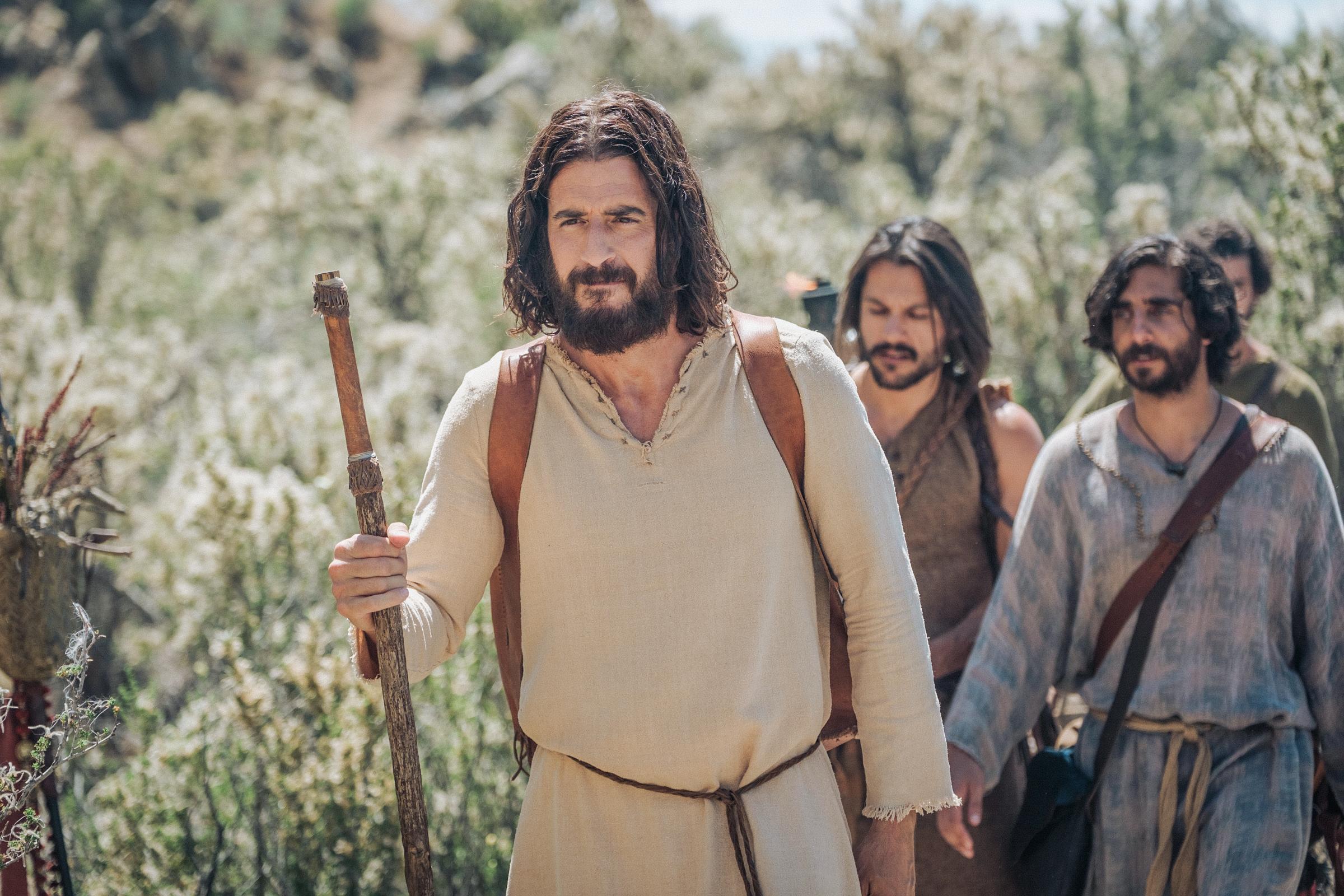
    Photo courtesy of The Chosen / Mike Kubeisy

    RELATED: Spiritual Streaming: 5 Catholic-Themed Films for Your Next Movie Night

    With all these matters raised and considered, the series is in some ways a choose-your-own-adventure; which parts of it stick with you will vary significantly from viewer to viewer. At the close of the final episode, the person who watched with me said, “The things some of those Christians he interviewed were doing…feeding migrants under bridges and saving trafficked women…how am I ever going to get to heaven?” Meanwhile, I was most affected by the unflinching honesty of the life-of-an-actor segments, which take the viewer from the dire situation Roumie was in just months before “The Chosen” came along to interviews with his sister, Olivia, and Dallas Jenkins (creator of “The Chosen”), discussing how both fame and the conflation of a human actor and the Son of God in the mind of fans can be disorienting, scary, and exhausting—even for a grounded person with a deep faith to sustain him. In my professional life, I’ve seen both actors eking out a living juggling acting gigs with low-paying survival jobs and actors dealing with sudden fame due to one big role (never mind the role of Jesus, which adds knotty moral questions to the already complex issue of fan adulation). These segments felt painfully real and raw to me, a look behind the curtain that we rarely get about the challenges of life as an actor. 

    Does the docuseries fully get its arms around all these subjects? Not precisely, but to my eyes that’s exactly the point. These subjects can be explored, dissected, studied, grappled with, and prayed over, but as Anthony Bova, Roumie’s acting coach, says in the plainest way possible: “…the whole Jesus Christ thing, that’s tough. Because…I mean, whadya do with that?” That statement works as both an acting coach throwing up his hands at the challenges of a role (the job of playing the perfect human is restricted to exactly one role in all of literature, and it’s this one) and a person questioning how much any of us can represent Jesus, even if we’re mandated as Christians to try. So fair enough, Anthony. That’s a question millions have asked over the ages.  

    RELATED: Less Worry, More Trust: Praying the Surrender Novena in Times of Change

    But along comes a scene near the end of the docuseries to show us what we do with the “whole Jesus Christ thing.” It takes us back to 2018, to a part of Jonathan Roumie’s personal story of surrender that many “Chosen” followers have heard about but not seen. I’m not going to go into detail; it is a losing proposition to try to find adequate words to describe someone at the end of his rope encountering the ineffable, and in any event, the powerful moment deserves to be experienced, not described. I’ll just note that if you want to see God starting to lift up someone who has fully surrendered after a long struggle in the wilderness, well, there it is. 

    So no, none of us can get our arms fully around these subjects. Not you, not me, not Jonathan Roumie. Three hours of screen time (or two thousand years of Anno Domini) cannot unlock the unfathomable. What “Jonathan & Jesus” shows us, viscerally and in multiple different testimonies, is what we can do: surrender to the unfathomable. And then the one who is the ultimate subject of this docuseries – the one whose credit is larger, in bold and after the ampersand in the title treatment of the trailer — can get his arms fully around us and take us on his journey.