Tag: The Rosary

  • The Rosary in Two Minutes

    The Rosary in Two Minutes

    The Rosary is a Catholic prayer devotion that draws us closer to Jesus and Mary by reflecting on key moments in their lives. According to Catholic tradition, Mary gave the Rosary to St. Dominic when she appeared to him in 1214. In 1520, Pope Leo X approved it for use by lay people. In those days, many were illiterate, so the Rosary allowed anyone to pray with familiar words from scripture.

    The word Rosary comes from the Latin rosarium, which means rose garden. In scripture, roses symbolize perfection. So, the Rosary is like a perfect garden of prayers.

    The Rosary involves a lot of repetition. You might be wondering, why pray the same prayers over and over again? Praying the Rosary helps slow us down, calm our hearts, and get in touch with our desires for God.

    So, if you want to try praying the Rosary, where do you start? Busted Halo’s new 2-minute video has you covered. Learn about the history and tradition of the Rosary, how to pray, what it means to meditate on the Mysteries of the Rosary, and more!

    To download this video go here and click the download arrow or choose save or download (top right). Please note, all Busted Halo videos are free to use in parishes, schools, or for other educational purposes. In fact, we encourage it!
    Resources and reflections

    The Rosary can be prayed anywhere and is a prayer for everyone. Here are a few additional resources to help you pray the Rosary or share this prayer with your parish or classroom.

    “The Catholic Rosary: A Study in the Power of Prayer”

    “What Are the Origins of the Rosary?”

    “Can I Wear a Rosary Around My Neck?”

    “Saying the Rosary and SAYING the Rosary”

    “Understanding the Rosary: A Wake-Up Call”

    Podcast: “How Did the Rosary Begin?”

    Podcast: “Mysteries of the Rosary”

    What are the prayers of the Rosary?

    Sign of the Cross

    In the name of the Father, and of the Son, and of the Holy Spirit. Amen.

    Apostles’ Creed

    I believe in God, the Father almighty, Creator of heaven and earth, and in Jesus Christ, his only Son, our Lord, who was conceived by the Holy Spirit, born of the Virgin Mary, suffered under Pontius Pilate, was crucified, died and was buried; he descended into hell; on the third day he rose again from the dead; he ascended into heaven, and is seated at the right hand of God the Father almighty; from there he will come to judge the living and the dead. I believe in the Holy Spirit, the holy catholic Church, the communion of saints, the forgiveness of sins, the resurrection of the body, and life everlasting. Amen.

    Our Father

    Our Father, who art in heaven, hallowed be thy name; thy kingdom come; thy will be done on earth as it is in heaven. Give us this day our daily bread; and forgive us our trespasses; as we forgive those who trespass against us; and lead us not into temptation, but deliver us from evil. Amen.

    Hail Mary

    Hail Mary, full of grace, the Lord is with thee; blessed art thou among women; and blessed is the fruit of thy womb, Jesus. Holy Mary, Mother of God, pray for us sinners, now and at the hour of our death. Amen.

    Glory Be

    Glory be to the Father, and to the Son, and to the Holy Spirit, * as it was in the beginning, is now and ever shall be, world without end. Amen.

    Fatima Prayer

    O my Jesus, forgive us our sins, save us from the fires of hell; lead all souls to heaven, especially those in most need of thy mercy.

    Hail, Holy Queen

    Hail, holy Queen, mother of mercy, our life, our sweetness, and our hope. To thee do we cry, poor banished children of Eve; to thee do we send up our sighs, mourning and weeping in this valley of tears. Turn then, most gracious advocate, thine eyes of mercy toward us; and, after this, our exile, show unto us the blessed fruit of thy womb, Jesus. O clement, O loving, O sweet Virgin Mary.

    Pray for us O holy mother of God, that we may be made worthy of the promises of Christ.

    Rosary Prayer

    Let us pray. O God, whose only-begotten Son by his life, death and Resurrection, has purchased for us the rewards of eternal life; grant, we beseech thee, that by meditating upon these mysteries of the most holy rosary of the Blessed Virgin Mary, we may imitate what they contain and obtain what they promise, through the same Christ our Lord. Amen.

    What are the Mysteries of the Rosary?

    These “Mysteries” (not the crime-solving kind) focus on the significant events in the lives of Jesus and Mary. They’re broken down into four categories and generally prayed on different days of the week:

    The Joyful Mysteries (Mondays and Saturdays)
    • The Annunciation
    • The Visitation
    • The Nativity
    • The Presentation
    • Finding Jesus in the Temple
    The Sorrowful Mysteries (Tuesdays and Fridays)
    • The Agony in the Garden
    • The Scourging at the Pillar
    • The Crowning of Thorns
    • The Carrying of the Cross
    • The Crucifixion
    The Glorious Mysteries (Wednesdays)
    • The Resurrection
    • The Ascension
    • The Coming of the Holy Spirit
    • The Assumption of Mary
    • The Coronation of Mary
    The Luminous Mysteries (or Mysteries of Light) (Thursdays)
    • Jesus’ Baptism
    • The Wedding Feast at Cana
    • The Proclamation of the Kingdom of God
    • The Transfiguration
    • The Institution of the Eucharist

    The Rosary is a powerful prayer. Many miracles have been attributed to the Rosary (like the miracle at Fatima), and countless others have experienced healing, conversion, and answered prayers. But the biggest miracle of all is the hope it has given to millions around the world.

    Originally published May 21, 2018.
  • How Memorizing Prayers Together Brought My Family Closer to God

    How Memorizing Prayers Together Brought My Family Closer to God

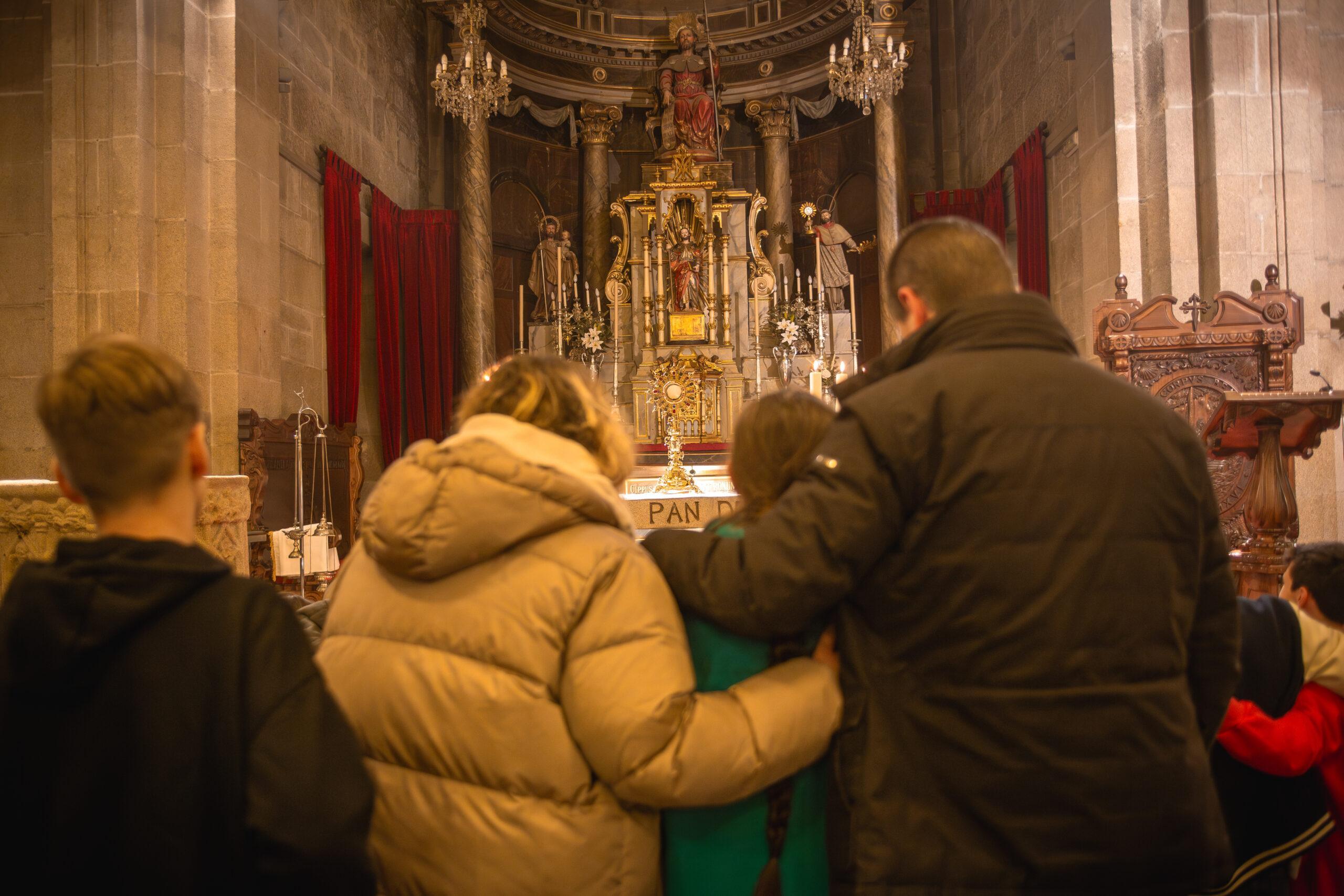
    Family kneeling before an alter in Church praying before the Eucharist
    Photo by Yandry Fernandez Perdomo on Cathopic

    Last fall, signs outside our parish and notices within our weekly bulletin reminded my family that the month of October in our Catholic faith is dedicated to the Rosary. Every time when we walked into Mass, we heard other parishioners reciting the Rosary before the service started. It may sound cheesy, but my husband and I felt a spiritual calling in October to participate in those prayers more actively. Notably, this isn’t a reflection on how my family learned to say the Rosary together during October. It is, however, an account of how we began to try.

    In this process of learning the prayers for the Rosary, we felt “behind” where we imagined other families we knew to be. In October, my family already knew “The Hail Mary” and “Glory Be,” but those were our only starting points. We began by adding “The Salve Regina” to our nightly routines, learning one line per night in our living room before the kids would dash off to brush their teeth and crawl into bed. 

    RELATED: Three Things I’m Doing to Teach My Young Children About the Mass

    In the process, we found that attempting to memorize new prayers together was unexpectedly spiritually rewarding for every member of our family—my husband, my two elementary-school-age children, and me. Before last October, we’d recite those prayers we already knew each night before bedtime, but we’d never attempted anything long. We’d also never practiced the memorization and recitation process nightly together. We had learned those prayers individually or with our church classes. Of course, the things that are spiritually rewarding in our lives are never quite as easy as we’d like them to be, and this process has been no different. It’s now Lent, and we’ve still yet to say the Rosary together without reading at least part of it from a book or a screen. 

    A little like brushing their teeth each night, my children often balk at reciting the prayers. Likewise, sometimes when there’s a football game on, so does my husband.  I also admit that if I’ve had a long day at work and would rather relax with a book and have some solitude, adding the drama of begging everyone to come together to learn prayers isn’t exciting for me. Still, once we start reciting the prayers and learning the lines, a sense of accomplishment and even a spiritual weight visits our living room that is worth every bit of nudging our family might have needed to start memorizing together. The kids might be fighting about whose cookie looks bigger for dessert, or what TV show they’ll watch in the morning, yet they’ll calm down once we’ve launched into saying the prayers a few times. Solemnity almost always takes hold, so to speak. 

    As part of our practice, we say each line of the prayer we’re covering that day five times together, adding whatever lines we learned the day before to it. Then we have each person say the prayer to the point they’ve learned it on their own. My children love taking center stage in the living room, standing on a certain part of the rug where there’s a big flower: This is their stage. They also enjoy checking and correcting my husband and me when we inevitably fumble certain lines or words in the prayers. Like the kids, we stand up on that same flower in the rug, making the recitation a more active, bodily endeavor. Even so, it still took my family three months to remember the “Salve Regina.” In part, this is because we didn’t recite the prayer every day, despite our best intentions. Yet when we’d get off schedule for a few days (like when my son got sick with the flu), we always picked back up where we left off as soon as we could. Now that we’ve finally learned “The Salve Regina,” the prayer is part of the fabric of our lives. We’ll say it together before I drop the kids off at school, or if they’re having an anxious moment, we’ll hold hands and pray it together. My 8-year-old daughter and I will also recite the prayers we’ve learned as I brush her hair in the morning.

    RELATED: What My Family Learned From Inviting Our Local Priests to Dinner

    As we’re approaching her First Communion this Easter, we’ve turned our focus to memorizing “The Apostles’ Creed.” The Rosary begins with it, and the Creed serves as a foundational statement of Catholic beliefs, focusing on our faith’s mysteries. When we practiced “The Apostles’ Creed” last week – again, before bed, in our living room betwixt the chaos of getting school clothes ready for the next day and lunch boxes packed – my daughter asked about the phrase in the creed stating that Jesus was “conceived by the Holy Spirit.” We realized she had no idea what the word “conceived” meant, and to be honest, my husband and I faltered for a moment in answering her. Theological explorations are not often at the forefront of our minds during our household bedtime routines. Even though we were saying the words together almost daily for months, it wasn’t until my daughter was able to repeat them without struggling that she began to ponder their meaning. How exactly was Jesus conceived by the Holy Spirit AND born of the Virgin Mary, not one or the other, she inquired?  

    After thinking through it—and, yes, Googling it—we explained that even though Jesus was born of a human mother, Mary, he possesses a divine nature, as his conception occurred through the Holy Spirit rather than a human father. Jesus is fully divine and fully human, both God and man. While we may worship this truth together at Mass and while my daughter may have learned this in her religious education classes, the lightbulb that went off in her head while we were discussing this mystery as a family was amazing to not only watch but also to participate in with her. Wow, we seemed to realize as a family, these words we’re repeating are astounding when one truly thinks through them and feels their power. 

    This was a special moment – and a rare one in our family routine – and it felt exhilarating to experience it. In fact, we encounter struggle more often than not. While we are almost done learning the Creed now, my husband is farther behind than the rest of us, and it’s not for lack of trying: memorization is simply harder for him. My daughter has a speech impediment, and the words don’t come easily to her either. Because every member of the family is different in how we learn, this can prove an impediment to keeping the energy and momentum needed to inspire daily practice. 

    RELATED: Children and the Church: Recognizing the Welcome

    Keeping this in mind, my husband and I try to keep an atmosphere of lightness. We never shame anyone if someone is struggling, but we encourage each other to make it to the end of that section no matter the attempts it takes. The laughter that inevitably happens as we mix or miss words is good for our family’s soul. Plus, it teaches our children to be kind to each other – and to us – because we’re all learning the prayers together simultaneously. Through memorizing and reciting prayers, our entire family can be described for one of the first times ever as spiritually curious. While we may have been fighting moments earlier before trying to pray about who did or did not do the dishes, we open ourselves to God being with us when we pause for this practice. Our hearts, minds, and days almost always settle. While it may not happen right away, after the final recitation, there is usually a sense of pervasive and palpable calm, and that is worth every up and down in getting there.

    It bears mention here that in Catholicism, memorization entails a spiritual recollection that is supposed to work in concert with the intellectual aspect of memory. For example, the liturgy of the Catholic Mass is a memorial, or “a remembering of” the re-presentation of the sacrificial act of Jesus’ death on the Cross. During each Mass, our salvation becomes present before us on the altar through the Sacrament of the Eucharist. In other words, Mass is not a mere recollection but an active participation in this past salvific event, making the past present in a sacred and transformative way.  

    As my family prepares for my daughter’s First Communion, we have learned that memorizing prayers has brought us closer to God’s divine mission on our couch at home in addition to on our parish’s pews. Memorizing together helps us connect with the Church’s past and lay claim to our own future within it. The often-fumbled words, the shared laughter, and the earnest attempts to understand the words we’re reciting have led us to find grace within our family’s spiritual life and to connect that grace with the broader Church family we also belong to and are learning more about through its prayers and creeds. 

    Indeed, in nurturing our children’s spiritual growth, my husband and I have inadvertently discovered a path to our own. Our family recitation and prayer time has become a conduit for grace, an opportunity to be present with one another and God. As my daughter prepares for her First Communion, “The Apostles Creed” stands not just as a set of words now memorized but as a testament to our shared journey, a journey that has drawn us closer to each other and the Church’s doctrines, and most importantly, closer to God.