Tag: Saints

  • 6 Resolutions I’m Making for the Liturgical New Year

    6 Resolutions I’m Making for the Liturgical New Year

    A couple of years ago, a friend told me that she and her partner were hosting a Liturgical New Year’s party on the Saturday night leading into the first Sunday of Advent. Fan of New Year’s energy and keeper of the liturgical year that I am, hearing about this party delighted me to no end. 

    What a fun way to celebrate an important communal transition from one liturgical year to the next, which happens with the commencement of Advent, the season representing the time in history before Christ was known to humans. During Advent, we anticipate and prepare for God entering this world through the person of Jesus, whose life we then follow throughout the rest of the liturgical year. 

    RELATED: Before Making a Resolution, Make a Confession

    I didn’t go to the party (heck, I wasn’t even invited, given that we live on opposite sides of the country!), but imagining my friends’ festive gathering planted the seed in me to mark the onset of a new liturgical year more intentionally. 

    Cue: liturgical New Year’s resolutions. 

    Now, it doesn’t take ordination to know that the self-improvement-new-year-new-me energy of January 1 isn’t a part of the liturgical new year vibe, which has much more to do with organizing the Scriptural readings, feast days, and seasons of the Church than it does with any individual’s agenda or goals. 

    That said, as the liturgical year walks us through the mystery of Christ, it also, according to the USCCB, “calls us to live his mystery in our own lives.” It makes sense to me, then, to make the liturgical year personal as well as communal, and to use this special time as an opportunity to think about the ways that I might strengthen, grow, and deepen my faith in the year ahead. 

    If this thought resonates with you, here are some ideas for liturgical New Year’s resolutions:

    Read a spiritual classic

    We have so much to gain from the saints who have gone before us, and one way to take in their wisdom is by reading their works. However, because books like “Dark Night of The Soul” and “The Confessions” are a heavier mental lift than your average beach read, it might take a resolution to make reading them actually happen. For instance, I had to psych myself up to read St. Teresa of Avila’s “Interior Castle” a couple of years ago, but I’m so glad that I did, as the book played (and continues to play) an influential role in my spiritual development. 

    WATCH: Advent in 2 Minutes

    Commit to going on a retreat or pilgrimage

    If going on a retreat or pilgrimage is something that you’ve long considered doing, make this year the year! 2025 is a Catholic jubilee year with the theme “Pilgrims of Hope;” if you have the time and the means, you might consider joining Catholics from all over the world as they make pilgrimages to Rome and other holy sites of significance. Check in with your local diocese to see if they have jubilee celebrations planned, or go your own way by planning to spend a day in prayer and rest at a place that nourishes your soul, like a state park or cathedral in your city. 

    Focus on a particular commandment

    Maybe you’ve noticed an area of thinking or behavior that has been a struggle for you lately – a tendency to tell white lies, or a pattern of using Sundays to catch up on your work email, for instance. Consider the commandment with which your habits most clash, and decide to go all-in on that commandment this year. Read about it, pray about it, talk to a spiritual director or trusted friend about it, and reflect on how you can better live out the commandment in your life. 

    Pick a patron saint for the year

    If you are looking for more of a vibe than a specific goal or two, choosing a patron saint for the year can help you get there. For instance, St. Monica is the patron saint of mothers, so if you are interested in deepening your role as a parent, son, or daughter, she might be a good choice. As part of this resolution, you can learn about your saint, pray to them for intercession, and consider practical ways that you can integrate their example into your life. Check out this extensive patron saint list to get started. 

    I’m thinking of choosing St. Dymphna, the patron saint of therapists, as my saint for the year, as I’m not only hoping to grow in my knowledge and skill as a psychotherapist this year, but am also planning to take my clinical licensure exam and will take all the help I can get in the process! 

    RELATED: Why I Choose a Word of the Year in Lieu of a Resolution

    Perform the Corporal Works of Mercy

    You can’t go wrong with a resolution that positions you to imitate the ways of Jesus. Choose one or more of the Corporal Works of Mercy – feed the hungry, give drink to the thirsty, shelter the homeless, visit the sick, visit the prisoners, bury the dead, give alms to the poor – to devote some of your time to in the year ahead. 

    Lean into Advent

    There’s a trope that most New Year’s resolutions are abandoned by February 1, and if you get the sense that this might be the case for you, it’s fine to let go of making a resolution for the whole liturgical year and instead focus on the season ahead. Consider how you can fill the four weeks of Advent with expectant waiting, hopeful anticipation, and joyful preparation – perhaps by attending Advent vespers at your parish, reading an Advent devotional daily, or volunteering at a local soup kitchen. 

    There’s a saying that fruit grows where you plant and water seeds. As we transition from one liturgical year to the next, take time to nourish the seeds of your spiritual life. Intentionality about setting goals is a good place to start. 

  • The Generosity of Less: Learning From St. Clare This Advent

    The Generosity of Less: Learning From St. Clare This Advent

    st clare statue as she is holding a lamp with a white background

    “Look closely, I say, to the beginning of the life of this admired one, indeed at the poverty of him who was wrapped in swaddling clothes and placed in a manger. O marvelous humility! O astonishing poverty! The King of the angels, the Lord of heaven and earth is laid to rest in a manger!” – St. Clare of Assisi, Fourth Letter to Agnes

    Two years ago, I was received into full communion with the Catholic Church as Advent began. I chose St. Clare as my confirmation saint for reasons that were largely intuitive at the time because of my previous community service experiences with Franciscans. Having gained more perspective since then as both a new Catholic and a young parent, I’ve found Clare’s devotion to simplicity particularly fitting to keep in mind as we approach the season of giving and gratitude. 

    Our culture often romanticizes generosity around the holidays by doing too much of everything. With small children, I am often confronted with temptations to maximize every moment, develop new traditions, and create picture-perfect memories. Instead, by embracing St. Clare’s example, I’m able to reconsider how to live generously in ways that are truer to the spirit of my faith’s humble Christian origins.

    RELATED: How to Make Friends With a Saint

    Clare knew these origins well; she contemplated them in solitude and encouraged others to do the same whenever she could. As I have grown in my faith the past two years, I have tried to learn more about Clare in order to discover how to integrate her example into my own life. Her original writings shed light on her devotion to Christ, while others have also written eloquently about her. In one of St. Pope John Paul II’s letters to the Poor Clares, the Franciscan order of nuns that St. Clare founded, he describes her as having a “spirit of poverty” that “emptie[d] her of everything but the simplicity of a gaze fixed on God.” 

    It can be hard to imagine that kind of austere intensity in our current environment. Particularly as we hope to begin to emerge from these dreadful pandemic days, it is far too tempting to make up for lost time in an excess of abundance: more commitments, more gifts, more time away from home. I have had to renew my focus by sticking closely to pre-planned lists and resisting the urge to feel pressured to match everyone else in material generosity. While even the Poor Clares made exceptions for Christmas and other feast days in their otherwise strict observances, their charism is a helpful reminder when we find ourselves biting off more than we can chew by the time we move into December. 

    LISTEN: Saints of Our Lives: Saint Clare of Assisi

    How did Clare keep her gaze on what she saw as the only thing that truly mattered? By never looking away from where the Christian faith began. In her writings, she frequently discussed the Christ Child and Mother Mary. In them, she saw the heart of the Christian life that could best be nurtured through constant prayer and focus, ultimately hoping to become a “mirror” that reflects “eternity.” Both her Rule and Testament and her letters to Agnes demonstrate an unwavering focus that enabled her to use her time as effectively and efficiently as possible. Because of this single-mindedness, the Poor Clares were able to serve their community far more than we might naturally assume. Clare’s physical separation from the outside world did not prevent her from helping those in need; instead, by seeing her vocation as a gift, she was able to offer herself as a gift to others in a fully authentic way through prayers and even healing. Most famously, her devotion to the Blessed Sacrament once saved her Sisters from an invading army

    These insights into Clare’s life again bring us back to Mary, our Mother — a fitting focal point as Advent approaches. Mary knew well what it meant to empty herself for the sake of Jesus and, ultimately, for the world. Through Clare’s example, I am humbled by the reminder that the spirit of Advent can serve as a sort of ongoing spiritual compass for our entire lives as Christians, looking to Our Mother and the Son of God and their patient endurance as constant models for how to grow ever more consumed by their guiding light.  

    RELATED: Patron Saints for Introverts

    And so now, we prepare to wait also for Christ. We gaze upon his face as Clare did, awestruck as ever that God chose to become man. What better time to be reminded that that is all that ever matters? As we approach the season of waiting and giving, we can keep these truths in mind to guide our hearts toward generosity. We can let go of the impulse to do too much and forgive those who do not know how to do otherwise. When relatives give my young children far too many presents, I can try to see the grace that’s intended instead of allowing myself to feel weighed down with the constant pull of stuff. I can make an effort to bake cookies for gifts and write my thank you notes before Valentine’s Day, grateful for the chance to return the love I have received. In all things, we can seek Clare’s “holy simplicity” wherever we go.

    Originally published November 11, 2021.

  • Holy Friends: 4 Saints to Turn to  This All Saints’ Day

    Holy Friends: 4 Saints to Turn to This All Saints’ Day

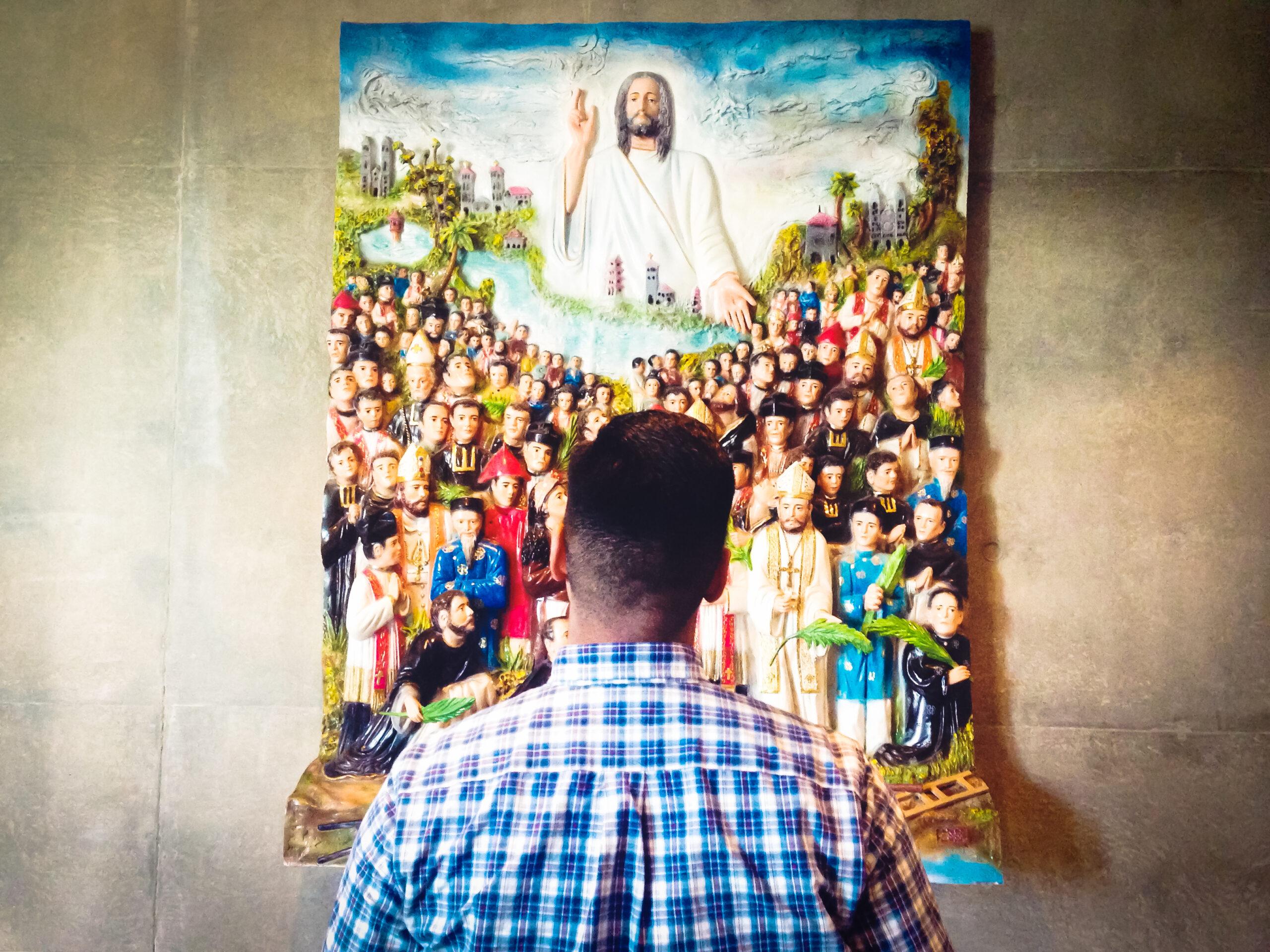
    Man in flannel shirt looking at a painting of Jesus and several saints.
    Photo by Angie Menes on Cathopic.

    As a convert to Catholicism, I’ve found that the veneration of the saints is a part of the faith that has taken me a little while to get used to. Having children has transformed that experience. Perhaps because they grew up with the idea of saints in their midst, my 9-year-old and 10-year-old bring up saints frequently. They love reading, watching, and listening to stories about the saints, celebrating feast days, and asking certain saints to intercede for our family at particular times.

    In this way — and perhaps this is normal for most Catholic families — I have realized that my family has “befriended” certain saints. Or maybe those saints have been kind enough to befriend us.

    RELATED: Want to Raise Little Saints? Tell the Saints’ Stories

    Throughout the day, we’ll talk to saints who have become part of the fabric of our lives, joking about what this saint might think of this or that daily task we’re doing. Would St. Thomas Aquinas, the patron saint of students, approve of my daughter deciding to watch another episode of “Bluey” instead of studying? Is St. Christopher, the patron saint of travelers, tired of seeing those Doritos bags strewn all over the car, and would he prefer a nicer ride, maybe?

    It probably won’t surprise you to learn that All Saints’ Day has become one of my family’s favorite holy days in the liturgical calendar. Here are a few of the saints that our family turns to frequently, and whom we’re happy to share with others looking for new family friends:

    1. St. Elizabeth Ann Seton (1774-1821)

    This new school year has been a test for my daughter. Third-grade math and social studies have been more challenging than she anticipated, and her grades have suffered. She prefers “girl saints,” so we’ve studied St.  Elizabeth Ann Seton together. St. Elizabeth Ann Seton, the first American-born Catholic saint, is perhaps best known as the founder of our parochial school system. 

    In reading a recent biography, I discovered that when she was younger, St. Elizabeth loved to dance and was fond of the fancy cream-colored slippers she wore to one of George Washington’s birthday parties. My daughter, who is a ballet enthusiast, found this anecdote inspiring. We often talk to St. Elizabeth about dancing and school—about how young women need to focus on both to be well-rounded. 

    Because Elizabeth Ann Seton also founded and led the Sisters of Charity, the first community for women religious in the United States, she’s an excellent role model for female leadership. As a teacher, I often turn to her myself! Before big test days, my daughter and I pray for St. Elizabeth Ann Seton’s intercession for her and her classmates, and she wears a St. Elizabeth medal around her neck daily.

    RELATED: How to Make Friends With a Saint

    2. St. Augustine of Hippo (354-430)

    If you’ve ever heard that old quip about kids who ask “why” constantly, then you’re actually talking about my fifth-grade son — who asks “why” about everything, including our Catholic faith. This cool kid spends most of his spare time reading books: You can’t catch him without a “Harry Potter” tome in his hands recently. He also has allergies and often rubs his eyes. 

    Last year, as his dad and I read Augustine’s “Confessions” together, we determined that this patron saint of theologians and sore eyes might be a good fit for our son to learn more about because we loved how Augustine transformed himself from a public thinker and speaker, or rhetorician, to a devoted intellectual and spiritual servant of God. 

    Every year, our parish hosts a fall festival, where children dress up as saints and participate in a costume contest. One of our family traditions is that our kids read a book about the saint they choose to emulate. When he was 8, our son flew through a biography about Augustine by Simonetta Carr, enjoying learning about the saint’s many travels. 

    St. Augustine is pretty inspiring for a child who loves facts and asking the “whys” of life, and I’m already looking forward to when my son’s old enough for us to read some of Augustine’s original writings together. (Plus, I always remind him that St. Augustine was a fan of another Catholic saint — his mom, St. Monica — who helped lead this beloved saint to his eventual conversion.)

    LISTEN: What Are the Benefits of Praying to Saints?

    3. St. Jude Thaddeus (between 1-80)

    I doubt there’s a Catholic household with children during cold and flu season where St. Jude — one of Christ’s 12 Apostles — isn’t often invoked. As a child, my husband caught pneumonia a few times, and because he also has asthma, he became extremely ill. St. Jude has always been a favorite friend of my spouse due to the saint’s association with sick children, mainly because of the famous children’s hospital that bears his name. 

    This fall, my father-in-law has been ill and hospitalized. He is currently in a rehabilitation center, but his case has been up and down for weeks. Some days, our family has been unsure if he will make it. Throughout this period, St. Jude, the patron saint of the “lost causes,” has been our family’s rock. We know we are not alone in this devotion. 

    St. Jude’s popularity rose in the United States during the Great Depression when many felt as if they were going through hopeless times. It was during this tumultuous period that Fr. John Tort felt called to found The National Shrine of St. Jude in Chicago: The saint’s popularity soon spread throughout the country and has since provided solace to many going through difficult times, whether due to illness or other challenges. St. Jude, who wears green in his iconography as a symbol of hope and renewal, is one of those saints whose name often rolls off the tongues of everyone in my family when we pray together during Mass or Adoration. Simply hearing his name tends to bring us a sense of peace.

    RELATED: How Do the Saints Hear Our Prayers?

    4. St. Hildegard of Bingen (1098-1179)

    As a convert, I often feel behind in my faith — and it might seem funny that I’ve found inspiration this past year in St. Hildegard — a German Benedictine abbess, writer, poet, composer, mystic, and theologian. If her résumé isn’t intimidating, I don’t know whose would be! St. Hildegard wrote nine books and at least 155 musical compositions, including a musical morality play, “Ordo Virtutum.” This only scratches the surface of her accomplishments! What I find most inspirational is that she didn’t begin writing until she was 42. In other words, there’s still hope for those of us who haven’t achieved all we would have liked yet. 

    Her first theological book, “Scivias (Know the Ways),” discusses the difficulties of balancing her spiritual experiences with intellectual reasoning. While we may not all have visions like Hildegard, many of us still struggle with balancing faith and reason and articulating our reconciled ideas to others with moral courage. Often, when I struggle in my professional life as a faith-filled teacher and writer, I think of Hildegard’s example and ask for her to intercede on my behalf, putting my fears to rest.

    By turning to these saints regularly — along with others I haven’t mentioned here and feel guilty about not including (please forgive me, St. Francis Xavier, St. Hedwig of Silesia, St. Sigismund of Burgundy, and St. Frances Cabrini, among others) — I’ve come to realize these figures aren’t distant at all. As St. Elizabeth Ann Seton reminds us, “We must pray without ceasing, in every occurrence and employment of our lives,” and that’s exactly what my family strives to do now, with her help and the help of our other saintly friends. These saints have become companions, offering guidance, humor, and solace during life’s inevitable ups and downs. 

    As my family prepares to celebrate All Saints’ Day, I’m heartened by how much richer our lives have become by welcoming these holy friends — not just as inspirations but as faithful intercessors walking alongside us. And yes, one day, I pray my family will be counted among them, too.

  • Boo! 5 More Spooky Saints to Help You Celebrate Halloween

    Boo! 5 More Spooky Saints to Help You Celebrate Halloween

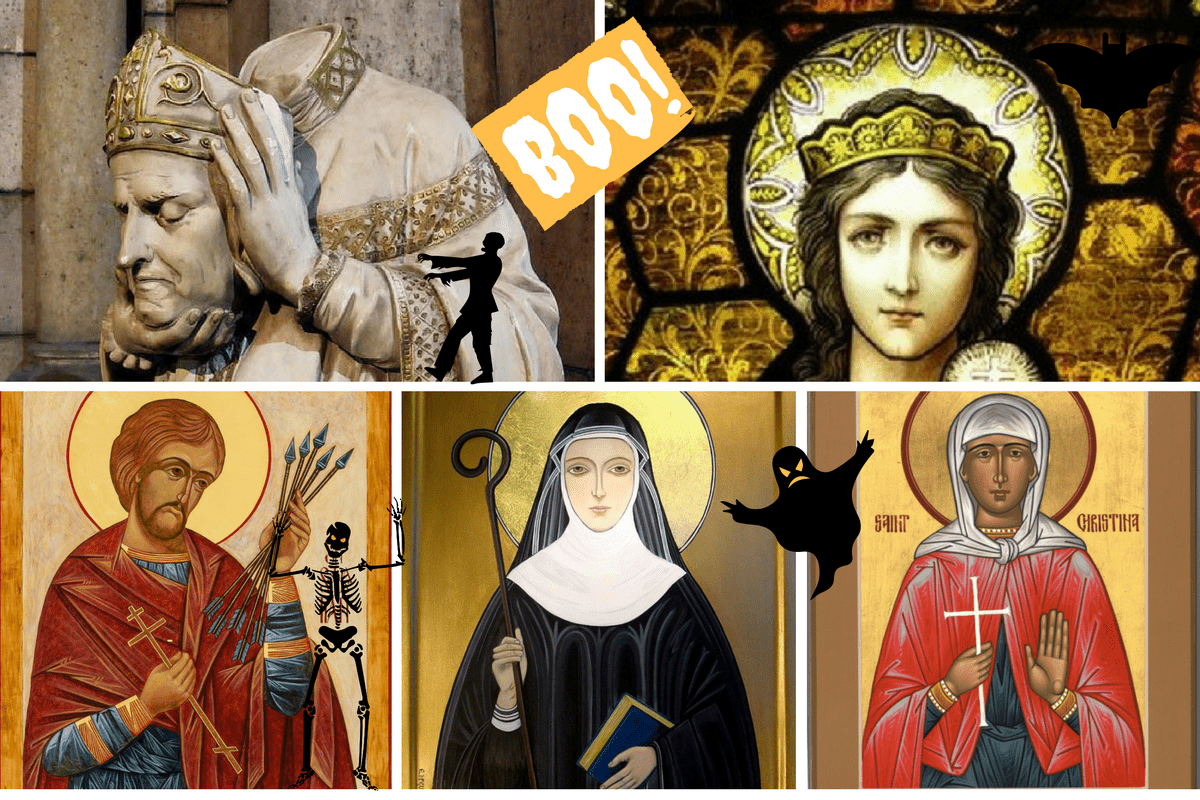
    Halloween is just around the corner! Usually, we associate this time of year with costumes, haunted houses, and trick-or-treating, but there are other sources of spook! Since Halloween comes just before All Saints’ Day, let’s get to know a little more about five saints with stories that contain a bit of faith and a bit of fright.

    RELATED: 5 Spooky Saints to Help You Celebrate Halloween

    saint-christina

    1. Saint Christina the Astonishing

    It’s probably safe to say that you’ve never had a travel experience anything quite like Saint Christina. She died at age 21 after a fatal seizure. At her own funeral, she levitated out of her coffin and condemned the people for their sinful ways. As she put it, an angel carried her away to Hell and Purgatory so that she could see what awaited the sinners on Earth. God gave her a choice: either remain in Heaven or return to Earth to live a life of simplicity and charity. Christina chose the latter, but even with her explanation, people still thought that she was a crazy woman.

    Christina would pray high above the trees, pray in the cold river during the winter time, and she would even set herself on fire during fits of agony. Yet she remained unharmed by all the stunts she pulled because of her faith. Truly astonishing.

    saint-barbara

    2. Saint Barbara

    The daughter of a rich pagan named Dioscorus, Barbara spent most of her life locked in a tower by her overprotective father. In protest, Barbara secretly converted to Christianity. Enraged by her choice, Dioscorus decided to let his sword do the talking. But before he could kill her, Barbara was saved by a prayer for salvation and a magical portal that transported her out of the tower.

    But Dioscorus caught up with her, and Barbara was captured and tortured. Because of her faith, her wounds would miraculously disappear. Dioscorus eventually had enough of her trickery. Barbara was beheaded. Dioscorus thought that he had the last laugh, but he was struck by lightning and consumed by flames. This legend led to Barbara becoming the patron saint of fire and explosives.

    hi-res-saint-denis

    3. Saint Denis

    Saint Denis was the Bishop of Paris in the third century and tasked with converting people throughout the region. Denis was exceptionally good at his job, which annoyed the local pagans who saw him as a threat. They called for the arrest (and the heads) of Denis and his missionaries.

    Beheadings tend to put an end to most people’s ambitions (See Saint Barbara), yet like any good workaholic knows, there is always more work to be done. After being decapitated, Denis reportedly picked up his own head and walked six miles, delivering a sermon the entire way. Ironically, Saint Denis is now known as the patron saint of headaches.

    saint-sebastian

    4. Saint Sebastian

    Is there such a thing as a zombie saint? Consider the case of Saint Sebastian, a Roman Christian in the third century with an impressive record of converting almost anyone who encountered him — from a mute woman who regained her ability to talk after she became a Christian to a young man named Tiburtius who would later become a saint himself.

    But not everyone was impressed with Sebastian, and he was sentenced to death by firing squad. After archers left Sebastian for dead, one of his followers went to find his body and discovered that he was still alive. When he recovered, Sebastian appeared before the emperor and condemned him for his treatment of Christians. Sebastian was then beaten to death by the emperor’s guards and thrown into the sewer. Afterward, one of Sebastian’s followers had a vision of Sebastian telling her the location of his body. Talk about a ghost story.

    saint-scholastica

    5. Saint Scholastica

    We’ve all had those great conversations with people that we just didn’t want to end. Saint Scholastica took it to the next level. She enjoyed having long talks about sacred texts with her twin brother, Saint Benedict. One day, they had supper together and when Benedict was ready to leave, Scholastica asked him to stay so they could continue to talk. Benedict refused, insisting that he needed to go. At that point, Scholastica closed her hands in prayer, and out of nowhere, a wild storm occurred outside of the house. Benedict asked, “What have you done?” to which she replied, “I asked you and you would not listen; so I asked my God and he did listen. So now go off, if you can, leave me and return to your monastery.” Benedict was out of luck that evening and had no choice but to stay with his sister. Better luck next time, Benedict.

    These spooky stories are strange enough to give Stephen King a run for his money, so be sure to add them to your list of essential Halloween tales.

    Originally published October 30, 2019.

  • Looking to the Saints This Halloween

    Looking to the Saints This Halloween

    Pictures of several different Catholic Saints underneath a book detailing the Saints livesI have so many great memories of trick-or-treating in my neighborhood as a child, just like so many other generations. And a core part of those Halloween nights was, of course, the costumes. I had many costumes over the years, from a cowboy, to a Power Ranger, to a ninja, to the Phantom of the Opera. I was also blessed that my mother would lovingly make the costumes by hand with her sewing machine.

    Like other kids, most of my costumes were picked based on the media I was consuming at the time. The characters I dressed as were often heroes, characters I looked up to for their fight against evil. Others were chosen because they were “cool” to me as a kid, not always being the most noble or upright figures (see the aforementioned Phantom).

    RELATED: 5 Spooky Saints to Help You Celebrate Halloween

    As I grew older and less frequently went trick-or-treating or donned new costumes each year, my connection to Halloween faded. However, reminiscing on the past got me thinking about what sort of costumes I might pick now as an adult if I were to make one. And given the connection between Halloween and All Saints’ Day, I started thinking: What saints I might pick to dress up as and why? 

    What if we turned to the saints with that same childlike wonder as we might have with heroes? We can look to the saints as great models of virtue, love, and wisdom and seek to be like them in our lives, to emulate them.

    In many ways, we pick saints in this manner if we choose to take on a saint name at the time of our Confirmation or are given one at Baptism. My confirmation name is Saint Ferdinand. I chose him as he is the patron saint of engineers, which is what I had desired to do with my life when I was being confirmed. Another saint I look up to and desire to emulate is St. Philip Neri, a patron of comedians among other things. He had a great way of diffusing tension with joy and humor that warms my heart. 

    WATCH: You Don’t Know Jack About Halloween

    Finally, St. Hildegard von Bingen’s curiosity is another saintly example in my life. She had a gifted scientific mind and would catalog all sorts of flora and fauna. All of this came from a curiosity to know what God had made in the world and to see God’s goodness in it.

    So which saint or saints would you pick? Who do you wish to emulate in your life and “put on” in a certain way? Not only as a costume (though if you dress as a saint this Halloween, please send photos), but also in living up to an example we admire, an example that helps us to seek our own journeys of holiness. 

    In our lives with Christ, we are all called to holiness, to strive to be saints, and so we have their examples to help us. But we also do it in a way that is unique to each of us. So we have the saints as “costumes” to help us in emulating sainthood, but underneath is us, seeking to be a saint in our unique lives and our unique ways. And in striving to do this, we ourselves become examples to others, signs of love and holiness, just as my mother is a sign of love to me whenever she made a costume (and in so many other ways).

  • How to Be Kinder to Yourself

    How to Be Kinder to Yourself

    I want to live a simple, joyful life. I don’t want it to be complicated—I don’t want my happiness to be dependent on luxuries and comforts that I cannot afford. In my quest for such simplicity, I am inspired by the life and example of St. Francis of Assisi. I’m often impressed by Francis’ ability to deny himself the pleasures life has to offer.

    The idea of self-care was not a primary concern for him. Francis used to refer to his body as “Brother Ass” because he treated it like one. “A person’s worst enemy is the flesh,” he once said. “All its concern is how to squander the present. What is worse, it claims for itself and takes credit for what was given not to it, but to the soul.” Francis would deny himself any comforts, even those that were necessary for him to accommodate the many illnesses he suffered late in his life.

    As Francis lay dying, he was asked by one of the brothers if he had any regrets, if there was anything he would have done differently.

    “Yes,” he said. “I would have been kinder to Brother Ass.”

    RELATED: Experiencing God’s Love Through the Splendor of Creation

    St. Francis seems to be telling me that a healthy spirituality does not require me to sacrifice the things I enjoy. I don’t have to practice extreme self-denial. Rather, a healthy spirituality can—and perhaps should—make room for me to enjoy the simple pleasures and savor God’s many gifts. I find that when I do not spend at least part of my day outdoors—even if it as simple as taking my dogs for a walk to the park or watching the birds at my feeder while sipping a cup of tea—I am not a happy person; I do not feel whole. My spiritual life is the way I grow closer to God; it makes me whole. The happiness I feel in something as simple as watching a woodpecker hang from my feeder must, therefore, tell me something about God. It is a prayer as much as anything else. 

    You can make similar moments prayers of your own by following a few easy steps:

    Give thanks. Take a moment to thank God for whatever it is you’re doing. This can be as simple as saying “Thanks, God!” out loud. You can also take some time at the end of the day and review those things that brought you happiness. You may want to begin this act of gratitude with this prayer or something similar: “Heavenly Father, all good things come from you. Thank you for the many signs of your love I received today.” Gratitude helps you keep your attention on God from whom all blessings flow and not on the activity or yourself.

    Find God. Actively seek God’s presence in whatever it is you’re doing. You might notice God in a feeling or thought. God might make himself known through the presence of another. By actively seeking God, you will find that you are more attentive to God’s presence surrounding you.

    Share. Joy is not something we hoard. It is not something for our self alone. Joy can only be made complete when it is shared with another. Share your experience of joy with someone else. Even solitary activities can be shared through conversations and social media. For example, I post pictures on Instagram and Facebook of the birds I see when I go birdwatching; this helps me share the beauty I see, and, I hope, brings beauty into other people’s lives.

    RELATED: Living a Life of Gratitude

    We all need to find the time and place where we can enjoy the gifts God has given us. God wants us to be happy. True happiness fills us with God’s goodness and love. It satisfies us; it doesn’t leave us hungry and craving for more. True happiness leaves us feeling light and free, not burdened with the fear that it is fleeting. When we are truly happy, we find that we are filled with peace, kindness, gentleness, meekness, and generosity; we know that God alone is enough.

    Life is hard. We don’t need to make it any harder than it is. Take the time to seek out those things that bring you true happiness. For me and my wife Cathy, that can be as simple as watching the birds that visit our yard. I remember the first time I captured a picture of a Cedar Waxwing. We were sitting on our backyard patio, and Cathy pointed out a strange looking bird, something we had never seen before. We grabbed our camera and snapped a few pictures. We then saw another, and another, and another. Soon we noticed a whole flock of Cedar Waxwings perched in a tree, feeding on berries from its branches. We were so excited. That moment of relaxation on our patio had turned into a shared moment when we felt God’s love, goodness, and beauty.

    So, be kinder to Brother Ass and treat yourself to the simple pleasures that bring you joy. And don’t be surprised when you discover God enjoying them with you.

    Originally published September 18, 2019.

  • Lessons From Saint Benedict: Creating Community in the Classroom

    Lessons From Saint Benedict: Creating Community in the Classroom

    A teacher holds a paper and is pointing at it while showing a young girl, her student, the paper. To her right a young boy, another student, writing something down.
    Photo by Wavebreak Media on Bigstock

    The first day of school can be scary, and it’s especially scary when you’re the teacher. The first time I stood in front of a classroom, I was apprehensive, if not terrified. I wanted to engage students academically, form them in community, and assure them of God’s loving plans for their lives. But, I was daunted by the challenges of diverse student needs, apathy, and classroom management. In the face of these obstacles, I sought to respond with both excellent pedagogy and Christocentric formation.

    Several years into my teaching career, I had made some progress but was still searching for inspiration. During a conference on formation, a colleague gifted me a small red booklet that would unlock a plethora of wisdom for my classroom: “The Rule of Saint Benedict.

    St. Benedict lived in Italy during the sixth century. He faced a multitude of challenges, including violence, economic instability, and a licentious culture. He wrote “The Rule” as a guide to community life in the Lord’s service. It includes instructions for prayers, meals, discipline, and work. As I read, I saw ways that St. Benedict’s wisdom could be applied in my classroom.

    LISTEN: Saints of Our Lives: Saints Benedict and Scholastica

    Classroom management

    On my first day as a teacher, I was terrified that my students would not respect me. My solution was to assign a large amount of work and enforce scrupulous rules. I thought if students were stressed about their grades and detentions, they wouldn’t have time to be disobedient. However, it only made my students anxious and left me exhausted. 

    St. Benedict suggests a different approach. He insists that boundaries and rules be put in place to protect the community and help people become holy. He writes, ”In drawing up its regulations, we hope to set down nothing harsh, nothing burdensome. The good of all concerned, however, may prompt us to a little strictness in order to amend faults and to safeguard love” (Prologue 45-47). 

    Following St. Benedict’s advice, I started assigning work from a place of purpose, not fear. I didn’t forbid bathroom privileges but limited the pass to one student at a time. This meant that if someone abused that privilege, they were taking an opportunity from someone else: Students challenged their peers to think about the needs of others. I allowed students to work in groups, but they had to rotate working roles, ensuring a shared effort. I also dedicated 25 minutes each week to community conversations, where we discussed and argued theology, school policies, or preferred ice cream flavors. 

    These changes took some energy and management on my part, but the students and I became galvanized and enlivened by just a few adjustments. 

    RELATED: How I Instill Enthusiasm for Faith in My 10th Grade Students

    Leading by example

    Students need to see that teachers believe what they say, and that is done by deeds, not words.  Benedict understood this to be true in the monastery, and it’s just as true in the classroom. He directs leaders to, “Point out to them all that is good and holy more by example than by words” (2.11). Whether I set an example by following the dress code, praying earnestly, or putting away my cell phone, students respond to direction well when they know that I do not expect anything from them which I do not demand of myself. 

    Meeting student needs

    Instructing a classroom of diverse learners is a challenge. Students learn and respond to direction differently, which has led to the rise of differentiated instruction — an understanding that education needs to be tailored to individual students. 

    While differentiation is relatively new to education, St. Benedict employed the idea over a century ago. He says, “With the undisciplined and restless, he will use firm argument; with the obedient and docile and patient, he will appeal for greater virtue; but as for the negligent and disdainful, we charge him to use reproof and rebuke” (2:24-26). Basically, form people in the way that will be most effective for them.

    I have high expectations for students, but leave room for charity. I allowed a student an afternoon snack break because medication suppressed his appetite in the morning. One of my students was exceptionally bright and needed more challenging reading, so I gave her a copy of a novel when the rest of the class only read a short selection. I added art analysis to my class and quizzes, since several students were captivated by pictures more than words. When we know our students and seek their well-being, we can lovingly differentiate. 

    RELATED: Four Tips for Keeping Your Semester Holy

    Lesson plans, interrupted

    I may craft excellent lessons and assessments, but there are days that students don’t need my lesson plan. Sometimes they need to ask new questions, catch up on work, or have time to pray. St. Benedict teaches, “Never give a hollow greeting of peace or turn away when someone needs your love” (4:20). We must never turn away someone who needs our love, which sometimes means putting aside my plans for the sake of the people in the classroom. 

    Love is patient

    I sometimes forget that my students are students! They may not know how to stay focused, compose a sentence, or work with others. They need to be taught math equations, grammatical terms, or how to say sorry when they’ve done something wrong. St. Benedict reminds teachers to have perspective. He says, “He should realize that he has undertaken care of the sick, not tyranny over the healthy” (27:6). When I find myself frustrated by student behaviors or deficits, St. Benedict reminds me of my task—to instruct with patience and love. 

    As the new school year approaches, I feel both optimism and the onus of teaching. St. Benedict writes, “anyone undertaking the charge of souls must be ready to account for them” (2:37). Every teacher will be held accountable for their effort to form their students. When I open the doors to my classrooms this fall, I will not forget to open my heart, and allow Jesus and the saints, like St. Benedict, to form my classroom beyond education and towards formation in love.

  • What St. Philip Neri Can Teach Us About the Sabbath

    What St. Philip Neri Can Teach Us About the Sabbath

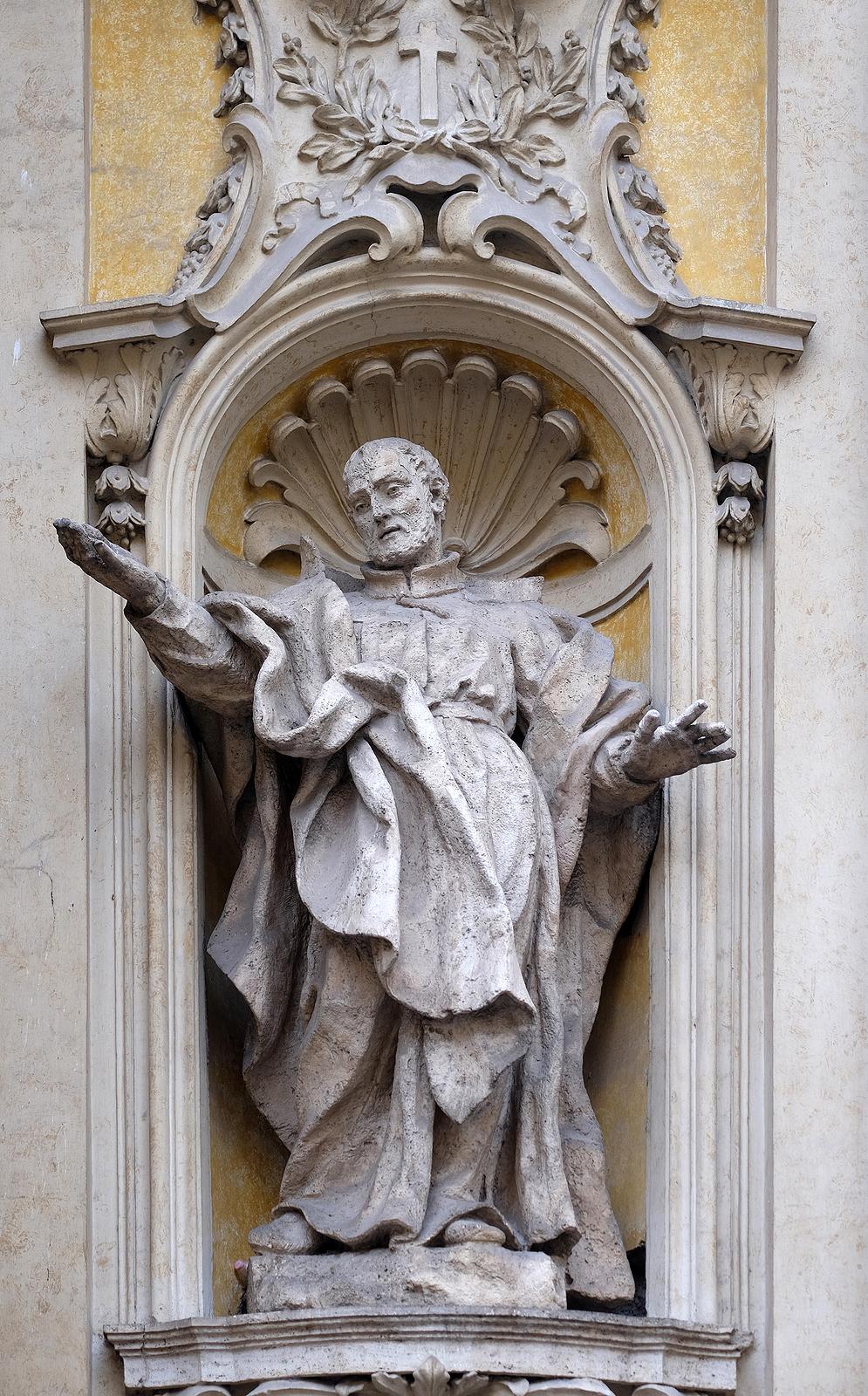
    A statue of Saint Philip Neri. His arms are outstretched. One hand faces upwards towards the sky, the other hand is facing down. His head is slightly tilted down. He wears a long robe. Above this statue is a cross carved into stone.
    Photo by zatletic on Bigstock

    If you’re anything like me, then the call to keep holy the Sabbath is something of a challenge, thanks to a constant struggle to maintain work-life balance. Whether you find it easy to overwork without respite or struggle to get started, hitting that happy medium can be difficult. 

    Honoring the Sabbath reminds us of the need for this balance: six days for work, and the seventh for worship, self-care, and spiritual and physical restoration. But when it proves difficult to actually live this out, what do we do?

    To live properly and pray sincerely, we have to avoid exhaustion. We need time for fun and joy, as these rejuvenate our souls. One saint strongly associated with joy is St. Philip Neri, whom I’ve been inspired by. He uniquely blended holiness and joy throughout his life, earning him the nickname “The Laughing Saint.” Philip Neri’s spirit beautifully encapsulates the Sabbath: a celebration of joyful life unmistakably connected to God.

    RELATED: How to Read Like the Saints

    The saints, as we know, are meant to be our exemplars, so how do we emulate Philip Neri? Well, I can give you an example of what not to do. It’s crucial to be intentional and avoid letting Sunday become overwhelmed with mundane tasks (yard work, for instance), or, for the readers in my age group, schoolwork. So many times I would walk into my college’s library on a Sunday and witness row after row of students hunkered over their studies. Though it is good for students to work, I wished we’d chosen another day to put our noses to the grindstone.

    Philip Neri was a very hardworking man, but also one who knew how to balance his duties with fun. Philip’s mission was to restore Rome, which had fallen into spiritual disarray during the early 16th century, to a passionate love of the faith. He accomplished this by establishing authentically human connections with those around him, which sometimes involved deep conversations, but oftentimes did not. He played practical jokes and took part in wine-drinking contests to make himself more approachable to those around him. After Philip’s death, doctors discovered that his heart had grown noticeably larger, to the point of damaging two of his ribs — a true testament to this great man’s jubilant heart.

    RELATED: Are We Allowed to Work on Sunday? 

    Everything Philip Neri did, regardless of how frivolous it may have seemed on the surface, had a purpose indisputably connected to God. His entire ministry was treated as one continuous Sabbath, vividly showcasing his blend of holiness and joy. This is why I’ve found him so inspiring personally — the mindset we’re called to emulate on the Sabbath, he exemplified throughout his whole life.

    Inspired by his love, passion, and charity, we can bring this saintly approach to the Sabbath into our own lives. Despite the importance of work, Philip knew how to incorporate joy into every day of his life, and so should we. His example reminds me that we aren’t made exclusively for work; we’re meant to live complete and fulfilling lives, with diverse interests and passions. Establishing boundaries between our work lives and the Sabbath, and engaging in the kind of Christ-centered fun Philip loved to partake in so much, is a valuable step in the right direction for us if we struggle to embrace the Lord’s Day.

    RELATED: How to Intentionally Plan a Day of Rest

    My Sundays might involve fun projects. I incorporate prayer into these activities— ora et labora, as St. Benedict would say. But boundaries are important, and I always make sure to never miss out on time for my important relationships, and for prayer. For others, take the day to relax, read, enjoy nature, or have a casual phone call with a friend. But without question, time for God must come first, especially on the Sabbath.

    Being mindful and intentional about observing Sabbath lets us capture the spirit of Philip Neri, that spirit of joy that helps us learn how to incorporate family, friendship, and fun into the Lord’s Day. As Phillip himself puts it, “A joyful heart is more easily made perfect than a downcast one.”

  • ‘Backyard Baseball’ and the Saints: Building Teams That Help Us Grow

    ‘Backyard Baseball’ and the Saints: Building Teams That Help Us Grow

    Baseball in green grass
    Photo by nytumbleweeds on Bigstock

    Pablo Sanchez, Pete Wheeler, Luanne Lui . . . Do these names strike any memories? If so, you may have invested more hours than you can count playing “Backyard Baseball” in the late ’90s and early 2000s. Perhaps you learned about “Backyard Baseball” recently, when fans of the original PC/Mac computer game launched an online server mimicking the features of the discontinued classic back in 2021.

    Whether I had just come home from school or had been stuck inside during a snowstorm, I loved assembling a fictional team of neighborhood kids to play baseball in varying environments, such as Sandy Flats and Tin Can City — Playground Commons was my first choice. My favorite part was testing the unique cast of characters in different groups to create the most advantageous team. I laughed hard at their punchlines — “Slick, you made the right decision!” — and I admired their headstrong eagerness to help me, the player, win the game.

    Recently, the cast of “Backyard Baseball” reminded me of another group of like-minded individuals who work together for the same purpose — the saints!

    RELATED: What Are the Benefits of Praying to Saints? 

    Choosing a saint to pray to is a lot like choosing a player to join my team on “Backyard Baseball.” Once I select a team name, the characters all line up on the bleachers, eager to be picked — some even waving to get my attention. When I click on a player to learn more, I hear their pitch to join my team and see their skill ratings, which show the areas where they excel and falter. This is not much different from looking at the communion of saints and praying to one who catches my eye!

    When looking to recruit players for batting, I may consider Achmed Khan, a strong hitter, or Vicki Kawaguchi, a fast runner. Similarly, when I need guidance in specific areas of my life, I think of certain saints right away — St. Joseph when I’m considering a career change or St. Maria Goretti when I’m pursuing a romantic relationship.

    If I check out the rest of Khan’s stats, though, I’ll see he’s not the best pitcher. In fact, his skill rating is so low, I wonder if he’s ever thrown a ball straight in his life. Likewise, the saints, while living on earth, had their challenges. Although St. Therese of Lisieux had a strong prayer life, she struggled with mental health.

    RELATED: How Video Games Helped Me Level Up My Faith

    However, St. Paul advised in his second letter to the Corinthians that God’s grace “is made perfect in weakness” (12:9), meaning that God gives us more help and guidance to be like him and the saints because of our weaknesses. Much like a player from “Backyard Baseball,” the saints contribute to my team. When I fear that my anxiety and depression are clouding my mind and the voice of God, I pray to St. Therese for guidance, because she made it to heaven despite these obstacles.

    Some characters like Sally Dobbs and Stephanie Morgan are evenly skilled across the scoreboard, not particularly talented in one specific area but reliable when placed in any position on the field. These characters remind me most of saints like St. Anthony of Padua, St. Paul, and St. Francis of Assisi, who are the patron saints of many areas. Many know St. Anthony as the patron saint of lost items, but he also guides me in improving ministries at my parish — he’s the patron of my local church!

    No matter who’s on my baseball team, all these characters care about is winning the game for me, the player, just like the saints root for me to win salvation. In real life, our souls are at stake, and the saints so eagerly want to extend grace from God so that we can achieve eternal life.

    We’re still on earth, and the saints are in Heaven in full communion with God. So why not ask for their help?

    In case you’re wondering, here are the saints on my team!

    • Maria Goretti — chastity and forgiveness
    • Francis de Sales — writing
    • Mother Cabrini — courage
    • Pope John Paul II — evangelization
    • Anthony of Padua — parish life
    • Joseph the Worker — career life
    • John of the Cross — dark times/spiritual desolation
    • Therese of Lisieux — humility/mental health
    • Mother Teresa — conviction
  • Lessons of Faith and Fortitude: Five Teachings From Saint Lawrence

    Lessons of Faith and Fortitude: Five Teachings From Saint Lawrence

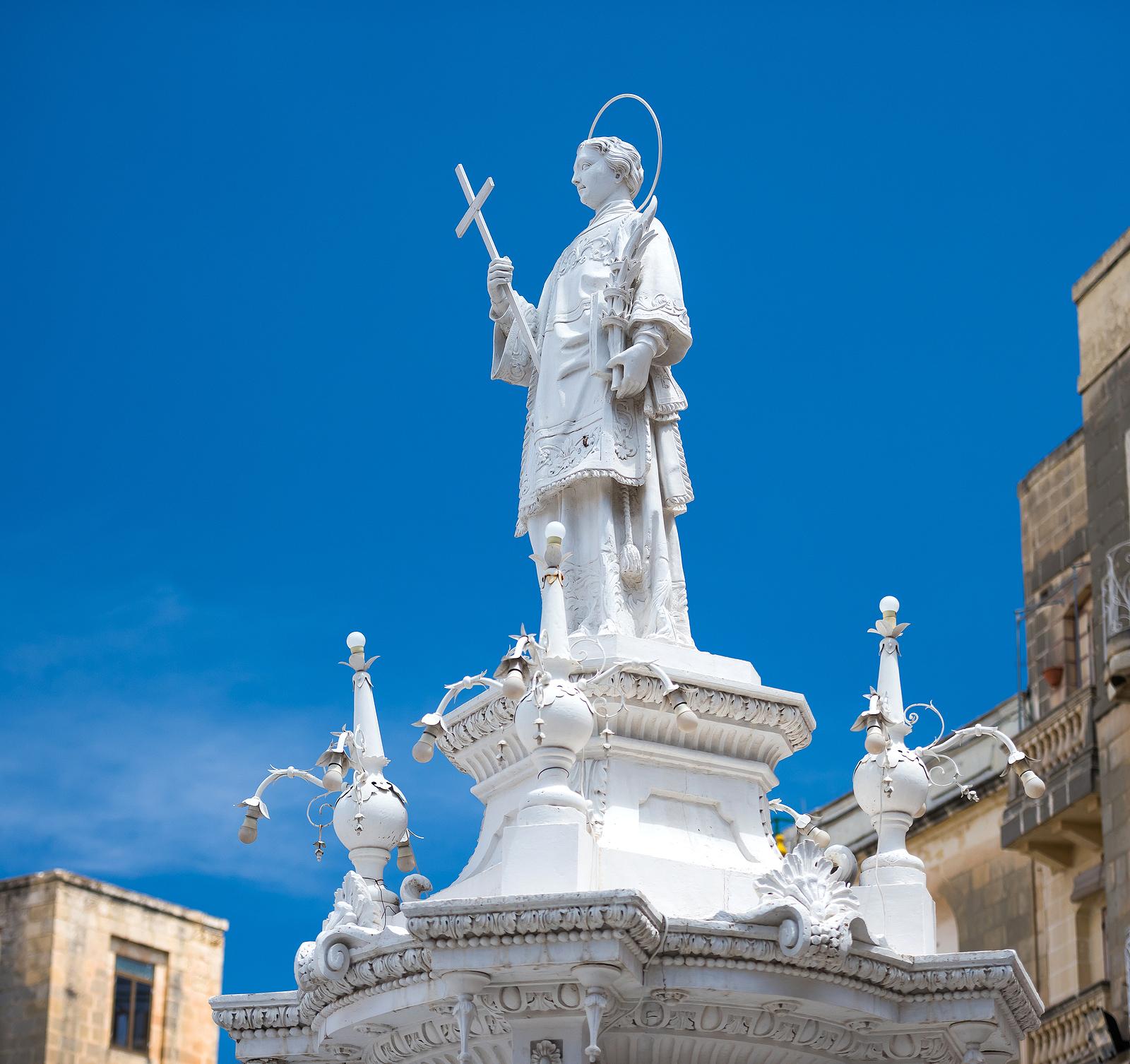
    Statue of St. Lawrence in front of a blue sky. He is holding a cross.
    Photo by LGreen on Bigstock

    I’m not sure where I first heard the story of Saint Lawrence’s martyrdom, but it has always resonated with me. Amidst all the theology and seriousness surrounding our Catholic faith, Saint Lawrence’s courage and wit in the face of dire circumstances offer valuable lessons for us all.

    This second-century saint’s life, most of which was lost to antiquity, continues to resonate with believers today. The story of Saint Lawrence’s martyrdom can provide us with humor, charity, and sacrifice, offering valuable lessons. Let’s delve into the life of Saint Lawrence, exploring five things to learn from his remarkable journey.

    Charity beyond wealth

    Perhaps the most renowned anecdote from Saint Lawrence’s life revolves around his act of charity during the tumultuous reign of Roman Emperor Valerian. As one of the seven deacons of Rome, Lawrence was entrusted with the Church’s treasures. However, when confronted by Roman authorities demanding the surrender of these riches, he astounded them with an act of selflessness. Instead of relinquishing the material wealth, Lawrence distributed it among the poor, widows, and orphans, proclaiming that these people were the true treasures of the Church.

    In a world where materialism often reigns supreme, Saint Lawrence’s actions offer a poignant reminder of the importance of charity and compassion. His legacy encourages us to look beyond our possessions and share our resources with those in need. True wealth lies not in material belongings, but in the warmth of human connection fostered through acts of love and generosity.

    RELATED: How St. Teresa of Avila Helped Me Overcome the Fear of Failure

    The unyielding spirit of faith

    Throughout his life, Saint Lawrence epitomized an unyielding spirit of faith, even in the face of dire circumstances. When commanded to renounce his beliefs under pain of death, he stood firm, refusing to abandon his Christian principles. This unwavering commitment to his faith resulted in his arrest and subsequent martyrdom. His execution by being roasted alive on a gridiron remains one of the most harrowing yet poignant testimonies to his steadfast faith.

    In an era where religious tolerance is often tested and religious persecution persists in some parts of the world, the example of Saint Lawrence resonates deeply. His courage inspires us to embrace our beliefs and convictions with resolute determination, regardless of the consequences.

    Humor amidst adversity

    Despite the grave situation he faced, Saint Lawrence displayed an unexpected and brave sense of humor as he was led to his execution by burning. Tradition holds that he humorously remarked to his executioners, “Turn me over, I’m done on this side!”, refusing to be cowed by the darkness surrounding him. This part of Saint Lawrence’s story also demonstrates the humor of the Catholic Church as Saint Lawrence is the patron saint of chefs.

    Saint Lawrence’s humor offers a powerful lesson in resilience. It reminds us that laughter can be a source of strength, even amidst the darkest moments. By finding joy in the face of adversity, we can better navigate life’s challenges with courage and hope.

    A spirit of service

    As one of the seven deacons of Rome, Saint Lawrence was dedicated to serving the Christian community and assisting the pope in various capacities. His life of service exemplifies the Christian ethos of caring for others, especially the marginalized and vulnerable. Through his ministry, Lawrence demonstrated that true greatness lies not in self-serving pursuits but in humbly dedicating oneself to the betterment of others.

    For example, Lawrence was known for his work with the destitute and his efforts to aid those who were suffering, often going out of his way to provide for the needs of the poor and the sick.

    In our busy days, where ambition often overshadows compassion, Saint Lawrence’s emphasis on service serves as a poignant reminder to prioritize the needs of others. By embracing the call to service, we can find fulfillment and purpose beyond personal achievements.

    RELATED: Paying the Ultimate Price: What Martyrs Can Teach Us About Sacrifices for Faith

    Martyrdom as a testament of faith

    Saint Lawrence’s martyrdom remains an enduring testament to his unwavering faith and commitment to his beliefs. His readiness to embrace death rather than betray his principles demonstrates the immense strength and conviction of his faith.

    Though few may be called upon to make such a dramatic sacrifice, Saint Lawrence’s martyrdom reminds us to remain steadfast in our beliefs, even when the world challenges our convictions. In a society that often values conformity over authenticity, his courage in the face of death serves as a powerful reminder to stand true to ourselves and our beliefs.

    The life of Saint Lawrence of Rome has always been a timeless source of inspiration for me, offering profound insights that resonate deeply in my own journey. His acts of charity, unwavering faith, and remarkable humor illuminate a path toward greater compassion, courage, and service. 

    From Saint Lawrence, I have learned the importance of standing firm in my beliefs, and finding strength in humor during tough times.

    As I contemplate his legacy, I strive to embrace these virtues in my own life. May we all find the strength to carry forward the flame of Saint Lawrence’s indomitable spirit, living with the same compassion, courage, and joyful resilience that he exemplified. By doing so, we ensure that his remarkable spirit continues to inspire generations to come.