Tag: sacrifice

  • Why I’m Fasting for Peace During Advent

    Why I’m Fasting for Peace During Advent

    In 2023, Advent arrived at a time when violence in Gaza was often on my mind. Harrowing news and calls for a ceasefire filled my Instagram feed, forcing me to consider what it would mean to respond authentically to the reality of such suffering. As a Catholic, I knew prayerful self-denial was an option, but I had resisted the idea. What good would a manufactured drop of my own suffering do amid the ocean already in existence? Compared to the suffering that war brings, though, that concern felt selfish. “Effective” or not, it is certainly fitting to offer proof of love through sacrifice, and as Lenten as that sentiment feels to me, Advent can be a time of “offering up” as well. 

    I’ll admit that I didn’t choose Advent for purely spiritual reasons. The liturgical season is shorter than Lent, and at 22 days, Advent 2023 was the shortest possible duration. I also knew that the short winter days would be a help: I’d decided to go without food from sunrise to sunset. I was particularly inspired by the fasting practices of Islam. In addition to it being the faith of those who bore the brunt of the violence, my fast was inspired by Ismatu Gwendolyn, a Muslim public scholar and activist, who had engaged in a 40-day fast in response to the violence in Palestine and shared about the experience.  

    RELATED: Fasting From Injustice

    Our Muslim siblings go without food and drink from sunrise to sunset during their holy month of Ramadan as a practice of devotion and spiritual discipline. As you can imagine, this is a far more intensive manner of fasting than the standard two small meals and one large meal that constitutes a standard day of Catholic fasting, especially when considering our reduced consumption is only required on Ash Wednesday and Good Friday. Despite softening the practice for myself (in addition to a shorter fasting period, I did not prohibit myself from drinking liquids during daylight hours), I still very much felt the deprivation of nourishment. What began as a fast for peace became an opportunity to better understand how more than a day of hunger feels.  

    What surprised me the most was how the lack of nutrients manifested itself. I didn’t often feel my stomach rumbling or find myself wanting food to combat the sensation of an empty stomach. What I did feel were the cognitive effects. This wasn’t a matter of being distracted by hunger; operating on less fuel, my brain simply couldn’t function as well as it normally did. I wasn’t as present. It was harder to communicate. It was harder to think. As an aspiring graduate student, I was alarmed by the brain fog I felt, knowing that clear thinking and eloquent expression are fundamental in academic environments. 

    RELATED: The Fast I Choose: No Matter the Season

    I found myself thinking of all the children who sit hungry at school, struggling to focus and learn. According to the USDA, in 2023, “7.2 million children lived in food-insecure households in which children, along with adults, were food insecure.” I thought about how these children may be met with punishment, rather than compassion, for living the effects of hunger. I thought about the long-term effects of that response. 

    How difficult it must be to struggle through elementary school when hunger prevents you from reaching your full potential. How difficult to live through any of the indignities of poverty – homelessness, insecurity, exploitation – with a diminished mental strength. How difficult to not only live under the constant threat of death from bombs or bullets, but also to starve through it. 

    RELATED: Swords into Plowshares: Finding Peace in Advent Today

    I want to emphasize that what I did is not novel: Muslims undergo their Ramadan fast yearly. Christian history reveals more extensive traditions of fasting as well, including during Quadragesima Sancti Martini, or the Forty Days’ Fast of Saint Martin’s, which took place during the weeks leading up to Christmas. Additionally, it feels odd to write about my experience when there are so many people for whom hunger is a daily experience and its effects a constant threat to livelihood. To choose to be hungry is, as a spiritual practice, a privilege. Nonetheless, experience is a powerful teacher: I’m not sure I would’ve understood the mental effects of hunger without experiencing them first-hand. This fast broadened my understanding of hunger and consequently deepened my compassion for those who have no choice but to go without their daily bread. 

    During Advent, we remember the arrival of a God who humbled Himself to live among us, who came to proclaim good news to the poor. If you, like me, have always been blessed with food security, I invite you – provided, of course, that it is healthy and safe for you to do so – to seek out hunger this Advent. Offer your sacrifice up for an intention. Consider donating the money saved on food to your neighbors in need. Prepare for the coming of a Savior who said “I was hungry and you gave me food” (Matt. 25:35) by sharing in and learning from his reality.

  • Memorial Day and the Power of Remembrance

    Memorial Day and the Power of Remembrance

    Photo by John Hill on Pexels

    While I was growing up, my family emphasized that calling to mind those who gave their lives to sacrifice for our country is always necessary and important. 

    We visited the cemetery on all major holidays to spend time at my grandparents’ graves. We traveled there on Thanksgiving, the week of Christmas, and Easter Sunday. My parents, my three brothers, and I would climb into the car after Mass and head to the cemetery.

    If we were at my paternal grandfather’s grave, we would all exit the car once we arrived and say a prayer at the tombstone. After a few minutes, my mom would bring us back to the car and my dad would stay behind at the grave of his father. If we were at my maternal grandmother’s grave, the opposite happened. Dad would usher us to the car and Mom would stay behind for a few extra minutes. 

    RELATED: Virtual Memorial Day Retreat: Remembering Those Who Serve 

    This was their intimate time alone with the parent they had lost. We honored their memory by going to the cemetery as a family, but I also remember that image of my mother or father spending one-on-one time with the grave as I peered out the car window looking at them. It was as if they were talking to their respective parent as if they were still alive and could hear them. They were remembering them by continuing their relationship with them. I was drawn into this moment because I witnessed my mom and dad love their own parent even beyond their death. 

    My maternal grandmother is buried at an armed services cemetery on Long Island because her husband served in the military. All the tombstones there are the same rectangle shape and the same color, white. The uniform aisles of tombstones evoke something inside of me that brings me to honor those who gave their lives and the family members of those who served. Every visit is like a miniature Memorial Day. 

    Today, we are called to remember and honor the sacrificial love of countless men and women who gave everything so we could live in our beautiful country. The challenge is to honor them even when it is not Memorial Day. 

    RELATED: What Should Catholics Do on Memorial Day?

    When I visited the cemetery as a child, I was so reflective of my grandparents’ lives as well as grateful for the love of my parents. I was more attentive to my relationship with them because I was reminded of how short and fragile life is. 

    But then, I would go back to my routine until the next holiday and forget how important it is to remember those who came before me so that I could live (literally in the case of my grandparents being my ancestors). On this Memorial Day, we are invited to take that focus towards those who died in service. How can we be more intentional about giving them honor and respect?

    Our Catholic faith offers two great connections that are easy and powerful. One, pray for veterans, those who died in the line of duty, and those current service men and women at Mass on Memorial Day weekend. The Eucharist is the memorial of Christ’s suffering, death, and resurrection. We do not simply call to mind what Christ did; those mysteries are made to present to us. As the Son of God died so that we could live, we can pray especially for those who died for our country so that we could have the freedoms we do today.

    RELATED: How Prayer Cards Help Me Honor the Holy Souls That Have Gone Before Me

    Second, pray a decade of the Rosary or an entire Rosary for our veterans. We can pray for those who have died and those who have returned from the armed forces. We know that so many returning service people struggle to reacclimate into society. Pray that they may find work and know their value. 

    Memorial Day is always the last Monday in May, a month dedicated to honoring the Mother of God. Praying for Mary’s intercession allows us to call to mind the fact that she is guiding all of her children, wherever they find themselves.

    Whatever you do for Memorial Day, make it something that serves as a powerful and lasting reminder of just how blessed we are to have people in our age and in our history who live out the sacrificial love of Christ. May we honor them by respecting that love and mirroring it in our own lives as best we can. 

  • Learning About Sacrifice, With the Help of St. Mark

    Learning About Sacrifice, With the Help of St. Mark

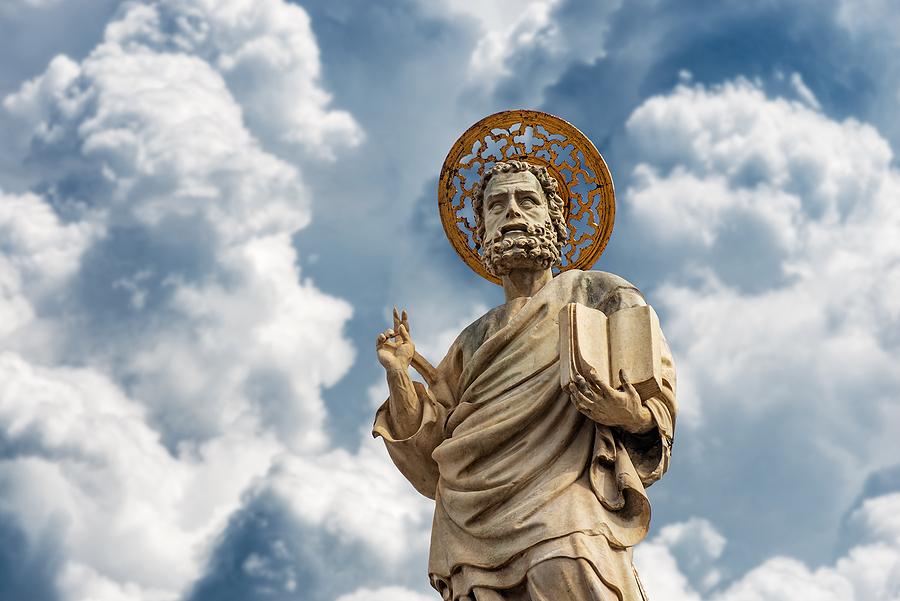
    Image of statue of St. Mark with sky in background.
    Photo by Alberto SevenOnSeven on Bigstock

    Sacrifice is key. We know that Jesus requires this of his followers, but I also heard this statement repeated many times when my wife and I were engaged.

    If I am honest, I think this kind of statement is kind of threatening. I know it to be true based on the life, witness, and words of Christ, but sacrifice is difficult. Approaching my fifth wedding anniversary while having two children (and one on the way) has validated the importance of sacrifice even more concretely in my life. Much of this investigation into sacrifice, however, has been enlightened by St. Mark. 

    The feast day of St. Mark falls on April 25 each year. This critically important saint is often overlooked because he was not one of the 12 Apostles. He does not appear in the stories about the earthly ministry of Jesus, but he wrote one of the four Gospels. 

    RELATED: How to Make Friends With a Saint

    I admit I used to know nothing about St. Mark; he was just a man who wrote a Gospel. My appreciation for him climbed last year when I decided, for the first time, to read the Gospel of Mark straight through from beginning to end. I often read the Gospel of the day, but after hearing a podcast about the importance of reading these accounts as they were written, I took up the task. I started with Mark, well, because it is the shortest Gospel!

    I learned that from the earliest days of the Church, Mark was known to be the interpreter of St. Peter. He became close to Peter and was able to write his account of Jesus’ life based on listening to Peter’s stories.  His writings are viewed as the preaching of St. Peter. We also know, from Acts 12, that Mark was once the companion of Paul and Barnabas as well. 

    Taking the time to read the entire Gospel of Mark transformed me. What became more palpable very quickly, was that Jesus was sent to sacrifice his life for me. I felt this in the way that Jesus spoke about his passion in the Gospel of Mark. I could picture Peter speaking these words to Mark and being moved by them as he heard them for the first time. It became more real for me because I realized that this message was literally passed down through the generations in a powerful and transformative way.

    RELATED: How to Be a Saint-in-the-Making

    At the start of the third chapter of Mark, people begin to plot Jesus’ death. All Jesus did prior was heal the sick, restore the possessed, and preach the truth. And yet, humanity rejected him. He was to be killed because of who he was. Still, he continued to place himself in the spotlight with more public healings and more intense preaching. Christ did all of this with the knowledge that he came to suffer.

    This reaches a shift in intentionality at the midway point in the Gospel. Peter confesses that Jesus is the Son of God and Jesus goes on, three times, to tell the Apostles that he will be arrested, suffer, die, and rise. Jesus states that he “must suffer” (Mark 8:31). 

    I became more and more intrigued by this truth as I reached the details of Jesus’ passion. It seemed more real to me and more powerful. If he tells us that in order to follow him we must also take up the cross (Mark 8:34), then why do I view sacrifice in such a negative way? The sacrifices that I am being invited into actually make me like Jesus. Mark, specifically, taught me this because of his intense focus on suffering and sacrifice. Sacrifice is an opportunity, it should not be a fear.

    RELATED: What I’ve Learned About Marriage When the Unexpected Happens

    My first practical thought was: Can I be more intentional about sacrificing in my marriage? I do my best to do this by helping around the house after work, but I think I view these tasks as things I just have to do. Mark’s insights helped me to see that I can offer difficult times (even if they are simple) as avenues of grace for my loved ones. Doing the dishes or folding the laundry late at night when I am tired and drained aren’t just nice things to do. They can be sacrificial and intentionally done to give me access to Jesus’ sacrificial love. 

    Second, I thought about my two boys. Being a parent of a 3-and-a-half-year-old and a 1-and-a-half-year-old can be chaotic. Noise, messiness, and lack of sleep are all side effects when the needs of your children demand all of your attention. My wife, Joanna, experiences this more than I do since she is home with them, but being consistently present to her children all day is a sacrifice. Rather than look to escape into my phone or have “me time,” Mark has inspired me to be more present during these special times with my kids. 

    The beauty of Christian sacrifice is that its focus is not on rigor. Sacrifice opens us up to love and makes us who we are meant to be. The tired tasks and intentional presence I strive to have with my children make me a better husband and dad. They do not make my life darker but brighter. Thanks to St. Mark, I am becoming less fearful of sacrifice and more grateful for the impact of Christ’s sacrifice in the concrete aspects of my life.

  • What Do Lent and Valentine’s Day Have in Common? More Than You Think

    What Do Lent and Valentine’s Day Have in Common? More Than You Think

    Grey heart made of ash and dustAsh Wednesday and Valentine’s Day can seem like contradictions. One day celebrates romantic love, while the other reminds us that our bodies will one day turn into dust. This year, February 14 will be filled with both Cupid and ashes.

    Ash Wednesday marks the beginning of the Lenten season of repentance and the preparation for the holiest days of the Church year. I always find that the beginning of Lent comes up so fast that I do not spend enough time reflecting on how I should spend this season. My tendency towards the eleventh hour isn’t new – if I am honest, I also tend to buy my Valentine’s Day gift for my wife at the last minute as well. So this year, I want to make the start of Lent and Valentine’s Day more impactful by considering what they mean — together.

    RELATED: Why Ash Wednesday Isn’t a Downer

    This year’s simultaneous occurrence of these two important days on the calendar has been a fruitful coincidence for me because it prompted me to start thinking about the day sooner than I usually do. So often, I live in a state of distraction – going from one day to the next without being intentional about the coming days. Once I investigated the significance of Valentine’s Day and Ash Wednesday, I found that their alignment offers a powerful opportunity to see that love means that we die to ourselves. 

    St. Valentine was a priest (possibly a bishop) who lived during the third century. He was a man of tremendous faith. During his time, Emperor Claudius struggled to employ soldiers in his army. He thought this was because men would rather marry than serve him. So, Claudius outlawed marriages in order to spike the numbers in his army.

    In response, Valentine often married couples in secret so they could enter into the sacred bond of lifelong love together. When he was later imprisoned for doing so, he healed the jailer’s daughter of blindness, befriended her, and would often sign his letters to her, “your Valentine.” Valentine was eventually beheaded for his defiance of the emperor and died as a martyr of the faith. 

    LISTEN: Saints of Our Lives: St. Valentine

    Learning about the life of St. Valentine has compelled me to reflect on what I do for Valentine’s Day and how I approach the everyday aspects of my marriage. Specifically, how can I sacrifice more for my wife? Instead of viewing ordinary tasks as a simple responsibility, I have begun to see that doing the dishes or laundry after a long day of work can be an offering of love to her because she so often does them for me. Simply carving out time to write a letter to her on an ordinary day is another practice that I know will make our relationship more rooted in the sacrifice of St. Valentine. 

    Love costs us something: our time, our energy, our sacrifice and effort. Lent is meant to cost us small offerings so that we can gain further insight into Jesus’ sacrifice. That is why we receive ashes on the first day of Lent. I would argue that Valentine lived from the consciousness of his own ashes. He knew that to follow Jesus meant that his entire being would be an offering to God.

    This Lent, I know I am being invited to do something similar. So, rather than giving up ice cream and sweets, I want to be committed to sacrificing in ways that explicitly proclaim the love that motivates the sacrifice. This Valentine’s Day will be made up of no extravagant gifts; my wife and I have decided to make Lent an extended Valentine’s Day of sacrifices for each other. 

    RELATED: In Defense of the Lenten Sacrifice

    Just like making time to sacrifice for my wife, this Lent I want to make the sacrifice of waking up 15 minutes earlier each day to pray. I want to commit to being more present at Sunday Mass, especially during the reception of Holy Communion. I hope that these practices will be more concerned with loving Christ and less concerned with giving things up because that is “what you do during Lent.” 

    This Valentine’s Day, and Ash Wednesday, practice sacrificial love that continues throughout Lent. See that love is most pure when it acts out of intentional choices for the other. Then we will experience that St. Valentine and ashes truly belong together.