Tag: Sacraments

  • ’A Christmas Carol’ Conversion: What Scrooge Teaches Us About Reconciliation

    ’A Christmas Carol’ Conversion: What Scrooge Teaches Us About Reconciliation


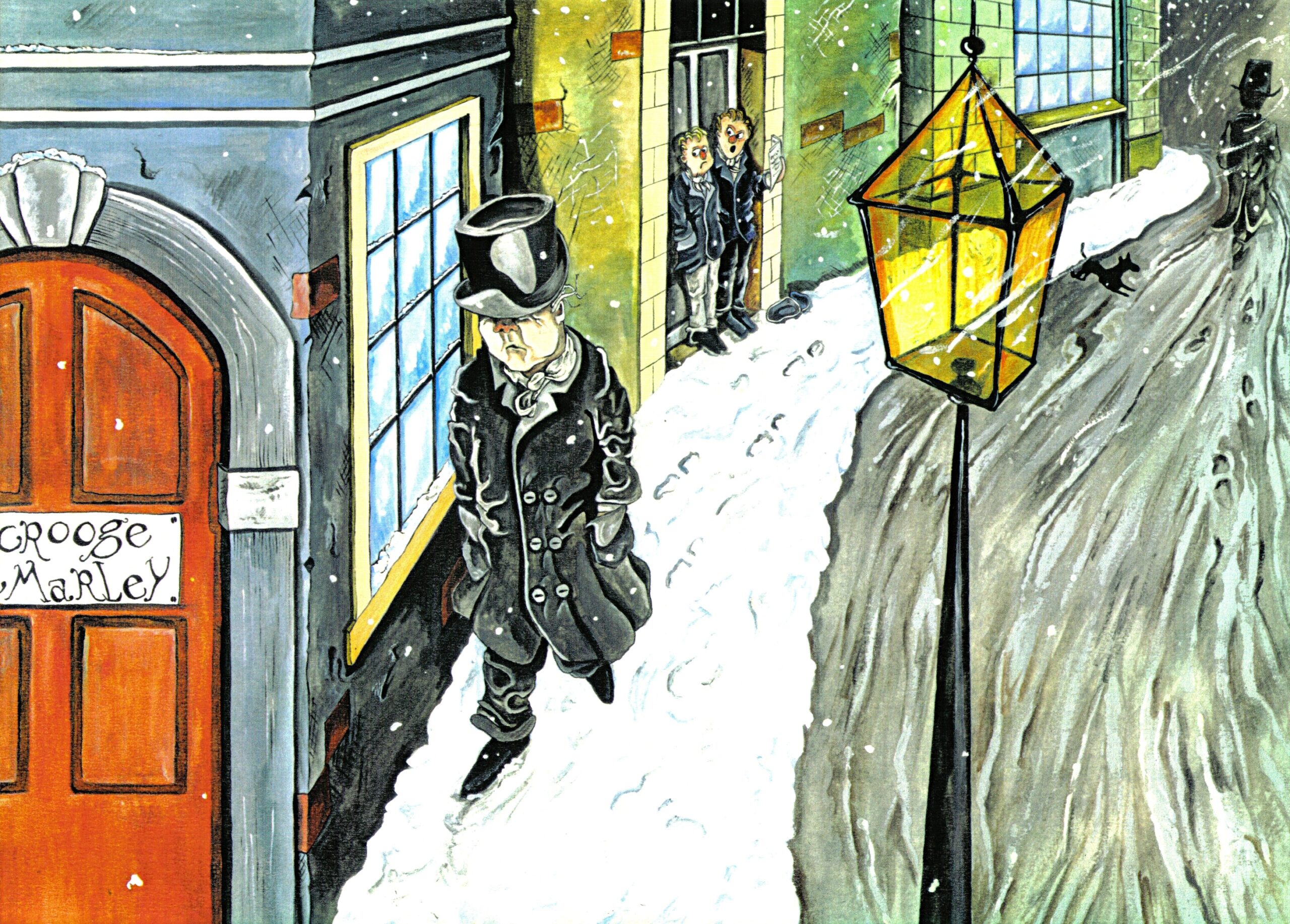
    Whether it’s the original novella by Charles Dickens or one of its many screen adaptations, “A Christmas Carol” is enshrined in my mind as a holiday staple. Why shouldn’t it be? Like the songs of the season remind us, Christmas is a time for telling “scary ghost stories and tales of the glories of Christmases long, long ago.” That is what Dickens’ book is – a dramatic event filled with encounters with haunting spirits that, when all is said and done, convince Ebenezer Scrooge of the unrighteousness of his deeds and the need to turn his life around.

    Jacob Marley, Scrooge’s deceased business partner, visits him and kickstarts the series of events that lead to a change in the protagonist. Marley’s chains shaken so horrifically are a symbol of his sins. He reminds Scrooge that he, like us, has sin in his soul – a ponderous chain, but through repentance and change, Scrooge’s unhappy fate can be sponged away. Because this Christmas classic deals so acutely with morality, it is no surprise that we can find in Scrooge’s conversion allusions to Reconciliation. In this story, we witness Scrooge’s sorrow, desire to amend his life, and penance for his misdeeds.

    WATCH: Sacraments 101: Penance

    The parts of Reconciliation

    The Sacrament in which Jesus ordinarily forgives sins is commonly referred to as Confession, Reconciliation, or Penance. While the terms are often interchanged, they really refer to different steps we take in the Sacrament.

    Confession is what it sounds like: confessing your sins to God through the priest. There is power in naming and denouncing our vices, and God’s grace is working in us and strengthening us along the way.

    Next comes reconciliation, part of which entails being sorry for your sins. If you are not sorry for something, you admit there is nothing to forgive. If we have sorrow (contrition) for our sins, then the priest gives us absolution – God’s forgiveness. Even though the penitent is forgiven, they must still try to make amends for the sin. In an act of contrition before absolution, we express our sorrow for our sins and our intention to amend our lives and avoid future sin.

    Finally, we are given penance to do. Sometimes this will be reciting rote prayers. Other times, it could be some external activity. For example, when I was young, I was supposed to empty the dishwasher as penance for disobeying my parents. Another time, I was told to play the Wii with my brother because it was something he really enjoyed (though I not as much). Entering the confessional takes initiative, and penance takes effort.

    RELATED: 4 Gifts to Give One Another From ‘It’s a Wonderful Life’

    The steps of Scrooge’s conversion

    At the beginning of Scrooge’s adventures, it’s clear that he does not desire this intervention of his own will. His associate, the late Jacob Marley, offers him hope to escape a doomed fate like his own: Scrooge will be haunted by a triad of spirits united in a single purpose – his conversion. At the outset, Scrooge is reluctant. But, as time goes on, he takes initiative and puts in the effort to externally express his reformed interior life.

    The first task of the spirits is to instill guilt or regret in Scrooge. The Ghost of Christmas Past shows Scrooge that he is selfish, that he let the desire for wealth dominate any charity in his life – even toward his lover. In his past, he chose greed over love and commitment. This wonderfully expresses how every sin is self-seeking at the expense of God and others.

    The Ghost of Christmas Present awakens Scrooge to the cold, harsh realities of poverty. When shown the home of his employee Bob Cratchit, Scrooge takes an interest in someone other than himself – the sickly Tiny Tim. The spirit reveals that unless the family’s means change, the boy will perish. A wave of sorrow washes over Scrooge, and the fact that he has a direct impact on this cuts him to the quick. Our actions, for good or ill, have consequences.

    It could be said that Scrooge is now in a state of contrition. His heart is being humbled and softened, ready to take on a new flame and vigor. But, if there was any question as to his resolve, the terror of the Ghost of Christmas Yet to Come makes Scrooge’s conversion a matter of personal, vested interest.

    RELATED: From Humbug to Humble: ‘A Christmas Carol’ Lives on

    As Marley’s chains and foreboding words alluded to, Scrooge’s fate is an unhappy one if he fails to amend his life. The final spirit shows our protagonist his grave, and that no one will mourn his death, leading Scrooge to a frenzied plea with the apparition that culminates in what could be considered an act of contrition if given in a sacramental context.

    “I am not the man I was. I will not be the man I must have been but for this intercourse,” cries Scrooge in the cemetery, glaring at his own name on a tombstone. “Assure me that I yet may change these shadows you have shown me by an altered life!” He proceeds to promise he will honor Christmas in his heart always and allow the three Christmas spirits to strive within him. Before waking to his new lease on life, he raises his hands “in a last prayer to have his fate reversed.”

    To some extent, Scrooge seems sorry for the misery he caused others. To an even greater extent, he was scared to death of a fate worse than fatality. Scrooge’s fear leading him to sorrow and repentance is akin to what is called imperfect contrition in Reconciliation. Imperfect contrition is the fear of punishment (the pains of hell) that our sins deserve. Perfect contrition is sorrow for sin out of love for God and recognizing that sin offends him. Yet, God can use our imperfect contrition to affect his Sacrament in us through the merits of Jesus, whose sacrifice supplies what our hearts lack in perfect contrition. Similarly, the imperfect contrition in Scrooge’s heart leads to a radical transformation for the better.

    Displaying contrition, Scrooge also revealed to the third spirit that his past life was in need of change and that he plans to change it. This is his confession, or admission of wrongdoing. For penance, he makes good on his word and avoids sinning in the future by treating others with charity and taking delight in bringing them joy. He chooses to live what is captured by the popular quote attributed to Mother Teresa: “It is Christmas every time you let God love others through you…it is Christmas every time you smile at your brother and offer him your hand.”

    RELATED: Busted Halo’s Guide to Confession

    Reconciliation

    So can we say Scrooge is reconciled? Is he squared away with God? Well, the effort by Marley and the three spirits certainly offers hope that the future can be altered – just as Scrooge’s life could be altered. Dickens certainly wishes the readers to carry such a hope away with them. The beautiful thing about the Sacrament of Reconciliation is that we are given a guarantee of God’s forgiveness.

    If we are good to our word (to strive against temptations and to do our penance), we have a hope greater than Scrooge’s. We have God’s word for it: “Go in peace. Your sins are forgiven.”
  • Finding Christ Worldwide: Embracing the Universal Celebration of Mass

    Finding Christ Worldwide: Embracing the Universal Celebration of Mass

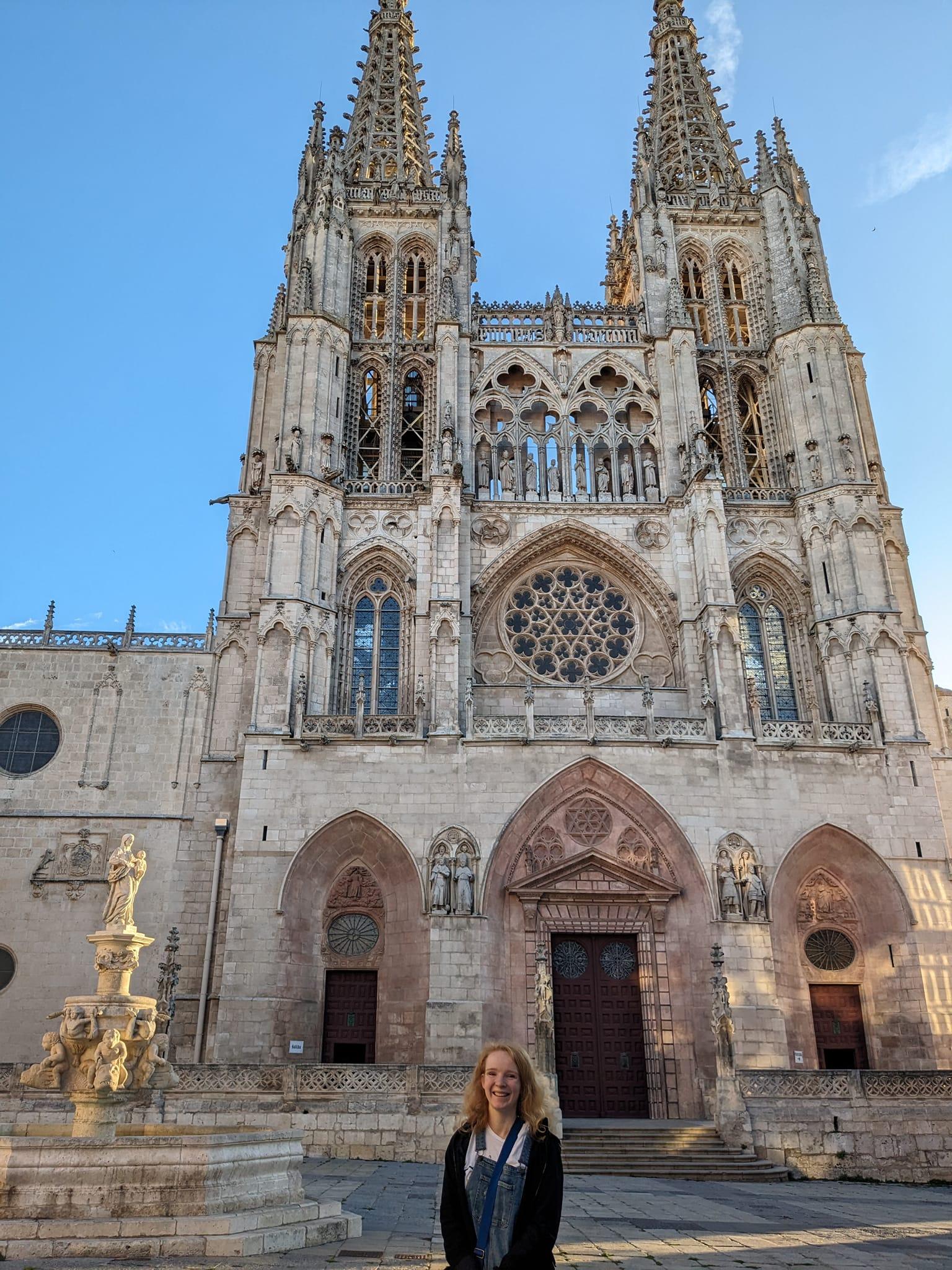
    The author in front of Burgos Cathedral in Spain. (Photo courtesy of Sheila DeBoer)

    Going to weekly Mass at St. Vincent de Paul – my large home parish in Washington State – was just another part of my routine growing up. I could count on sliding into a pew each Sunday with my parents and younger brother and sister, and I might even altar serve on a given weekend. 

    Mass was something I enjoyed, but it wasn’t something I connected to on a deeper level. To me, Mass was just what we did as a family, something very regular and earthly, like going to the grocery store or the park. I paid attention, enjoyed the music, and looked around at all those gathered, but I didn’t understand much of what was happening. Afterward, our family would head out for a meal or run errands, and the Mass we had attended would take its place as a pleasant memory.  

    As I entered high school, received the Sacrament of Confirmation, and began lectoring, my interest in discovering a deeper-than-surface-level understanding of the Mass began to grow. Then, when I experienced Mass in other Catholic Churches besides my home parish — a midwestern parish in North Dakota while visiting my sister, a beautiful basilica in Spain on pilgrimage, or Galway’s cathedral in Ireland on a trip with my mom all in my early 20s—  I began to notice the uniqueness of liturgical worship in a new way. 

    RELATED: Attending Mass in a Different Language Taught Me About the Universality of the Church

    I began to recognize that the Mass I was part of in my home parish each week was being celebrated universally around the world, in different languages and cultures — and the same Christ was present through the words of the priest in each act of consecration at the altar. This realization broadened my view of the Mass from something ordinary to something extraordinary. 

    As my appreciation for the Mass grew, I came across an even more profound reality: The Mass is a celebration where both the living and dead are in attendance. I discovered this truth only a year or two ago when listening to the Catechism in a Year podcast with Fr. Mike Schmitz. According to the Catechism of the Catholic Church in article #1354 regarding the Mass: “The Church indicates that the Eucharist is celebrated in communion with the whole Church in heaven and on earth, the living and the dead, and in communion with the pastors of the Church, the pope, the diocesan bishop, his presbyterium and his deacons, and all the bishops of the whole world together with their Churches.” 

    It is out-of-this-world (literally!) to realize that the Mass is more than a universal celebration across lands and peoples on earth, but that at each and every Mass, heaven literally touches earth. In the Lord’s Prayer, we ask that God’s will be “done on earth as it is in heaven,” and the Mass is a foretaste of heaven. In the book of Revelation, the apostle John has a vision of heavenly worship. He writes: “Day and night without ceasing they sing, ‘Holy, Holy, Holy, is the Lord God Almighty, who was and is and is to come.’” 

    It is fitting, then, that at Mass, we echo these words on earth in the Sanctus, a Latin Eucharistic prayer, or prayer of the angels, offering our praise and thanksgiving to God: “Holy, Holy, Holy, Lord God of hosts, heaven and earth are full of your glory. Hosanna in the highest.” At every Mass, we are in attendance with the angels, as well as those loved ones who have gone before us — participating personally with a great cloud of heavenly witnesses singing and glorifying God. 

    RELATED: 7 Ways to Connect More Deeply With Sunday Mass

    St. John Chrysostom, an early father of the Church, once said: “When Mass is being celebrated, the sanctuary is filled with countless angels who adore the Divine Victim [sacrificed] on the altar. Do we consider the presence of angelic hosts with us at Mass as we remember and represent the one and only sacrifice of Christ on the cross upon the altar? Whenever I attend Mass, I enter into worship of the creator with those in heaven and those on earth. What I have come to believe is that the Mass is anything but ordinary. The Mass is an extraordinary gathering not just of persons around the world from different languages and cultures, but a unity of persons and angelic hosts spanning time and era, life and death.   

    Now when I attend Mass, whether at my home parish or elsewhere around the world, I take a moment to appreciate and acknowledge the ways the heavenly worship is part of my earthly worship. Instead of only looking around at the other parishioners, I remember loved ones who have gone before me, and I praise and thank God while at Mass as they do at every moment in heaven, imagining they are sitting beside me in the pew. When I listen to the music, I also gaze at the altar or smell the sweet aroma of incense, imagining a choir of angels around the priest at the table of the Lord. These small adjustments help me to view Mass not only as something earthly but also as something deeply and profoundly heavenly.    

  • What Does the Church Say About Limbo?

    What Does the Church Say About Limbo?

    White Clouds and Blue Sky
    Photo by Ithalu Dominguez on Pexels

    Editorial note: The following article contains mentions of pregnancy/infant loss.

    The loss of a child is a heartbreaking situation. There is grief over the death of the beloved child, of course, but also over the child’s future now lost. Additionally, there can be grief and uncertainty over the soul of the child and where they are now. In the midst of this loss, the Catholic Church has always offered words of consolation and hope, trusting in God’s infinite love and mercy. Amid the pain of miscarriages, stillbirths, and lost children, we find consolation in our God who desires all children of the world to come to him. To any and all persons facing such loss, please know you have the prayers of the Busted Halo staff.

    Throughout history, some have responded to these griefs and uncertainties by saying that children who pass away before receiving the Sacrament of Baptism are in Limbo. Limbo is at the heart of a tension between understanding God as being all-loving and desiring the salvation of all and the Catholic understanding that baptism is needed for salvation. This raises questions, especially about the souls of unbaptized children and what happens to them in the next life. The loss of a child is always especially difficult, and many in the Church have tried to find explanations that offer consolation. Limbo was one such answer to those questions, and while never completely embraced by the Church, neither has it been completely done away with. The answer to “Does Limbo exist?” is a much more complex question and requires a look at the growth of the idea of Limbo over time.

    LISTEN: Navigating Miscarriage, Stillbirth, and Infant Loss With Abigail Jorgenson

    In the tension between understanding salvation that required baptism and understanding that a loving God wouldn’t punish children who never had the option or ability to be baptized, St. Augustine was among the first to discuss the idea of “Limbo.” This would be a place separate from heaven and fully enjoying the presence of God, but also away from hell. To some theologians, Limbo existed on the edge of hell but was not a place of suffering. To others, it was a place of pleasant neutrality. There was, however, never an official definition or understanding of what Limbo was or what it was like. Other theologians throughout the ages, such as St. Thomas Aquinas and St. Alphonsus Liguori, would continue to write about Limbo.

    Yet with all of this writing, the concept of Limbo had never been formally adopted as the Church’s position. The closest the Church got was the mention of Limbo in St. Pius X’s Catechism in question 100 wherein he wrote: “Children who die without baptism go to Limbo, where they do not enjoy God, but neither do they suffer.” However, this Catechism was never made known as official teaching for the whole world, but rather, for the faithful in the city of Rome. St. Pius X wrote and published it only for the immediate Church in Rome as the local bishop, not for the whole world.

    Even though this idea was shared by a pope, it was never a universal idea in the Church, or adopted as official Catholic teaching. St. Cajetan, a priest in the 16th Century, notably wrote against the idea of Limbo. He argued that children who are unable to be baptized in life share in the concept of Baptism by Desire (that someone who desires God’s grace but is physically unable to be baptized is still saved and in effect, baptized) because of their mothers’ love and desire to have them baptized. St. Cajetan argued for a more open approach to God’s mercy for these children.

    WATCH: Baptism 101

    In 1980, the Congregation for the Doctrine of Faith (CDF) put out Instruction on Infant Baptism. In this document, they stated that: “As for children who die without Baptism, the Church can only entrust them to God’s mercy, as she does in the funeral rite provided for them.” The CDF felt that the most important thing to say on the death of a child before they were baptized was to entrust that soul to God’s infinite mercy.

    About 25 years later, the International Theological Commission wrote The Hope of Salvation for Infants Who Die Without Being Baptized. In this, the Commission made several arguments to uphold the idea that a child who died before baptism could share in God’s joy in heaven eternally. They rooted these arguments in paragraph 1261 of the Catechism of the Catholic Church which states: “[there is] hope that there is a way of salvation for children who have died without Baptism.” They also point to our celebration of the infant martyrs on December 28, that we celebrate them as martyrs and saints even though they were never baptized. Finally, the document reminds us that Christ’s salvific love is true – and a greater truth than original sin, which we are all subject to. As such, Christ’s love will win out, and this gives us great hope and joy for the salvation of unbaptized children.

    RELATED: 9 Ways to Help a Grieving Friend

    Interestingly enough, though, none of these statements outright deny the existence of Limbo. Rather, the Church places greater emphasis on hope and trust in God’s love when it comes to the souls of unbaptized children. One can be a good Catholic whether or not they believe in Limbo.

    Personally, I find that the idea of Limbo does not line up with what I have been taught about a loving and merciful God. I have great hope and trust in God’s love to welcome unbaptized children into heaven and find that this gives greater peace to those who have faced such a loss. If anyone should find themselves in the situation of walking with someone who lost a child before a baptism was celebrated, my first piece of advice is simply to be with them. Not necessarily to even say anything, but to be present alongside them in mourning and an image of God’s merciful love in the time of loss. When words are needed, words of hope, especially those of Christ, are most consoling. As Jesus said, “Let the children come to me, and do not prevent them; for the kingdom of heaven belongs to such as these” (Matthew 19:14).

  • A New Perspective on Our Faith: A Look at First Reconciliation Through My Daughter’s Eyes

    A New Perspective on Our Faith: A Look at First Reconciliation Through My Daughter’s Eyes

    A young girl goes to confession
    Photo by Yandry Fernández Perdomo on Cathopic

    My daughter is in second grade, which means it is the year of her First Communion. When she began her religious education classes at our parish this year, her dad and I were focused on preparing her for this milestone. We had prayers to practice, doctrines to discuss, and — as my daughter kept reminding me — a dress to dream about and purchase.    

    While the weekend of her First Communion was beautiful, what I found in the time leading up to it was that it was not that sacrament that my daughter was focused on most. It was the Sacrament of Reconciliation she was particularly curious about.

    What would she tell the priest? My daughter wondered. Would she talk to our parish priest specifically, the one she knows, the one who plays the harmonica and likes chocolate? Would he dislike her after she told her sins to him?  

    LISTEN: Preparing Your Kids for First Reconciliation and First Communion

    At dinner, my daughter would pretend to whisper her sins to her older brother, and he would laugh. If you knew her, you would know that this was a sign of how nervous she was about the experience, joking to cover up her worries, playing pretend to imagine the experience.

    As someone who converted to Catholicism at age 28, I felt as if I couldn’t always field my daughter’s questions or worries in the best way. I had never been a child participating in the Sacrament of Reconciliation, and children see the world through different lenses than adults. How was I to guide her and ease her nervousness?

    I talked with her about my experience with First Reconciliation, which she joked must have been hours long because I was almost 30 when I went. Just think about all of those sins I had to recount, she jested. While I didn’t recount all of my sins with her as I did during my first Confession, what I did share with her was the feeling of relief I experienced after it.

    I told her I was nervous like her when I went the first time, and I still get nervous, every time. Somehow, though, my soul always feels healed afterward. God’s grace, working through the priest, transforms my heart, and I feel lighter. The sacrament is a gift, and the nervousness we feel before we go to Confession is natural because, unlike Christ, we aren’t perfect. We sin, and so we try to reconcile ourselves and our hearts with him. This is how I tried to explain it to her at least, focusing on the feelings after the Confessional experience rather than what seemed to be the worries plaguing her heart before it.

    RELATED: Busted Halo’s Guide to Confession

    On the day of her First Confession, my daughter dressed up, not in her communion dress, but in one of her other favorites. To her, that Saturday felt as momentous as the next day, the day of her First Communion, would be. After all, one could not happen without the other. We practiced her confessional prayer before we left. We also discussed how she didn’t need to share anything she divulged about her sins in the confessional with her parents, her brother, or even the family dog unless she wanted to. 

    When we arrived at the parish and waited in line with the other children, she hopped from one foot to the next. There was a palpable sense of nervousness in the air. Some of the kids remarked noisily about their feelings, others simply stared, wide-eyed. On the car ride over, my daughter had wondered aloud if her confession would be longer or shorter than others, which might explain why she had inquired so persistently about the length of my first one.

    As she ventured into the booth during her turn, I thought about the times as a family we had gone together and she had waited on me. What must it be like, as a child, to know your parents are receiving forgiveness for their sins? 

    Throughout this year, my family has made it a point to go to confession together during each liturgical season, and I have been cognizant of my daughter’s eyes on me, searching and following, contemplating her own future steps in the Church as she grows up in it — and she sees her family growing up in it, too. 

    I speak with her often about how, as a child, she gets to experience the faith in a different way than I did because she receives many of the sacraments over time in her life (i.e. Baptism, Reconciliation, Communion, Confirmation), whereas I received them fairly close together in an RCIA setting. Through witnessing her journey, my faith deepens because I experience the sacraments anew, this time with a child’s gaze. We learn together, I tell her. She teaches me, as much as I do her. 

    WATCH: Confession 101

    With this said, God teaches us all through his sacraments, through these channels of God’s grace. I am reminded of Psalm, 32:8, which reads, “I will instruct you and teach you in the way you should go; I will counsel you with my loving eye on you.” Throughout this year, I have felt God’s loving eye on both my daughter and me. Our journey toward her Reconciliation has been one of growth and togetherness.

    It is likely not a surprise that when my daughter came out of the confessional, she looked lighter. Her smile of relief mixed with joy is one I’ll never forget. We did her penance together. 

    On the way home, I saw she had grabbed my phone and had texted her dad who was working that day. “She was very nervous!” she wrote about herself. Imagine a few thousand cry/laugh emojis attached to this text.

    After I took my phone back, I told her that while she may have been nervous, I was also a little nervous (to which she laughed), but that she did great.

    “We both did great,” she responded.

    In the end, preparing my daughter for the Sacrament of Reconciliation not only laid the groundwork for her to enter more fully into the Church, but also reconciled me closer to her, to God, and the sacraments that drew me to convert to the faith in the first place. 

    It deepened our connection to each other, and most importantly, to God’s love and his wondrous works in the world — in my family’s hearts.

  • What Does the Bible Say About the 7 Sacraments?

    What Does the Bible Say About the 7 Sacraments?

    Question: What aspects of the seven sacraments are in the Bible? Are there any that are not?

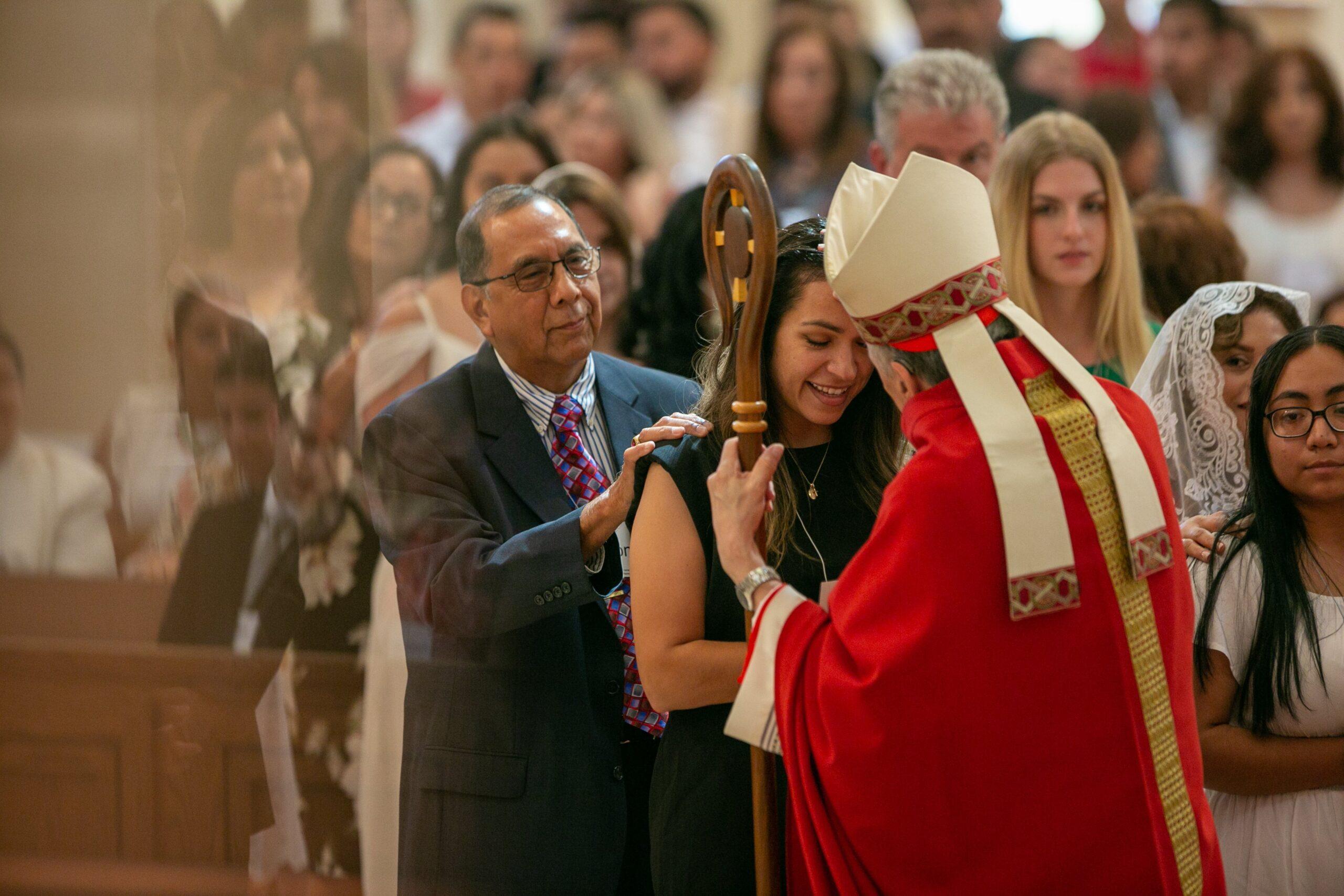
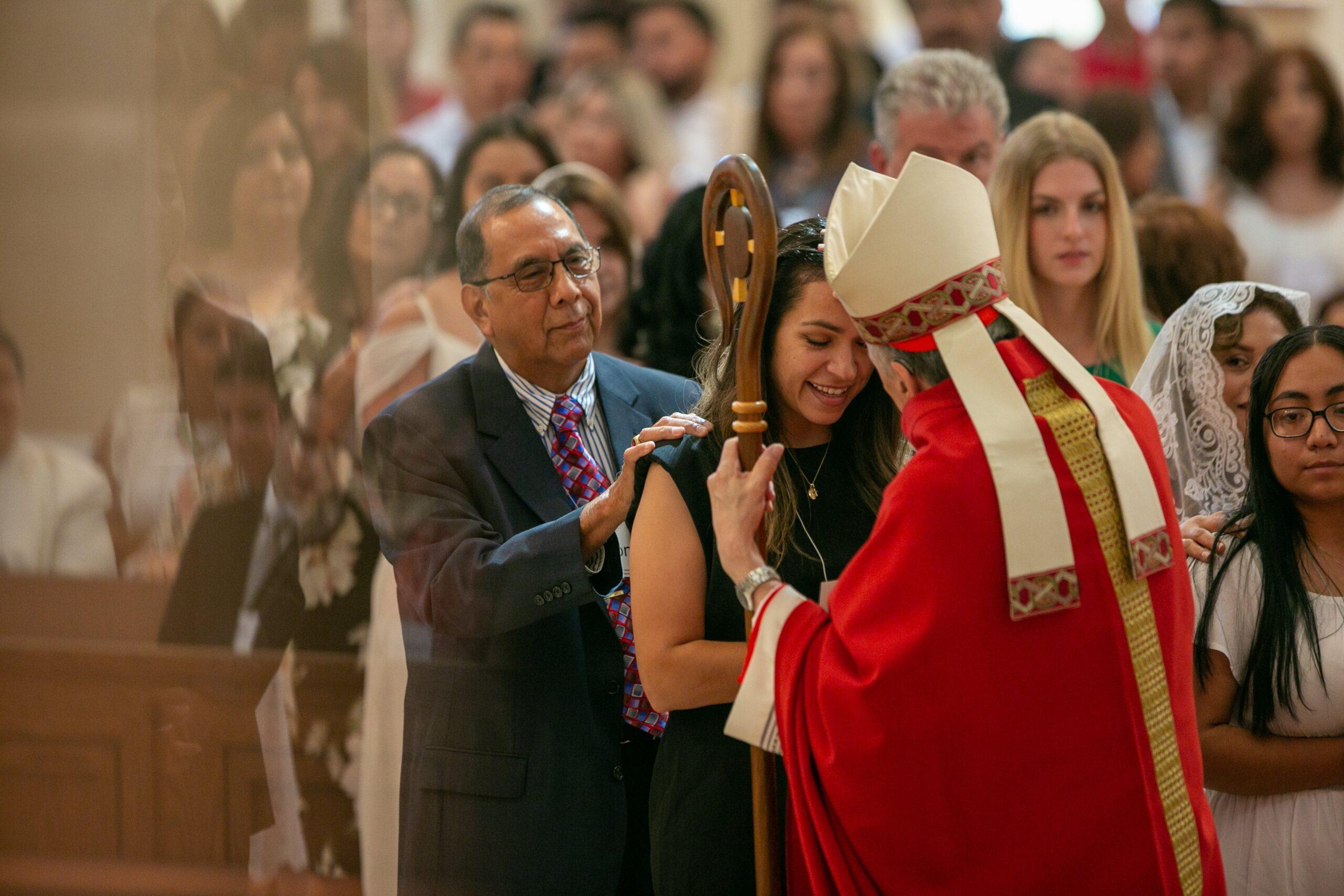
    Cardinal Daniel N. DiNardo of Galveston-Houston anoints the head of a confirmation candidate at the Co-Cathedral of the Sacred Heart in Houston June 5, 2022, during a celebration of the sacrament of confirmation. Cardinal DiNardo and Auxiliary Bishop Italo Dell'Oro confirmed more than 1,000 adult Catholics from 93 parishes and institutions across eight Masses at several parishes around the archdiocese before, during and after Pentecost. (CNS photo/James Ramos, Texas Catholic Herald)
    Cardinal Daniel N. DiNardo of Galveston-Houston anoints the head of a confirmation candidate at the Co-Cathedral of the Sacred Heart in Houston (CNS photo/James Ramos, Texas Catholic Herald)

    The seven sacraments celebrated by Catholics all have their roots in Scripture, although some are featured more prominently than others. There are many references to Baptism, of course, beginning with Jesus’ Baptism by John. The Eucharist was instituted by Jesus at the Last Supper (Matthew 26:26-29). Confirmation, though not specifically named in the Bible, is traced back to the outpouring of the Holy Spirit on Jesus at his Baptism and on his followers after Jesus’ resurrection (see John 20:22 and Acts 2:1-4). The Sacrament of Reconciliation, while not practiced in the same way in biblical times as we know it now, is rooted in Jesus’ ministry of forgiving sins and proclaiming salvation to the lost. After his resurrection, he breathed on the disciples, imparting them with the Holy Spirit and stating, “If you forgive the sins of any, they are forgiven them” (John 20:23). The Sacrament of the Anointing of the Sick can be traced to the New Testament Letter of James (5:14): “Are any among you sick? They should call for the elders of the church and have them pray over them, anointing them with oil in the name of the Lord.”

    RELATED: Sacraments 101 and 201 Videos

    Finally, the two Sacraments of Vocation — Marriage and Holy Orders — derive from Scripture, although the format of the liturgical celebrations has obviously evolved through the centuries. The Bible begins with the creation of man and woman in the image and likeness of God and very soon refers to them becoming “one flesh” (Genesis 1-2). Countless other passages refer to the covenant between married spouses, and Jesus himself defended the nature of marriage when he declared, “What God has joined together, let no one separate” (Matthew 19:6). Holy Orders take shape from Jesus’ appointment of the Apostles to extend his ministry of teaching, healing, and proclaiming salvation (Matthew 10:1-8). Later, those Apostles prayed and laid their hands on other “men of good standing, full of the Spirit and of wisdom” to share in the ministry (Acts 6:3-6). Thus the succession of the apostles began and with it the tradition of a pope or bishop laying hands on a man to ordain him as a bishop, priest, or deacon.

  • Who Decides Who Can Be a Confirmation Sponsor?

    Who Decides Who Can Be a Confirmation Sponsor?

    Q: Who makes the decision as to who can be the sponsors for a child making his confirmation? The rules are 1) church-goer in good standing 2) not divorced 3) Catholic. I don’t know anyone who qualifies for all three.

    A sponsor for baptism or confirmation must be at least 16 years old and be a Catholic who has received the Sacraments of Confirmation and Eucharist and who “leads a life of faith in keeping with the function to be taken on” (see the Code of Canon Law, paragraph 874, for the complete requirements). In most places, as determined by the local bishop or the pastor of a church, “leading a life of faith” is interpreted to mean that a person is following the teaching of the Church with respect to marriage. If single, he or she must not be living with a partner; if married, he or she must be sacramentally married in the Church. (Someone who is civilly divorced but not remarried can still be eligible.) While these standards can certainly vary by parish and priest, these rules aim to ensure that the sponsor can set a good example for his/her godchild or confirmandi. The most important role of sponsorship is sharing your faith and helping your godchild/confirmandi’s spirituality flourish. A young person needs a role model who attends Mass regularly and who takes the teaching of the Church seriously. 

    If you don’t know anyone who meets the requirements, make an appointment with the director of the confirmation program to discuss your particular situation. He or she will know if any exceptions might be approved by your local bishop. Alternatively, he or she could also connect you with faithful members of your parish who would be delighted to meet you and accompany a candidate on the journey to confirmation.

  • Busted Halo’s Guide to Confession

    Busted Halo’s Guide to Confession

    From parables like the Prodigal Son and the Pharisee and the Publican, to Christ uttering the words, “Father, forgive them, for they know not what they are doing,” before his death, we come to understand just how important seeking forgiveness is to our faith. 

    As Catholics, we are called to partake in the Sacrament of Reconciliation. But for many, the confessional can be an intimidating place, and one that raises some questions. Why should we confess our sins to a priest, when we can pray to God and ask for forgiveness? 

    First of all, we absolutely should ask God for forgiveness whenever we are aware of any sin, no matter how small. But the Church teaches that certain sins that more severe than others. When committing these “mortal” sins, we not only break our bond with God, but we also break our bond with the entire community of faith that is the Body of Christ. So, when we participate in the Sacrament of Confession, we restore that bond between God and the community, since the priest both represents the community and acts as an intercessor between us and God.

    Even with all of this in mind, we’re still only human, and we have very human fears. Will the priest judge me? What if he scolds me the way my second-grade teacher did when I pushed that kid on the playground? Wait, how do I even make a decent confession? And what’s penance all about? Confession ought to be a liberating experience, and we can help you leave the confessional feeling strong and confident in your restored relationship with God and the community.

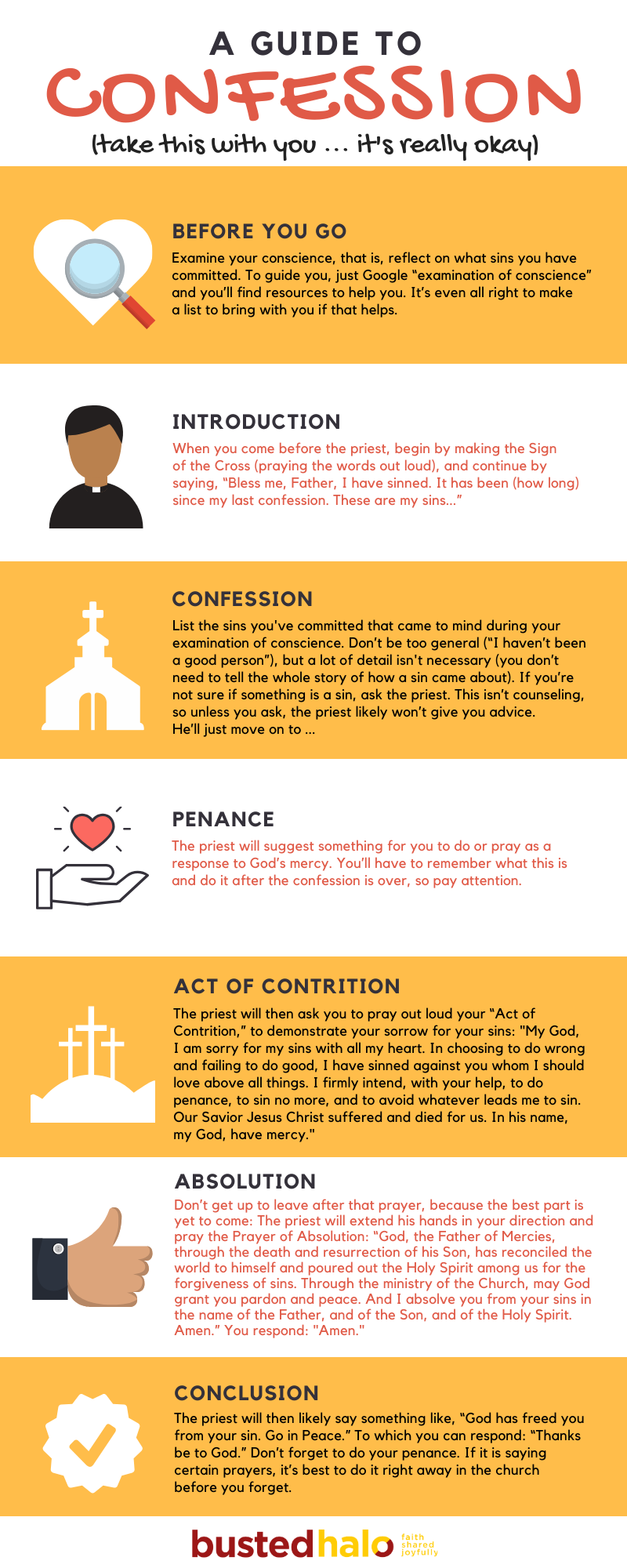
    Busted Halo has put together a Guide to Confession, which explains the Sacrament’s steps so you know what to expect. If it puts you at ease, feel free to print this guide and bring it with you to the confessional!

    Click here to download a printer-friendly version of this infographic.


    Busted Halo's guide to confession

    Other Confession Resources:

    So, You Want to Go to Confession

    Do you get sweaty palms just thinking about the Sacrament? These tips from one formerly reluctant confessor will help you prepare for your trip to the confessional and get rid of any jitters.

    Fatherly Advice: Going Back to Confession

    In this podcast from the Busted Halo Show, Father Dave encourages a listener, who had a negative experience with her first Confession, to return to the Sacrament.

    Is Confession Useful If I’m Not Sorry for All of My Sins?

    A listener struggles with the common dilemma of knowing that something is sinful and confessing it, but also wanting to live by his own rules. Father Dave prompts us to be honest about this in Confession, as doing so can help us to overcome such a struggle.

    Where in the Bible Does It Say One Must Go to Confession? 

    Ann Naffziger answers a reader’s question and explains that Saint Paul provides an excellent explanation as to why Confession is necessary to rebuild our relationship with God and the entire community of faith. 

    Bad at Confessing

    It’s common to head into the Confessional with preconceived notions. Even if your Confession isn’t quite what you expect, there’s still wisdom and healing to be gained. Vanessa Gonzalez Kraft shares that priests usually provide her with guidance, even if her Confession doesn’t go the way she imagined it in her head. 

  • Models of Marriage: Remember These Lessons From Biblical Power Couples This Valentine’s Day

    Models of Marriage: Remember These Lessons From Biblical Power Couples This Valentine’s Day

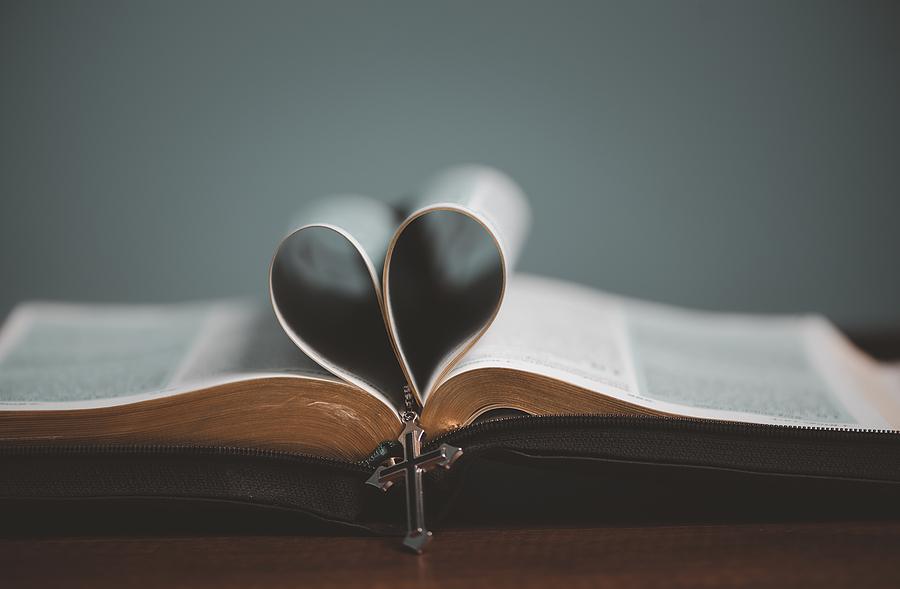
    Holy Bible open with pages folded in the middle to make a heart shape and cross charm haning from the heart.
    Photo by May_Chanikran on Bigstock

    In the Sacrament of Matrimony, we are called to love each other fully in word, spirit, and deed, not only on our wedding day, but every day of our lives. That’s why the celebration of love just once a year on Valentine’s Day – the origins of which include a Roman fertility ritual and the execution of the martyr Valentine on February 14 – felt counterintuitive to me. It didn’t help that Valentine’s Day evolved into a consumerist holiday benefiting greeting card and chocolate corporations. But, after I got married, I realized that we can reframe this day in a Catholic way: Valentine’s Day can be an opportunity for couples to reenergize their commitment to each other. 

    The best place to begin this re-commitment is the Bible. Though many relationships in the Old and New Testaments reveal the pitfalls of sinfulness and the reality of our human brokenness, many also demonstrate how spouses can be wholly committed to each other. These holy unions, while far from perfect, are built on similar foundations, and we can use these lessons as models for our own marriages.

    LISTEN: Saints of Our Lives: Saint Valentine 

    Trust triumphs over darkness.

    Every marriage faces hardships, but we can survive life’s struggles together if we put our trust in God. Early on in my marriage, for example, my husband and I found it challenging to spend quality time together, as he had a rotational work schedule that made him spend most weekends at work. Our days off hardly ever coincided, and planning for family gatherings was a logistical nightmare. We realized that to deepen our union, we had to take time in our daily lives to fully enjoy each other’s company, which took commitment and communication. But these were lessons that benefited us in the long run. And now, in our fourth year of marriage, my husband’s schedule was finally adjusted to reflect a standard work week. Weekends together now feel like long-awaited blessings, and we soak in every minute of our time together. 

    There are many struggles that can strain a marriage. Several couples in the Bible faced a particular challenge: infertility. Many modern married couples, including some of my close friends, also suffer this specific struggle in private silence. Abraham and Sarah (Genesis 15-23), Isaac and Rebekah (Genesis 24-27), Elkanah and Hannah (1 Samuel 1–2:21), and Zechariah and Elizabeth (Luke 1:5-24) relied on God to direct the course of their lives. Through prayer and patience, they remind us that we are never alone in our struggles. God is with us to comfort and carry us. Ultimately, God blessed these couples with children – and some exceptional ones, too, like Jacob, Samuel, and John the Baptist. 

    However, whether or not children are part of God’s plan for us, we can strengthen our resolve as married couples by trusting in his will – and accepting it. We must be patient when our marriages are tested, keep praying even when things seem impossible, and remember that God’s blessings are always worth waiting for, in whatever form they come. 

    RELATED: Why Is Valentine’s Day Such a Big Deal?

    Kindness is key.

    There’s a saying I’m particularly partial to: “Happy wife, happy life.” But there is truth in this: If spouses aim to keep each other happy, marital life is more peaceful and joyful.

    One way to maintain authentic happiness is through kindness. Being kind to each other goes a long way, as we see in the story of Boaz and Ruth (Ruth 1-4). Ruth, who had been living in the land of the Moabites, lost her spouse and had no one to turn to. She and her mother-in-law Naomi returned to Israel, and Ruth sought out work. She found herself in Boaz’s fields, and though she was a foreigner, Boaz permitted her to work there. He ordered his men not to touch her and to treat her with respect. Boaz gave her lodging and invited her to share meals with him. In return, Ruth was grateful for all the help she could get. Eventually, Boaz and Ruth wed. 

    This power couple shows us that kindness means accepting and respecting each other. It means being patient with each other, helping with chores, taking on more when your spouse is stressed or exhausted, listening, and forgiving. Kindness is loving the person – and showing it.

    RELATED: 6 Tips for Being Better Prepared for Marriage

    Shared goals give purpose.

    Shared values and vision provide purpose for a couple’s shared life. Working towards something together is often more meaningful and enjoyable than going at it alone. My husband and I, for instance, agree that we want to live a life as simply and naturally as possible. This means having adventures in the great outdoors, prioritizing time with our family, and attending to daily joys together, like cooking and dog walking. In the long run, we hope to have our own homestead, raise chickens, and build a family in faith. In the New Testament, Priscilla and Aquila also shared a vision, playing an integral part in the spread of the early Church (Acts 18:2-3, Acts 18-19, Acts 26; Rom 16:3-5; 1 Cor 16:19; 2 Tim 4:19). After Claudius had evicted Jews from Rome, the couple settled in Corinth. There, they met St. Paul and followed him to Ephesus to evangelize, housing disciples and training them in the faith. The couple was so in sync with each other that Priscilla and Aquila are never mentioned separately in the Bible. In this way, they teach us that married couples are strongest when they are working together. This doesn’t mean spouses should always be glued to the hip, but that the strongest marriages are those unified in values and vision. 

    RELATED: Chastity, Poverty, and Obedience in Marriage

    A good Christian marriage is a holy one.

    To find a true, authentic model of Christian marriage, we need look no further than the ultimate power couple: Mary and Joseph. There were many tests in their marriage: Mary’s pregnancy before being betrothed to Joseph; King Herod’s decree of infanticide which drove them to flee to Egypt; losing their son Jesus in Jerusalem during the Passover festival. And there were no doubt many private hardships that Mary pondered in her heart (Luke 2:19). But through it all, Mary and Joseph strove to lean on each other to uncover God’s purpose for them and follow his path, wherever it would lead them. And this ultimate partnership – this ultimate true love – enabled them to create a holy home, one which raised the Son of Man and Son of God.   

    These power couples from the Bible can inspire us to recommit ourselves to our spouses this Valentine’s Day. Though it is conventionally a secular holiday, we can celebrate it in our own Catholic way, by reflecting on our role in our marriages, recommitting all our strength, faith, and love to our chosen ones, and dedicating our union to God. Plus, it is a good excuse to just have a little fun. We usually crack open a bottle of champagne and cook a meal together. (So, despite my prior jab at the consumerist aspect of the day, husbands and spouses alike, take note: flowers, chocolate, a date night, or a wonderful home-cooked meal will still be happily accepted.)


  • How Attending Mass in a Different Language Taught Me About the Universality of the Church

    How Attending Mass in a Different Language Taught Me About the Universality of the Church

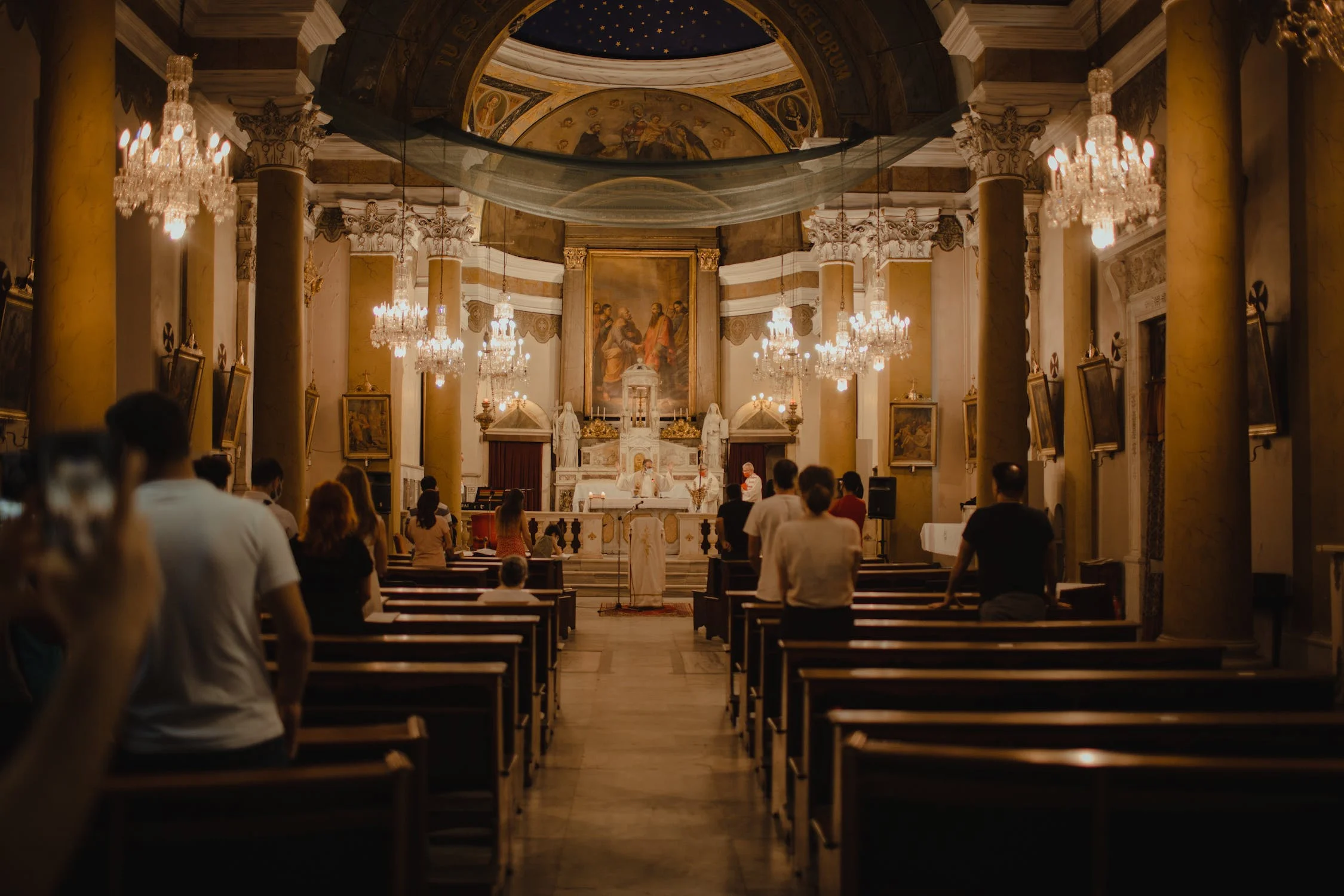
    Faruk Tokluoglu on Pexels

    Growing up in one of Canada’s English-speaking provinces, I experienced a faith that was passed on to me at home, at Mass, and at Catholic school. This exposure was consistently in English, apart from a few basic prayers taught and subsequently memorized in French. In my 20s, I moved around quite a bit, spending time in the United Kingdom and the United States. I found a new parish wherever I went, and always in an English setting. 

    Eventually, I moved to Montreal, a vibrant, multicultural, and multilingual (with French as the official language) metropolis in Canada, and I have been blessed with the opportunity to now call this city home. My husband and I live in one of the city’s historically Italian residential neighborhoods. Although it is a very diverse community today, there is still a significant Italian presence, and our local parish offers Masses in either Italian or French, accordingly. I am at a proficient level in French, and I have a basic understanding of Italian. Since further connecting with my Italian heritage and rekindling my French language skills were both on my bucket list, I viewed these Masses as an exciting opportunity.

    LISTEN: How Can I Follow Along With Mass in a Different Language?

    The experience of participating regularly (that is to say, not just occasionally while on vacation) in a non-English Mass has been enlightening and refreshing, but of course, took some adapting. Following all the points made in the homily, for instance, was a particular challenge for me at first. Still, there are lots of people locally and worldwide who have to adapt to attending Mass in a different language than their own. I had never really given much thought to this fact, but now I have a much greater awareness and appreciation of individuals in such a scenario.  

    Before the Second Vatican Council in the first half of the 1960s, Masses around the world were celebrated in a common language, Latin. It was only after this important ecumenical council that the faithful were able to attend Mass in the language of the local community. Despite this change to the vernacular, the format of the Mass remains the same in whichever part of the world and in whichever translation. 

    This consistency provides a visible sign of the universality of the Church. In fact, the word “catholic” literally means universal. The Catholic Church is indeed a vibrant community of believing women, men, and children connected in faith across the globe. The universality of the Church in the context of the Mass has become clearer to me since moving to Montreal and joining a parish community that functions in a language that I had not been accustomed to using at Mass.  

    RELATED: Experiencing Spanish Mass

    I would like to share two actions that helped me to adapt to a non-English Catholic Church community more readily.  

    First, I take more time to prepare for Masses. Before each Mass, I read through the Sunday readings and corresponding reflections in my English-language Missal. (I use the Canadian edition.) At the Italian-language Masses, the parish provides printouts at the entrance of the Church, which contain the corresponding readings for the day and other key parts of the Mass, including the Creed and Prayers of the Faithful, in Italian. This resource is very helpful to follow along and participate more fully in the celebration. To better streamline my adaptation to the French-language Masses, I subscribed to a monthly resource providing the Readings for all the Masses, including the daily Masses as well. About a year ago now, I started as a lector during the weekday French Masses, and the preparation involved in that context has also helped me adapt more seamlessly. 

    Second, I seek out alternative ways to celebrate the faith in English (or the language that I am used to attending Mass in), in addition to personal/family prayer. Shortly after moving to Montreal, amidst the first year of the pandemic, I became aware of an online prayer session hosted by the Sisters of the Congregation of Notre Dame. This virtual English-language prayer session in the Lectio Divina format gathers a small group of young adults (or those young at heart) once a month to pray together using one of the readings from the upcoming Sunday Mass. Lectio Divina is a beautiful way to pray with Holy Scripture. The Scripture passage is read three times and participants are invited to reflect upon what the passage is saying today and to share these thoughts with the group. Sometimes a reflection may be about certain emotions that have moved our hearts. Other times, it relates to a specific character in the passage, and other options could be seeing the pertinence of the text in the context of a current personal circumstance.  

    RELATED: A Dead Language? 5 Facts About Latin in the Catholic Church?

    Regularly participating in the Mass in a different language has presented me with some graces, despite the natural challenges associated with adapting to the less familiar. The extra preparation that I do in advance of Mass gives me more time to think deeply about the readings. I can be more attentive and focused throughout the celebration. 

    I highly recommend attending Mass in a different language if the opportunity arises, perhaps while traveling or if there is a local parish that celebrates Mass in another language. A change from the familiar, a switch from the routine, can be a valuable blessing to heighten one’s focus or reduce distractions during the Mass and to develop or renew one’s awe and appreciation of the various rites.

    To sum up, the Church is indeed universal. Participating in the Mass, in whichever language, is a powerful sign of the unity that connects Catholics around the globe. Each time we gather around the Eucharistic table for the fulfilling nourishment that only Christ can provide, we partake with others worldwide who are receiving the same sacrament.