Q: Scientists are constantly trying to “prove” the existence of ghosts or departed spirits. What is the Catholic teaching on the presence of ghosts or spirits?
Catholics believe that death is not the end of human existence. While our present, corruptible bodies decay after death, our immortal souls will be reunited with our glorified bodies in the fullness of time. We don’t actually know what this will look like, although we do believe that we can have contact with the dead who have gone before us. That’s what we do when we pray for the intercession of the saints. But the Church does not teach that tormented souls linger on earth like the ghosts of popular imagination. Instead, Catholics believe that the communion of saints is invisible to most people most of the time. Any contact we have with the dead comes through the experience of faith, not necessarily though the empirical channels employed by scientists in search of the paranormal.
Theologian Karl Rahner, S.J., explains this well:
“The great mistake of many people … is to imagine that those whom death has taken, leave us. They do not leave us. They remain! Where are they? In the darkness? Oh, no. It is we who are in darkness. We do not see them, but they see us. Their eyes radiant with glory, are fixed upon our eyes … Though invisible to us, our dead are not absent … They are living near us transfigured into light and power and love.”
Students at Cristo Rey New York High School. (CNS photo/Chaz Muth)
Faith is not taught, it is caught. So while it’s important to present your curriculum clearly and accurately, you must also offer an enthusiastic example of a life lived in faith.
Can your students see that your own life is infused with joy and grace? Do they recognize that you are living in the peace and freedom that only God can give? While maintaining appropriate boundaries, are you honest with them about your own times of struggle and the fruits of those struggles?
Your witness will be the strongest message they carry away from your classroom. While doctrines and jargon may go in one ear and out the other, the example of a life shaped by the good news remains in the heart. Be a person of faith and trust that God will touch your students’ hearts and inspire them to respond.
Overcoming anger is no easy task, especially when one has been hurt. It is possible, however. Our first task to understand is that anger is an emotion. Emotions are normal and not at all sinful. However, we cannot allow our emotions to rule our decisions. The evil one would like nothing more than for us to fall into what St. Ignatius of Loyola calls desolation–thinking that all is lost or hopeless and that nothing really matters anymore.
Recovering from anger takes time and when we are thrust into desolate times it is important not to make any decisions or take any actions towards others when we aren’t thinking clearly. Only after we heal and can begin to see the light again can we actually make a good, discerned decision.
So if you are angry about something, notice where your anger comes from and work on healing from that hurt. Talk to a trusted mentor, a counselor, a spiritual director or a priest from your parish or that you trust about your anger and work towards healing. Healing will involve feeling that emotion, but not allowing that emotion to rule your heart.
The “Seven Sorrows of Mary” refers to the seven feats of “spiritual martyrdom” (suffering spiritually through experiences) endured by the Mother of God in loving solidarity with her Son. They are:
1) Mary’s sorrow at the prophecy of Simeon
2) The flight into Egypt
3) Having lost the Holy Child in Jerusalem
4) Meeting Jesus on his way to Calvary
5) Standing at the foot of the Cross
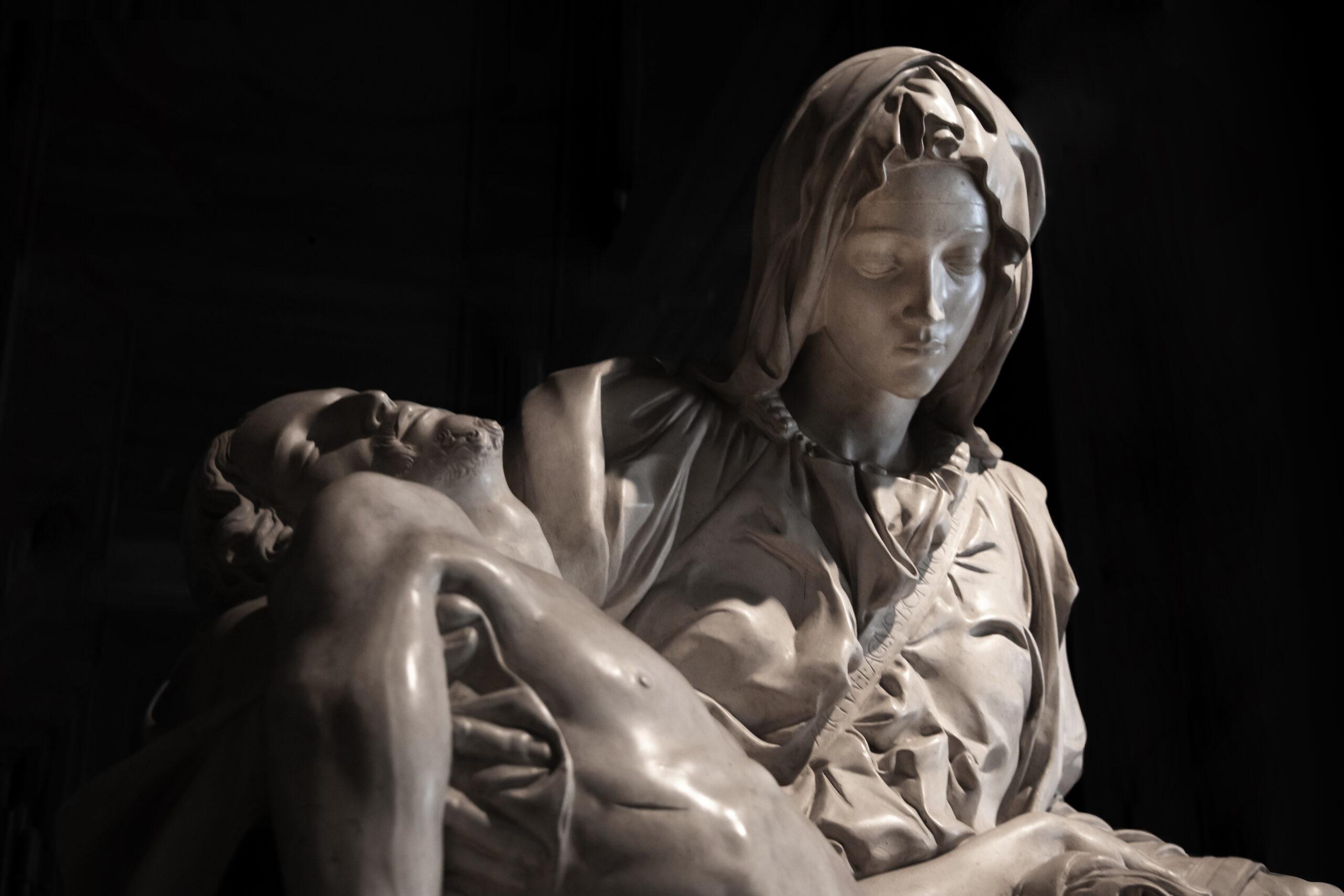
6) Jesus being taken from the Cross (Depicted in art as The Pieta)
7) The burial of Christ.
The Seven Sorrows are all rooted in Scripture. Devotion to the Seven Sorrows of Mary stems primarily from the Order of Servites (The Servants of Mary) and has given rise to the Seven Sorrows Rosary as well as many other devotions to the sorrows (or dolors) of Our Lady. The Feast of the Seven Sorrows of Mary falls on September 15 and was first celebrated by the Servites before becoming part of the liturgical calendar of the Church Universal.
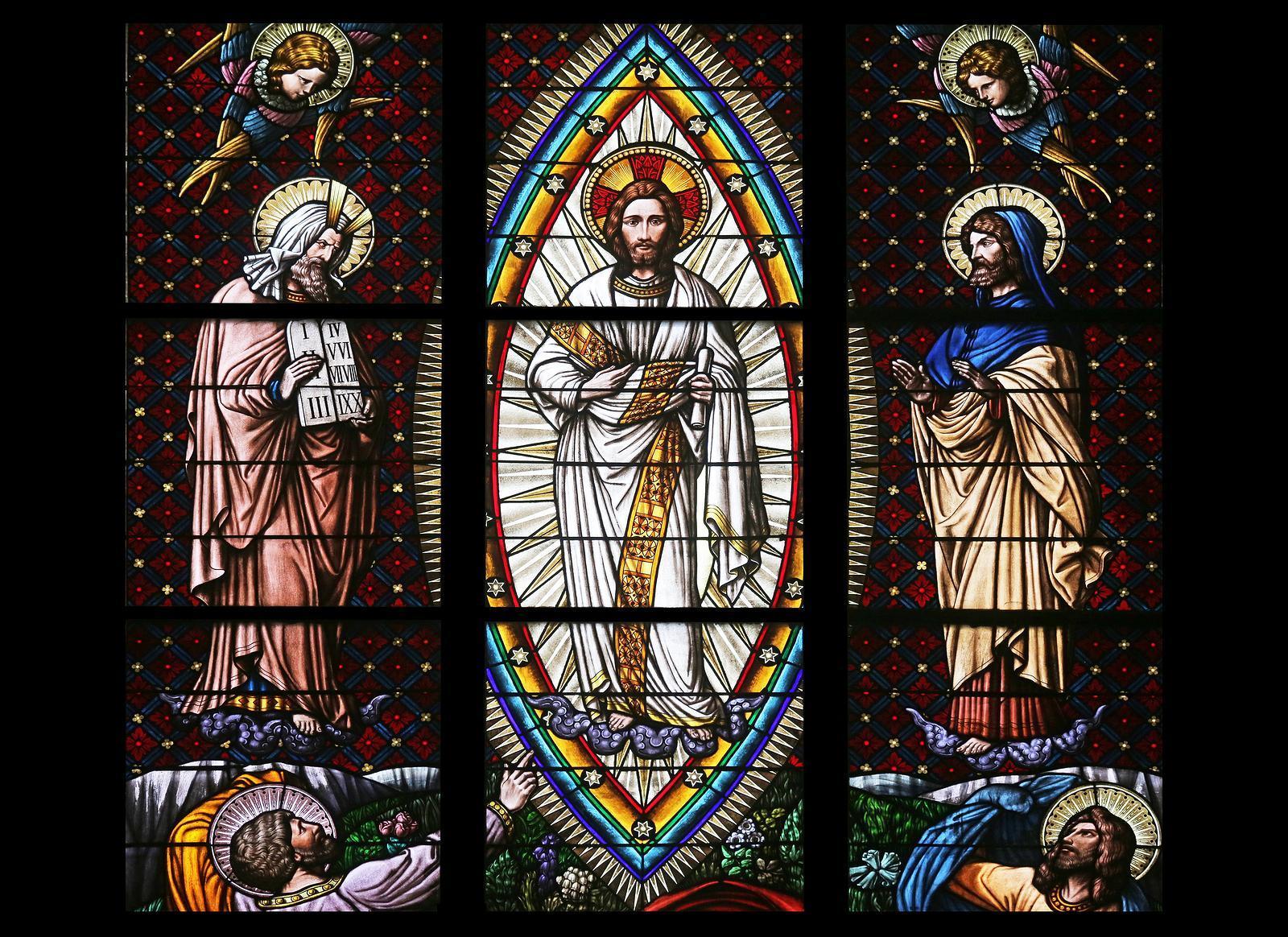
The Transfiguration is an event from the life of Jesus that’s reported in three of the four gospels (Matthew 17:1-9, Mark 9:2-8, Luke 9:28-36). Jesus, along with his disciples, went up a mountain that overlooks Jerusalem and then appears with Elijah and Moses while he “transfigures,” meaning that the disciples see Jesus as he would appear after the resurrection. The gospels report that Jesus’ face and clothes became “dazzling white.”
The story is meant to not simply be a miracle but also has several other meanings. One is that Jesus is the fulfillment of the Old Testament law and prophets. At the Transfiguration, he’s seen with Moses (giver of the law) and Elijah (greatest of all prophets). As they overlook Jerusalem, the story foreshadows where this fulfillment of the law will take place: Jerusalem, where Jesus will meet his death. The disciples are confused by the Transfiguration and don’t realize that Jesus must die in order to save the world.
Lastly, the story is a foretaste of what is in store for us. We will all rise again, and with the Transfiguration, Jesus gives his disciples just a glimpse of what the afterlife holds for both them and us.
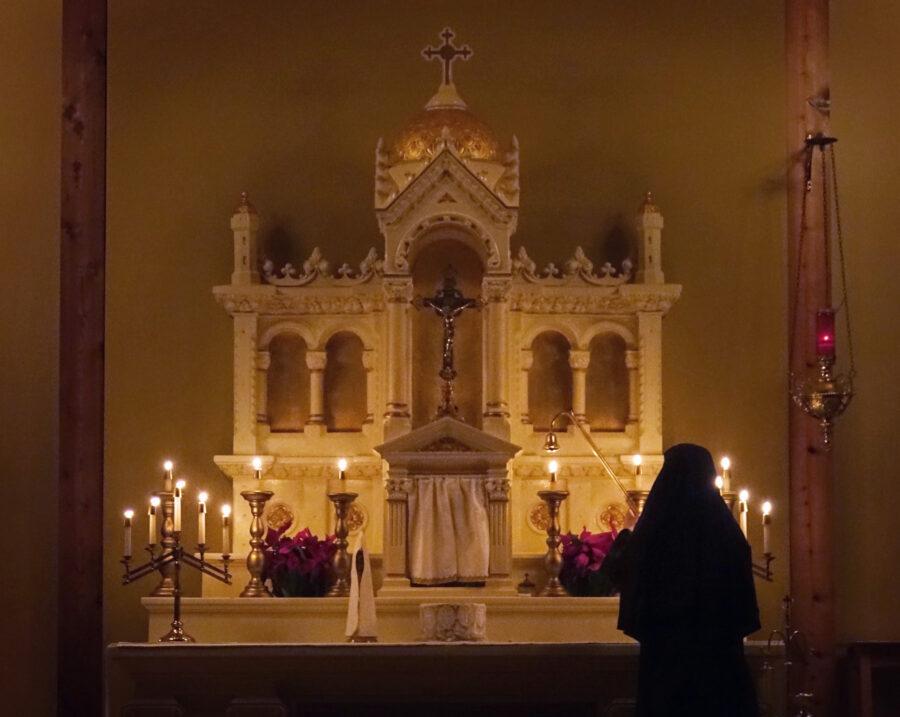
A member of the Benedictines of Mary, Queen of Apostles is seen during vespers in Gower, Missouri. (CNS photo/Karen Pulfer Focht)
After our parents died, my sister and I knew that our maiden name would not carry on. Since there were just the two of us girls and we both took our husbands’ names when we married, the surname “Arthur” died with my dad. But it wasn’t just the name that we lost with the passing of the older generation. We also lost some family traditions that were important to my parents but less so to my sister and me, like eating peanut butter pie on Christmas day and my dad’s prayer before meals. We even lost a bit of the connection with some cousins that we used to see more regularly when my mom controlled the family social calendar.
Many religious communities are working now to keep this same kind of thing from happening to them. Since the number of religious sisters, priests, and brothers has decreased significantly in recent decades, wise communities of vowed religious are working to ensure that their order’s unique spin on how they live out the Gospel can be passed to future generations through the lay people involved in their sponsored ministries.
That spin has a name, one that is commonly misunderstood: Charism. A charism is defined in some circles as a “special power,” but this conjures up images of snake-handling believers speaking in tongues, which doesn’t quite hit the mark. Others define it as a talent, but in common parlance, we don’t say that a good pianist has a “musical charism” or that an accomplished chef has a “culinary charism.” Still, others define it as a “gift of the Holy Spirit,” which is certainly true and the original meaning of the root word in Greek, but this definition is still a bit too general to be useful.
The Catechism of the Catholic Church defines charisms as “graces of the Holy Spirit which directly or indirectly benefit the Church, ordered as they are to her building up, to the good of men, and to the needs of the world” (Article 799). In everyday language, a charism can be understood as “the gifts from God that allow a person or group to live out the Gospel in relation to the world around them.” In this way, it is the power/talent/gift/grace through which a religious order puts the Gospel into daily practice.
You’d be forgiven for assuming that religious orders are all pretty much the same. Many people do since, after all, they take many of the same vows. But just as your family and mine both celebrate Christmas, we might have very different ways of doing so. Your family might insist on exchanging presents on Christmas Eve before attending midnight Mass. Mine might prioritize the use of an Advent calendar, caroling, and Christmas movie marathons. Both of us honor the feast, but we each have our own spin on it.
Similarly, all Catholic religious orders work to live out the Gospel, but each one does so in its own way. Some emphasize prayer and contemplation while others concentrate on service in the community. Some sponsor ministries in health care while others are devoted to education. Some prioritize long-standing traditional Catholic practices, while others emphasize advocacy and social justice. Each has its own “gifts of the Holy Spirit” that enable them to live out their mission as a religious order in the Church.
Understanding charism in this way is more important today than ever before. Just as I lost family traditions and connections to relatives after my parents died, religious orders are in danger of losing their particular spins on Gospel living now that the future of the ministries they sponsor are run by lay people.
Although this may sound like bad news, it’s not! At least, it doesn’t have to be. In fact, religious communities have a unique opportunity to nurture – and even elevate – their charism within the ministries that they sponsor. I work at an all-girls Catholic high school sponsored by the Sisters of Mercy. When the school opened in 1955, all the teachers and administrators were religious sisters who lived in the convent attached to the building. But we haven’t had a Sister of Mercy employed as a teacher at our school in more than 20 years.
However, the charism of the Sisters of Mercy is stronger and more visible at our school than it ever was before the advent of lay teachers. That’s because the sisters recognized the need to be very intentional and explicit in teaching their charism to the lay people who began to replace them in their ministries. At my school, everyone from the president and principal down to the newest freshman student can tell you what the core values of the Sisters of Mercy are and what social justice issues they prioritize in their service and advocacy. That was not the case in decades past.
Fortunately, many religious orders have been forward-thinking as they look to the future. They have wisely taken the challenge of declining numbers and turned it into an opportunity to clearly define and communicate their charism. In fact, their example has encouraged me to be more intentional about the family traditions I hope my son will pass on to his children and grandchildren. Sometimes the threat of losing something of value is the very thing that makes it more precious over time.
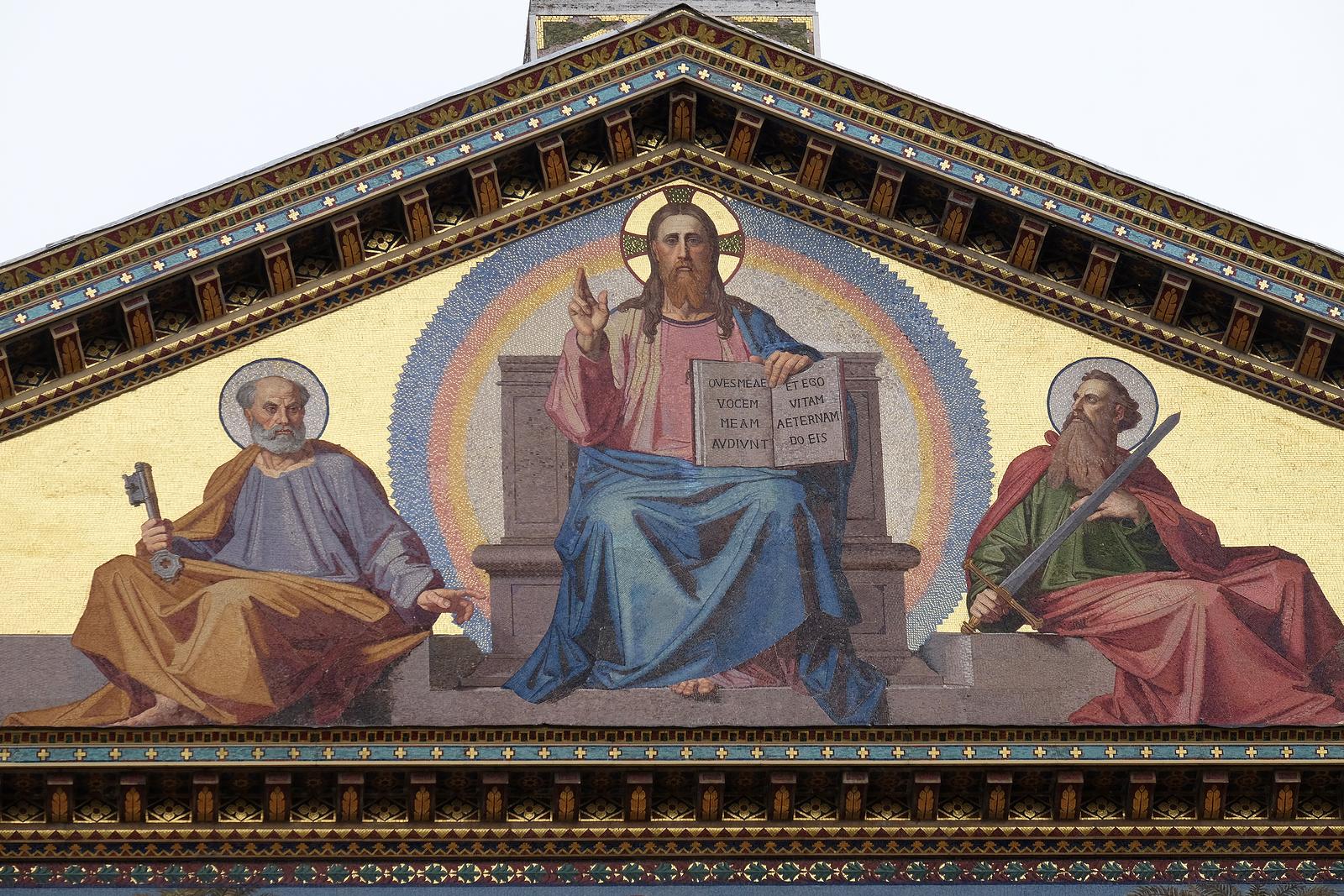
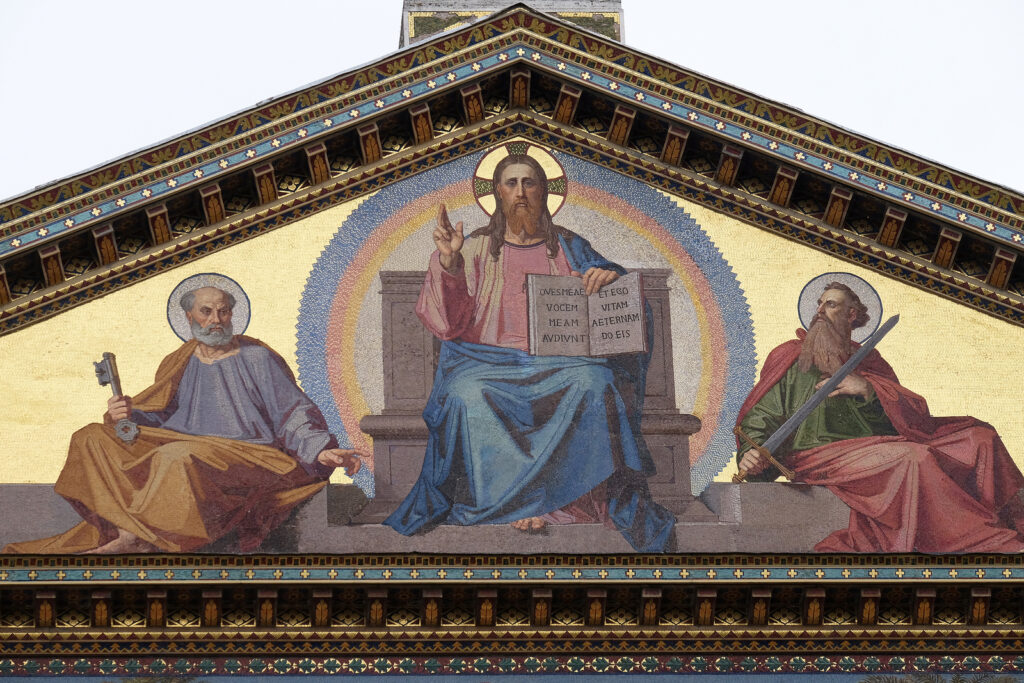
ROME, ITALY – SEPTEMBER 05: Mosaic of Jesus Christ the Teacher, Saints Peter and Paul, Basilica of Saint Paul outside the walls, Rome, Italy on September 05, 2016.
St. Peter and St. Paul are two of the most well-known saints and are often spoken of as the two men most responsible for spreading the Christian message in the days of the early church.
As to why they are celebrated on the same day, legend has it that they were executed on the same day under the command of Emperor Nero and buried in Rome. (Although historical accounts cite Peter being martyred in 64 AD and Paul in 67 AD.)
Because of his Roman citizenship, Saint Paul was beheaded. St. Peter was reportedly crucified upside down because he said he was not worthy to be sacrificed in the same manner as Christ.
June 29, the Church celebrates the feast day of both men, and as early as 258 AD, there is evidence of an already-lengthy tradition that both Saint Peter and Saint Paul were celebrated on the same day.
In a sermon in the year 395, St. Augustine of Hippo said of Saints Peter and Paul:
“Both apostles share the same feast day, for these two were one; and even though they suffered on different days, they were as one. Peter went first, and Paul followed. And so we celebrate this day made holy for us by the apostles’ blood. Let us embrace what they believed, their life, their labors, their sufferings, their preaching, and their confession of faith.”
Editorial note: The following article contains mentions of pregnancy/infant loss.
The loss of a child is a heartbreaking situation. There is grief over the death of the beloved child, of course, but also over the child’s future now lost. Additionally, there can be grief and uncertainty over the soul of the child and where they are now. In the midst of this loss, the Catholic Church has always offered words of consolation and hope, trusting in God’s infinite love and mercy. Amid the pain of miscarriages, stillbirths, and lost children, we find consolation in our God who desires all children of the world to come to him. To any and all persons facing such loss, please know you have the prayers of the Busted Halo staff.
Throughout history, some have responded to these griefs and uncertainties by saying that children who pass away before receiving the Sacrament of Baptism are in Limbo. Limbo is at the heart of a tension between understanding God as being all-loving and desiring the salvation of all and the Catholic understanding that baptism is needed for salvation. This raises questions, especially about the souls of unbaptized children and what happens to them in the next life. The loss of a child is always especially difficult, and many in the Church have tried to find explanations that offer consolation. Limbo was one such answer to those questions, and while never completely embraced by the Church, neither has it been completely done away with. The answer to “Does Limbo exist?” is a much more complex question and requires a look at the growth of the idea of Limbo over time.
In the tension between understanding salvation that required baptism and understanding that a loving God wouldn’t punish children who never had the option or ability to be baptized, St. Augustine was among the first to discuss the idea of “Limbo.” This would be a place separate from heaven and fully enjoying the presence of God, but also away from hell. To some theologians, Limbo existed on the edge of hell but was not a place of suffering. To others, it was a place of pleasant neutrality. There was, however, never an official definition or understanding of what Limbo was or what it was like. Other theologians throughout the ages, such as St. Thomas Aquinas and St. Alphonsus Liguori, would continue to write about Limbo.
Yet with all of this writing, the concept of Limbo had never been formally adopted as the Church’s position. The closest the Church got was the mention of Limbo in St. Pius X’s Catechism in question 100 wherein he wrote: “Children who die without baptism go to Limbo, where they do not enjoy God, but neither do they suffer.” However, this Catechism was never made known as official teaching for the whole world, but rather, for the faithful in the city of Rome. St. Pius X wrote and published it only for the immediate Church in Rome as the local bishop, not for the whole world.
Even though this idea was shared by a pope, it was never a universal idea in the Church, or adopted as official Catholic teaching. St. Cajetan, a priest in the 16th Century, notably wrote against the idea of Limbo. He argued that children who are unable to be baptized in life share in the concept of Baptism by Desire (that someone who desires God’s grace but is physically unable to be baptized is still saved and in effect, baptized) because of their mothers’ love and desire to have them baptized. St. Cajetan argued for a more open approach to God’s mercy for these children.
In 1980, the Congregation for the Doctrine of Faith (CDF) put out Instruction on Infant Baptism. In this document, they stated that: “As for children who die without Baptism, the Church can only entrust them to God’s mercy, as she does in the funeral rite provided for them.” The CDF felt that the most important thing to say on the death of a child before they were baptized was to entrust that soul to God’s infinite mercy.
About 25 years later, the International Theological Commission wrote The Hope of Salvation for Infants Who Die Without Being Baptized. In this, the Commission made several arguments to uphold the idea that a child who died before baptism could share in God’s joy in heaven eternally. They rooted these arguments in paragraph 1261 of the Catechism of the Catholic Church which states: “[there is] hope that there is a way of salvation for children who have died without Baptism.” They also point to our celebration of the infant martyrs on December 28, that we celebrate them as martyrs and saints even though they were never baptized. Finally, the document reminds us that Christ’s salvific love is true – and a greater truth than original sin, which we are all subject to. As such, Christ’s love will win out, and this gives us great hope and joy for the salvation of unbaptized children.
Interestingly enough, though, none of these statements outright deny the existence of Limbo. Rather, the Church places greater emphasis on hope and trust in God’s love when it comes to the souls of unbaptized children. One can be a good Catholic whether or not they believe in Limbo.
Personally, I find that the idea of Limbo does not line up with what I have been taught about a loving and merciful God. I have great hope and trust in God’s love to welcome unbaptized children into heaven and find that this gives greater peace to those who have faced such a loss. If anyone should find themselves in the situation of walking with someone who lost a child before a baptism was celebrated, my first piece of advice is simply to be with them. Not necessarily to even say anything, but to be present alongside them in mourning and an image of God’s merciful love in the time of loss. When words are needed, words of hope, especially those of Christ, are most consoling. As Jesus said, “Let the children come to me, and do not prevent them; for the kingdom of heaven belongs to such as these” (Matthew 19:14).
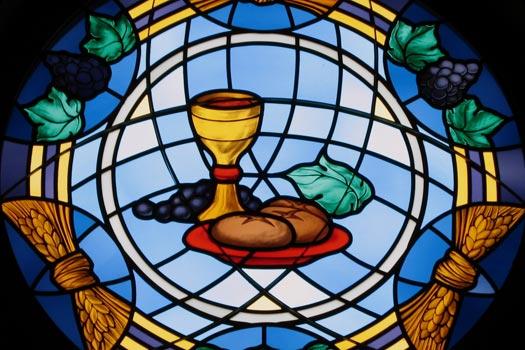
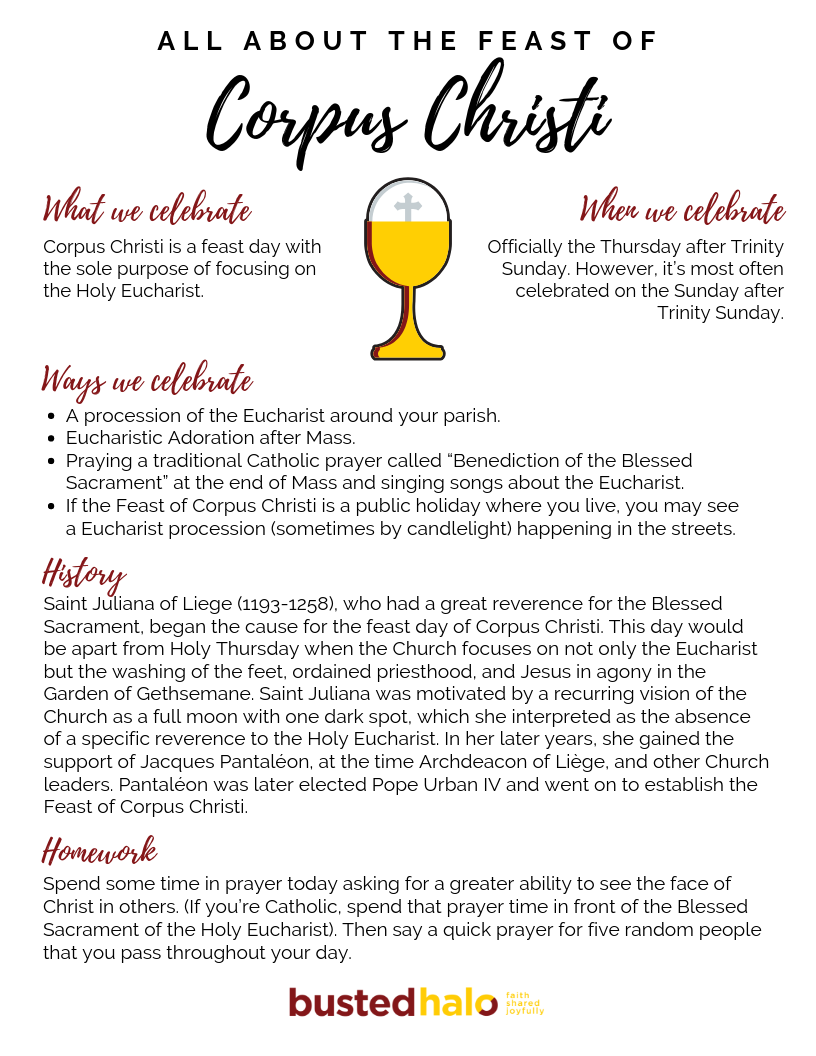
Have you ever wondered why there’s a specific celebration for Corpus Christi (Latin for “Body of Christ”)? Don’t we celebrate the Body and Blood of Christ at every Mass? Here are a few facts about this Holy Day. (We also created a handout with some of these details, below, that you can download and share at your parish.)
Date:
Officially the Thursday after Trinity Sunday. However, it’s most often celebrated on the Sunday after Trinity Sunday.
Established:
By Pope Urban IV on September 8, 1264
What we celebrate:
Corpus Christi is a feast day with the sole purpose of focusing on the Holy Eucharist.
History:
Saint Juliana of Liege (1193-1258), who had a great reverence for the Blessed Sacrament, began the cause for the feast day of Corpus Christi. She thought that the Eucharist deserved its own exclusive day of reverence and recognition. This day would be apart from Holy Thursday when the Church focuses on not only the Eucharist but the washing of the feet, ordained priesthood, and Jesus in agony in the Garden of Gethsemane. Saint Juliana was motivated by a recurring vision of the Church as a full moon with one dark spot, which she interpreted as the absence of a specific reverence to the Holy Eucharist. She worked more than 40 years for the cause until her death. In her later years, she gained the support of Jacques Pantaléon, at the time Archdeacon of Liège, and other Church leaders. Pantaléon was later elected Pope Urban IV and went on to establish the Feast of Corpus Christi.
How we celebrate:
There may be a procession of the Eucharist around your parish.
Eucharistic Adoration may be held after Mass. (Stick around and see what it’s all about!)
You might hear a traditional Catholic prayer called “Benediction of the Blessed Sacrament” at the end of Mass. There will also be songs about the Eucharist and lots of incense.
If you live in one of the countries where the Feast of Corpus Christi is a public holiday, you may see a Eucharist procession (sometimes by candlelight) happening in the streets.
Homework:
Spend some time in prayer today asking for a greater ability to see the face of Christ in others. (If you’re Catholic, spend that prayer time in front of the Blessed Sacrament of the Holy Eucharist). Then say a quick prayer for five random people that you pass throughout your day.
Here’s some inspiration for your prayers from Pope Francis: “The Eucharist affects the way we see others. In his life, Christ manifested his love by being with people, and by sharing their desires and problems. So, too, the Eucharist brings us together with others — young and old, poor and affluent, neighbors and visitors. The Eucharist calls us to see all of them as our brothers and sisters, and to see in them the face of Christ.”
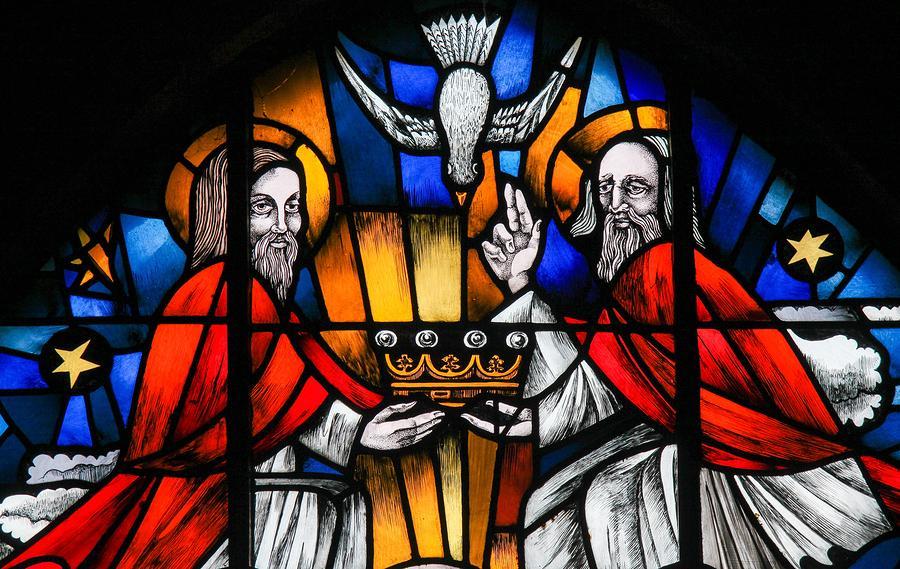
The Trinity is the manner in which Catholics believe God is revealed to the world. The Catechism of the Catholic Church tells us, “The mystery of the Holy Trinity is the central mystery of the Christian faith and of the Christian life.” (CCC, #261)
The Church shows that because God is “mystery,” meaning that we just can’t pin God down — we’re unable to know everything there is to know about God — God has tried to communicate to us just who He is. Traditionally, the Church expressed this as, God being revealed as Father, Son, and Holy Spirit, three expressions or “persons” of one divine essence. The Trinity is one. Catholics do not believe in three Gods but rather one God in a unity of three persons with one divine nature.
The church uses the image of the Father — the Creator from which everything flows and has its being — to express the first person of the Trinity. While the Son and the Holy Spirit are not “lesser gods” they do proceed from the Father as God’s own self-gift to humanity.
God the Son
The second person of the Trinity is the Son — Jesus himself, God become man. Catholics believe that God freely chooses to come into human history in the person of Jesus. God becomes like us and dies our human death for us. But because Jesus is God, He cannot be held by death and rises to a new life, supremely better than human experience.
God the Holy Spirit
The third person of the Trinity is the Holy Spirit, who proceeds from both the Father and the Son. Jesus announces that his Father will send the Holy Spirit to be with and in the disciples, to teach and guide them. The Spirit is God’s real presence living within all of us, which brings us inspiration (which literally means “to draw in the Spirit”).
God is three “persons” but one “essence.” The Father is just as much “God” as the Son and neither is “more God” than the Spirit.
Still confused? Let’s try thinking of these things in yet another way. Instead of “persons” let’s substitute the word “expressions” of God.
Expressions of God
The Trinity can be thought of in these three expressions:
God is “beyond us.”
We can never really fathom what God is, but we know that He is far beyond our limited human nature or anything we can come to know in that human experience. God is the ultimate mystery, the question that we never fully answer. This is God the Father — the creator, the one who is beyond all understanding.
God is also “among us.”
We come to know God in the person of Jesus. God takes on our human nature and becomes “one of us.” Catholics also believe that this human experience of God continues in the sacrament of the Eucharist. God the Son is among us.
God is also “within us.”
God is the “divine spark” that awakens us to the fact that we are alive. God imbues us with our creativity, our gifts and talents, and our limitations as well. As we come to know ourselves as people, we also come to know God — who knows us better than we know ourselves. This is the experience of God the Holy Spirit.
God is all these things and more. We don’t know all that God is but this is how God has been revealed to us throughout the course of our history — how we have come to best express God.


 Q: Scientists are constantly trying to “prove” the existence of ghosts or departed spirits. What is the Catholic teaching on the presence of ghosts or spirits?