
Tag: purgatory

  • How Prayer Cards Help Me Honor the Holy Souls That Have Gone Before Me

    How Prayer Cards Help Me Honor the Holy Souls That Have Gone Before Me

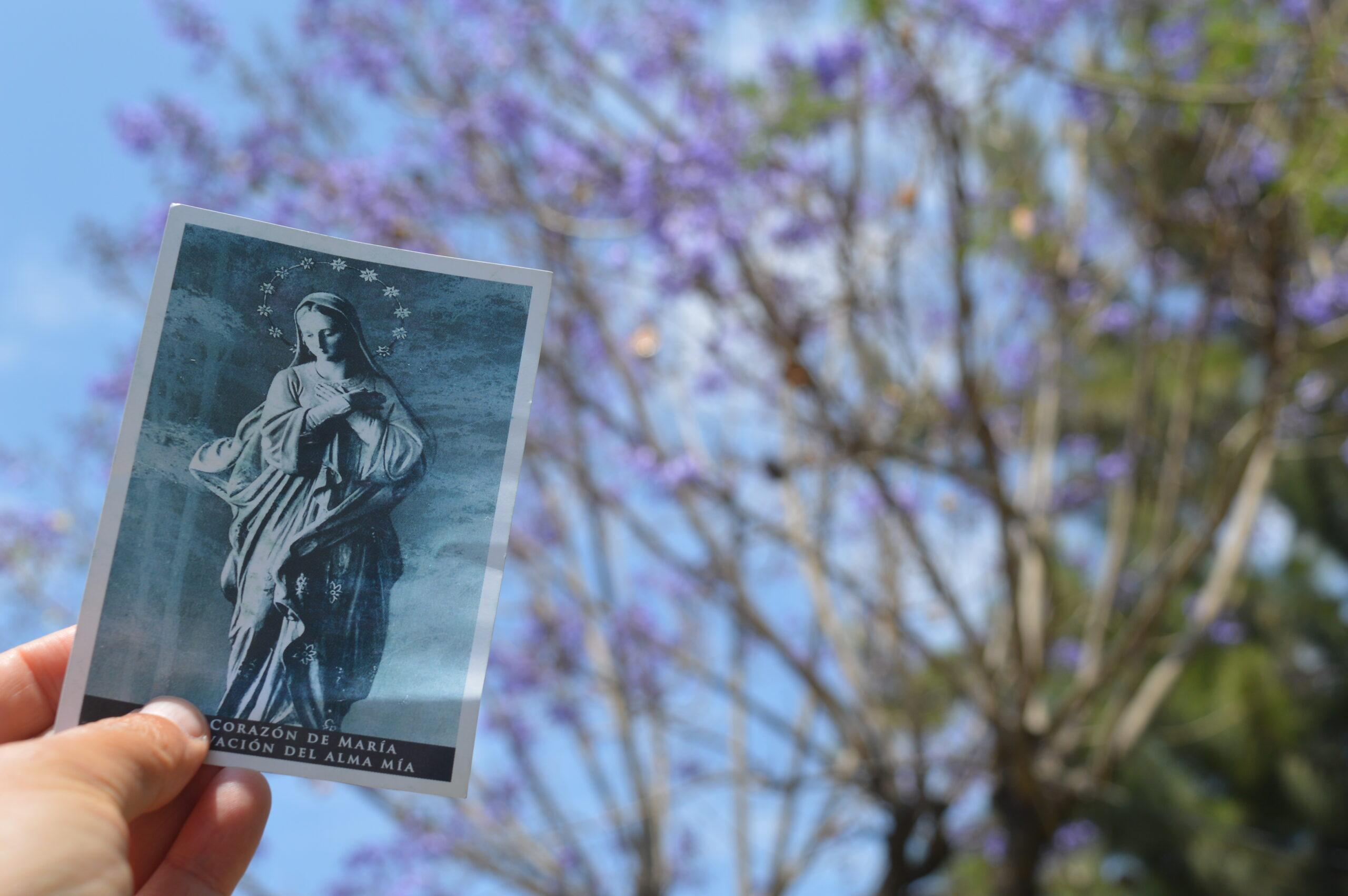
    The cover photo consists of the Virgin Mary on a prayer card held up towards the sky.

    A few years ago, some bedroom repair work forced me to move piles of stuff around. As I was rearranging the room, I happened to notice a novelty box in which I have kept memorial cards of the deceased for many years.

    As I looked through the cards, there were surprises – people I had forgotten about who had shown acts of kindness to me: a friend’s sister, a woman I volunteered with at a pregnancy resource center, great aunts and uncles, holy priests. Cards of relatives who had died before I was born had been passed down to me — like my grandfather, who I never knew (except through stories from my Mom and grandmother).

    RELATED: Grateful to Our Beloved Dead: Remembering Lessons From My Late Grandparents

    As I went through the remembrances, I said the prayers on the backs of them. I noticed connections – this person died on the same day as that person, years later. I thought about these women and men, all of whom had an effect on my life in little or big ways, in ways that I will never know; I realized, we really are “the communion of saints.”

    Since I work in communications, my thoughts often focus on the tools we use to communicate. Those memorial cards communicate! They communicate a life of a man or woman made in the image and likeness of God with a unique story of love and pain and joy and suffering – of God’s plan lived out.

    In November, we pray for the Holy Souls so they can share in the Beatific Vision of our Lord Jesus Christ who sacrificed his life and death for us and loves every single soul.

     LISTEN: Can the Souls in Purgatory Pray for Us?

    A friend of mine puts praying for the Holy Souls in action by keeping a running prayer list with names of the deceased, going back generations. Similar to keeping memorial cards, it is a tangible reminder of those who have been before us and our need to pray for them. It also makes me think of the tradition of Native Americans that I learned about in the Knights of Columbus documentary, “Enduring Faith: The Story of Native American Catholics,” aired on EWTN prior to the Holy Father’s visit to Canada in the summer of 2022.

    Harold Compton, the Deputy Director of Policy and Research for the Rosebud Reservation talked about how they believe in the sacredness of the number seven, and aim to look at how their actions as a tribe will affect seven generations forward. They encourage thinking about how one sits in the middle of those seven generations: “Looking back three generations – what did you learn from those three generations; what have they given you? And the three generations coming after you, and looking at what you, as the middle of that seven generations, can do, sharing that knowledge from the past with the future.”

    As I think back three generations, I recall a story about how a great-grandfather (who of course I did not know) would open the door of his home after Mass to provide food for the homeless. My grandmother carried that story forward to me and I can share it with my nieces and nephews.

    RELATED: Why Do Catholics Pray for the Dead?  

    So, if you are in a desperate fit when cleaning, do not throw out those memorial cards. This November, pray for the departed, ponder something you know about him or her, and how you might carry that lesson forward. Ask the Holy Souls to pray for you.

    When we were children, we were taught to pray for “the most abandoned soul in purgatory.” It is a spiritual work of mercy. Saint Stanislaus Papczyński said: “There is no greater act than to pray for the holy souls in Purgatory because unlike us on earth, they can no longer pray for themselves.”

    My box of memorial cards is overflowing. Soon I will need a new one. And someday there will be a dusty card with my name on it (I sure hope they don’t go all digital). I hope one November, decades from now, some great-great niece or nephew picks up that card and prays for me. That, indeed, will be a work of mercy.

    Originally published Nov. 3 2023.

  • What Does the Church Say About Limbo?

    What Does the Church Say About Limbo?

    White Clouds and Blue Sky
    Photo by Ithalu Dominguez on Pexels

    Editorial note: The following article contains mentions of pregnancy/infant loss.

    The loss of a child is a heartbreaking situation. There is grief over the death of the beloved child, of course, but also over the child’s future now lost. Additionally, there can be grief and uncertainty over the soul of the child and where they are now. In the midst of this loss, the Catholic Church has always offered words of consolation and hope, trusting in God’s infinite love and mercy. Amid the pain of miscarriages, stillbirths, and lost children, we find consolation in our God who desires all children of the world to come to him. To any and all persons facing such loss, please know you have the prayers of the Busted Halo staff.

    Throughout history, some have responded to these griefs and uncertainties by saying that children who pass away before receiving the Sacrament of Baptism are in Limbo. Limbo is at the heart of a tension between understanding God as being all-loving and desiring the salvation of all and the Catholic understanding that baptism is needed for salvation. This raises questions, especially about the souls of unbaptized children and what happens to them in the next life. The loss of a child is always especially difficult, and many in the Church have tried to find explanations that offer consolation. Limbo was one such answer to those questions, and while never completely embraced by the Church, neither has it been completely done away with. The answer to “Does Limbo exist?” is a much more complex question and requires a look at the growth of the idea of Limbo over time.

    LISTEN: Navigating Miscarriage, Stillbirth, and Infant Loss With Abigail Jorgenson

    In the tension between understanding salvation that required baptism and understanding that a loving God wouldn’t punish children who never had the option or ability to be baptized, St. Augustine was among the first to discuss the idea of “Limbo.” This would be a place separate from heaven and fully enjoying the presence of God, but also away from hell. To some theologians, Limbo existed on the edge of hell but was not a place of suffering. To others, it was a place of pleasant neutrality. There was, however, never an official definition or understanding of what Limbo was or what it was like. Other theologians throughout the ages, such as St. Thomas Aquinas and St. Alphonsus Liguori, would continue to write about Limbo.

    Yet with all of this writing, the concept of Limbo had never been formally adopted as the Church’s position. The closest the Church got was the mention of Limbo in St. Pius X’s Catechism in question 100 wherein he wrote: “Children who die without baptism go to Limbo, where they do not enjoy God, but neither do they suffer.” However, this Catechism was never made known as official teaching for the whole world, but rather, for the faithful in the city of Rome. St. Pius X wrote and published it only for the immediate Church in Rome as the local bishop, not for the whole world.

    Even though this idea was shared by a pope, it was never a universal idea in the Church, or adopted as official Catholic teaching. St. Cajetan, a priest in the 16th Century, notably wrote against the idea of Limbo. He argued that children who are unable to be baptized in life share in the concept of Baptism by Desire (that someone who desires God’s grace but is physically unable to be baptized is still saved and in effect, baptized) because of their mothers’ love and desire to have them baptized. St. Cajetan argued for a more open approach to God’s mercy for these children.

    WATCH: Baptism 101

    In 1980, the Congregation for the Doctrine of Faith (CDF) put out Instruction on Infant Baptism. In this document, they stated that: “As for children who die without Baptism, the Church can only entrust them to God’s mercy, as she does in the funeral rite provided for them.” The CDF felt that the most important thing to say on the death of a child before they were baptized was to entrust that soul to God’s infinite mercy.

    About 25 years later, the International Theological Commission wrote The Hope of Salvation for Infants Who Die Without Being Baptized. In this, the Commission made several arguments to uphold the idea that a child who died before baptism could share in God’s joy in heaven eternally. They rooted these arguments in paragraph 1261 of the Catechism of the Catholic Church which states: “[there is] hope that there is a way of salvation for children who have died without Baptism.” They also point to our celebration of the infant martyrs on December 28, that we celebrate them as martyrs and saints even though they were never baptized. Finally, the document reminds us that Christ’s salvific love is true – and a greater truth than original sin, which we are all subject to. As such, Christ’s love will win out, and this gives us great hope and joy for the salvation of unbaptized children.

    RELATED: 9 Ways to Help a Grieving Friend

    Interestingly enough, though, none of these statements outright deny the existence of Limbo. Rather, the Church places greater emphasis on hope and trust in God’s love when it comes to the souls of unbaptized children. One can be a good Catholic whether or not they believe in Limbo.

    Personally, I find that the idea of Limbo does not line up with what I have been taught about a loving and merciful God. I have great hope and trust in God’s love to welcome unbaptized children into heaven and find that this gives greater peace to those who have faced such a loss. If anyone should find themselves in the situation of walking with someone who lost a child before a baptism was celebrated, my first piece of advice is simply to be with them. Not necessarily to even say anything, but to be present alongside them in mourning and an image of God’s merciful love in the time of loss. When words are needed, words of hope, especially those of Christ, are most consoling. As Jesus said, “Let the children come to me, and do not prevent them; for the kingdom of heaven belongs to such as these” (Matthew 19:14).