Tag: parenting

  • Hands-on Faith: How Contact Builds Our Connection to Christ

    Hands-on Faith: How Contact Builds Our Connection to Christ

    My daughters love museums  –  a fact which has required practice, cajoling, and plenty of snacks – but, once sparked, the adventure of discovery is contagious. Throughout our family’s recent trip to Washington, D.C., we experimented with which museums worked best for children. The National Art Gallery, with its automated “please step back from the art!” alerts and constant shushing of giggles was not a friendly option for us. We felt more at home in the National Museum of Natural History. My girls, barely 3 and almost 6 years old, stared in awe at the towering dinosaur bones, the blue whale suspended above the ocean room, and the countless treasures encircling the iconic elephant, Henry, who oversees the entryway. In the Hall of Fossils, I noticed a sign that both shocked and delighted me, reading “please touch.” My girls hurried over to feel the dinosaur bones replicas, their faces alight with joy at having the opportunity to interact with something so precious. 

    We discovered more of these thoughtful signs throughout the museum, on huge stones containing amethysts, on ammonoid fossils, and on a section of sea coral. My younger daughter chatted all day about how she touched the amethyst. She loved the shape of the gemstones, how cold it felt to the touch, its color and how it shifted in the light. Having seen a great deal of beautiful and fascinating things behind pristine glass, the opportunity to touch and handle an exhibit was priceless. 

    RELATED: Children and the Church: Recognizing the Welcome

    While my husband and I chuckled at her newfound love for gemstones, we also recognized a deep truth within her delight: Connection is strengthened through contact. Contact can manifest in various forms, but that tactile connection impacted her in a way that merely viewing never could have. These dear signs scattered across the museum brought to my mind John 20:27. As the newly resurrected Jesus offers his hands and side for Thomas to touch, he tells Thomas, “Put your finger here; see my hands. Reach out your hand and put it in my side…”offering his body as proof of his resurrection. 

    Photo courtesy of the author

    Throughout the New Testament, Jesus offers his incarnated body to his people to see, to hear, and to touch. The Gospels open with the nativity, a sign of God’s love for us which shocks and delights. Although we celebrate the birth of Jesus yearly, this gift of the incarnation of our God continues to astound me. God became man, took on flesh, accepted vulnerability and human needs in order to connect with, serve, and save his creations. His birth, upbringing, and adulthood were far from lavish, sheltered experiences; he was born in a time of danger and fear for the lives of the young. He was brought into the world by a young woman away from her family and spent his early years in a foreign country; Christ touched and lived in the world of the lowly. 

    RELATED: How My Young Family is Making Room for Christ this Christmas

    In turn, he offered himself in ministry and sacrificed for the humble and proud alike. The incarnation was a fulfillment of prophesies and promises, but the way Christ served his people while on earth was also an invitation for connection. Christ told his disciples, “Let the little children come to me, and do not stop them; for the kingdom of heaven belongs to such as these.” (Matthew 19:14). He never shied away from his people and their need for him. He walked dusty roads, cried with his friends, healed with spit and mud, and in all his actions, formed connections through contact. 

    We are a tactile people, drawn to contact, longing for connection. Our God knew this; he created us in this way. So, in all his love for us, he reached down from heaven, took on flesh and said to all his people, “please touch.” As we enjoy this season of Advent and remember the incarnation, how will we answer God’s invitation for connection? Perhaps this Advent we will clasp Christ’s outstretched hand and focus on our relationship with him, leaning into each week of Advent and preparing our hearts for his second coming. Or maybe our connection will be extending that hand of welcome to our neighbor; inviting them in so as to reflect God’s love into their life. Hopefully we can do both, loving our neighbor as God loves us. Connecting with others in the knowledge that we serve a God who continually invites us into a relationship with him. 
  • Holy Friends: 4 Saints to Turn to  This All Saints’ Day

    Holy Friends: 4 Saints to Turn to This All Saints’ Day

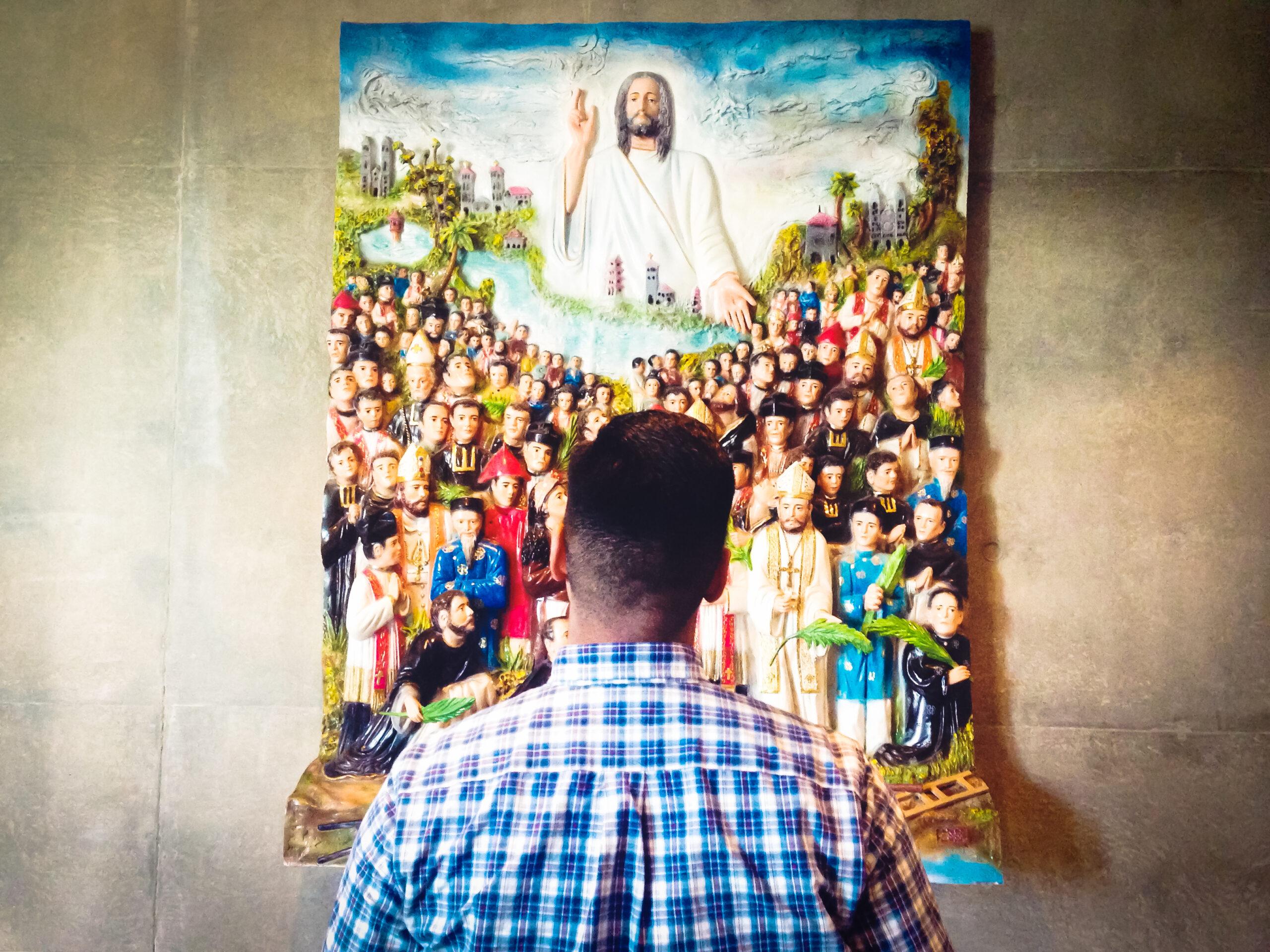
    Man in flannel shirt looking at a painting of Jesus and several saints.
    Photo by Angie Menes on Cathopic.

    As a convert to Catholicism, I’ve found that the veneration of the saints is a part of the faith that has taken me a little while to get used to. Having children has transformed that experience. Perhaps because they grew up with the idea of saints in their midst, my 9-year-old and 10-year-old bring up saints frequently. They love reading, watching, and listening to stories about the saints, celebrating feast days, and asking certain saints to intercede for our family at particular times.

    In this way — and perhaps this is normal for most Catholic families — I have realized that my family has “befriended” certain saints. Or maybe those saints have been kind enough to befriend us.

    RELATED: Want to Raise Little Saints? Tell the Saints’ Stories

    Throughout the day, we’ll talk to saints who have become part of the fabric of our lives, joking about what this saint might think of this or that daily task we’re doing. Would St. Thomas Aquinas, the patron saint of students, approve of my daughter deciding to watch another episode of “Bluey” instead of studying? Is St. Christopher, the patron saint of travelers, tired of seeing those Doritos bags strewn all over the car, and would he prefer a nicer ride, maybe?

    It probably won’t surprise you to learn that All Saints’ Day has become one of my family’s favorite holy days in the liturgical calendar. Here are a few of the saints that our family turns to frequently, and whom we’re happy to share with others looking for new family friends:

    1. St. Elizabeth Ann Seton (1774-1821)

    This new school year has been a test for my daughter. Third-grade math and social studies have been more challenging than she anticipated, and her grades have suffered. She prefers “girl saints,” so we’ve studied St.  Elizabeth Ann Seton together. St. Elizabeth Ann Seton, the first American-born Catholic saint, is perhaps best known as the founder of our parochial school system. 

    In reading a recent biography, I discovered that when she was younger, St. Elizabeth loved to dance and was fond of the fancy cream-colored slippers she wore to one of George Washington’s birthday parties. My daughter, who is a ballet enthusiast, found this anecdote inspiring. We often talk to St. Elizabeth about dancing and school—about how young women need to focus on both to be well-rounded. 

    Because Elizabeth Ann Seton also founded and led the Sisters of Charity, the first community for women religious in the United States, she’s an excellent role model for female leadership. As a teacher, I often turn to her myself! Before big test days, my daughter and I pray for St. Elizabeth Ann Seton’s intercession for her and her classmates, and she wears a St. Elizabeth medal around her neck daily.

    RELATED: How to Make Friends With a Saint

    2. St. Augustine of Hippo (354-430)

    If you’ve ever heard that old quip about kids who ask “why” constantly, then you’re actually talking about my fifth-grade son — who asks “why” about everything, including our Catholic faith. This cool kid spends most of his spare time reading books: You can’t catch him without a “Harry Potter” tome in his hands recently. He also has allergies and often rubs his eyes. 

    Last year, as his dad and I read Augustine’s “Confessions” together, we determined that this patron saint of theologians and sore eyes might be a good fit for our son to learn more about because we loved how Augustine transformed himself from a public thinker and speaker, or rhetorician, to a devoted intellectual and spiritual servant of God. 

    Every year, our parish hosts a fall festival, where children dress up as saints and participate in a costume contest. One of our family traditions is that our kids read a book about the saint they choose to emulate. When he was 8, our son flew through a biography about Augustine by Simonetta Carr, enjoying learning about the saint’s many travels. 

    St. Augustine is pretty inspiring for a child who loves facts and asking the “whys” of life, and I’m already looking forward to when my son’s old enough for us to read some of Augustine’s original writings together. (Plus, I always remind him that St. Augustine was a fan of another Catholic saint — his mom, St. Monica — who helped lead this beloved saint to his eventual conversion.)

    LISTEN: What Are the Benefits of Praying to Saints?

    3. St. Jude Thaddeus (between 1-80)

    I doubt there’s a Catholic household with children during cold and flu season where St. Jude — one of Christ’s 12 Apostles — isn’t often invoked. As a child, my husband caught pneumonia a few times, and because he also has asthma, he became extremely ill. St. Jude has always been a favorite friend of my spouse due to the saint’s association with sick children, mainly because of the famous children’s hospital that bears his name. 

    This fall, my father-in-law has been ill and hospitalized. He is currently in a rehabilitation center, but his case has been up and down for weeks. Some days, our family has been unsure if he will make it. Throughout this period, St. Jude, the patron saint of the “lost causes,” has been our family’s rock. We know we are not alone in this devotion. 

    St. Jude’s popularity rose in the United States during the Great Depression when many felt as if they were going through hopeless times. It was during this tumultuous period that Fr. John Tort felt called to found The National Shrine of St. Jude in Chicago: The saint’s popularity soon spread throughout the country and has since provided solace to many going through difficult times, whether due to illness or other challenges. St. Jude, who wears green in his iconography as a symbol of hope and renewal, is one of those saints whose name often rolls off the tongues of everyone in my family when we pray together during Mass or Adoration. Simply hearing his name tends to bring us a sense of peace.

    RELATED: How Do the Saints Hear Our Prayers?

    4. St. Hildegard of Bingen (1098-1179)

    As a convert, I often feel behind in my faith — and it might seem funny that I’ve found inspiration this past year in St. Hildegard — a German Benedictine abbess, writer, poet, composer, mystic, and theologian. If her résumé isn’t intimidating, I don’t know whose would be! St. Hildegard wrote nine books and at least 155 musical compositions, including a musical morality play, “Ordo Virtutum.” This only scratches the surface of her accomplishments! What I find most inspirational is that she didn’t begin writing until she was 42. In other words, there’s still hope for those of us who haven’t achieved all we would have liked yet. 

    Her first theological book, “Scivias (Know the Ways),” discusses the difficulties of balancing her spiritual experiences with intellectual reasoning. While we may not all have visions like Hildegard, many of us still struggle with balancing faith and reason and articulating our reconciled ideas to others with moral courage. Often, when I struggle in my professional life as a faith-filled teacher and writer, I think of Hildegard’s example and ask for her to intercede on my behalf, putting my fears to rest.

    By turning to these saints regularly — along with others I haven’t mentioned here and feel guilty about not including (please forgive me, St. Francis Xavier, St. Hedwig of Silesia, St. Sigismund of Burgundy, and St. Frances Cabrini, among others) — I’ve come to realize these figures aren’t distant at all. As St. Elizabeth Ann Seton reminds us, “We must pray without ceasing, in every occurrence and employment of our lives,” and that’s exactly what my family strives to do now, with her help and the help of our other saintly friends. These saints have become companions, offering guidance, humor, and solace during life’s inevitable ups and downs. 

    As my family prepares to celebrate All Saints’ Day, I’m heartened by how much richer our lives have become by welcoming these holy friends — not just as inspirations but as faithful intercessors walking alongside us. And yes, one day, I pray my family will be counted among them, too.

  • 6 Bible Verses That Shepherd My Parenting

    6 Bible Verses That Shepherd My Parenting

    Parents and a toddler preparing food togetherWhen I became a Christian, I felt like God was inviting me to come to him for parenting support, through prayer and reading his word. 

    When I first looked at what the Bible said, I didn’t see much advice for parents. Apart from the often-quoted Proverbs 22:6 “train up a child in the way he should go,” there doesn’t seem to be a lot of advice that directly speaks to our parenting challenges. However, a deeper look reveals that many verses can support parents raising their children. 

    RELATED: How Memorizing Prayers Brought My Family Closer to God

    Loving our children is a reflection, on the micro level, of how Jesus loves us. As imperfect humans with a tendency to sin, it’s a lot to live up to, but thankfully God gave us his Holy Spirit to be with us. 

    Here are six Bible verses to meditate on and memorize to help us along our parenting journey. I try to read and reread these as often as I can so that when I’m in a sticky parenting situation, God’s words of advice remind me to parent in the spirit and not in the flesh. 

    1. Remember the fruit

    But the fruit of the Spirit is love, joy, peace, patience, kindness, goodness, faithfulness, gentleness, self-control; against such things there is no law (Galatians 5:22-23).

    There are many parenting moments where I don’t feel peaceful or patient, when my words aren’t kind or gentle. Having this verse at the forefront of my mind can interrupt any negative patterns of thinking. It’s so easy to forget, which is why I like to read this one often; I even spent a week meditating on it. You could put it in a prominent place like your bathroom mirror, or on the fridge. 

    2. Pray without ceasing

    Cast all your anxieties on him, because he cares for you (1 Peter 5:7).

    When I first became a Christian three years ago, I gave up new-age practices after God showed me to rely solely on him. However, my parenting actually deteriorated for a while as I did not share my problems with him! It felt much harder to rely on a God I could not see. It took an inspiring sermon on the power of prayer to really make me sit down every day, and make sure I gave every anxiety to God. After that, I felt much calmer as a parent. 

    It can be all too easy to get caught up in my worries and not involve God. The Bible is full of reminders such as; “pray without ceasing” (1 Thessalonians 5:16) and “do not be anxious about anything but in everything by prayer and supplication with thanksgiving let your requests be made known to God.” (Philippians 4:6)

    3. Speak gently

    A soft answer turns back wrath: but a harsh word stirs up anger (Prov. 15:1).

    When I want to make a request or set a limit with my kids, it can be easy to let my own emotions come out in my tone of voice. Sometimes I get frustrated about the state of the kitchen or my irritation rises as a simple request is met with complaints or arguing. Nevertheless, using a gentle, loving tone, even when we need to hold a firm limit can help to build the sense of connection children need to cooperate with us. 

    LISTEN: Tackling Kids’ Tough Questions of Faith

    4. Stay quiet

    No human being can tame the tongue. It is a restless evil, full of deadly poison (James 3.8).

    I have found this particularly helpful as my daughter has gotten older and more prone to debating or questioning me. Sometimes rising irritation can lead me to say things that I may regret later. In those moments, I try to remember the book of James which has many reminders about staying quiet. 

    5. Stop complaining

    Do all things without grumbling or disputing, that you may be blameless and innocent, children of God without blemish in the midst of a crooked and twisted generation, among whom you shine as lights in the world (Philippians 2:14-15).

    Before coming to Christ, I must admit I complained a lot, often about the state of the house and the amount of items on my to-do list. I thought of it as a healthy expression of my feelings, but in reality, there were times when my moaning just created a bad atmosphere. This verse helps me, as it acknowledges that yes, this world is fallen and broken, so there will be many struggles. But we are servants of Christ so it’s our job to shine.

    6. God makes the impossible possible

    With man this is impossible, but with God all things are possible (Matthew 19.26).

    There have been moments when things seem impossibly hard, and I feel there is no hope. When I find myself caught thinking I’m not a good enough parent, or this is never going to change, I just remember that I’m not doing it alone.

  • How My Struggle With Infertility Deepened My Relationship With Mary

    How My Struggle With Infertility Deepened My Relationship With Mary

    Photo of the Virgin Mary pregnant with Christ.
    Photo by Carolina BR on Cathopic.

    Editorial note: The following article contains mentions of pregnancy/infant loss.

    The desire to become a mother took me by surprise. Beyond early childhood years of wanting five daughters named after American Girl dolls, having kids wasn’t on my radar. However, after two years of marriage, I faced the possibility of having kids with a heart of hope. What I didn’t know at the time was that an unexpected diagnosis would make becoming pregnant more challenging than I ever thought possible.

    “You have PCOS. How has no one told you that before?” 

    I met my doctor’s gaze through the webcam. I had pushed for a meeting after months of being seen by well-intentioned but uninformed medical technicians. This diagnosis came after working with OBGYNs, holistic practitioners, and even acupuncturists while on the search for an answer to family-building. The diagnosis, though, was less of a path forward and more of a cul-de-sac.

    LISTEN: Coping With Infertility

    Turning towards Mary’s holy help

    I knew God was listening. However, He felt far away. I needed a girlfriend with whom to commiserate, a mother figure who would help me. I thought about this during my weekly Thursday night Adoration hour.

    “Am I not your mother […] how else can I help?”

    I reread the last line of Mary’s message under a painting of Our Lady of Guadalupe on the wall of my parish’s Adoration chapel. I figured if I needed help on the journey toward motherhood, who better to rely on than the Mother of Mothers? My heart began to ease as I spoke. 

    Holy Mary, I ask for your help. That you would intercede for me and ask God that if it’s not His will for me to have a child, to please, please, take the desire from my heart. 

    After another disappointing fertility cycle, I decided to try one more time. My husband, who never pressured me to have children, agreed I should take a break if this next one didn’t pan out. 

    Mary, I ask for your help again. For your holy intercession through Jesus Christ, your son my Lord, to God that it could be his holy will that I become pregnant this time. 

    As I called out to Mary, again and again, words appeared in my mind. In my head I heard, “I will help you become a mother because you first went to my mother.” I was still as that notion began to increase my confidence that maybe it was almost time. 

    RELATED: Turning to Mary in Difficult Times

    Mary’s light in dark times

    A week after my 35th birthday, the doctor’s office confirmed that not only was my positive at-home pregnancy test accurate, but also — I was having twins. After the initial shock, I imagined my bump and how I would reveal the news. My prayer life and budding relationship with Mary continued to grow as well. It all felt too good to be true, but I pushed those thoughts away.  

    At 12 weeks, I woke up and went into the bathroom. I was bleeding. Terror filled within me as I sat there trying to figure out what to do. My husband turned on his bedside lamp and we called the doctor. 

    The on-call nurse said I would need to wait until the doctor’s office opened. As I laid on wet bed sheets, I saw my grandmother’s painting of Our Lady of Guadalupe hanging in the room across the hallway. My eyes locked on her serene face and hands folded in prayer and thought, “Am I not your mother? How else can I help?” 

    Oh Mary, please help me. Please help my babies. Keep them there. Oh Mary, please. 

    My reliance on the Holy Mother’s intercession and listening ear was all that I had, and I found it to be the only thing I needed. Later that morning, I was bumped up to be the first seen by the medical technician. I burst into tears when she found two beating hearts. 

    RELATED: I Never Connected With the Rosary… Until I Became a Mother

    At the beginning of my journey to motherhood, I felt that there would be a natural conclusion to my prayer — a time when I wouldn’t need to rely on the Holy Mother as much as before. First it was becoming pregnant, but she was there during my pregnancy to hear my fears and joys. Then, I thought that after I gave birth, the journey would conclude and I wouldn’t have to “bother” her so much. However, I still rely on Mary every moment of every day. 

    When my boys wake up, I thank her for praying over them during the night. I ask her to watch over them as they explore which comes with the inevitable toddles and falls. Mostly, I ask her to help me to be the best mother I can be in each moment. To not stress so much about the little things, but to continue to trust in God. I jokingly ask her to pray for my kids through my mistakes while I earnestly navigate the learning curve of motherhood.    

    My path towards motherhood led me to Mary’s perfect example of seeking light through dark times. Mary’s faithfulness to God and her unceasing love continues to be an option for all of us to choose daily when seeking hope. 

  • Breaking the Cycle: How I Stopped Worshipping My Phone

    Breaking the Cycle: How I Stopped Worshipping My Phone

    Dad using smartphone while toddler son playsA few weeks ago, my wife and I were running errands with our 1-year-old and 3-year-old. Since they were tired and a little cranky, she ran into the grocery store to get bread while I waited in the car with the boys.

    I pulled out my phone and started to answer emails and scroll through social media. 

    My older son, Benedict, began to ask me questions about random things — and I continued to scroll on my phone as I answered him. After about two minutes, Ben said, “Daddy, get off your phone. I’m talking to you.” He wasn’t stating it angrily. His tone was more sad that his father was not paying attention to him. At that moment, I felt like I was choosing my phone over my son. I was ashamed, but I felt something else: convicted to love him more. So, I put my phone down in the car, and I pledged to put it down more often. 

    LISTEN: Father Dave Talks Mental Health and Social Media

    We all know that people of all ages have become addicted to their phones. They have become an extension of our bodies. According to Consumer Affairs, “on average, cell phone users look at their phones 144 times a day,” and the average American spends 4 hours and 39 minutes on their phone every day. That means we spend almost 70 days staring at that small rectangular device in our pockets over the course of a year. 

    In many ways, I worshipped my phone. What we worship is what we spend the most time thinking about and what we care most about. Worship is what orients our time, energy, and attention. 

    When Ben called me out about my phone, it didn’t feel good, but choosing to separate myself from my phone certainly did. I realized that my phone was keeping me from loving my family more and distracting me from opportunities to pray more often. So, I began to place my phone in my room when I got home from work until the kids went to bed. This freed me to be so much more attentive to my kids and my wife. I was looking them in the eyes; I was more willing to simply play on the floor with my sons. 

    RELATED: God First: Discerning Where Idols Are in Our Lives

    I also found myself freer from the worries of that particular workday and more present with my family, rather than thinking about what others were saying on social media or the score of the sports game. I became more concerned with the person in front of me rather than a screen, and, quite frankly, more happy because I wasn’t living through my device; I was living for my loved ones. 

    I also began to charge my phone on my dresser rather than my nightstand to avoid numbingly scrolling through social media or the internet at night. This made me more eager to speak to my wife about our day or to pray for an extended period before bed. The unproductive time I would have spent on my phone became a time for true worship. 

    The combination of healthier relationships in my family and more intimate prayer time has allowed me to further appreciate the need to be detached from my phone. It also helped me understand that by loving God first, along with my family, I was placing the one who is to be worshipped alone in his proper place. 

    This week, consider your phone habits. Look up your screen time and reflect on if those around you would claim that you occasionally choose your phone over conversation with them. If so, make a commitment to put it down. Then watch and see how your worship of God and relationships can flourish.

  • Our ‘Hidden Lives’ in Nazareth: How Embracing the Ordinary Encourages Holiness

    Our ‘Hidden Lives’ in Nazareth: How Embracing the Ordinary Encourages Holiness

    Orange sky over Nazareth
    Photo by Vytautas Markūnas on Cathopic

    My 17-month-old daughter signals me to replay the “Freeze Dance” song for the 10th time in a row. A look of repetitive torture creases my brow as I sigh and rewind one more time. My baby girl once again dances when commanded and then freezes when prompted. Meanwhile, I just stare blankly at the television screen, my enthusiasm used up about eight dances ago. I would love to do anything else, but I keep hitting play for my daughter. This is what I call my hidden life in Nazareth.

    Jesus spent 30 years in Nazareth, a small, backwater town about 60 miles from Jerusalem. This leads to a big question: What exactly did Jesus do for three decades during these hidden years of Nazareth? 

    Answers to this question can prove elusive because there is very little written record or information about Jesus from this time. Gnostic Gospels, such as “The Infancy Gospel of Thomas,” even try to fill in the blanks of this period by giving an apocryphal account of Jesus’ childhood. We have no detailed answer as to what Jesus did during this time except for one episode in the second chapter of Luke in which Jesus is lost for three days in the temple. Luke gives a vague statement at the end of the chapter, “And Jesus advanced in wisdom and age and favor before God and Man.”

    LISTEN: Do We Have Any Information on Jesus’ Life Before His Public Ministry? 

    How was Jesus able to grow in wisdom and favor before God and Man in such a small place, around the same people, doing the same old tasks day in and day out? The simple answer is Jesus is God. However, Nazareth also played an important role in developing Jesus’ human nature as well. There, Jesus likely experienced what I felt when I watched the “Freeze Dance” with my daughter for the 10th time: The monotony of everyday life. This is what helped him grow in wisdom and holiness. 

    Here are a few things that I imagine Jesus could have experienced on a day-to-day basis:

    • On the way to a carpentry job with Saint Joseph, Jesus meets the neighbor who says the same thing to him for the thousandth time, “Hey, Jesus! Working hard or hardly working?” (Complete with a wink, finger point, and goofy smile.)
    • At night, Jesus sticks his fingers in his ears and prays for patience as Saint Joseph’s snoring kept most of the neighborhood awake. 
    • The Blessed Mother prepares the same meal for multiple days in a row. Jesus learns to be thankful and enjoy it for the nourishment and sustenance it gave him. 

    RELATED: How to See Life’s Interruptions as Blessings

    These examples are silly, but it is entirely possible that Jesus grew in wisdom and holiness through instances like these. He learned to give of himself for the love of his neighbors and to treat them with a smile and a kind word. It is in Nazareth that he likely did the same things every day, as we often do, and learned humility and abandonment of self to the will of God. Nazareth taught Jesus to detach from worldly things and embrace the spiritual. This is what our hidden lives of Nazareth teach us as well, by learning to drop our selfish desire to do anything but watch the “Freeze Dance” again with our children and see this normal life as a beautiful gift from God.

    I would like to share three Scripture verses and reflections to help you contemplate your own hidden life in Nazareth, and how to detach from the world and embrace the spiritual life.

    1. “Jesus said to him, ‘If you wish to be perfect, go sell what you have and give to the poor, and you will have treasure in heaven. Then come, follow me’” (Matthew 19:21). 

    There is nothing in the world as important as living for Jesus. All our money, honors, and dreams will someday die with our final breath. Our eternity will be based on one of the following questions: Did I follow Christ? Did I not follow Christ? The answer will depend on whether we die to our own selfish will and follow God’s. 

          2. “If anyone wants to go to law with you over your tunic, hand him your cloak as well” (Matthew 5:40).

    I often find myself worked up or anxious about worldly things I encounter daily. I worry about money, if I am doing my job correctly, my family, and how people perceive me. These worries keep me focused on myself and on things that pass away with this life. I aim to hand them over to Christ and practice detachment.

          3. “And to another he said, ‘Follow Me.’ But he replied, ‘Lord, let me go first and bury my father.’ But he answered him, let the dead bury their dead. But you, go and proclaim the kingdom of God” (Luke 9:59-60).

    God wants us to follow him. Is there anything more beautiful than knowing that the creator of the world wants us to be with him? To do this, he asks that we let go of the sins we are attached to before we are buried with them in the ground. What sins do we need to repent from that keep us from life?

    Remember when you find yourself dragged down by the monotony of the day, that Jesus endured this too. He embraced his Nazareth, loved his Nazareth, and learned in Nazareth to obey the will of the Father. May we imitate him in the daily routines of our lives. 

  • ‘Inside Out 2’ and the Journey of Self-Acceptance and Reconciliation

    ‘Inside Out 2’ and the Journey of Self-Acceptance and Reconciliation

    “Inside Out 2” (Courtesy of Walt Disney Pictures)

    As a rising kindergartener, my 5-year-old feels our summer schedule should encompass all things big-kid-related. One of her ideas for a rite of passage: movie theaters. I was hesitant at first, but after she saw a trailer for “Inside Out 2,” there was no stopping the flood of requests to see the new movie. 

    We attended a sensory-friendly screening where the lights are merely dimmed and the volume plays a tad softer. Overall, it was a success. My 2-and-a-half-year-old lost interest midway through, but discovered the joys of popcorn and was placated, while my big kid was utterly mesmerized.

    RELATED: A Good Dog: How ‘Bluey’ Inspires Goodness for the Whole Family

    For those unfamiliar with the “Inside Out” movies, the plots center on the Emotions that reside in our heads: Joy, Sadness, Fear, Anger, and Envy. These Emotions control the console of our feelings while creating and storing memories. The mind in which most of the plot’s action takes place belongs to Riley, a lovable young lady who is 11 in the first movie and 13 in the sequel. The first film is a favorite at our house and focuses on the important roles of both Joy and Sadness in our life and growth.

    The writers of Pixar’s “Inside Out 2” succeeded again in crafting a film that not only appeals to youngsters, but also speaks with a nuanced wisdom to tweens, teens, and adults. While the new emotions in Riley’s head, led by Anxiety, have received a great deal of attention, an aspect of the movie that fascinated me was the Belief System. 

    The Belief System is a curated set of memories that create Riley’s continually forming Sense of Self. At the start of “Inside Out 2,” the audience witnesses Joy carefully choosing good memories to add to Riley’s Belief System; thereby forming a string of light that fuels and develops the Sense of Self. Joy also creates a launching device for all painful or embarrassing memories; they are sent flying to the back of the mind. The emotions express pride in Riley’s Sense of Self as it intones beliefs like “I am a good person” and “I am a good friend.” Then, puberty begins and Anxiety usurps the console of Emotions. 

    Anxiety destroys Riley’s Sense of Self and begins to form a new Sense of Self based on anxious beliefs; this new Belief System crackles and pops while shining a scalding orange. Riley acts out of character, ignoring her friends in favor of popularity, lying for clout, and appearing altogether lost internally. The Emotions are faced with a tough choice as they struggle to fight Anxiety and restore Riley’s Sense of Self: Do they release the bad memories to influence the Belief System in order to incorporate the good ones as well?

    RELATED: Spiritual Streaming: 5 Faith-Themed Films for Your Next Movie Night

    The Emotions realize that clinging to the Belief that we are all good, without the nuance of our flaws, isn’t a realistic or healthy way to live. The floodgate of memories is unleashed and Riley copes with the influx of new threads to her Belief System: She is a good person, but she makes mistakes and bad choices. Riley doesn’t accept her faults, but instead acknowledges them, and attempts to repair the damage she’s done. She finds a way to grow and move forward with a more holistic view of who she is.

    As I sat in the theater with my daughters cuddled on either side of me, I couldn’t help but think about how we as Christians take this idea of acknowledging our faults to an even more fulfilling conclusion.

    Rather than being left with the emotions in our head waging war against our poor choices and their effects on our Sense of Self, we are offered a beautiful example of love and forgiveness through God’s offer of Reconciliation. When we bring our whole selves, mistakes and all, vulnerably before God, He offers us grace. We are reminded in Romans 5:8 that, “God proves his love for us in that while we were still sinners Christ died for us.” Our faults do not have to become entrenched in our Sense of Self; we recognize our sinfulness and we bring it to him who loves us nonetheless. 

    When we acknowledge before God our failings, mistakes, and sins, we move into a relationship of love; for as C.S. Lewis writes “to love at all is to be vulnerable.” This vulnerability and willingness to confess our sins before God allows us to accept his love and grace. As Riley has to come to understand her Sense of Self as a fluctuating core, capable of good and bad choices, we too have the chance to humbly admit our failures and embrace our deep need for God.

    LISTEN: Co-Creator of ‘Blue’s Clues’ and ‘Daniel Tiger’s Neighborhood’ Offers Life Lessons for All Ages

    My 5-year-old tends to be hard on herself when she makes a mistake – a reaction I understand all too well. We often talk through how a poor choice does not indicate that you are a mean or bad person; in fact, feeling regret and disappointment in your actions shows that you know what is right, good, and true. The key is to make amends for our bad decisions. I appreciated how the movie showed Riley’s realization of her unkind behavior towards her friends, and her willingness to apologize and patiently build back their trust. When Riley makes amends with the friends whom she has hurt, she has to admit that she was wrong, but she moves towards a wholeness within herself.

    Reconciliation restores not only our relationship with God, but also our relationship with ourselves. Acknowledging our need for God’s grace creates an opportunity for our Sense of Self to broaden from internal musings to external appreciation for what God tells us about ourselves. He reminds us that we are fearfully and wonderfully made (Psalm 139), we are precious, honored, (Isaiah 43), chosen (Ephesians 1), created in God’s own image (Genesis 1:27), forgiven (1 John 1:9), and loved (Romans 8:38). When our Sense of Self wavers, as “Inside Out 2” reminds us it is prone to do, we can lean back on the truth of what God tells us about ourselves.

    I think the concept that our feelings about ourselves will change over time is an important one for both young and mature audiences. There are days of soaring pride and dark disappointment. However, when our Sense of Self relies not on our own fluctuating emotions, but on the steady promises of God, we can rest in the peace of his gaze. This is my hope and prayer for my girls, that movies like “Inside Out 2” remind them that everyone struggles with identity and belonging, yet their worth is not measured by feelings or validation from their peers. Their significance and Sense of Self is guaranteed and beautifully crafted by a God who loves them and welcomes them with open arms.

  • Turning to St. Joseph as a Rookie Father

    Turning to St. Joseph as a Rookie Father

    In 2021, as a rookie father of only five months or so, I often found myself turning to St. Joseph, the patron saint of fathers, during this time of change in my life. Although Jesus’ stepfather never says a word in the Bible and is only mentioned a handful of times, his witness to and relationship with the Son of God should be something each disciple ponders anew in order to gain depth and insight into who Jesus is. In the moments when I have fled to him for help, Joseph has proven to be a true guide for strength and prayerfulness.
    Coincidentally, Pope Francis named 2021 the “Year of St. Joseph.” Often, popes decide to dedicate an entire year to the patronage of a saint or theological principle in order to orient our ordinary lives completely to God. The Year of St. Joseph called for the faithful to trust in the Father’s promises. Joseph never drew attention to himself, but his importance in salvation history is unquestioned. He simply does as God asks, and we are called to humbly follow his example. 

    HOMILY: St. Joseph: Righteous and Pastoral

    My wife was pregnant between the months of January and October 2020, which was a period filled with ebbs and flows of joy, exhaustion, excitement, and anxiety. Worries about caring for the financial needs of the child along with the health of the baby were mingled with the utter amazement that a soul was traveling with us through it all. Through the advice of a close friend, I began to turn to Joseph each day and began a more intentional relationship with the man who was responsible for the safety and care of the Blessed Mother and the God-child. 

    My friend explained that each moment we have as fathers, whether before or after the birth of our children, and whether it is beautiful or challenging, is an opportunity to learn from St. Joseph. Joseph knew what it was like to wait for the birth of his child, and he knew what it was like to embark upon an unknown pilgrimage into the future. Joseph is the king of dealing with unpredictable and unforeseen situations. From the pregnancy of Mary before they lived together (Matthew 1:18), to having no place for her to give birth in Bethlehem (Luke 2:7) all the way through the flight from Egypt in fear for their lives (Matthew 2:13-14) and providing for his family with his small carpentry shop.

    RELATED: A Closer Look at St. Joseph

    Journeying from Nazareth to Bethlehem must have been arduous for Mary. For Joseph, it was a time when he was called upon to do his best to help his wife while also coming to terms with the fact that there are times that we might just feel helpless. We simply must be there for our loved ones through difficult times. 

    Joseph experienced this firsthand because he and Mary had no other choice, they had to go to Bethlehem for the census (Luke 2:4). He had to watch as she struggled through the terrain and possibly the extreme heat or bitter cold. As a first-time dad, I saw this in the times when there was nothing I could do to take away the pain or discomfort of pregnancy and labor. In these moments, Joseph as a “just man” (Matthew 1:19), would have turned inwardly to God in deep prayer. He would have brought his wife’s struggles to the Father, trusting that God was immensely and intimately close to them. 

    Trust and faithfulness to prayer must have been the defining trait of their marriage, and something that my wife and I are attempting to emulate in certain ways by turning more to God, giving him thanks, and asking for his aid. Mary and Joseph are relatable to every couple because their “plans” were never neatly organized but consistently met with challenges and hurdles. While they are the most exceptional couple of all time, they are also the most practically helpful couple of all time. The manner in which they turned to prayer was completely natural and never forced.

    RELATED: St. Joseph and a Small Lenten Miracle

    Traveling through pregnancy, my wife and I tried to do our best to come together to pray before important doctor appointments or in the midst of unclear or challenging news. The unknown pushed us to unite with each other, and pulled us closer into the love that God has for us. 

    Through the example of Joseph, I learned that life has uncertainties and challenges, but that following his lead will allow you to perceive God’s fingerprints in every present moment – no matter what might come. Joseph’s silence in the Bible, humility in following God, and trust in God’s plan made him the best suited stepfather to Christ. My prayer is that I may take his witness and become the best father I can be.

    Originally published March 19, 2021. 

  • How Adopting a ‘Growth Mindset’ Has Enriched My Spiritual Life

    How Adopting a ‘Growth Mindset’ Has Enriched My Spiritual Life

    Mom And Her Daughters Planting Seedlings In Garden BoxWhen I saw the first spots of bright green in our long planter boxes, a jolt of adrenaline shot through my veins. It’s actually happening! I thought to myself as I called my daughters, who are 4 and 7, to see the sprouts. We are actually growing things in our garden! 

    Just two weeks prior, I had fussed around them as they spilled soil, sloshed water, and sprinkled flower seeds. I was nervous. After a long history of gardening failures, I had finally been able to keep a few houseplants alive for a few months. Growing something from seeds seemed like the next logical step, but it also felt like a colossal leap, like attempting to cross a divide just a few inches too wide. As I carefully arranged the planters in the sun, I truly didn’t know if they would bloom or die.

    That’s because, for a long time, I thought I was just bad at gardening. As I watched neighbors and friends successfully grow their own food, I wrote it off as a special talent that they were blessed with, and one I didn’t receive. “I’m good at other things,” I would joke as I thought about the garden beds around my house overrun with weeds. 

    RELATED: Wisdom Learned From Gardening With My Mother

    Then, in a professional development session for high school teachers, I learned about the concept of having a growth mindset, the belief that a person can grow in their abilities and skills, and I decided to give gardening a more intentional try. What if I did a little research first? I asked myself. What if I invested a little money in getting the right tools? What if I made it a habit to do a little bit of work each day? What if I tracked my progress slowly over a longer period of time? 

    The questions intrigued and excited me. Suddenly gardening didn’t feel like an activity that was never meant for me, but a challenge that I could take on at my own pace and in my own way. 

    Adopting a growth mindset can transform the way a person looks at any new or interesting skill they want to try, like playing the piano, painting with watercolor, or skateboarding. It can also transform the way we approach our spiritual lives. Ordinary Time, with its slower rhythm and focus on steady discipleship, is the perfect time to look at our spiritual lives with an eye to slow and steady growth. 

    My time in the garden has taught me that I need the same things whether I want to learn something brand new or cultivate the thing that is already a cornerstone of my life – my relationship with God: a reasonable goal, the right tools, and daily attention, patience, and time. 

    RELATED: Weeds and Wheat: Getting Rid of What We Don’t Need

    Growing vegetables still feels too daunting this year, so our family is trying to grow a few pots of flowers and herbs. This goal seems just challenging enough that I want to work toward it. I will celebrate if we are successful, but I won’t be devastated if we fail. 

    If I want to grow in my spiritual life, setting a reasonable goal is important, too. I once heard a priest preach about this when it comes to establishing a habit of daily prayer. “You’ll never start with an hour a day! Try 10 minutes,” he said. When I wanted to get into the habit of praying the Rosary every day, I started with just one decade a day. I don’t have to do everything all at once. I can work toward a bigger goal via small steps over time. 

    The right tools have also made a big difference in my abilities as a gardener. I set a small budget for this hobby and intentionally bought items that would help me troubleshoot problems I have encountered in the past: pots with good drainage (I tend to drown my plants) and potting soil that has nutrients mixed in (sometimes just the sun is not enough—who knew?). 

    LISTEN: Simple Ways to Rejuvenate Your Faith With Joe Paprocki

    I’ve learned there’s no need to go all out and spend a ton of money on products or services that promise they will help me connect with God. By thinking carefully about roadblocks that have prevented my spiritual growth in the past, I’ve found creative solutions for overcoming them one at a time. For instance, an old-fashioned alarm clock has helped me and my husband wake up early for personal prayer so we no longer start our day by reaching for our phones. 

    I think the hardest truth about learning something new is that it takes consistent daily attention, patience, and time. I need to check on my garden every day, just as a musician needs to practice or an athlete needs to train every day. These daily tasks can feel tedious because they rarely provide evidence of growth or development. However, when I take a longer view, success is easier to see. I am a more confident gardener than I was a few years ago. And perhaps in a few years, I will be better at it still. 

    The same is true for spiritual growth. It can feel tedious to show up to Mass every week or prayer every day. But as the seasons of my life change over time, or as I start to encounter challenges and difficulties with more trust and grace, I can see the ways that God has been nurturing my soul with careful attention all along, just like a gardener.