
Tag: novena

  • Advent Reflection: Simple Devotional Practices to Bring Peace Amidst Holiday Fatigue

    Advent Reflection: Simple Devotional Practices to Bring Peace Amidst Holiday Fatigue

    It seems that every year, the unofficial start of the secular Christmas season creeps up earlier and earlier. Just after Halloween, my husband shared with me how one of his coworkers had already set up their tree and décor because they wanted to “get the most out of the season.” While I often feel the urge to blast my favorite Christmas tunes and pull out the cheerful decorations when I see neighbors and local businesses doing so, my Catholic instincts tell me otherwise

    The Church has given us the season of Advent to awaken ourselves to Christ’s coming and turn our minds from the world’s distractions. When I was younger, before Advent began, my parents encouraged my siblings and me to reflect on what spiritual gifts we could give to the Christ child on his birthday. Through their instruction and the Church’s guidance, I came to see Advent as a time to focus on spiritual treasures rather than earthly ones, helping me understand how these weeks leading up to Christmas are meant to gradually lead us to the birth of Christ. 

    RELATED: 10 Meaningful Advent Traditions to Try This Year

    Though it is difficult to refrain from merrymaking, and sometimes feels Scroogelike to resist, I’ve found great merit in celebrating the Advent season before Christmastide. While the world tells us to indulge in early celebration, the Church invites us to prepare during Advent.

    The Catechism urges us to gird ourselves with a spirit of anticipation, reminding us that, “The coming of God’s Son to earth is an event of such immensity that God willed to prepare for it over centuries” (Catechism of the Catholic Church, 522). The Advent season stands apart as a time to recall the ache and hope of the world for a Savior and look forward to his second coming (Catechism of the Catholic Church, 524). There is a saying that goes, “The greater the fast, the greater the feast,” indicating that sacrifice bears meaning, allowing us to create space for the joy of redemption. By keeping the weeks before Christmas simple, prayerful, and full of hopeful longing, we bear witness to the magnificence of this feast. 

    If you have struggled this year to keep Advent quiet and preparatory, the season is not over. Here are a few ways you can still partake in the preparation during these final weeks.

    Pray the St. Andrew Novena

    While the St. Andrew Novena begins on the feast of St. Andrew, November 30, and ends on Christmas Eve, there’s no reason why you can’t jump into it right now. The beautiful prayer emphasizes the humble reality of Christ’s arrival into the world on a cold dark night in Bethlehem, inviting us to unite our personal petitions to the hour of Christ’s arrival. Here is a link to the full prayer, along with instructions on how to pray the novena. 

    Meditate on the O Antiphons 

    The O Antiphons are verses sung during vespers in the Liturgy of the Hours between Dec. 17 and Dec. 24. Each verse introduces a title of Christ, which can also be found in the well-known Advent Hymn, “O Come O Come Emmanuel.” They give voice to the longing for Christ which Advent ought to rouse, allowing us to declare our need for a Savior. If you don’t have access to the full Vesper prayers, pray and meditate on the O Antiphons themselves and consider singing the appropriate verse from “O Come O Come Emmanuel.” You can find the antiphons, along with relevant Scripture verses and suggestions for meditation here.  

    RELATED: Why I’m Fasting for Peace During Advent

    Fast before Christmas 

    While Lent is often seen as the liturgical season for fasting, the Church traditionally observed another 40-day fasting period beginning after Nov. 11, or Martinmas (the feast of St. Martin), to prepare for Christmastide. While fasting and abstinence aren’t required for Catholics during Advent, they are effective ways to create space in our hearts for Christ’s arrival at Christmas. Whether you choose to abstain from meat on certain days of the week, give up TV, social media or some other pleasure, disciplining our bodies alerts our spirits to Christ’s voice calling us to prepare room for him in our lives. 

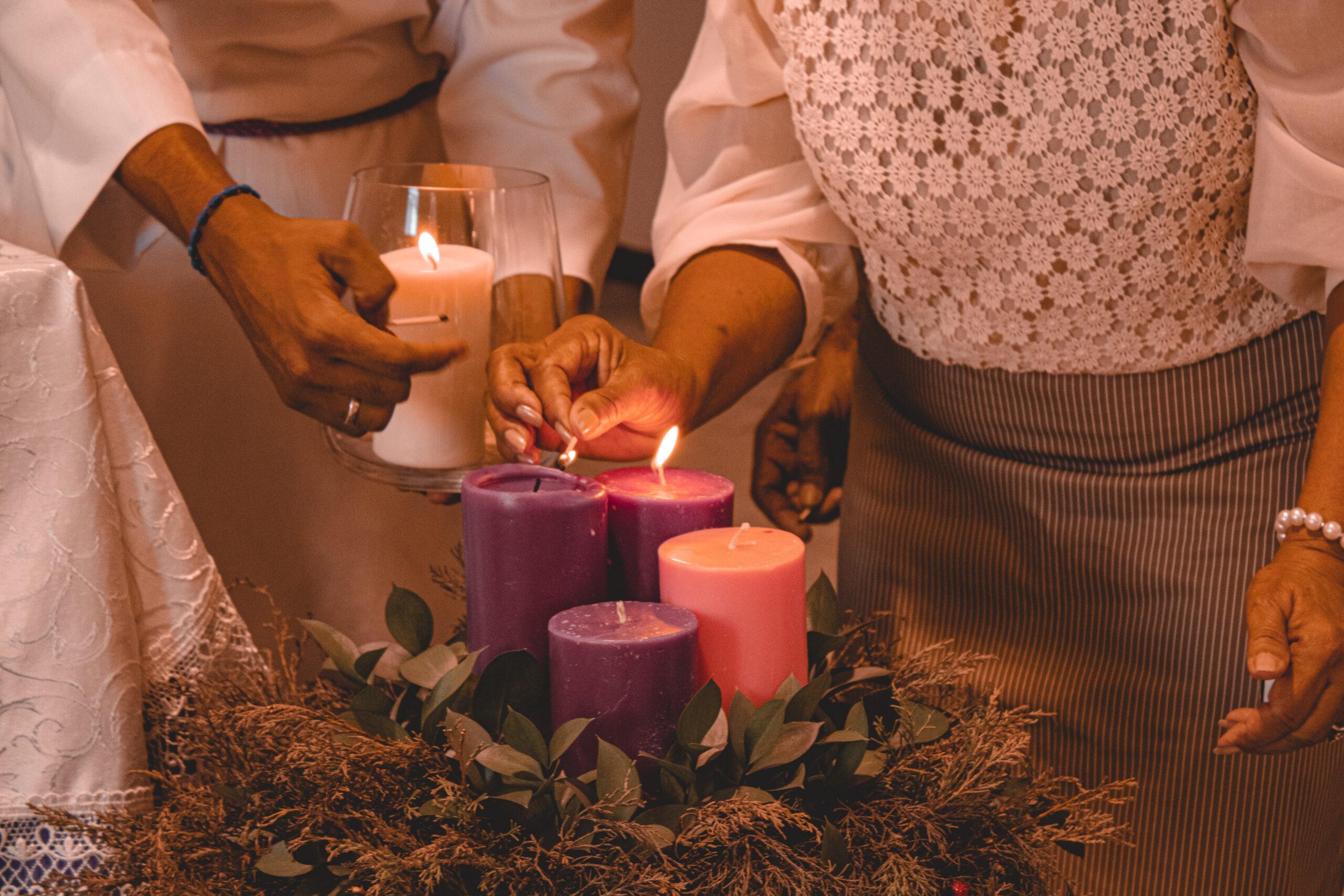
    When I was young, one way my family celebrated Advent was to prepare a bed of straw for Jesus. Any time we made a personal sacrifice or did a good deed for another, we cut a piece of yellow yarn to place in the center of our Advent wreath so that by Christmas Eve, Jesus had a warm cradle of “straw” in which to rest. While there is no harm in attending holiday parties or tuning into some Christmas music, let us strive this Advent to embrace a spirit of anticipation rather than indulgence, so that we might fully enter into the joy of salvific redemption during the Christmas season. 

  • Less Worry, More Trust: Praying the Surrender Novena in Times of Change

    Less Worry, More Trust: Praying the Surrender Novena in Times of Change

    Photo by Ben White on Unsplash

    Sometimes, I really miss my childhood. With my parents reliably around to take care of everything for me, I didn’t have to worry about much. As an adult with many more responsibilities, though, I often wish for that same sense of security and the ensuing freedom to rest unencumbered by the anxieties and fears of daily life. I want to be assured that someone else has things under control — especially at a time like this, when we remain gripped by a global pandemic.

    Jesus longs to give us that sense of security, to take care of everything for us in a way that even our parents couldn’t do when we were children: “If God so clothes the grass of the field, which grows today and is thrown into the oven tomorrow, will he not much more provide for you, O you of little faith?” (Mt 6:30). But in order to allow him to provide for us, we need to surrender.

    RELATED: How to Trust God When You’re Filled With Doubt and Disappointment

    Surrender sounds lovely in theory, but it’s difficult in practice. Although letting go of our fears and anxieties seems like it should be simple, it requires that we stop worrying, and that takes great effort. Yet, until we learn to replace our worry with trust, we won’t live in freedom.

    Okay, but how, exactly, do we do that?

    Enter the Surrender Novena.

    I first discovered the prayer at my parish’s Adoration chapel a few years ago, at a time when I was experiencing severe anxiety. Captivated by the freedom promised by a greater childlike dependence on God, I prayed it that spring and then tucked it into my prayer journal to revisit later in the future, when I was sure I would need it again. But then I completely forgot about it.

    …Until a friend of mine shared recently that she has been praying the Surrender Novena on a loop for the last year or so, and that whenever she finishes the nine-day circuit, she begins again. Listening to her describe how the prayer had gradually strengthened her trust and peace over time, I saw that the Surrender Novena could become a powerful tool for spiritual transformation when prayed with consistency — and that it is most necessary when so much in the world around us feels out of our control.

    RELATED: 9-Day Back-to-School Prayer Challenge: A Novena for the Start of the School Year

    Revealed by Jesus to Servant of God Don Dolindo Ruotolo, the Novena of Surrender to the Will of God (as the prayer is officially called) encourages us to lean into the Heart of Jesus with great confidence in his ability to care for us, through all the circumstances of our lives.

    And we don’t have to wait for something big to arise in order to practice this kind of surrender, although I’m sure that in the midst of the coronavirus pandemic, none of us are at a loss for worries. I myself am beginning a full-time graduate program at a time when the university environment looks completely different, and global uncertainty compounds all the usual concerns that come along with making a significant transition. How will the pandemic challenge the cultivation of community when I move to a new city? Will the university be able to sustain the learning environment it’s currently planning? What happens if there’s a resurgence? How will everyone stay safe?

    My friend’s reminder about the novena felt timely — definitely a sign that I should consider taking it up again. So I searched for the old handout in my prayer journal and settled into bed on night one, confident that leaving everything in the Lord’s hands before I went to sleep would be the best way to end my day: “O Jesus, I surrender myself to you, take care of everything!”

    RELATED: The Suscipe: A Prayer for All Occasions

    I woke up the next morning feeling lighter and freer, deeply aware for the first time in a while that I didn’t have to carry everything by myself. As I continued to pray the novena in the days that followed, I increasingly surrendered to God concerns both large and small — the people I love, trips to the grocery store, conversations with friends, and on-campus learning conditions this fall, for starters. Doing so hasn’t entirely eliminated my worries, but it has given me a sense of peace and security, a certainty of being held through it all.

    “Leave the care of your affairs to me and everything will be peaceful,” Jesus promises on day one of the Novena. For anyone desiring to rest in the heart of the Lord, particularly during a time still marked by lingering uncertainty, the Surrender Novena is an indispensable spiritual practice.

    Originally published July 29, 2020