Tag: Mary

  • The Radiance of Mary: How Lippi’s ‘Adoration’ Deepened My Faith

    The Radiance of Mary: How Lippi’s ‘Adoration’ Deepened My Faith

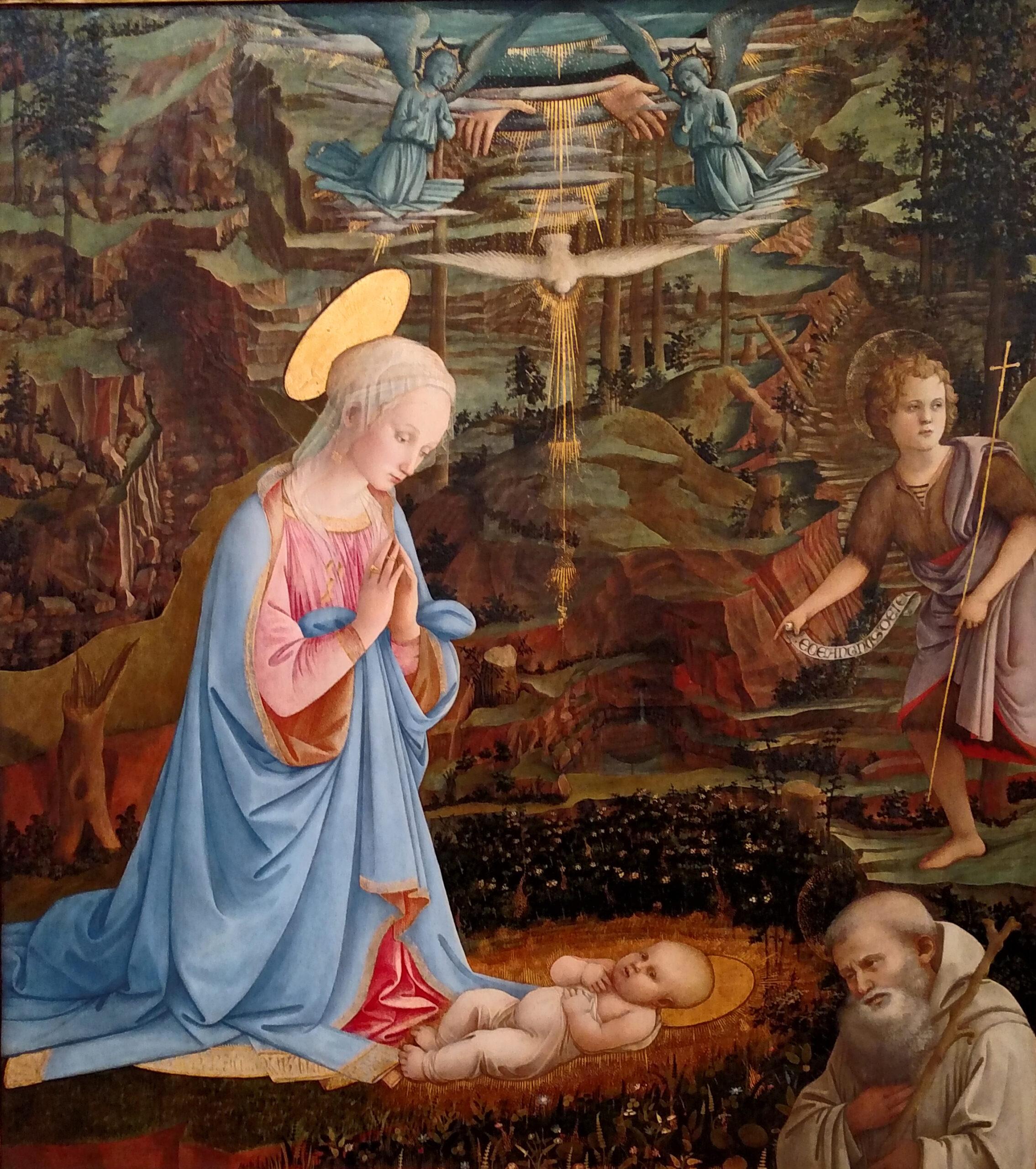
    As I marched through the Uffizi Gallery, I could see how, as the Renaissance progressed, artists made the figures in their paintings less like icons and more like human beings.  Suddenly, I found myself looking at a painting of a very real, very young woman. She was kneeling in a dark wilderness. Her hair and face were radiant. I first thought this was an anachronism, like the blue-eyed, blond Jesus of a certain era of popular art. Then I saw what better observers have seen. She was suffused with light. We say every Sunday, “God from God, Light from light…” The girl had been given the same gift of light — light nourishing, pure, powerful. Even her blue robe was richer and brighter than any earthly fiber.

    The 1463 painting is “The Adoration of the Christ Child” by Filippo Lippi. In it, Mary’s delicate features mixed tenderness, awe, and astonishment. Her hands are clasped together gently in prayer; her slender fingers seem to be on the verge of trembling. She is looking down at her newborn boy, lying exposed on the ground. I recalled the shock I felt 38 years ago when I first realized my wife and I were in charge of an utterly helpless child who was more precious than anything we had ever imagined. In the painting, moreover, there is no stable, no St. Joseph, no Magi, no shepherds. There are only two other people pictured: St. John the Baptist, in the form of a young boy, and the founder of the monastery for which the painting was commissioned. 

    RELATED: Art and Adoration: How Artwork Opens My Eyes to God’s Handiwork

    Mary’s look is full of awe and love, but awe can bring bewilderment, and love always brings vulnerability. I imagine from her expression that she sensed, even before a wise old man told her, that “a sword will pierce even your own soul.” Her faith was not daunted, but neither was her pity lessened. She had been given the greatest gift, and the deepest anguish. At the same time, the painting reminds us that, even as she kneels in this dark wilderness, she is accompanied by the greatest of powers. At the top is the Father, indicated by a pair of hands. The dove of the Holy Spirit dives down, blazing with the Holy Spirit. She will never be alone, even when she seems to be. 

    Seeing the painting in Florence, Italy on a trip last summer, I was reminded that art can be as powerful as words in conveying truth. The painting underlines the way God’s work has made us more deeply and truly human. Before Lippi and his peers came on the stage, art was about gods and goddesses, kings and queens. Then, artists began to see the glory in ordinary people. This reflects how the Lord has selected otherwise ordinary people, such as Abraham and Ruth, to change the world. The summit of this was his anointing of a young girl in an obscure Middle Eastern land to be the Queen of the Universe.

    RELATED: What Is the Solemnity of Mary?

    It’s a reminder that the Blessed Virgin Mary was a girl who had been visited by a messenger from God with news that 2,000 years later still baffles many. Pregnant, she traveled with her husband in a land troubled by foreign occupation and simmering unrest to give birth far away from her family. We rightly are in awe of the Queen of Heaven! Let us also take heart from the brave, young woman in this painting, and remember that great things can also come to ordinary people like us, with all our cares, troubles, and needs.

    Finally, let us remember that inspiration can strike even when we least expect it. You might think that being in one of the world’s great art museums would have primed me to get the most out of paintings. However, we had spent the previous week of our trip in Rome, where we trudged past miles of paintings and sculptures. Then the Uffizi welcomed us with art on every wall and the ceiling too. As guidebooks and more experienced travelers had warned, I had reached a point where I didn’t think I could absorb anything new about sacred art. I was half-wishing I could see one of those paintings of dogs playing poker, just to rest my overloaded brain.

    RELATED: Using Art as a Path to the Holy Spirit

    Promptly, I was confronted with Lippi’s painting of Mary glowing and grieving, foreseeing joy and wonder, yet accepting also toil and sorrow. It’s a reminder that experiences of the sacred can break through anything that weighs you down, from boredom to despair. And, of course, this need not happen in a world-famous museum. One day, after returning home, I took a walk around a lake near my house. The day was so gorgeous and the park so quiet that for once I turned off my phone and just welcomed the quiet. I looked at the blue sky and the sunlight on the leaves. It was my final realization: There are sacred masterpieces all around us.
  • Our Lady of Guadalupe: More Than Meets the Eye

    Our Lady of Guadalupe: More Than Meets the Eye

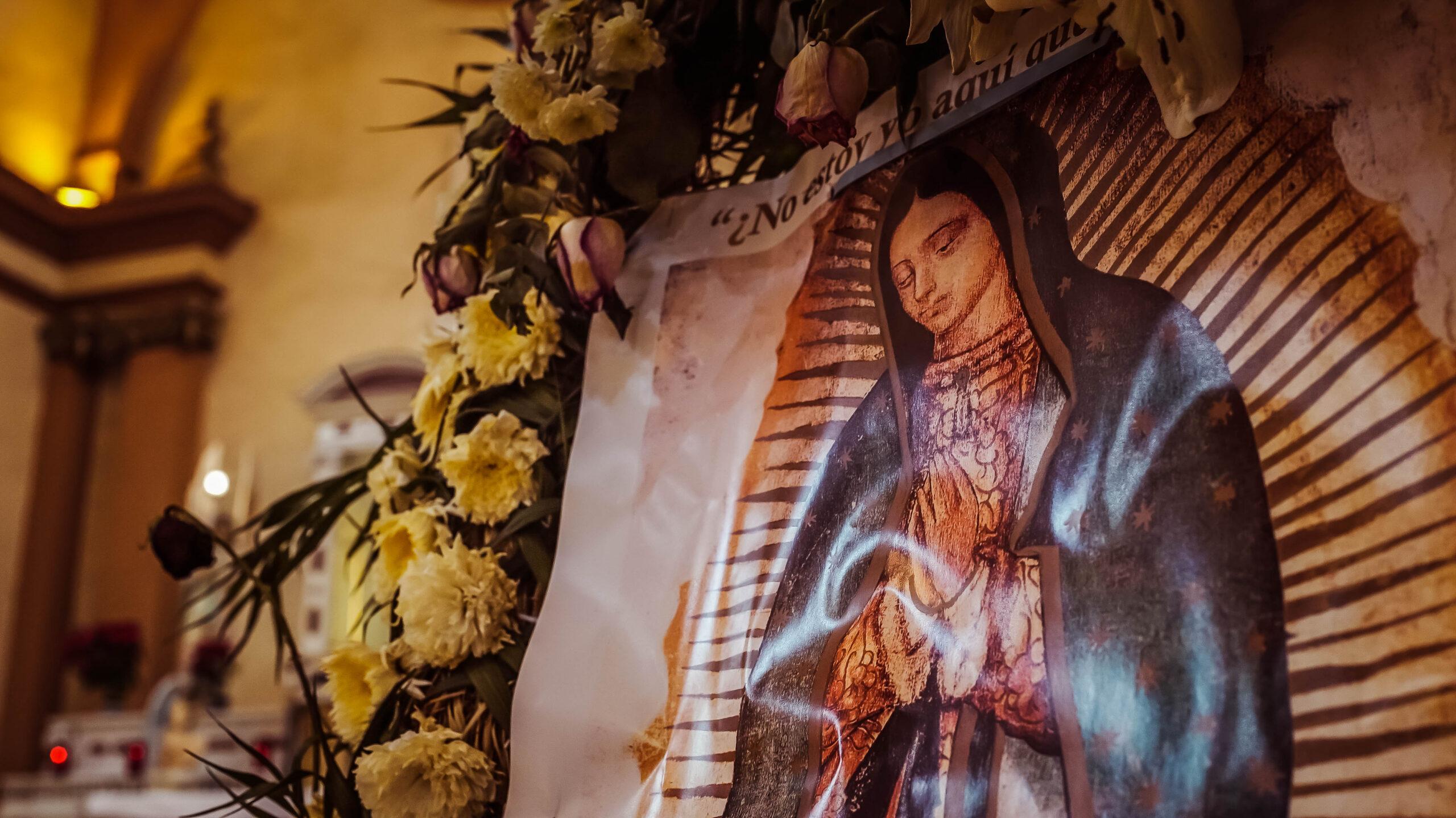
    Our Lady of Guadalupe, as she appeared in Mexico to Saint Juan Diego in the year 1531, is one of the most popular depictions of the Blessed Virgin Mary around the world. In my own experience, seeing her radiant image week after week as it hangs near the altar of my home church in Northern New Jersey piqued my interest and led me to learn more about this apparition. Upon first glance at the holy image, Our Lady’s beauty, humility, and tenderness are clear for all to see, but as it turns out, there is actually far more to this stunning self-portrait of Mary than one might suspect. As we prepare to celebrate the annual Feast of Our Lady of Guadalupe on December 12, let’s take some time to appreciate what makes La Virgen de Guadalupe so unique:

    1. Practicality

    On a basic level, I find it utterly amazing that the image of Our Lady of Guadalupe was given to humanity by Mary herself. As the historical account of the miraculous apparition goes, the Blessed Virgin came to Juan Diego and instructed him to petition the bishop of Mexico to build a church on the Hill of Tepeyac where she appeared. When the bishop asked Juan Diego for proof, Mary once again visited Juan Diego and gave him roses – in the dead of winter – to carry in his tilma, or cloak, and present to the bishop. Arriving before the skeptical clergyman once more, Juan Diego opened his tilma to reveal not only the beautiful roses, but the heavenly image of Our Lady of Guadalupe herself as we know her today. 

    This is the very same image that we still see of the Blessed Mother almost 500 years later. It’s not every day that the Mother of our Lord descends from heaven and quite literally hands us a self-portrait as a means of introducing herself to those who don’t yet know her. In a practical sense, this image allows us to honor Mary more intimately. It is not a man-made rendition of what some artist believed the Blessed Virgin might have looked like. When we look at this image, we see our Mother exactly as she appeared to Juan Diego centuries ago, her likeness crafted by heavenly design and gifted to humanity on a poor man’s cloak.

    RELATED: Our Lady of Guadalupe and the Joy of Knowing Her Son

    2. Symbolism

    The full account of the symbolism woven into La Virgen de Guadalupe’s image could stand as its own dissertation, but it is certainly worth mentioning in brief. Many elements incorporated into the depiction served to explain Mary’s identity – and that of the child in her womb – to the Aztec people. For example, the stars on her royal blue-green cloak that mirrored the constellations as they illuminated the sky on the morning of her apparition signified that she came to the Aztecs from heaven. The traditional black maternity band worn around her waist drew the natives’ attention to the child in her womb. With the sun behind her and the crescent moon under her feet, both of which were symbols of Aztec deities, Mary revealed that she was bearing the one and only true God. 

    I find it especially powerful that Our Lady came to her sons and daughters of Mexico in a way that was so personally meaningful to them, embodying their history and culture to demonstrate that she came to them as their mother. This leaves no doubt in my mind that when Christ gave us his mother to be our own as he hanged dying on his cross (John 19:26-27), Mary took us into the fold of her mantle as her beloved children. She is truly and devotedly our mother.

    RELATED: Our Lady of Guadalupe: A Convert’s Guide to Feasting the Patroness of the Americas

    3. Signs of Life

    Yes, you read that correctly. Though claims about the many miraculous attributes of Our Lady of Guadalupe’s image have naturally been met by their fair share of critics and naysayers, studies by doctors and scientists over the past century have resulted in some phenomenal findings. In the case of a three-hour infrared study of the tilma conducted in 1981 by Dr. Philip Callahan, a biophysicist and consultant for NASA, it was discovered that the figure of the Blessed Virgin Mother on the tilma maintains a temperature of 98.6 degrees Fahrenheit, which is the natural temperature of the living human body. Another investigation by gynecologist Carlos Fernandez del Castillo revealed that, when listening to the image with a stethoscope, one heartbeat could be heard at the chest of Our Lady, and a second within her womb that carries the unborn Christ. Ophthalmologists Dr. Manuel Torroella, Dr. Enrique Graue, and their colleagues likewise examined the image and discovered that the eyes of Our Lady of Guadalupe reflect images back at the viewer just as the normal human eyeball does. The list goes on

    Being a devout Roman Catholic and first-year medical student who loves all things science, I can’t help but take some personal satisfaction in these findings. As anyone with internet access can attest, an unfortunate “religion versus science” mentality seems to predominate our society and all too easily brings contention to discussions of either topic. Perhaps these scientific anomalies woven into La Virgen de Guadalupe’s image will show those who choose science alone at the expense of faith that it is God who is the author of the natural world; it is through science that we strive to decode his divine language.

    One of the main points I take away from the apparition of Our Lady of Guadalupe is that Mary comes to us as our own loving Mother, fully compassionate toward our personal circumstances and seeking above all to bring us closer to her and her beloved Son. Just as she did for the Aztec people centuries ago, Our Lady of Guadalupe comes to meet us precisely where we are, and as we are, to offer us her love and intercession. I often find great comfort in the words she spoke to Saint Juan Diego in one of his most difficult moments, and I encourage you to do the same: “Am I not here, I, who am your Mother? Are you not under my shadow and protection? Am I not the source of your joy?”

  • How My Struggle With Infertility Deepened My Relationship With Mary

    How My Struggle With Infertility Deepened My Relationship With Mary

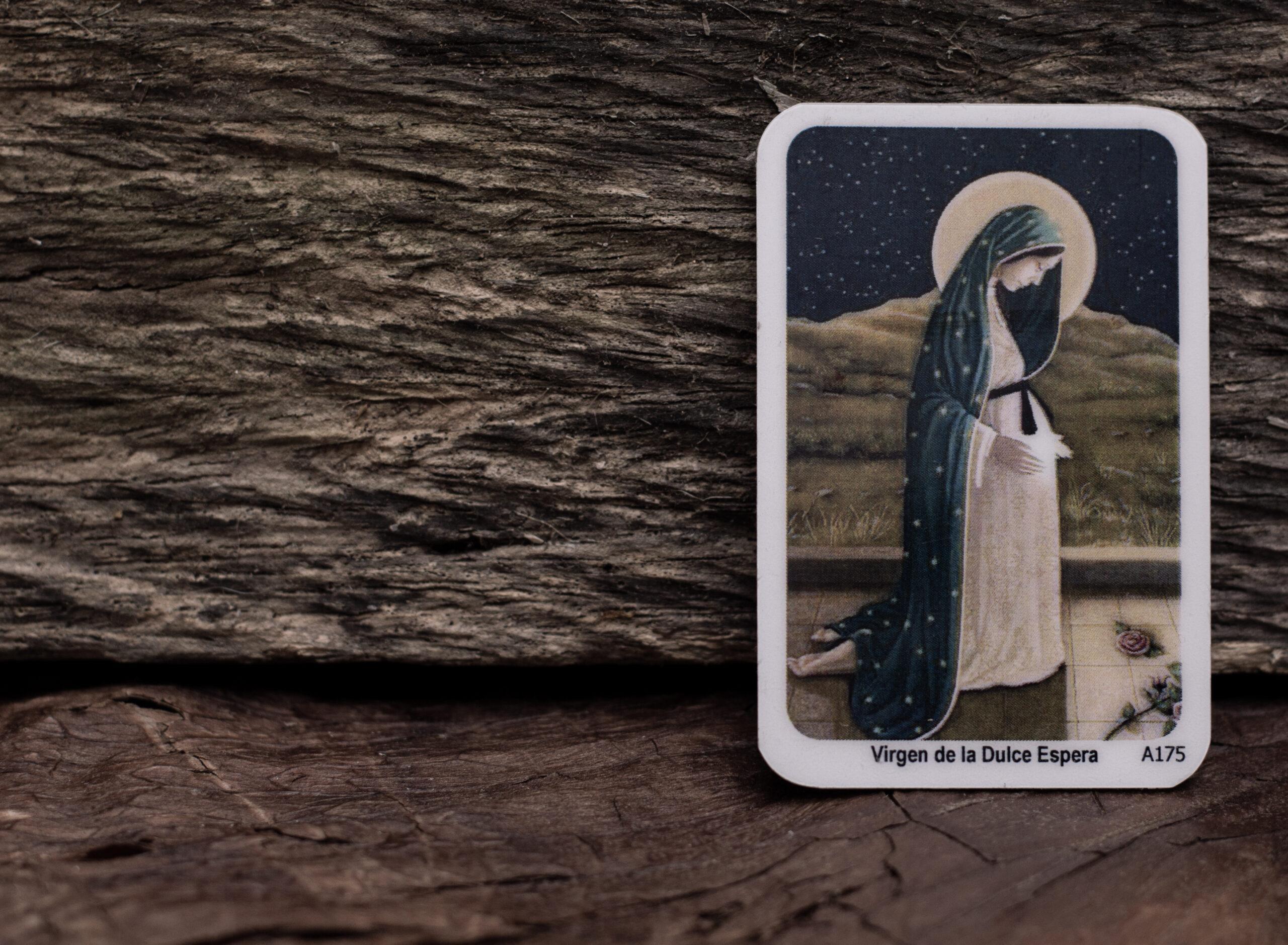
    Photo of the Virgin Mary pregnant with Christ.
    Photo by Carolina BR on Cathopic.

    Editorial note: The following article contains mentions of pregnancy/infant loss.

    The desire to become a mother took me by surprise. Beyond early childhood years of wanting five daughters named after American Girl dolls, having kids wasn’t on my radar. However, after two years of marriage, I faced the possibility of having kids with a heart of hope. What I didn’t know at the time was that an unexpected diagnosis would make becoming pregnant more challenging than I ever thought possible.

    “You have PCOS. How has no one told you that before?” 

    I met my doctor’s gaze through the webcam. I had pushed for a meeting after months of being seen by well-intentioned but uninformed medical technicians. This diagnosis came after working with OBGYNs, holistic practitioners, and even acupuncturists while on the search for an answer to family-building. The diagnosis, though, was less of a path forward and more of a cul-de-sac.

    LISTEN: Coping With Infertility

    Turning towards Mary’s holy help

    I knew God was listening. However, He felt far away. I needed a girlfriend with whom to commiserate, a mother figure who would help me. I thought about this during my weekly Thursday night Adoration hour.

    “Am I not your mother […] how else can I help?”

    I reread the last line of Mary’s message under a painting of Our Lady of Guadalupe on the wall of my parish’s Adoration chapel. I figured if I needed help on the journey toward motherhood, who better to rely on than the Mother of Mothers? My heart began to ease as I spoke. 

    Holy Mary, I ask for your help. That you would intercede for me and ask God that if it’s not His will for me to have a child, to please, please, take the desire from my heart. 

    After another disappointing fertility cycle, I decided to try one more time. My husband, who never pressured me to have children, agreed I should take a break if this next one didn’t pan out. 

    Mary, I ask for your help again. For your holy intercession through Jesus Christ, your son my Lord, to God that it could be his holy will that I become pregnant this time. 

    As I called out to Mary, again and again, words appeared in my mind. In my head I heard, “I will help you become a mother because you first went to my mother.” I was still as that notion began to increase my confidence that maybe it was almost time. 

    RELATED: Turning to Mary in Difficult Times

    Mary’s light in dark times

    A week after my 35th birthday, the doctor’s office confirmed that not only was my positive at-home pregnancy test accurate, but also — I was having twins. After the initial shock, I imagined my bump and how I would reveal the news. My prayer life and budding relationship with Mary continued to grow as well. It all felt too good to be true, but I pushed those thoughts away.  

    At 12 weeks, I woke up and went into the bathroom. I was bleeding. Terror filled within me as I sat there trying to figure out what to do. My husband turned on his bedside lamp and we called the doctor. 

    The on-call nurse said I would need to wait until the doctor’s office opened. As I laid on wet bed sheets, I saw my grandmother’s painting of Our Lady of Guadalupe hanging in the room across the hallway. My eyes locked on her serene face and hands folded in prayer and thought, “Am I not your mother? How else can I help?” 

    Oh Mary, please help me. Please help my babies. Keep them there. Oh Mary, please. 

    My reliance on the Holy Mother’s intercession and listening ear was all that I had, and I found it to be the only thing I needed. Later that morning, I was bumped up to be the first seen by the medical technician. I burst into tears when she found two beating hearts. 

    RELATED: I Never Connected With the Rosary… Until I Became a Mother

    At the beginning of my journey to motherhood, I felt that there would be a natural conclusion to my prayer — a time when I wouldn’t need to rely on the Holy Mother as much as before. First it was becoming pregnant, but she was there during my pregnancy to hear my fears and joys. Then, I thought that after I gave birth, the journey would conclude and I wouldn’t have to “bother” her so much. However, I still rely on Mary every moment of every day. 

    When my boys wake up, I thank her for praying over them during the night. I ask her to watch over them as they explore which comes with the inevitable toddles and falls. Mostly, I ask her to help me to be the best mother I can be in each moment. To not stress so much about the little things, but to continue to trust in God. I jokingly ask her to pray for my kids through my mistakes while I earnestly navigate the learning curve of motherhood.    

    My path towards motherhood led me to Mary’s perfect example of seeking light through dark times. Mary’s faithfulness to God and her unceasing love continues to be an option for all of us to choose daily when seeking hope. 

  • The Rosary in Two Minutes

    The Rosary in Two Minutes

    The Rosary is a Catholic prayer devotion that draws us closer to Jesus and Mary by reflecting on key moments in their lives. According to Catholic tradition, Mary gave the Rosary to St. Dominic when she appeared to him in 1214. In 1520, Pope Leo X approved it for use by lay people. In those days, many were illiterate, so the Rosary allowed anyone to pray with familiar words from scripture.

    The word Rosary comes from the Latin rosarium, which means rose garden. In scripture, roses symbolize perfection. So, the Rosary is like a perfect garden of prayers.

    The Rosary involves a lot of repetition. You might be wondering, why pray the same prayers over and over again? Praying the Rosary helps slow us down, calm our hearts, and get in touch with our desires for God.

    So, if you want to try praying the Rosary, where do you start? Busted Halo’s new 2-minute video has you covered. Learn about the history and tradition of the Rosary, how to pray, what it means to meditate on the Mysteries of the Rosary, and more!

    To download this video go here and click the download arrow or choose save or download (top right). Please note, all Busted Halo videos are free to use in parishes, schools, or for other educational purposes. In fact, we encourage it!

    Resources and reflections

    The Rosary can be prayed anywhere and is a prayer for everyone. Here are a few additional resources to help you pray the Rosary or share this prayer with your parish or classroom.

    “The Catholic Rosary: A Study in the Power of Prayer”

    “What Are the Origins of the Rosary?”

    “Can I Wear a Rosary Around My Neck?”

    “Saying the Rosary and SAYING the Rosary”

    “Understanding the Rosary: A Wake-Up Call”

    Podcast: “How Did the Rosary Begin?”

    Podcast: “Mysteries of the Rosary”

    What are the prayers of the Rosary?

    Sign of the Cross

    In the name of the Father, and of the Son, and of the Holy Spirit. Amen.

    Apostles’ Creed

    I believe in God, the Father almighty, Creator of heaven and earth, and in Jesus Christ, his only Son, our Lord, who was conceived by the Holy Spirit, born of the Virgin Mary, suffered under Pontius Pilate, was crucified, died and was buried; he descended into hell; on the third day he rose again from the dead; he ascended into heaven, and is seated at the right hand of God the Father almighty; from there he will come to judge the living and the dead. I believe in the Holy Spirit, the holy catholic Church, the communion of saints, the forgiveness of sins, the resurrection of the body, and life everlasting. Amen.

    Our Father

    Our Father, who art in heaven, hallowed be thy name; thy kingdom come; thy will be done on earth as it is in heaven. Give us this day our daily bread; and forgive us our trespasses; as we forgive those who trespass against us; and lead us not into temptation, but deliver us from evil. Amen.

    Hail Mary

    Hail Mary, full of grace, the Lord is with thee; blessed art thou among women; and blessed is the fruit of thy womb, Jesus. Holy Mary, Mother of God, pray for us sinners, now and at the hour of our death. Amen.

    Glory Be

    Glory be to the Father, and to the Son, and to the Holy Spirit, * as it was in the beginning, is now and ever shall be, world without end. Amen.

    Fatima Prayer

    O my Jesus, forgive us our sins, save us from the fires of hell; lead all souls to heaven, especially those in most need of thy mercy.

    Hail, Holy Queen

    Hail, holy Queen, mother of mercy, our life, our sweetness, and our hope. To thee do we cry, poor banished children of Eve; to thee do we send up our sighs, mourning and weeping in this valley of tears. Turn then, most gracious advocate, thine eyes of mercy toward us; and, after this, our exile, show unto us the blessed fruit of thy womb, Jesus. O clement, O loving, O sweet Virgin Mary.

    Pray for us O holy mother of God, that we may be made worthy of the promises of Christ.

    Rosary Prayer

    Let us pray. O God, whose only-begotten Son by his life, death and Resurrection, has purchased for us the rewards of eternal life; grant, we beseech thee, that by meditating upon these mysteries of the most holy rosary of the Blessed Virgin Mary, we may imitate what they contain and obtain what they promise, through the same Christ our Lord. Amen.

    What are the Mysteries of the Rosary?

    These “Mysteries” (not the crime-solving kind) focus on the significant events in the lives of Jesus and Mary. They’re broken down into four categories and generally prayed on different days of the week:

    The Joyful Mysteries (Mondays and Saturdays)
    • The Annunciation
    • The Visitation
    • The Nativity
    • The Presentation
    • Finding Jesus in the Temple
    The Sorrowful Mysteries (Tuesdays and Fridays)
    • The Agony in the Garden
    • The Scourging at the Pillar
    • The Crowning of Thorns
    • The Carrying of the Cross
    • The Crucifixion
    The Glorious Mysteries (Wednesdays)
    • The Resurrection
    • The Ascension
    • The Coming of the Holy Spirit
    • The Assumption of Mary
    • The Coronation of Mary
    The Luminous Mysteries (or Mysteries of Light) (Thursdays)
    • Jesus’ Baptism
    • The Wedding Feast at Cana
    • The Proclamation of the Kingdom of God
    • The Transfiguration
    • The Institution of the Eucharist

    The Rosary is a powerful prayer. Many miracles have been attributed to the Rosary (like the miracle at Fatima), and countless others have experienced healing, conversion, and answered prayers. But the biggest miracle of all is the hope it has given to millions around the world.

    Originally published May 21, 2018.

  • What are the Seven Sorrows of Mary?

    What are the Seven Sorrows of Mary?

    The “Seven Sorrows of Mary” refers to the seven feats of “spiritual martyrdom” (suffering spiritually through experiences) endured by the Mother of God in loving solidarity with her Son. They are:

    1) Mary’s sorrow at the prophecy of Simeon
    2) The flight into Egypt
    3) Having lost the Holy Child in Jerusalem
    4) Meeting Jesus on his way to Calvary
    5) Standing at the foot of the Cross
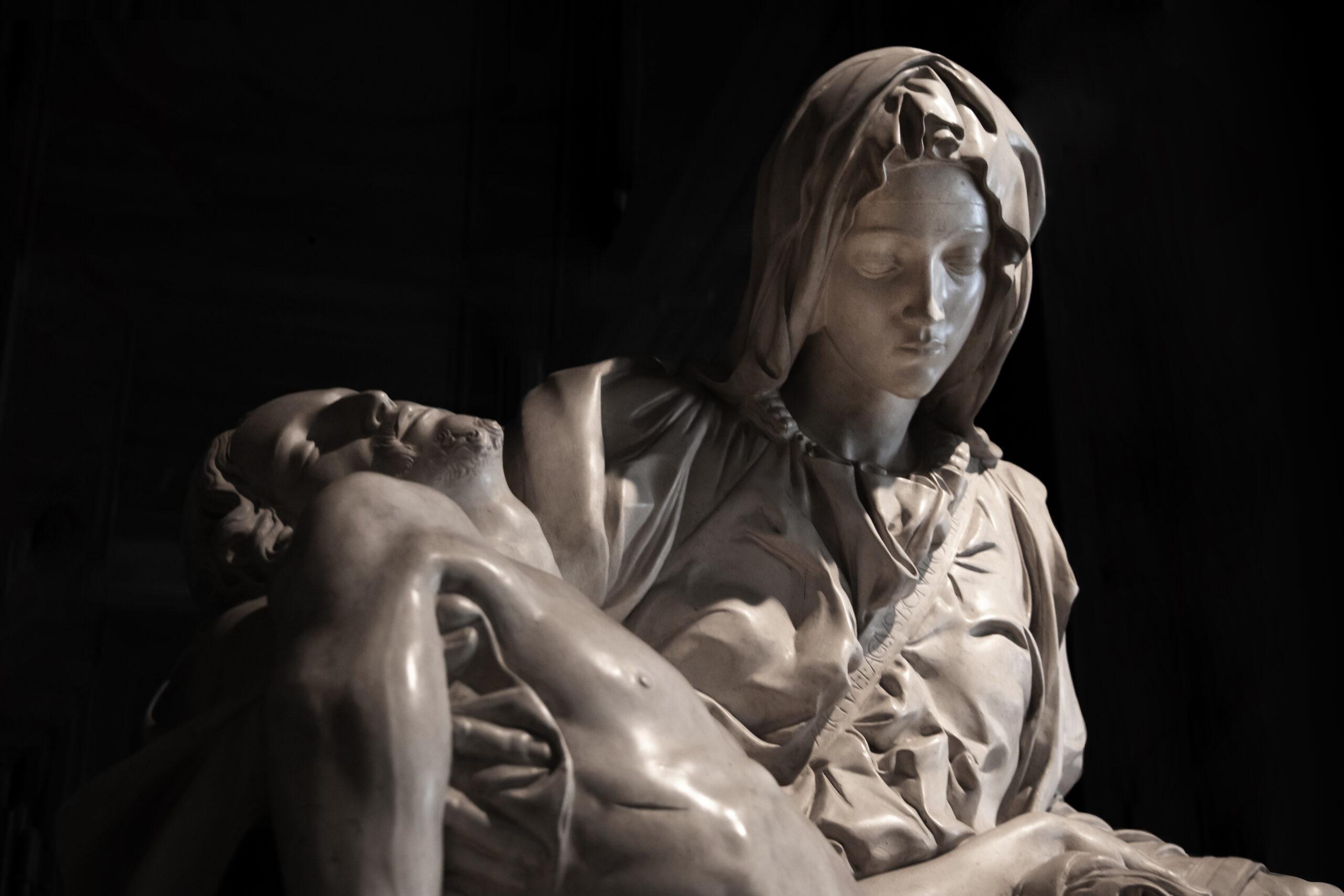
    6) Jesus being taken from the Cross (Depicted in art as The Pieta)
    7) The burial of Christ.

    The Seven Sorrows are all rooted in Scripture. Devotion to the Seven Sorrows of Mary stems primarily from the Order of Servites (The Servants of Mary) and has given rise to the Seven Sorrows Rosary as well as many other devotions to the sorrows (or dolors) of Our Lady. The Feast of the Seven Sorrows of Mary falls on September 15 and was first celebrated by the Servites before becoming part of the liturgical calendar of the Church Universal.

    Originally published April 2013.

  • Our Lady of the Assumption: Her Importance and Influence in Everyday Life

    Our Lady of the Assumption: Her Importance and Influence in Everyday Life

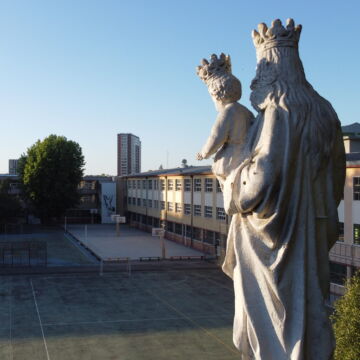
    Statue of the Virgin Mary holding the Infant Jesus overlooking a schoolyard.
    Photo by jlopez on Cathopic

    One day, I asked students at the school where I work, “What’s the name of our school?” They responded in chorus with the expected exuberance of 23 first graders, “OLA!” 

    “What does OLA stand for?”

    This response wasn’t quite as resounding as the first, “Our Lady of the Assumption!” Their eyes shone bright with proud enthusiasm.

    “On what date do we celebrate Our Lady of the Assumption?” 

    Blank stares… then

    “Wednesday!”

    “Christmas!”

    “New Year’s!”

    One clever set of eyes darted about for clues and found a hint on a plaque hanging on the brick facade near where we stood outdoors, on our way inside from recess. She confidently blurted out “1952,” the only numbers on the plaque (the year the school was founded). Other parroting voices trailed in echo. 

    From that day on, the first graders could recall August 15 as Our Lady’s Day of Assumption as readily as they recalled their own birthdays. Whenever they did, I felt an inner joy and a renewed connection to Our Lady. 

    RELATED: Understanding and Celebrating the Feast of the Assumption

    In addition to the date, the children would eventually learn the Church’s teaching on the Assumption: “The Most Blessed Virgin Mary, when the course of her life was completed, was taken up body and soul into the glory of heaven…” (Catechism of the Catholic Church 974).

    Of Our Lady’s devotions and prayers, there are the Rosary, seven sorrows of Our Lady, Our Lady of the Miraculous Medal, etc. Similar to their attractions to certain of her apparitions, many Marian devotees are partial to specific feast days. Often, one chooses a particular devotion because of an experience where Jesus opens a door, and his mother appears from behind it. That was the case for me and my devotion to Our Lady of the Assumption. 

    A few years ago, I felt a nudge from God that it was time to seek employment outside the home after a hiatus to raise my children. To take the guesswork out of where God was calling me, I prayed the Lord would open one and only one door for my employment. Eventually one opportunity arose and the Blessed Mother seemed to confirm it in a dream. 

    WATCH: Mary in 2 Minutes

    In the beginning of employment at OLA, the name of where I worked held no significance for me. But when I had a hard time adjusting to my job, I found solace when my eyes landed on the sign that announced Our Lady of the Assumption, as I drove into the parking lot to start the day. In solid block letters announcing her title, I found consolation on difficult days and the comfort in knowing she had chosen this place for me. 

    There was a time, just after I converted to the Catholic faith as an adult, I didn’t know a thing about the Blessed Mother. After some buds of our relationship began to blossom, I attempted to keep Marian dates straight to honor her. Once, I mixed up the dates of the Immaculate Conception — December 8 — and Assumption — August 15 — by mistakenly combining the two days into one and confidently marking December 15 on my calendar as an important feast day.

    While my family teases me for my inability to recall anything verbatim, not even a single lyric of a beloved song, I somehow memorized all the mysteries of the Rosary practically overnight. Through the Rosary, and the maternal mentors God has placed in my life, Our Lady weaves threads of her care. From guiding me to a counselor during the rocky times of marriage to selecting our children’s high school – titled after another of Mother Mary’s namesakes  – her gentle presence in my life became palpable.

    Last year, on August 15, as I attended the Solemnity of the Assumption Mass at the church and school that both bear her name, I marveled at how a last minute schedule change had brought me to this landmark Mass. Mother Mary indeed wanted me there to reassure me of her call for me to this place of employment. 

    RELATED: Why Does Mary Have So Many Different Feast Days and Names? 

    I randomly recalled that when my children were in elementary school, I would attend this Mass at their school every year to pour out all my hopes for the new school year to Our Lady. One year, after the August 15 Mass, my then-13-year-old daughter had announced that she was going to teach religious education classes. I immediately knew this was a grace from Our Lady. The fruit of Mother Mary’s intercession continued as my daughter taught catechism and Vacation Bible school classes the following years; she went on to obtain a college minor in teaching, and took a gap year after graduation to volunteer as a teacher. Our Lady of the Assumption’s intercession continues to bear great fruit in my family’s lives.

    My new place of employment was her nod to me as my mother, and yet another thread confirming she claimed me as her own. At the place that bears her name, this mother of all mothers is schooling me in true discipleship. Lesson plans in love, sacrifice, and humility often shine a mirror on warts I never saw before; some days the virtues she’s trying to instill in me scratch against my pride and leave scrapes that feel like cuts. But when I look at my paycheck, I’m reminded that of all the places to work, I labor for Our Lady, and there is no one kinder and gentler to tutor me in the virtues.

    One chooses a saint as his/her own because of an experience of his/her intercession. It’s a mystical, reciprocal companionship. A devotion to Our Lady’s feast day is similar. Of her feast days, I have to say Our Lady of the Assumption, where she schools me in lessons in love, is my favorite. Wherever I go, whenever I see a church or school named Our Lady’s Assumption. I feel the warmth of a mother’s arms; I’ll always honor her on this and other special occasions.

    Our Lady of the Assumption, pray for us!

    Originally published August 14, 2023.

  • Memorial Day and the Power of Remembrance

    Memorial Day and the Power of Remembrance

    Photo by John Hill on Pexels

    While I was growing up, my family emphasized that calling to mind those who gave their lives to sacrifice for our country is always necessary and important. 

    We visited the cemetery on all major holidays to spend time at my grandparents’ graves. We traveled there on Thanksgiving, the week of Christmas, and Easter Sunday. My parents, my three brothers, and I would climb into the car after Mass and head to the cemetery.

    If we were at my paternal grandfather’s grave, we would all exit the car once we arrived and say a prayer at the tombstone. After a few minutes, my mom would bring us back to the car and my dad would stay behind at the grave of his father. If we were at my maternal grandmother’s grave, the opposite happened. Dad would usher us to the car and Mom would stay behind for a few extra minutes. 

    RELATED: Virtual Memorial Day Retreat: Remembering Those Who Serve 

    This was their intimate time alone with the parent they had lost. We honored their memory by going to the cemetery as a family, but I also remember that image of my mother or father spending one-on-one time with the grave as I peered out the car window looking at them. It was as if they were talking to their respective parent as if they were still alive and could hear them. They were remembering them by continuing their relationship with them. I was drawn into this moment because I witnessed my mom and dad love their own parent even beyond their death. 

    My maternal grandmother is buried at an armed services cemetery on Long Island because her husband served in the military. All the tombstones there are the same rectangle shape and the same color, white. The uniform aisles of tombstones evoke something inside of me that brings me to honor those who gave their lives and the family members of those who served. Every visit is like a miniature Memorial Day. 

    Today, we are called to remember and honor the sacrificial love of countless men and women who gave everything so we could live in our beautiful country. The challenge is to honor them even when it is not Memorial Day. 

    RELATED: What Should Catholics Do on Memorial Day?

    When I visited the cemetery as a child, I was so reflective of my grandparents’ lives as well as grateful for the love of my parents. I was more attentive to my relationship with them because I was reminded of how short and fragile life is. 

    But then, I would go back to my routine until the next holiday and forget how important it is to remember those who came before me so that I could live (literally in the case of my grandparents being my ancestors). On this Memorial Day, we are invited to take that focus towards those who died in service. How can we be more intentional about giving them honor and respect?

    Our Catholic faith offers two great connections that are easy and powerful. One, pray for veterans, those who died in the line of duty, and those current service men and women at Mass on Memorial Day weekend. The Eucharist is the memorial of Christ’s suffering, death, and resurrection. We do not simply call to mind what Christ did; those mysteries are made to present to us. As the Son of God died so that we could live, we can pray especially for those who died for our country so that we could have the freedoms we do today.

    RELATED: How Prayer Cards Help Me Honor the Holy Souls That Have Gone Before Me

    Second, pray a decade of the Rosary or an entire Rosary for our veterans. We can pray for those who have died and those who have returned from the armed forces. We know that so many returning service people struggle to reacclimate into society. Pray that they may find work and know their value. 

    Memorial Day is always the last Monday in May, a month dedicated to honoring the Mother of God. Praying for Mary’s intercession allows us to call to mind the fact that she is guiding all of her children, wherever they find themselves.

    Whatever you do for Memorial Day, make it something that serves as a powerful and lasting reminder of just how blessed we are to have people in our age and in our history who live out the sacrificial love of Christ. May we honor them by respecting that love and mirroring it in our own lives as best we can. 

  • Marian Consecration: The What, Why and How

    Marian Consecration: The What, Why and How

    Marian consecration. Even for practicing Catholics who already know a thing or two about devotions to a saint, the phrase might stir up some confusion. 

    I get it, and I want to help clear up some of the mystery!

    I myself stumbled across consecration at a time when I wanted to deepen my faith. I had chosen Mary for my Confirmation name and prayed the Rosary every once in a while, but I felt a call to form a more personal relationship with her. In 2016, I saw that a women’s fellowship group was leading a retreat for Marian consecration. I leapt at the promise that it would be a game-changer and decided to participate. 

    WATCH: Mary in Two Minutes

    If to consecrate means “to set aside for a particular purpose,” what does it mean, exactly, when the term is applied to our relationship with Mary? Put simply, Marian consecration is an entrustment of oneself to Our Lady. But if that “simple” idea still sounds vague and mystical, know that consecration involves the following concrete steps: 

    1. A substantial period of prayerful preparation (typically 33 days). Often, parishes will host small groups that commit to making the consecration together over this time period, but you can also make it alone at any time. 
    2. A final prayer — the Act of Consecration itself — to be said on the day of the consecration (preferably a Marian Feast Day).
    3. A persistent spirit of trust in Mary’s motherly care and intercession, to endure for the rest of your life.

    As Catholics, we recognize that when, from the Cross, Jesus gave Mary to the disciple John, and John, in turn, to Mary, Jesus made her our spiritual mother. As such, Mary’s equipped in a special way, over and above all the other saints in heaven, to lead us to holiness. “Mary’s task is to give spiritual birth to Christians, to feed and nurture them with grace, and to help them grow to full stature in Christ.” Fr. Michael Gaitley writes, in his popular guide to Marian consecration, “33 Days to Morning Glory,” “In short, Mary’s job is to help us grow in holiness. It’s her mission to form us into saints” (25). 

    RELATED: I Never Connected With the Rosary… Until I Became a Mother

    Moreover, Fr. Gaitley explains that Mary is united to the will of God more closely than any other human being throughout all of time. If we want to know and follow the will of God in our own lives, there’s no better person to entrust the care of our souls to than Mary herself. A friend of mine once said, “The question isn’t really, ‘Why should you consecrate yourself to Mary?’ but, ‘Why shouldn’t you?’” 

    But does that mean that we’re making Mary more important than God Himself?

    I can see why it might seem that way, especially to someone who’s new to the idea of consecration. But the answer is an emphatic no. Mary’s goal, while alive, was simply to live in union with God, and now that she’s in Heaven, she has the same goal for each of us. If we consecrate ourselves to Mary, it’s not with the intention of replacing God but rather, of allowing Mary to bring us closer to him, as other servants of the Lord, committed to doing his will in the world. 

    Okay, this sounds good, but where do I start?

    Since there’s a particular kind of preparation associated with making a consecration to Mary, you’ll need some guidance through the process. If your parish hosts small groups for Marian consecration, you might find it helpful to join one, because of the benefit of being able to pray and process your reflections with others. But you can also make it by yourself!

    Either way, you’ll need a book. If you want to go “old school,” you can use St. Louis de Montfort’s “True Devotion to Mary,” but I prefer Fr. Gaitley’s conversational, approachable style in “33 Days to Morning Glory” (which I’ve already cited above). He does a great job of breaking down consecration into related themes that build on one another, and offering short prayers to meditate with each day. Plus, he organizes each week of the retreat according to the theology of a particular Marian saint: Louis de Montfort, Maximilian Kolbe, Mother Teresa, and John Paul II. 

    LISTEN: Fatherly Advice: Relating to Mary

    At the heart of any Marian consecration, though, is a total gift of ourselves to Mary: an offering of all of our prayers, intentions, works, sacrifices, and gifts, for her to use as needed to help form us into saints. 

    I consecrated myself to Mary for the first time on the Feast of the Immaculate Conception in 2016, and have since re-consecrated myself (you can renew the offering as many times as you’d like!) twice more — in 2017, on the Feast of Our Lady of the Rosary (October 7) and in 2020, on the Feast of the Visitation, which also fell on Pentecost (talk about a perfect day for a consecration, combining a Marian feast day with the celebration of the Holy Spirit’s descent!). Each time, I’ve felt myself grow in my own understanding of how Mary wants to be a mother to me, and of how she leads me to her son. Most of all, I’ve grown in a spirit of trustful abandonment regarding God’s will for my life, as I’ve prayed to emulate Mary’s fiat. Last year, I purchased a bracelet to remind me of my consecration, and I wear it each day as a tangible reminder of the offering I’ve made and of Mary’s unceasing care for me.  

    If there’s one thing I recommend that you do for your faith life this May, particularly if you’re serious about becoming a saint (as we all should be!), it’s consecration to Mary. You won’t regret it. 

    Originally published May 16, 2022.

  • Mary: The Background Music to My Spiritual Life

    Mary: The Background Music to My Spiritual Life

    For over two years, every night it’s the same: At the appointed time, I gather my freshly bathed and pajamaed toddler into my arms, all fuzz and snuggles. We turn off the light in his bedroom and settle into the rocking chair. My son knows the drill, so he tucks his fuzzy head under my chin and cuddles into my arms. Then we begin:

    Softly, we rock in the darkness. I recite “Goodnight Moon.” Then five nursery rhymes, another book, four prayers, and a lullaby.

    RELATED: I Never Connected With the Rosary… Until I Became a Mother

    They’re the same words every night, and they’re my child’s bridge between the discoveries of day and the peace of sleep. As we sit together, heart-to-heart, my voice surrounds and comforts him, but I imagine he is not thinking of me. My voice, and our nightly litany, is background music that fades away while he reviews the day and surrenders all his anxieties to calm.

    It is a sweet privilege to be his background music, to be that safety that allows him to bound with courage into the world.

    Sweeter still is the knowledge that although I am not a child anymore, that although I am all grown up, my Heavenly Father has given me this background music, too.

    WATCH: Mary in 2 Minutes

    At one time, the Son of God rocked in his mother’s arms, tucking his fuzzy head under her blessed chin as she cuddled and sang to him. The Blessed Virgin Mary was the background music to his earthly ministry. First, it was the beating of her heart at the Incarnation, when Jesus spent nine months safely in the tabernacle of her womb. Then, her voice was the background music at his foretold birth in Bethlehem, and even during an exiled flight into Egypt that lasted a number of years while powerful men sought to take his life. Mary was there in the background when Jesus performed his first miracle, quietly and confidently telling the Galilean wedding staff, “Do whatever he tells you” (John 2:5). When Jesus’ time had come, Mary was there, in the background, as her Son obediently met his ultimate suffering: his Passion and death. Mary had seen him all the way there. And what a gift, that the Lord passed her on:

    “Woman,” He said, “behold your son.” Her new “son” was to be John, who represents all of us.

    Then: “Behold your mother” (John 19:26-27).

    And our mother she is. 

    RELATED: No Mere Greeting: The Hidden Meaning of the Hail Mary

    It was with a shock that I realized, while rocking my son, that Mary is the background music to my relationship with God in the Church — and quite literally! Every time I pray the Rosary, I pray for her intercession 53 times, but each time, the “Hail Mary” fades away as I meditate on that decade’s mystery, which is a moment in the life of Christ.

    It was a great surprise because I had struggled to feel devoted to Mary ever since I turned 13, when I reached — and passed — the age of her world-saving “yes” to God. But now, as a mother, I can understand her differently. She is the background music to my spiritual life: to my relationship with Christ.

    “She is an echo of God, speaking and repeating only God. If you say ‘Mary’ she says ‘God.’” Writes St. Louis de Montfort in “True Devotion to Mary.” “[Y]ou never think of Mary without Mary thinking of God for you. You never praise or honour Mary without Mary joining you in praising and honouring God.”

    WATCH: The Rosary in 2 Minutes

    In that “Hail Mary” greeting, in the repetition of her prayers, Mary smooths out the wrinkles between me and God, pouring his grace into my life and carrying me — as a mother carries her child — to see the King of Kings.

    And it’s almost like she rocks me, with my head tucked under her chin. Her warmth remains as her voice fades to the background, so all that remains for me to embrace is the light of Heaven: the Son she rocked thousands of years ago, who went to the cross for me, and pursues me even now.

    Now, and at the hour of our death. Amen.

    Originally published May 5, 2021.

  • Mary in Two Minutes

    Mary in Two Minutes

    Ever wonder about Catholics’ relationship with the Virgin Mary? Do they worship her or just pray to her? What’s the Annunciation? What’s the Immaculate Conception? What’s the Assumption? All these questions and more are answered in this short two (okay, three) minute video.

    To download this video go here and click the download arrow or choose save or download.