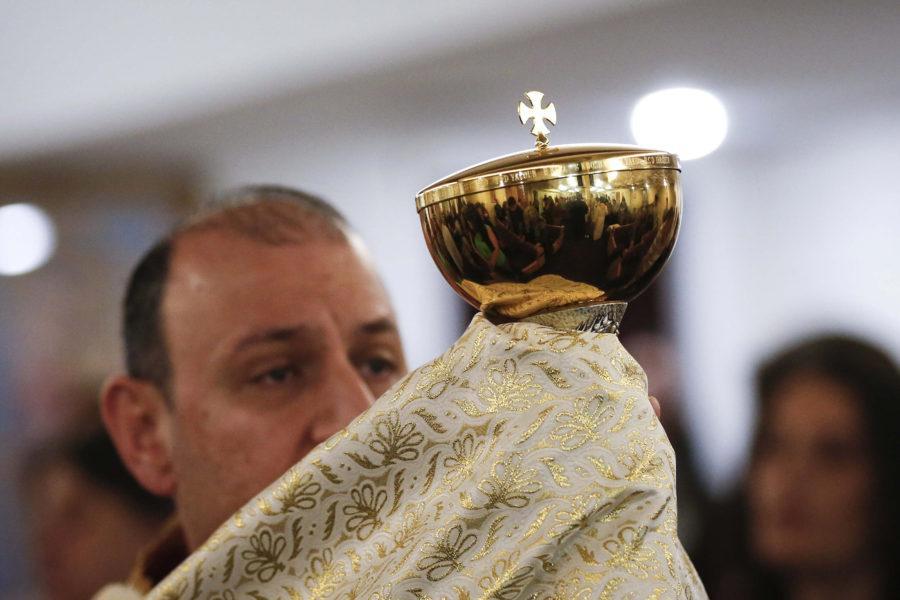
Msgr. Felix Shabi carries a chalice containing the Eucharist to a place of repose following Holy Thursday Mass of the Lord’s Supper at Mar Abraham Chaldean Catholic Church in Scottsdale, Arizona. (CNS photo/Nancy Wiechec)
Dating back to my preteen altar server days, I’ve always had a deep connection to the Triduum. Every year, when the volunteer ministry schedule for Holy Week came out, I was the first to sign up. Back then, the novelty of the unique rituals intrigued me; it’s not every day that you see your priest kneeling down to wash parishioners feet in imitation of Christ.
Through the years, I still find myself just as connected to the observances of Holy Week. Now, though, instead of having my curiosity piqued by different liturgical traditions like it was during my youth, these blessed holy days signify a deep, spiritual time of reverence, thanksgiving, and self-reflection. Looking back over the season of Lent, I’m reminded how the emptiness I’ve experienced signifies my dependence on the Holy Spirit.
Our Catholic faith is full of so many beautiful traditions, but one that leaves me speechless every time I witness it is the procession of the Blessed Sacrament on Holy Thursday. When the Mass of the Lord’s Supper has ended, the consecrated Hosts are solemnly carried over to a special repository, commonly referred to as the altar of repose. Many churches use their chapels for this occasion. The Blessed Sacrament remains in this location until the Communion Service on Good Friday.
I was attending the Holy Thursday service at St. Joseph’s Cathedral in San Diego when I first felt the magnitude of this procession. The priest had just finished reciting the post-Communion prayer, the incense was being prepared, and I was gazing around trying to find where the altar of repose was located. The cathedral was packed full of congregants, yet the air hung perfectly silent. Without the rays of the bright Southern California sun shining in, the dark, wooden fixtures set a somber tone. The sanctuary was mostly illuminated by candles burning on the main altar.
I expected the choir to begin playing a quiet melody or to start a soft chant as the procession of the Blessed Sacrament commenced. Instead, the priest invited us all to follow behind him. Parishioners were encouraged to join the Blessed Sacrament as the procession trickled outside, down to the sidewalks that circled the cathedral, before ultimately resting at the temporary altar set up in the social hall. As the priest began to walk, the only sounds to break the silence were from Luke 23:42: “Jesus, remember me when you come into your kingdom.” These sweet, somber words, quietly sung, echoed throughout the remainder of the procession.
“Jesus, remember me when you come into your kingdom.”
This humble plea sits heavily on my chest every time I hear it. These words serve as a meaningful reminder to me that we’re all invited to partake in the kingdom of God by actively participating in our Catholic faith through the sacraments. Remembering the importance of the sacraments inspires me to regularly receive the Eucharist and nudges me to go to Confession.
On Holy Thursday, we commemorate the night that Jesus made a gift of himself for the human race. This year, before you head out for Holy Thursday Mass, remind yourself of what you are celebrating when you remember the Last Supper. You are about to stand witness to the body and blood of Christ.
If you don’t usually participate in Adoration, spend some extra time with Jesus on the eve of his crucifixion. Allow yourself to remain open to hearing God’s message. How can you follow in Jesus’ footsteps by serving others? What are the blessings in your life that you take for granted? What might be holding you back from picking up your cross and following in Christ’s footsteps?
As I reflect upon the beautiful procession of the Blessed Sacrament, I find myself praying, “Jesus, remember me when you come into your kingdom.” My soul takes comfort in knowing that we all have an open invitation to live in eternity with God.
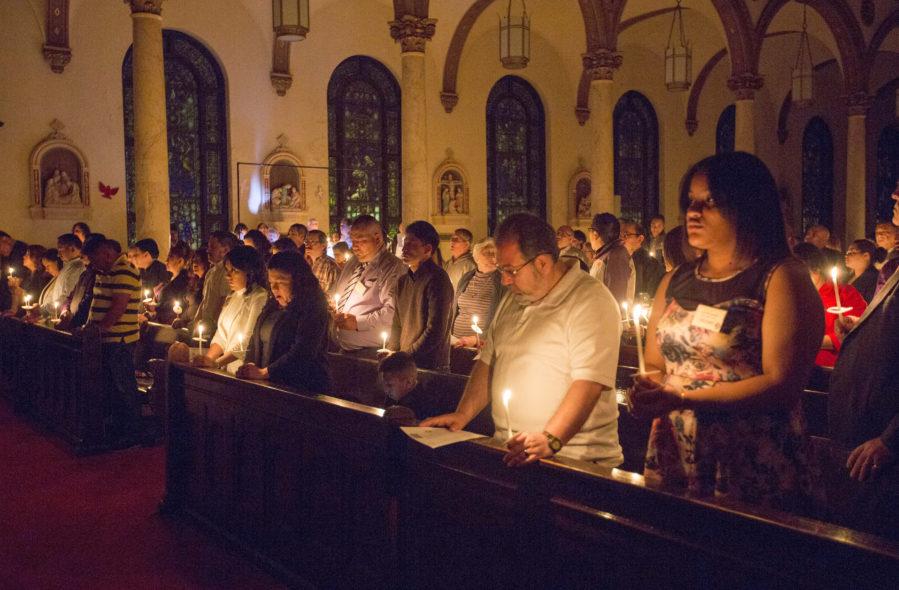
2015 Easter Vigil at St. Paul Church in Wilmington, Delaware (CNS photo/Octavio Duran)
The Triduum (TRIH-du-um) is the time of the Church year when we celebrate the passion, death, and resurrection of Jesus Christ. This three-day celebration begins with the Holy Thursday Mass and continues on Good Friday with the Liturgy of the Lord’s Passion. At the end of this liturgy, we leave the church in silence, waiting to celebrate the glory of our Lord’s resurrection. Then, on Saturday at sundown, the Church re-gathers to celebrate the final, and most grand moment of the Triduum: the Resurrection of our Lord.
The Triduum is somewhat like a three-day prayer marathon, and if you are a novice there may be some rituals that are unfamiliar to you. This guide will help you walk and pray through the liturgies of the Triduum.
The Mass on Holy Thursday is commonly known as the Feast of the Lord’s Supper. This Mass is a time for Catholics to remember the Last Supper where Jesus and his apostles gathered to celebrate Passover. In the Holy Thursday celebration, two ritual actions stand out among the rest:
The Washing of the Feet
At the Last Supper, Jesus took a basin and a towel, got down on his hands and knees and washed the feet of all of his apostles. After this action, he commanded the apostles, “I have given you a model to follow, so that as I have done for you, you should also do” (John 13:15). This is Jesus’ commandment: Just as Jesus has been a servant to his apostles, so the apostles must go out into the world and be servants to everyone around them.
We are called to do the same in our daily lives. Well, we are not called literally to wash each other’s feet (though sometimes that may be the case). The action of washing one another’s feet reminds us of the call to humble servitude. Foot washing is not a re-enactment or re-creation of a past event, but rather, it is a commemorative action that reminds us that God calls us first and foremost to be servants to others in our daily lives.
The ritual washing of the feet can take place in many ways. Some churches choose to have 12 people, who represent the apostles, have their feet washed by the priest presiding over the celebration. Other churches invite the entire gathered community to have its feet washed (this particular tradition is very powerful because everyone is invited to come and have their feet washed by someone else in their community). However the ritual takes shape, foot washing should always be a reminder that Christ has called us to be servants to the entire world.
The Celebration of the Eucharist and the Eucharistic Procession
At the very first Last Supper, Jesus also instituted the Eucharist for the Church. At this Holy Thursday celebration, we are reminded of who we are in Jesus Christ and that, through the sacrament of the Eucharist, we are and we become even more the Body of Christ together.
At the conclusion of the Holy Thursday celebration, there is no concluding prayer. Once the celebration of the Eucharist is completed, there is a Eucharistic Procession (where the Eucharist that is left from Communion is processed to a Chapel of Reservation). This procession to the Chapel of Reservation reminds us of Jesus’ time in the garden of Gethsemane when he prayed so fervently through the night. The entire community is invited to join in this procession and then join in the silent prayer and adoration until night prayer is prayed and the Eucharist is put in the Tabernacle. The gathered community leaves in silence only to return in prayer the next day for the Good Friday celebration.
Reflection questions for Holy Thursday:
Who are those people who need our help the most?
Am I willing to get down on my own hands and knees and help those who are unable to help themselves?
What does the sacrament of the Eucharist mean to me?
In this solemn celebration, we remember the Passion and Death of Our Lord. The service is marked by several important rituals including the proclaiming of the Passion according to John, the Veneration of the Cross, an extended form of General Intercessions, and finally, the distribution of Communion (reserved from the Holy Thursday celebration of the Eucharist).
The Veneration of the Cross
It seems strange that in the Good Friday liturgy Catholics choose to venerate, or show reverence to, the very instrument that was used to crucify Jesus. The Veneration of the Cross reminds us that through this Cross, the Glory of the resurrection emerges. So, on Good Friday, we come forward to show our great reverence and respect for the Cross. People have various traditions when they approach the Cross. Sometimes they kiss the Cross, kneel before the Cross, or even just touch it in some fashion. As you participate in this ritual, venerate the Cross in whatever way feels most normal. And most of all, just take in the experience of the gathered community coming so close to such a tragic, but integral, event in our faith.
The General Intercessions
If you enjoy spiritual aerobics, then this ritual is for you! In this expanded form of General Intercessions, the presider and the deacon work together to pray 10 intercessions. These intercessions are the same intercessions the entire Church prays on Good Friday, and they include praying for the Holy Church, praying for the unity of all Christians, praying for the Jewish people, praying for people who do not believe in Christ or in God, praying for people in public office, and praying for people who are suffering or facing difficult times. These prayers recognize how universal our Church is and that we should be aware of all of the faiths and traditions in the world that are different from our own.
Reflection questions for Good Friday:
What does the death of Jesus mean to me?
What does it mean to “Glory in the Cross”?
The celebration of the Easter Vigil tells the whole story of our salvation — from creation to resurrection and beyond. Because of all the ritual moments, this service tends to be on the lengthy side (an average Easter Vigil will last at least 2-2 1/2 hours). But don’t let the length of the celebration detract you from participating. The Easter Vigil includes the lighting of the Easter Fire and Paschal Candle (the large candle that we will use throughout the year), the singing of the Exsultet (the Easter Proclamation), the expanded Liturgy of the Word that traces time through Salvation History (the story of our Salvation), the Liturgy of Initiation (where new people come into the Church), and the celebration of the Holy Eucharist. All these rituals come together for one purpose: to remember and recall the saving deeds of our God on our behalf. Here’s an explanation of two moments from the celebration.
The Singing of the Exsultet
The Exsultet, or the Easter Proclamation, is a hymn that is sung by a deacon, priest, or cantor. This hymn speaks of how God has interceded in our lives on our behalf. The Exsultet especially recalls the Holy Night when Jesus Christ rose from the dead. What makes this moment particularly dramatic is that the Exsultet is sung in a church lit only with the light of the Paschal Candle and other smaller candles, which people are holding. In order to pray this hymn along with the deacon, priest, or cantor, try reflecting on the words of the hymn throughout Holy Saturday.
The Liturgy of the Word
The Liturgy of the Word for the Easter Vigil is comprised of nine readings and seven responsorial psalms. The first reading begins with the story of Creation and then, each subsequent reading recounts the story of our faith lives through history. You’ll hear the story of Issac and Abraham, the story of Moses and the Exodus, and more. All of these readings lead up to the singing of the Gloria when all the lights come on in the church, and then the final reading, the Resurrection of Christ, is proclaimed. Why so many readings? Again, like the singing of the Exsultet, the readings recount the many ways in which God has interceded on our behalf throughout history.
Most churches do not do the entire set of nine readings (for time’s sake). But keep in mind that the point is to recall how God has interceded on humanity’s behalf from the very beginning of time and that through this Easter Vigil we celebrate that God is present and always working in our lives, even still today.
Reflection questions for the Easter Vigil:
How has God interceded in my life?
After hearing the Resurrection story, what events do I see in my own life that are in need of new life, in need of resurrection?
How can I carry on the story of the resurrection to others?
Easter
Throughout these three days, we experience the highs and lows in our faith, ending with the ultimate high — the new life of the resurrection. The Easter Season begins with the Easter Vigil, and we enter a time (50 days) when endless “Alleluias” will ring out throughout all of our liturgical celebrations. May you experience the joy of new life in your own way this Easter Season. Have a happy and blessed Easter!
Why do Catholics wave palms on Palm Sunday, wash each other’s feet on Holy Thursday, or kiss the cross on Good Friday? In an updated version of our classic video (with a bonus extra minute — because there’s a lot going on this week!), Busted Halo explains the significance of the final week we spend preparing for Easter.
To download this video go here and click the download arrow or choose save or download.