Tag: Holy Days & Seasons

  • O Antiphons: A Prayerful Homestretch to Christmas

    O Antiphons: A Prayerful Homestretch to Christmas

    “O Come, O Come Emmanuel” is one of my favorite hymns, if not my all-time favorite. This hymn is ubiquitous with the Advent season and is heard in most Catholic churches in the United States at least once in the season. The words of this hymn, simultaneously wonderfully ancient and ever-new, are based on what is referred to as the “O Antiphons.” Now, maybe you already knew that, maybe you’ve heard of the “O Antiphons” before, or maybe you’re now wondering what an antiphon even is. Chances are though, you’ve heard this hymn and might have wondered where it came from.

    An antiphon is a short phrase or sentence that is used in liturgies like the Mass or Liturgy of the Hours. Antiphons serve as small refrains and often highlight a particular message or prayer of the season. In this case, the “O Antiphons” refer to the specific antiphons used in Vespers (evening prayer of Liturgy of the Hours) that go with reciting the Magnificat (Mary’s prayer of praise from Luke) from December 17 to 23. Together, these seven antiphons – all of which start with calling upon Jesus Christ with an exclamatory O, hence the name –  help to serve as a prayerful conclusion to Advent, a homestretch prayer on our way to Christmas.

    LISTEN: Father Dave Explains O Antiphons

    Structurally, each antiphon has two key parts. The first is a traditional title of Jesus Christ as the messiah, the one who was promised to come, such as Emmanuel, used by Gabriel in the Annunciation meaning “God with us.” These titles reflect how the prophets thought of the coming messiah and who he is. The second part of each antiphon is a reflection of that role by drawing upon the words of the prophet Isaiah. This portion helps to reflect on the mission and ministry of the messiah and how he would live out that particular title. For us as Christians, we use these prophetic titles and words to reflect on Jesus Christ, what he has done in history, and how he continues to act in our lives today.

    We can sit with these seven little phrases and draw upon their richness in helping us to know Jesus Christ as the wisdom of God, guiding us in our lives and actions. We too call upon Jesus Christ in a longing way as we look forward to and hope for his second coming. So just as the prophets longed for his first arrival, we too wait eagerly and look forward to his return in glory.


    December 17: O Sapientia

    O Wisdom, O holy Word of God, you govern all creation with your strong yet gentle care. Come and show your people the way to salvation.

    O Wisdom, O Word of God! These ancient titles reflect God’s perfect knowledge and are titles given specifically to Jesus Christ. In the Book of Wisdom, wisdom is personified as existing before all time with God, and in relationship with the Father. In the original Greek of the Book of Wisdom, the word used for Wisdom is “Sophia” (which may ring bells of the Hagia Sophia or Holy Wisdom). Wisdom was depicted in feminine language as one who is gentle and caring. In the prologue of the Gospel of John, we hear how the Word was with God and was God (John 1:1). The Greek word used here is “Logos,” which, in addition to word, can also be translated as wisdom. Christ is this wisdom of God, the perfect knowledge of the divine, loving, and creative, made manifest in human life.

    Christ was present at the creation of the universe as the Son, the Wisdom, and the Word. Indeed, Christ was not passive in the creation, but was the very blueprint of creation itself. As Psalm 33:6 states: “By the Lord’s word the heavens were made; by the breath of his mouth all their host.” The world was made to reflect this Wisdom and Word, and humanity, made in God’s image, is called to look to Christ for the very way to live our lives. Christ is not distant from creation either, as this antiphon reminds us. Rather, he continues to govern and care for creation, remaining intimately connected and in relationship with all he has made.

    Through the goodness of the world that Christ created, he shows us the way to eternal life. We are a sacramental people, meaning that physical signs point us to the goodness of God and salvation. As we enter the final days of preparation for Christmas, may the bright decorations and the joyful celebrations with family and friends be a sign of God’s love and lead us deeper into knowing the Wisdom and Word made flesh.


    December 18: O Adonai

    O sacred Lord of ancient Israel, who showed yourself to Moses in the burning bush, who gave him the holy law on Sinai mountain: come, stretch out your mighty hand to set us free.

    Christ is not a new creation that was spontaneously generated on December 25 over 2000 years ago. Christ, as the Son of God, the second person of the Trinity, has always and will always exist. The title used for Christ in this antiphon is Adonai, a Hebrew word for the Lord of all who is a good and just ruler, a giver of law.

    Even if they were not known in the moment, all three persons of the Trinity were present at the burning bush. The same Christ who would be held as an infant in Mary’s arms declared himself as “I am who I am” to Moses (Ex. 3:14). Our Lord and God, who is infinite and eternal, humbled himself to be held as a child to set us free.

    St. Paul writes of Christ coming under the law to free us from it. This is not to set us free from the moral and theological precepts, such as the Ten Commandments, but to free us from the law of sin and death. Christ is the author of true law, of the laws given to Moses, and ultimately, of the law of life. It is this same Christ who sets us free from the law of sin who gives us the laws of love and freedom. The same Christ who has acted in history to give the law and set us free continues to act in our lives with his mighty hand.


    December 19: O Radix Jesse

    O Flower of Jesse’s stem, you have been raised up as a sign for all peoples; kings stand silent in your presence; the nations bow down in worship before you. Come, let nothing keep you from coming to our aid.

    O Flower, Christ, who is the sign of new life, flourishing, and beauty! In the dark of winter, the thought of a freshly bloomed, beautiful flower can bring us to a place of peace, warmth, and tranquility. In the difficulties of life, Christ is the flower that brings us to these same places. Christ, through sharing our humanity in the incarnation, knows our pains and struggles. He sees us in our times of need and comes to be with us, to hold and comfort us, to grant us hope and peace like the thought of a beautiful flower on a cold night.

    It’s interesting to note that “radix” is translated as “flower” in the English breviary when it actually means “root.” This reality of being both root, stem, and flower shows Christ’s presence throughout history. In the antiphon, it seems odd at first to call upon Christ, who in his human family is a descendant of Jesse, as the root of the stem. And yet, as God, Christ is the root, the beginning, of the family line. He has existed before the world and helped bring forth the family of Jesse and his son, King David. He is the source of their life, the root which draws in to care for them. And yet, Christ also steps into the world as their descendant. Christ humbles himself and is born from the stem of Jesse as a humble shepherd. This language is drawn from chapter 11 of Isaiah where the prophet states “A shoot shall come out from the stump of Jesse” (v. 1) and “the root of Jesse shall stand as a signal to the peoples” (v. 10).

    All nations will bow down in worship; all peoples are called to life with Christ. This humble flower blossoms not just for us as individuals, but for all peoples throughout the world and history. We share in the mission to bring all nations to Christ, to proclaim his love and his truth to the world. We ask Christ to remove all barriers between us and him so that he may come to help us just as he came to help the world at his birth. We share in this, too, by removing the barriers in the world between all peoples, so that we may live together in the love of Christ.


    December 20: O Clavis David

    O Key of David, O royal Power of Israel, controlling at your will the gate of heaven: come, break down the prison walls of death for those who dwell in darkness and the shadow of death; and lead your captive people into freedom.

    O key of the royal family, open for us the treasury of your goodness. You have loosened our chains. You have given us the freedom of eternal life in your love. You, O God and Christ, have humbled yourself, as the one who opens the gates of heaven, to be given to Peter and your Church. In your love, you have made the path of salvation known to us and promised to be with us in our journey.

    By your incarnation, O Son of God, you came to give us freedom from death. By your paschal mystery, your death and resurrection, you lead us out of the dark valley of death and into eternal life. Death has no power over us any longer; you have trampled death by death. In your birth, we remember why you have come. We remember and look forward to the ultimate glory of your resurrection.

    As we look towards Christmas in just a few days, we can reflect in prayer on what Christ has freed us from in our lives. What shackles has Christ removed for us so that we can love God and neighbor more? We can also reflect on what barriers there are in our hearts to loving more deeply, and asking Christ to give us the grace to remove them. By the birth of Christ, we are invited to love God and neighbor with our whole heart and selves.


    December 21: O Oriens (Dawn of the East)

    O Radiant Dawn, splendor of eternal light, sun of justice: come, shine on those who dwell in darkness and the shadow of death.

    O Radiant Dawn, how we long for the rising of the sun in the dark months – to feel the warmth on our faces. Knowing the shadow of death that looms over all of us, we long for the eternal light of God all the more. Christ is the light we long for and know in our lives and the Church. Christ’s light guides us in our steps and helps lead us to a life of love and discipleship. The child born in the manger is this sun, this great light of God’s love, who continues to walk with us and guide us. 

    In facing the cold and dark of injustice, separation, and pains of our world, we desire the sun of justice. We know that Christ not only brings justice to earth and rights wrongs, but that Christ is the true justice we seek. He calls us to follow him in this world, to share that justice. This justice is not harsh and punitive, but kind, patient, loving, and uniting. The prophet Malachi describes the rays of this sun as healing (Malachi 4:2). The warm rays of Christ heal our souls, warm our hearts, and guide our steps in justice. In welcoming these healing rays, Christ transforms us and sends us forth into the world to share that same light and warmth.


    December 22: O Rex Gentium

    O King of all the nations, the only joy of every human heart; O Keystone of the mighty arch of man, come and save the creature you fashioned from the dust.

    O King of the nations, you are the true ruler of all peoples and all creation. You call all peoples to yourself and call all of us to live together as your people. You rule not as a despot or tyrant, but as a loving servant who cares for the hearts of all. Truly, you bring us the joy that lasts forever, a joy that does not perish; you satisfy our every longing.

    O Christ, through you humanity was made, and through you, humanity is completed. You are the keystone of the arch of humanity. You have wonderfully made us in your image out of lowly dust and made us to share in your love forever. Our arch, however, is not complete without you. Only with you, O Christ, humanity is made whole and complete. In taking on human flesh as a lowly child in the manger, you bring the fullness of our true selves. You restore us and bring us to new life. Come, save us, bring us to eternal life, bring all of humanity to completion in and through your love.

    In looking to Christ as our King, we look to see how we emulate his kingship. At our baptisms, we are anointed as sharing in Christ’s roles as priest, prophet, and king. As ones who share in his kingly role and ministry, we lead in our lives and in our worlds. Whether that is as leaders in our families, our work, or any other aspect of our lives, it is a moment to reflect Christ in his role as our king, to be one who serves.


    December 23: O Emmanuel

    O Emmanuel, king and lawgiver, desire of the nations, Savior of all people, come and set us free, Lord our God.

    O Emmanuel is our final antiphon and final evening prayer before Christmas begins. We find ourselves on the precipice of a great day and season of celebration. Knowing what is to come, we cry out to Jesus Christ; we cry out with titles that summarize all the other antiphons. We cry out, knowing that Christ alone will save us and set us free. This antiphon is short, knowing the light of Christmas dawn is coming soon.

    Emmanuel means “God is with us.” It’s an intimate reminder at the start of this antiphon that God is always near us. We remember the unique way that Christ walked among us at Christmas, but know that he is still always with us. He is the king and lawgiver, the one who rules over our lives and makes the laws that govern the world. Christ is not a distant ruler or a despot, but one who is close and in relationship with all of us.

    Christ is the desire of all nations, the savior of all. Christ came to the world and became like us in all things but sin so that we could be like him and share in eternal life. We cry out now, especially from the darkness of sin and separation in our lives, for the same Christ born in the manger to save us this day. We cry out to our God, our Lord, who loves us all, transforms us, and brings us everlasting life.

    As the Church prepares to celebrate Christmas starting with the vigil on Christmas Eve, we close out our reflections upon the “O Antiphons.” These short stanzas, these poetic lines drawing upon scripture, help us to prepare our hearts for the great celebration of Christmas and can guide us in our daily lives as Christians. We invite you to prayerfully recite each of these antiphons, taking a small pause between each one, as a final prayer of Advent. Reflect on where God has spoken to you in this season, and where God is leading you to share the joy of Christmas with others. May you have a wonderful, blessed, and merry Christmas!
  • Our Lady of Guadalupe: More Than Meets the Eye

    Our Lady of Guadalupe: More Than Meets the Eye

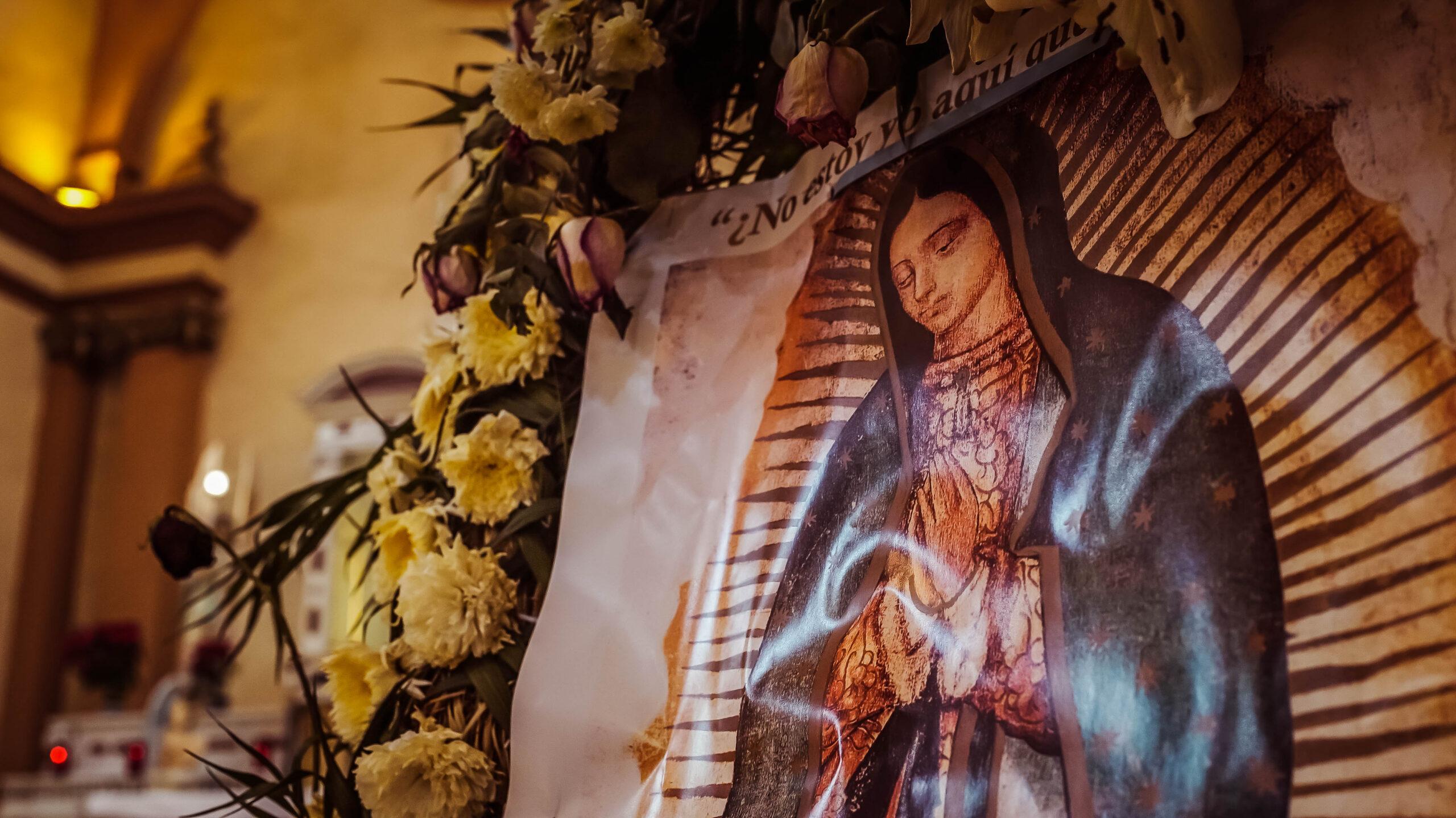
    Our Lady of Guadalupe, as she appeared in Mexico to Saint Juan Diego in the year 1531, is one of the most popular depictions of the Blessed Virgin Mary around the world. In my own experience, seeing her radiant image week after week as it hangs near the altar of my home church in Northern New Jersey piqued my interest and led me to learn more about this apparition. Upon first glance at the holy image, Our Lady’s beauty, humility, and tenderness are clear for all to see, but as it turns out, there is actually far more to this stunning self-portrait of Mary than one might suspect. As we prepare to celebrate the annual Feast of Our Lady of Guadalupe on December 12, let’s take some time to appreciate what makes La Virgen de Guadalupe so unique:

    1. Practicality

    On a basic level, I find it utterly amazing that the image of Our Lady of Guadalupe was given to humanity by Mary herself. As the historical account of the miraculous apparition goes, the Blessed Virgin came to Juan Diego and instructed him to petition the bishop of Mexico to build a church on the Hill of Tepeyac where she appeared. When the bishop asked Juan Diego for proof, Mary once again visited Juan Diego and gave him roses – in the dead of winter – to carry in his tilma, or cloak, and present to the bishop. Arriving before the skeptical clergyman once more, Juan Diego opened his tilma to reveal not only the beautiful roses, but the heavenly image of Our Lady of Guadalupe herself as we know her today. 

    This is the very same image that we still see of the Blessed Mother almost 500 years later. It’s not every day that the Mother of our Lord descends from heaven and quite literally hands us a self-portrait as a means of introducing herself to those who don’t yet know her. In a practical sense, this image allows us to honor Mary more intimately. It is not a man-made rendition of what some artist believed the Blessed Virgin might have looked like. When we look at this image, we see our Mother exactly as she appeared to Juan Diego centuries ago, her likeness crafted by heavenly design and gifted to humanity on a poor man’s cloak.

    RELATED: Our Lady of Guadalupe and the Joy of Knowing Her Son

    2. Symbolism

    The full account of the symbolism woven into La Virgen de Guadalupe’s image could stand as its own dissertation, but it is certainly worth mentioning in brief. Many elements incorporated into the depiction served to explain Mary’s identity – and that of the child in her womb – to the Aztec people. For example, the stars on her royal blue-green cloak that mirrored the constellations as they illuminated the sky on the morning of her apparition signified that she came to the Aztecs from heaven. The traditional black maternity band worn around her waist drew the natives’ attention to the child in her womb. With the sun behind her and the crescent moon under her feet, both of which were symbols of Aztec deities, Mary revealed that she was bearing the one and only true God. 

    I find it especially powerful that Our Lady came to her sons and daughters of Mexico in a way that was so personally meaningful to them, embodying their history and culture to demonstrate that she came to them as their mother. This leaves no doubt in my mind that when Christ gave us his mother to be our own as he hanged dying on his cross (John 19:26-27), Mary took us into the fold of her mantle as her beloved children. She is truly and devotedly our mother.

    RELATED: Our Lady of Guadalupe: A Convert’s Guide to Feasting the Patroness of the Americas

    3. Signs of Life

    Yes, you read that correctly. Though claims about the many miraculous attributes of Our Lady of Guadalupe’s image have naturally been met by their fair share of critics and naysayers, studies by doctors and scientists over the past century have resulted in some phenomenal findings. In the case of a three-hour infrared study of the tilma conducted in 1981 by Dr. Philip Callahan, a biophysicist and consultant for NASA, it was discovered that the figure of the Blessed Virgin Mother on the tilma maintains a temperature of 98.6 degrees Fahrenheit, which is the natural temperature of the living human body. Another investigation by gynecologist Carlos Fernandez del Castillo revealed that, when listening to the image with a stethoscope, one heartbeat could be heard at the chest of Our Lady, and a second within her womb that carries the unborn Christ. Ophthalmologists Dr. Manuel Torroella, Dr. Enrique Graue, and their colleagues likewise examined the image and discovered that the eyes of Our Lady of Guadalupe reflect images back at the viewer just as the normal human eyeball does. The list goes on

    Being a devout Roman Catholic and first-year medical student who loves all things science, I can’t help but take some personal satisfaction in these findings. As anyone with internet access can attest, an unfortunate “religion versus science” mentality seems to predominate our society and all too easily brings contention to discussions of either topic. Perhaps these scientific anomalies woven into La Virgen de Guadalupe’s image will show those who choose science alone at the expense of faith that it is God who is the author of the natural world; it is through science that we strive to decode his divine language.

    One of the main points I take away from the apparition of Our Lady of Guadalupe is that Mary comes to us as our own loving Mother, fully compassionate toward our personal circumstances and seeking above all to bring us closer to her and her beloved Son. Just as she did for the Aztec people centuries ago, Our Lady of Guadalupe comes to meet us precisely where we are, and as we are, to offer us her love and intercession. I often find great comfort in the words she spoke to Saint Juan Diego in one of his most difficult moments, and I encourage you to do the same: “Am I not here, I, who am your Mother? Are you not under my shadow and protection? Am I not the source of your joy?”

  • 2024 InstaAdvent Photo Challenge

    2024 InstaAdvent Photo Challenge

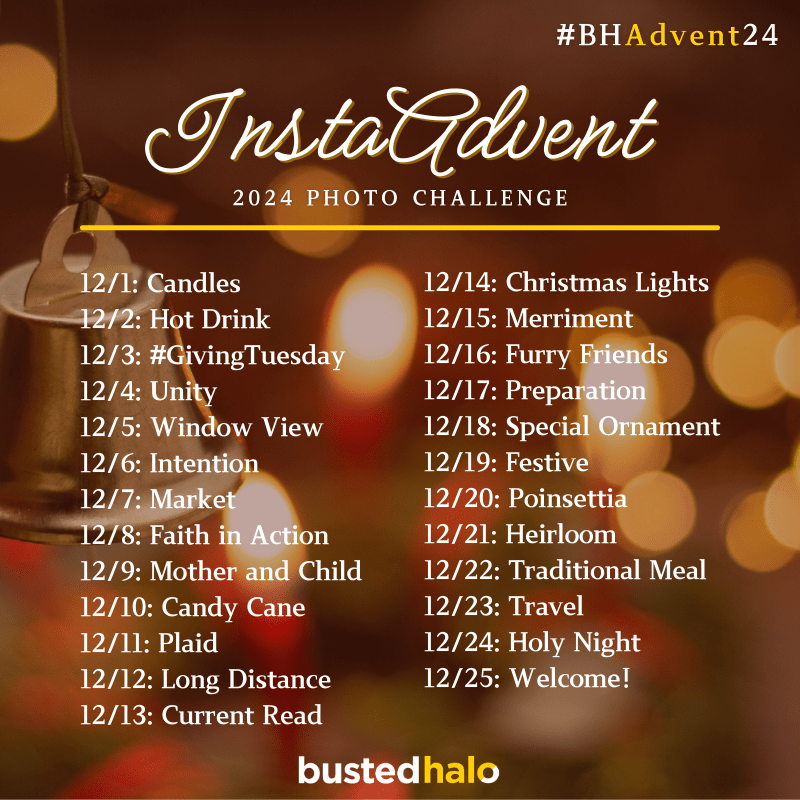
    Our InstaAdvent Photo Challenge is back! Advent is a time of anticipation and waiting for the birth of Jesus. There’s so much wonder and love in the air! So, join us in Busted Halo’s InstaAdvent Photo Challenge! Post a photo every day during Advent and stay connected to the hope, joy, and occasional candy cane that make this time of year so special. It’s the season of giving, so we’ll be giving away prizes each week!

    How do you participate?

    • Share our InstaAdvent image on Instagram so we know you are participating in the challenge!
    • Take a pic following our theme of the day and tag #BHAdvent24 and @bustedhalo on all your posts!
    • If you’re not on Instagram, no worries! You can still participate in the fun by uploading your Advent photos to Twitter or Facebook, using the hashtag #BHAdvent24, and mentioning @bustedhalo.

    We can’t wait to see your photos! Have a blessed Advent journey!


    Busted Halo Advent Photo Challenge

  • Our Lady of the Assumption: Her Importance and Influence in Everyday Life

    Our Lady of the Assumption: Her Importance and Influence in Everyday Life

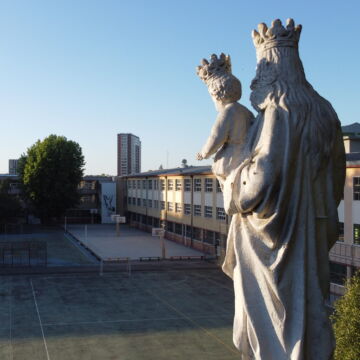
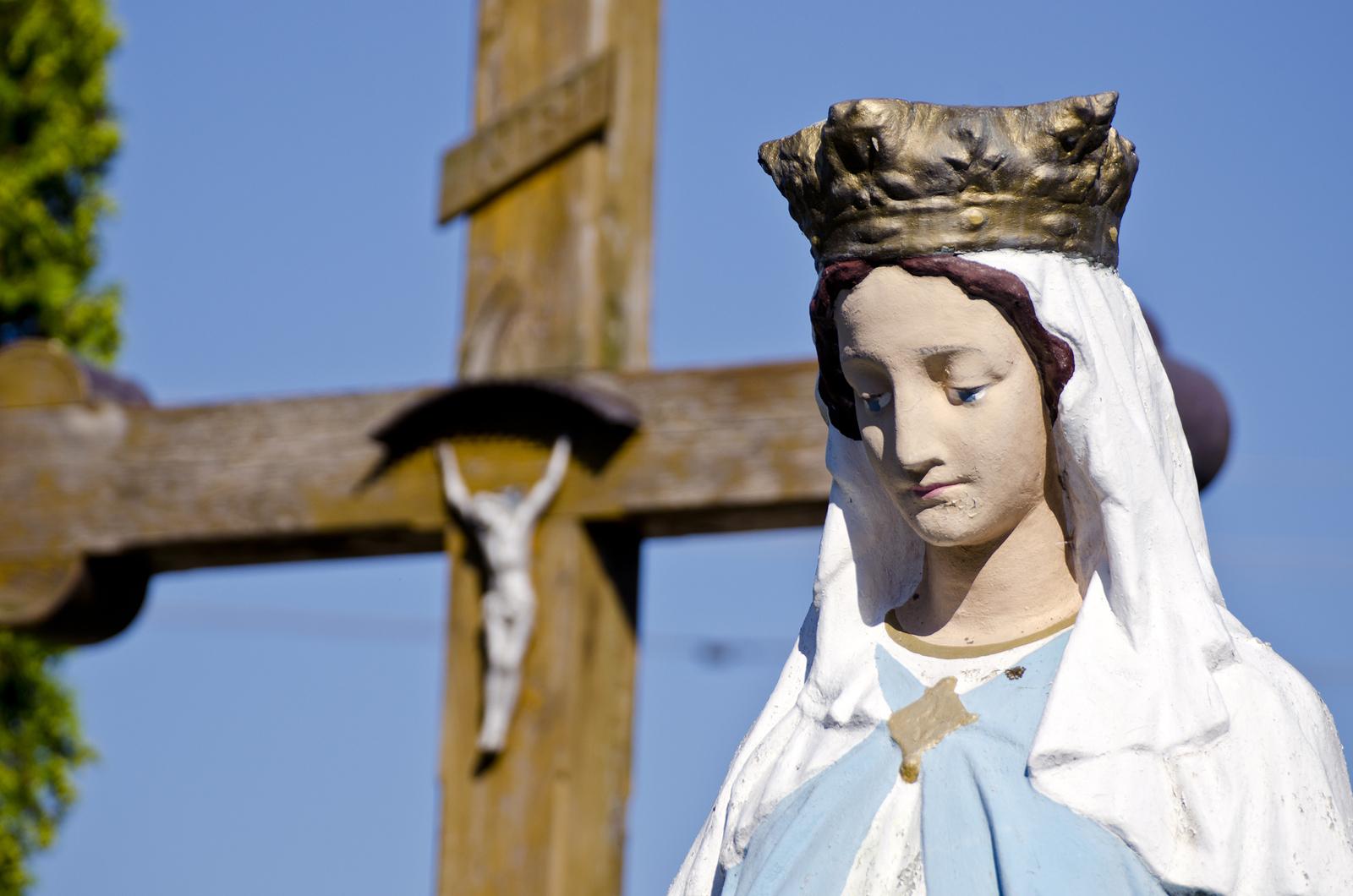
    Statue of the Virgin Mary holding the Infant Jesus overlooking a schoolyard.
    Photo by jlopez on Cathopic

    One day, I asked students at the school where I work, “What’s the name of our school?” They responded in chorus with the expected exuberance of 23 first graders, “OLA!” 

    “What does OLA stand for?”

    This response wasn’t quite as resounding as the first, “Our Lady of the Assumption!” Their eyes shone bright with proud enthusiasm.

    “On what date do we celebrate Our Lady of the Assumption?” 

    Blank stares… then

    “Wednesday!”

    “Christmas!”

    “New Year’s!”

    One clever set of eyes darted about for clues and found a hint on a plaque hanging on the brick facade near where we stood outdoors, on our way inside from recess. She confidently blurted out “1952,” the only numbers on the plaque (the year the school was founded). Other parroting voices trailed in echo. 

    From that day on, the first graders could recall August 15 as Our Lady’s Day of Assumption as readily as they recalled their own birthdays. Whenever they did, I felt an inner joy and a renewed connection to Our Lady. 

    RELATED: Understanding and Celebrating the Feast of the Assumption

    In addition to the date, the children would eventually learn the Church’s teaching on the Assumption: “The Most Blessed Virgin Mary, when the course of her life was completed, was taken up body and soul into the glory of heaven…” (Catechism of the Catholic Church 974).

    Of Our Lady’s devotions and prayers, there are the Rosary, seven sorrows of Our Lady, Our Lady of the Miraculous Medal, etc. Similar to their attractions to certain of her apparitions, many Marian devotees are partial to specific feast days. Often, one chooses a particular devotion because of an experience where Jesus opens a door, and his mother appears from behind it. That was the case for me and my devotion to Our Lady of the Assumption. 

    A few years ago, I felt a nudge from God that it was time to seek employment outside the home after a hiatus to raise my children. To take the guesswork out of where God was calling me, I prayed the Lord would open one and only one door for my employment. Eventually one opportunity arose and the Blessed Mother seemed to confirm it in a dream. 

    WATCH: Mary in 2 Minutes

    In the beginning of employment at OLA, the name of where I worked held no significance for me. But when I had a hard time adjusting to my job, I found solace when my eyes landed on the sign that announced Our Lady of the Assumption, as I drove into the parking lot to start the day. In solid block letters announcing her title, I found consolation on difficult days and the comfort in knowing she had chosen this place for me. 

    There was a time, just after I converted to the Catholic faith as an adult, I didn’t know a thing about the Blessed Mother. After some buds of our relationship began to blossom, I attempted to keep Marian dates straight to honor her. Once, I mixed up the dates of the Immaculate Conception — December 8 — and Assumption — August 15 — by mistakenly combining the two days into one and confidently marking December 15 on my calendar as an important feast day.

    While my family teases me for my inability to recall anything verbatim, not even a single lyric of a beloved song, I somehow memorized all the mysteries of the Rosary practically overnight. Through the Rosary, and the maternal mentors God has placed in my life, Our Lady weaves threads of her care. From guiding me to a counselor during the rocky times of marriage to selecting our children’s high school – titled after another of Mother Mary’s namesakes  – her gentle presence in my life became palpable.

    Last year, on August 15, as I attended the Solemnity of the Assumption Mass at the church and school that both bear her name, I marveled at how a last minute schedule change had brought me to this landmark Mass. Mother Mary indeed wanted me there to reassure me of her call for me to this place of employment. 

    RELATED: Why Does Mary Have So Many Different Feast Days and Names? 

    I randomly recalled that when my children were in elementary school, I would attend this Mass at their school every year to pour out all my hopes for the new school year to Our Lady. One year, after the August 15 Mass, my then-13-year-old daughter had announced that she was going to teach religious education classes. I immediately knew this was a grace from Our Lady. The fruit of Mother Mary’s intercession continued as my daughter taught catechism and Vacation Bible school classes the following years; she went on to obtain a college minor in teaching, and took a gap year after graduation to volunteer as a teacher. Our Lady of the Assumption’s intercession continues to bear great fruit in my family’s lives.

    My new place of employment was her nod to me as my mother, and yet another thread confirming she claimed me as her own. At the place that bears her name, this mother of all mothers is schooling me in true discipleship. Lesson plans in love, sacrifice, and humility often shine a mirror on warts I never saw before; some days the virtues she’s trying to instill in me scratch against my pride and leave scrapes that feel like cuts. But when I look at my paycheck, I’m reminded that of all the places to work, I labor for Our Lady, and there is no one kinder and gentler to tutor me in the virtues.

    One chooses a saint as his/her own because of an experience of his/her intercession. It’s a mystical, reciprocal companionship. A devotion to Our Lady’s feast day is similar. Of her feast days, I have to say Our Lady of the Assumption, where she schools me in lessons in love, is my favorite. Wherever I go, whenever I see a church or school named Our Lady’s Assumption. I feel the warmth of a mother’s arms; I’ll always honor her on this and other special occasions.

    Our Lady of the Assumption, pray for us!

    Originally published August 14, 2023.

  • A Guide to the Month of the Most Sacred Heart of Jesus

    A Guide to the Month of the Most Sacred Heart of Jesus

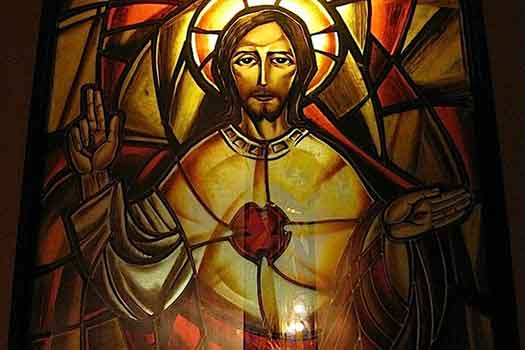
    i-heart-jesusThe Church dedicates the month of June to the Sacred Heart of Jesus, one of the most popular Catholic devotions throughout the world. So what is the Sacred Heart, anyway? When Catholics talk about the Sacred Heart we’re referring to the physical (yes, blood and ventricles and valves … this is an unabashedly embodied faith, y’all) Heart of Jesus as a representation of his Divine Love for humanity. Throughout his earthly ministry, Jesus’ Heart was moved by compassion for the poor, the sick, the forgotten, and the grieving. Pierced by a sword on the Cross as an act of self-giving love and enthroned in Heaven for eternity, this same Heart still beats for us and yearns for us and overflows with mercy for us and aches in solidarity with us. Come along with your favorite convert and start your summer off right(eous) with a few ideas to celebrate the month of the Sacred Heart:

    1. Begin at the Beginning

    During June, make an effort to begin your day with prayer. If this is a new practice for you, start out simply. If you have a picture of the Sacred Heart of Jesus, use it to focus as you pray. Try this little prayer to start:

    Consecration to the Sacred Heart of Jesus and the Immaculate Heart of Mary

    For a couple or family: Sacred Heart of Jesus and Immaculate Heart of Mary, I give myself and my whole family entirely to you [here name your family members], and to show our devotion to You this day, we consecrate to You our eyes, our ears, our mouths, our hearts, our whole being without reserve. Wherefore, dear Mother and sweet Jesus, we are Your own, guard us and keep us always as Your property and possession. Amen. (from The Catholic Mother’s Resource Guide by Maria Compton-Hernandez, Queenship Publishing, 2002)

    For a single person: Sacred Heart of Jesus and Immaculate Heart of Mary, I give myself entirely to you, and to show my devotion to You this day, I consecrate to You my eyes, my ears, my mouth, my heart, my whole being without reserve. Wherefore, dear Mother and sweet Jesus, I am Your own, guard me and keep me always as Your property and possession. Amen.

    If there are little people at your house, invite them to pray along by making the Sign of the Cross over their eyes, ears, mouth, and hearts as you pray aloud. (Also, make it clear that you want them touching their own eyes, ears, etc. … or else what started off as an act of piety will turn into a no holds barred cage match. Ask me how I know.)

    2. Tell it to his heart

    If you (like me) are a child of the ’80s, this song is now stuck in your head … probably forever. You’re welcome. This month, as we think about the boundless love of Christ and his Heart … which is set aflame with love for us, which was contained in his earthly body, which contains the whole universe … let’s imagine our prayers, petitions, worries, joys, and fears tucked into the living, beating Heart of Jesus. Here are a couple of ideas to get you started:

    • Using a dry erase or chalk board, draw an outline of the Sacred Heart. For the rest of the month of June, write your petitions inside the Heart.
    • Cut out a large Sacred Heart shape from poster board. Using photos, magazine clippings, and newspaper headlines, fill the Heart with images of loved ones, images that represent personal intentions, and words or images that represent petitions for your community and the whole world. Use the collage you’ve created as a starting point for prayer.
    • Try this exercise: Imagine you are standing face to face with Jesus. As you tell him the joys, burdens, and concerns of you heart, imagine his Sacred Heart growing more and more radiant with love. See your intentions inside his Heart and trust that they are safe there.

    3. Go to Mass

    Did you ever notice that the priest pours a bit of water into the wine before the Eucharist is consecrated? Ever wonder why? One reason comes from Scripture. In John’s Gospel, the soldier pierces Jesus side (i.e. his Heart) with a sword and blood and water flows from the wound. When we receive the Eucharist, we are receiving the Heart of Jesus. After you receive Communion, pray that through the grace of the Blessed Sacrament your heart may be made more like his Heart … merciful, compassionate, humble, and fearless. If you have yet to receive your first Communion, pray this prayer as you place your hands over your own heart to receive the God’s blessing from your priest.

    4. Divine Mercy

    The Divine Mercy Chaplet (a prayer) originates from a vision St. Faustina received of Jesus, his Heart overflowing with radiant mercy for all of us. All you need to try this popular devotion is an ordinary rosary (or 10 fingers … or toes). If praying a full chaplet feels intimidating at first, try quietly repeating this short prayer from the chaplet:

    O Blood and Water, which gushed forth from the Heart of Jesus as a fountain of Mercy for us, I trust in You!

    5. And what would a feast be without food

    Although the actual Solemnity of the Most Sacred Heart of Jesus is June 7, let the feasting continue all month! Check out Catholic Cuisine for loads of ideas for great food to celebrate the month. If your local farmers’ market is open (ours just opened this weekend), try making a Sacred Heart shape out of sliced strawberries, blueberries for the thorns, and sliced peaches for the flames. You can also make a treat to bring to someone in your parish, neighborhood, or apartment building who is homebound. Let them know that they’re in Jesus’ Heart … and yours too.

    Originally published June 10, 2013.

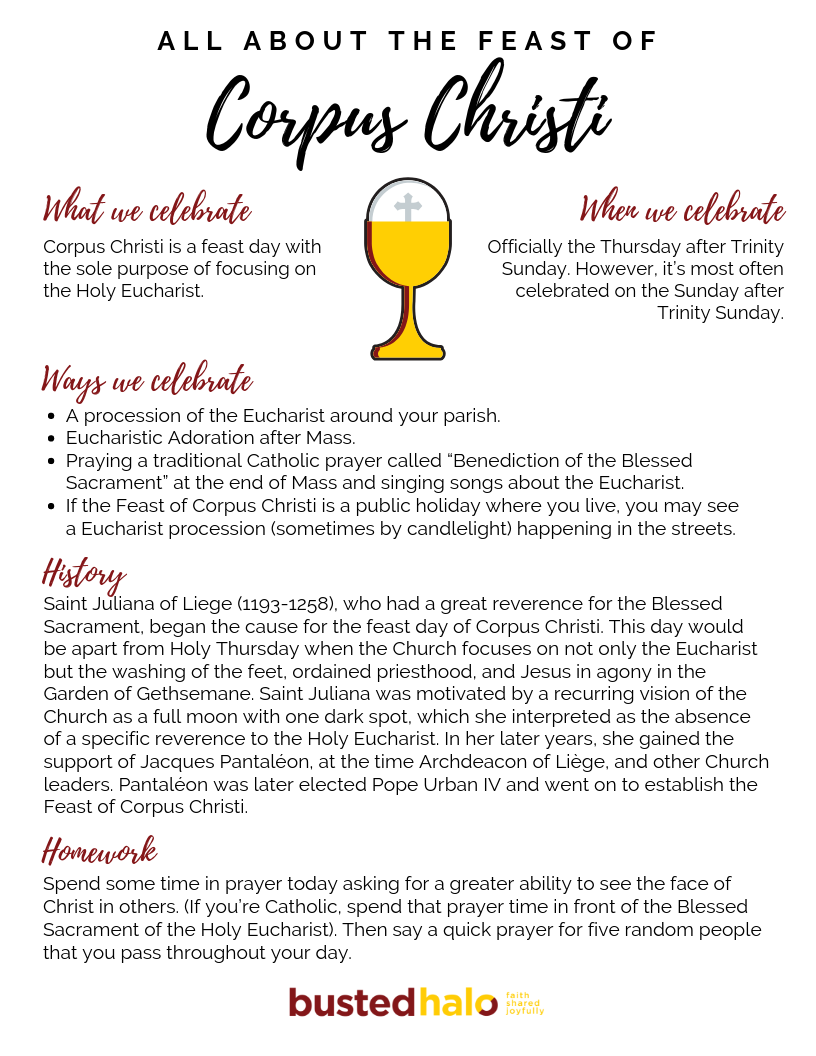
  • All About the Feast of Corpus Christi

    All About the Feast of Corpus Christi

    Have you ever wondered why there’s a specific celebration for Corpus Christi (Latin for “Body of Christ”)? Don’t we celebrate the Body and Blood of Christ at every Mass? Here are a few facts about this Holy Day. (We also created a handout with some of these details, below, that you can download and share at your parish.)

    Date:

    Officially the Thursday after Trinity Sunday. However, it’s most often celebrated on the Sunday after Trinity Sunday.

    Established:

    By Pope Urban IV on September 8, 1264

    What we celebrate:

    Corpus Christi is a feast day with the sole purpose of focusing on the Holy Eucharist.

    History:

    Saint Juliana of Liege (1193-1258), who had a great reverence for the Blessed Sacrament, began the cause for the feast day of Corpus Christi. She thought that the Eucharist deserved its own exclusive day of reverence and recognition. This day would be apart from Holy Thursday when the Church focuses on not only the Eucharist but the washing of the feet, ordained priesthood, and Jesus in agony in the Garden of Gethsemane. Saint Juliana was motivated by a recurring vision of the Church as a full moon with one dark spot, which she interpreted as the absence of a specific reverence to the Holy Eucharist. She worked more than 40 years for the cause until her death. In her later years, she gained the support of Jacques Pantaléon, at the time Archdeacon of Liège, and other Church leaders. Pantaléon was later elected Pope Urban IV and went on to establish the Feast of Corpus Christi.

    How we celebrate:

    • There may be a procession of the Eucharist around your parish.
    • Eucharistic Adoration may be held after Mass. (Stick around and see what it’s all about!)
    • You might hear a traditional Catholic prayer called “Benediction of the Blessed Sacrament” at the end of Mass. There will also be songs about the Eucharist and lots of incense.
    • If you live in one of the countries where the Feast of Corpus Christi is a public holiday, you may see a Eucharist procession (sometimes by candlelight) happening in the streets.

    Homework:

    Spend some time in prayer today asking for a greater ability to see the face of Christ in others. (If you’re Catholic, spend that prayer time in front of the Blessed Sacrament of the Holy Eucharist). Then say a quick prayer for five random people that you pass throughout your day.

    Here’s some inspiration for your prayers from Pope Francis: “The Eucharist affects the way we see others. In his life, Christ manifested his love by being with people, and by sharing their desires and problems. So, too, the Eucharist brings us together with others — young and old, poor and affluent, neighbors and visitors. The Eucharist calls us to see all of them as our brothers and sisters, and to see in them the face of Christ.”

    All About the Feast of Corpus Christi

  • WATCH: Pentecost in Two Minutes

    WATCH: Pentecost in Two Minutes

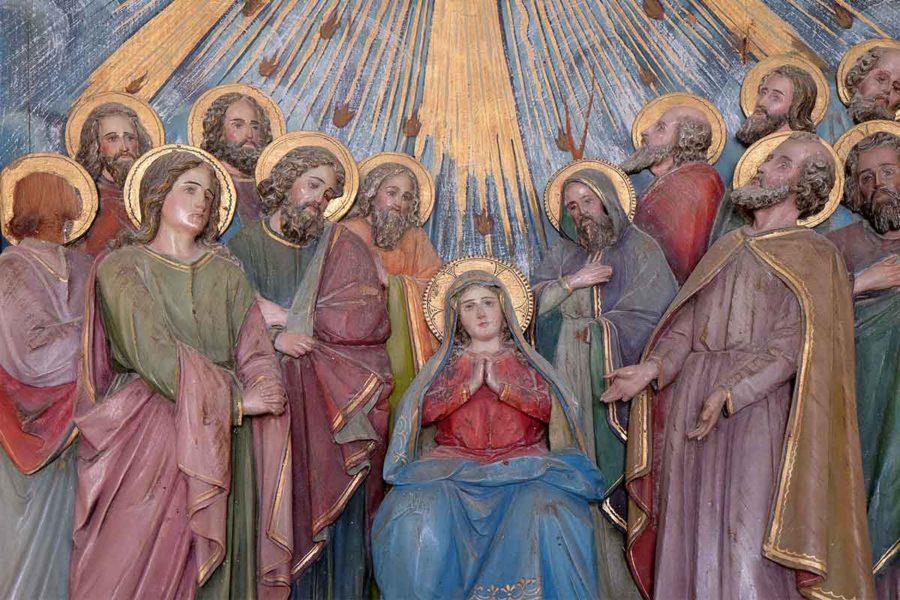
    Can’t remember what or when Pentecost is? Well for starters, it’s this Sunday; and if you want a little more info on this celebration of the Holy Spirit and the birthday of the Church, take a look at Busted Halo’s two-minute video.

    RELATED: What Are the Gifts of the Holy Spirit?

    To download this video go here and click the download arrow or choose save or download.

  • Mary in Two Minutes

    Mary in Two Minutes

    Ever wonder about Catholics’ relationship with the Virgin Mary? Do they worship her or just pray to her? What’s the Annunciation? What’s the Immaculate Conception? What’s the Assumption? All these questions and more are answered in this short two (okay, three) minute video.

    To download this video go here and click the download arrow or choose save or download.

  • Why Are There No Old Testament Readings During the Easter Season?

    Why Are There No Old Testament Readings During the Easter Season?

    The Old Testament has (almost) never been read at the Eucharist during the Easter season. St. Augustine of Hippo in the fourth century started this based on earlier practices by Cyril of Jerusalem.

    Instead, the Hebrew Scriptures are replaced by the Acts of the Apostles. The logic is based on the practice of looking forward from the Resurrection and balances the Easter Vigil’s looking back on our salvation history. (At the Easter Vigil, we draw out the history of our salvation in one night from creation, through Abraham, through Moses, etc.)

    On weekdays in the Easter season, in fact, the Acts of the Apostles are read in pretty much a continuous way, with the whole book completed by the end of the season. The Second Readings on Sundays come from I Peter, I John, and the unusual Book of Revelation, during Years A, B, and C, respectively. The Gospel readings are almost exclusively from John.

    All of this is to center us on the celebration of the Resurrection and to keep us looking forward from that event into today’s time.