For over two years, every night it’s the same: At the appointed time, I gather my freshly bathed and pajamaed toddler into my arms, all fuzz and snuggles. We turn off the light in his bedroom and settle into the rocking chair. My son knows the drill, so he tucks his fuzzy head under my chin and cuddles into my arms. Then we begin:
Softly, we rock in the darkness. I recite “Goodnight Moon.” Then five nursery rhymes, another book, four prayers, and a lullaby.
They’re the same words every night, and they’re my child’s bridge between the discoveries of day and the peace of sleep. As we sit together, heart-to-heart, my voice surrounds and comforts him, but I imagine he is not thinking of me. My voice, and our nightly litany, is background music that fades away while he reviews the day and surrenders all his anxieties to calm.
It is a sweet privilege to be his background music, to be that safety that allows him to bound with courage into the world.
Sweeter still is the knowledge that although I am not a child anymore, that although I am all grown up, my Heavenly Father has given me this background music, too.
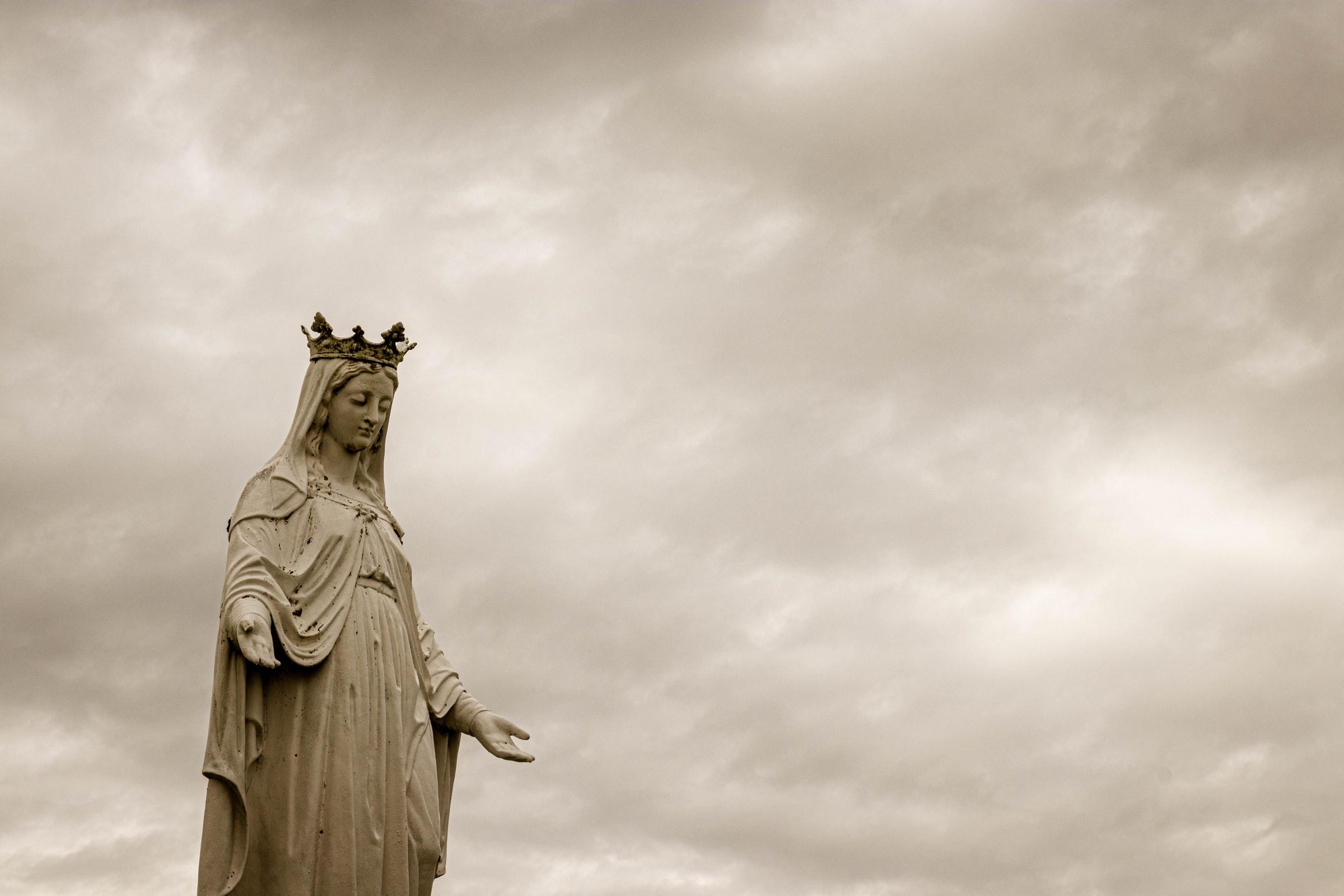
At one time, the Son of God rocked in his mother’s arms, tucking his fuzzy head under her blessed chin as she cuddled and sang to him. The Blessed Virgin Mary was the background music to his earthly ministry. First, it was the beating of her heart at the Incarnation, when Jesus spent nine months safely in the tabernacle of her womb. Then, her voice was the background music at his foretold birth in Bethlehem, and even during an exiled flight into Egypt that lasted a number of years while powerful men sought to take his life. Mary was there in the background when Jesus performed his first miracle, quietly and confidently telling the Galilean wedding staff, “Do whatever he tells you” (John 2:5). When Jesus’ time had come, Mary was there, in the background, as her Son obediently met his ultimate suffering: his Passion and death. Mary had seen him all the way there. And what a gift, that the Lord passed her on:
“Woman,” He said, “behold your son.” Her new “son” was to be John, who represents all of us.
It was with a shock that I realized, while rocking my son, that Mary is the background music to my relationship with God in the Church — and quite literally! Every time I pray the Rosary, I pray for her intercession 53 times, but each time, the “Hail Mary” fades away as I meditate on that decade’s mystery, which is a moment in the life of Christ.
It was a great surprise because I had struggled to feel devoted to Mary ever since I turned 13, when I reached — and passed — the age of her world-saving “yes” to God. But now, as a mother, I can understand her differently. She is the background music to my spiritual life: to my relationship with Christ.
“She is an echo of God, speaking and repeating only God. If you say ‘Mary’ she says ‘God.’” Writes St. Louis de Montfort in “True Devotion to Mary.” “[Y]ou never think of Mary without Mary thinking of God for you. You never praise or honour Mary without Mary joining you in praising and honouring God.”
In that “Hail Mary” greeting, in the repetition of her prayers, Mary smooths out the wrinkles between me and God, pouring his grace into my life and carrying me — as a mother carries her child — to see the King of Kings.
And it’s almost like she rocks me, with my head tucked under her chin. Her warmth remains as her voice fades to the background, so all that remains for me to embrace is the light of Heaven: the Son she rocked thousands of years ago, who went to the cross for me, and pursues me even now.
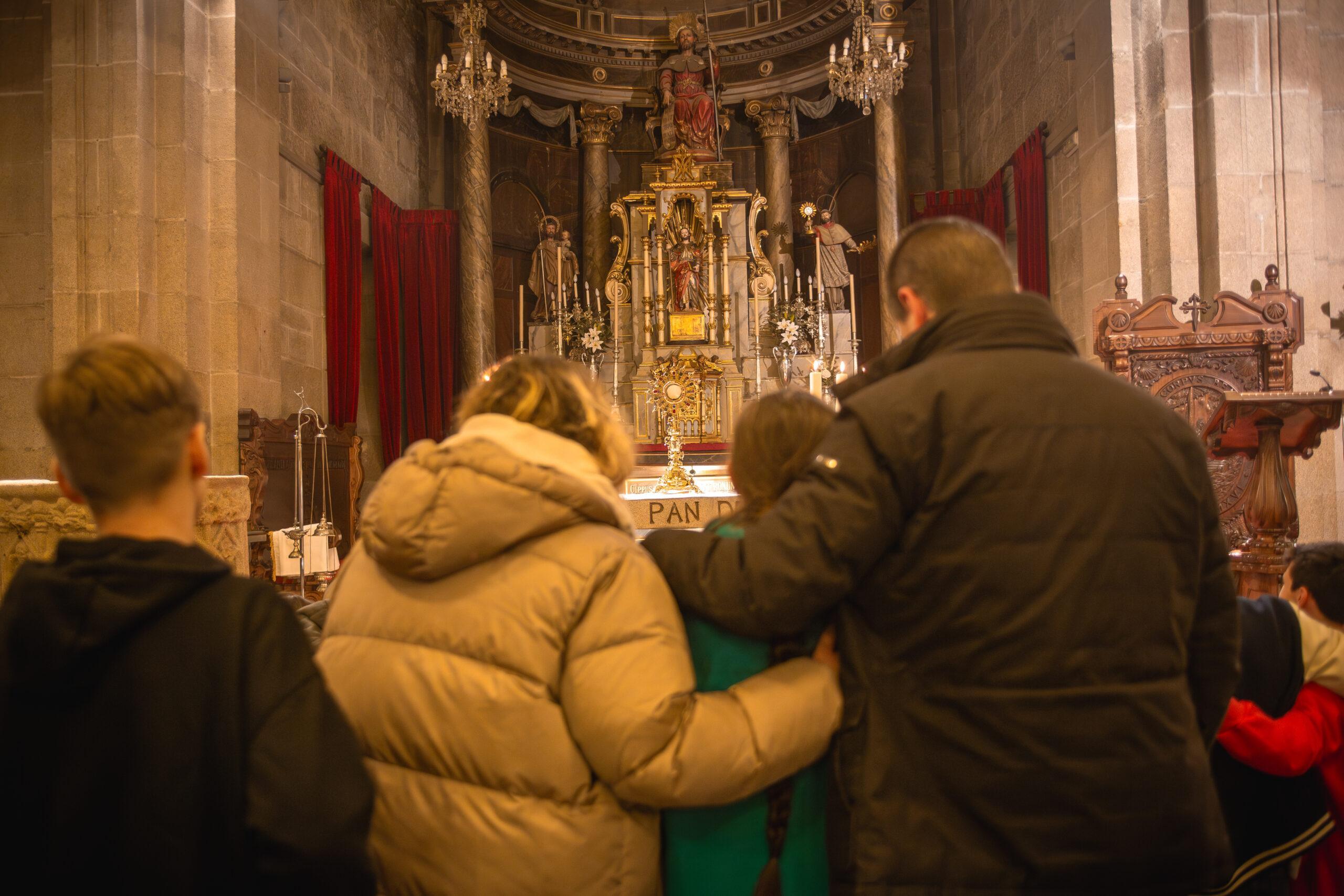
Last fall, signs outside our parish and notices within our weekly bulletin reminded my family that the month of October in our Catholic faith is dedicated to the Rosary. Every time when we walked into Mass, we heard other parishioners reciting the Rosary before the service started. It may sound cheesy, but my husband and I felt a spiritual calling in October to participate in those prayers more actively. Notably, this isn’t a reflection on how my family learned to say the Rosary together during October. It is, however, an account of how we began to try.
In this process of learning the prayers for the Rosary, we felt “behind” where we imagined other families we knew to be. In October, my family already knew “The Hail Mary” and “Glory Be,” but those were our only starting points. We began by adding “The Salve Regina” to our nightly routines, learning one line per night in our living room before the kids would dash off to brush their teeth and crawl into bed.
In the process, we found that attempting to memorize new prayers together was unexpectedly spiritually rewarding for every member of our family—my husband, my two elementary-school-age children, and me. Before last October, we’d recite those prayers we already knew each night before bedtime, but we’d never attempted anything long. We’d also never practiced the memorization and recitation process nightly together. We had learned those prayers individually or with our church classes. Of course, the things that are spiritually rewarding in our lives are never quite as easy as we’d like them to be, and this process has been no different. It’s now Lent, and we’ve still yet to say the Rosary together without reading at least part of it from a book or a screen.
A little like brushing their teeth each night, my children often balk at reciting the prayers. Likewise, sometimes when there’s a football game on, so does my husband. I also admit that if I’ve had a long day at work and would rather relax with a book and have some solitude, adding the drama of begging everyone to come together to learn prayers isn’t exciting for me. Still, once we start reciting the prayers and learning the lines, a sense of accomplishment and even a spiritual weight visits our living room that is worth every bit of nudging our family might have needed to start memorizing together. The kids might be fighting about whose cookie looks bigger for dessert, or what TV show they’ll watch in the morning, yet they’ll calm down once we’ve launched into saying the prayers a few times. Solemnity almost always takes hold, so to speak.
As part of our practice, we say each line of the prayer we’re covering that day five times together, adding whatever lines we learned the day before to it. Then we have each person say the prayer to the point they’ve learned it on their own. My children love taking center stage in the living room, standing on a certain part of the rug where there’s a big flower: This is their stage. They also enjoy checking and correcting my husband and me when we inevitably fumble certain lines or words in the prayers. Like the kids, we stand up on that same flower in the rug, making the recitation a more active, bodily endeavor. Even so, it still took my family three months to remember the “Salve Regina.” In part, this is because we didn’t recite the prayer every day, despite our best intentions. Yet when we’d get off schedule for a few days (like when my son got sick with the flu), we always picked back up where we left off as soon as we could. Now that we’ve finally learned “The Salve Regina,” the prayer is part of the fabric of our lives. We’ll say it together before I drop the kids off at school, or if they’re having an anxious moment, we’ll hold hands and pray it together. My 8-year-old daughter and I will also recite the prayers we’ve learned as I brush her hair in the morning.
As we’re approaching her First Communion this Easter, we’ve turned our focus to memorizing “The Apostles’ Creed.” The Rosary begins with it, and the Creed serves as a foundational statement of Catholic beliefs, focusing on our faith’s mysteries. When we practiced “The Apostles’ Creed” last week – again, before bed, in our living room betwixt the chaos of getting school clothes ready for the next day and lunch boxes packed – my daughter asked about the phrase in the creed stating that Jesus was “conceived by the Holy Spirit.” We realized she had no idea what the word “conceived” meant, and to be honest, my husband and I faltered for a moment in answering her. Theological explorations are not often at the forefront of our minds during our household bedtime routines. Even though we were saying the words together almost daily for months, it wasn’t until my daughter was able to repeat them without struggling that she began to ponder their meaning. How exactly was Jesus conceived by the Holy Spirit AND born of the Virgin Mary, not one or the other, she inquired?
After thinking through it—and, yes, Googling it—we explained that even though Jesus was born of a human mother, Mary, he possesses a divine nature, as his conception occurred through the Holy Spirit rather than a human father. Jesus is fully divine and fully human, both God and man. While we may worship this truth together at Mass and while my daughter may have learned this in her religious education classes, the lightbulb that went off in her head while we were discussing this mystery as a family was amazing to not only watch but also to participate in with her. Wow, we seemed to realize as a family, these words we’re repeating are astounding when one truly thinks through them and feels their power.
This was a special moment – and a rare one in our family routine – and it felt exhilarating to experience it. In fact, we encounter struggle more often than not. While we are almost done learning the Creed now, my husband is farther behind than the rest of us, and it’s not for lack of trying: memorization is simply harder for him. My daughter has a speech impediment, and the words don’t come easily to her either. Because every member of the family is different in how we learn, this can prove an impediment to keeping the energy and momentum needed to inspire daily practice.
Keeping this in mind, my husband and I try to keep an atmosphere of lightness. We never shame anyone if someone is struggling, but we encourage each other to make it to the end of that section no matter the attempts it takes. The laughter that inevitably happens as we mix or miss words is good for our family’s soul. Plus, it teaches our children to be kind to each other – and to us – because we’re all learning the prayers together simultaneously. Through memorizing and reciting prayers, our entire family can be described for one of the first times ever as spiritually curious. While we may have been fighting moments earlier before trying to pray about who did or did not do the dishes, we open ourselves to God being with us when we pause for this practice. Our hearts, minds, and days almost always settle. While it may not happen right away, after the final recitation, there is usually a sense of pervasive and palpable calm, and that is worth every up and down in getting there.
It bears mention here that in Catholicism, memorization entails a spiritual recollection that is supposed to work in concert with the intellectual aspect of memory. For example, the liturgy of the Catholic Mass is a memorial, or “a remembering of” the re-presentation of the sacrificial act of Jesus’ death on the Cross. During each Mass, our salvation becomes present before us on the altar through the Sacrament of the Eucharist. In other words, Mass is not a mere recollection but an active participation in this past salvific event, making the past present in a sacred and transformative way.
As my family prepares for my daughter’s First Communion, we have learned that memorizing prayers has brought us closer to God’s divine mission on our couch at home in addition to on our parish’s pews. Memorizing together helps us connect with the Church’s past and lay claim to our own future within it. The often-fumbled words, the shared laughter, and the earnest attempts to understand the words we’re reciting have led us to find grace within our family’s spiritual life and to connect that grace with the broader Church family we also belong to and are learning more about through its prayers and creeds.
Indeed, in nurturing our children’s spiritual growth, my husband and I have inadvertently discovered a path to our own. Our family recitation and prayer time has become a conduit for grace, an opportunity to be present with one another and God. As my daughter prepares for her First Communion, “The Apostles Creed” stands not just as a set of words now memorized but as a testament to our shared journey, a journey that has drawn us closer to each other and the Church’s doctrines, and most importantly, closer to God.