Tag: grief

  • Virtual Remembrance Retreat

    Virtual Remembrance Retreat

    With All Souls’ Day, November 2, Catholic parishes and other faith communities begin a month-long remembrance for all who have died. In the same spirit, we share this retreat as a way to remember the people in your life who have died. This virtual retreat offers a chance for you to reflect more deeply on what they have taught you, as well as an opportunity to offer thanks and determine how their legacy will guide your life going forward. Click here to open/download a PDF of the retreat.

    Getting started

    Many faith communities have a Book of Remembrance in which people are invited to write the names of those who have died.

    Begin your retreat by writing down the names of the people you would like to remember. In order to not overwhelm yourself, list no more than five names per retreat. Write these names in your journal, on a writing pad, or on a small note board so they remain visible to you for a few days. Next to each name, write a two-word description of that person. No more than two words for now, you can write more later if you’d like.

    Here’s an example:

    Michael Davis – faithful friend.

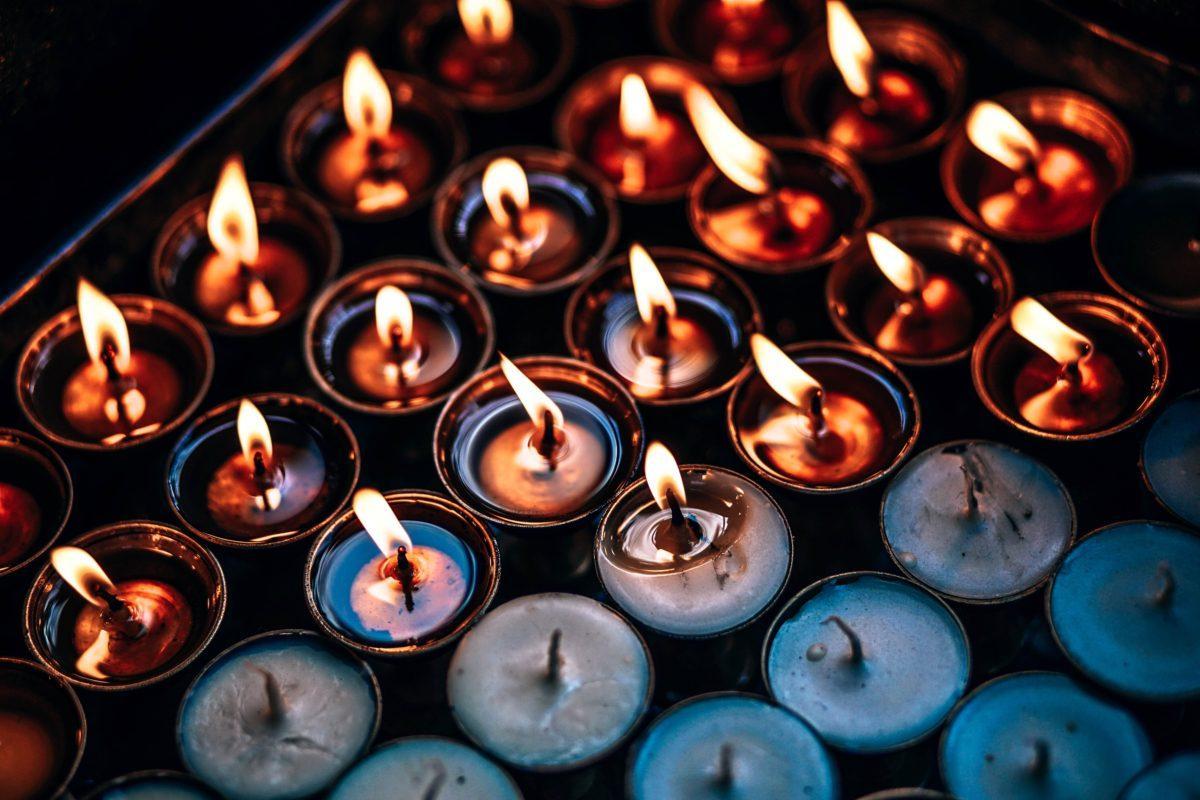
    Finally, light a candle in memory of the one(s) you have named as a sign of hopefulness

    Prayer (based on Numbers 6:24-26)

    “The Lord bless you and keep you! The Lord let his face shine upon you, and be gracious to you! The Lord look upon you kindly and give you peace!”

    Gracious God, Author of Life and Victor over Death, at this time of remembrance, I ask that you continue to bless and keep (say the names you listed above) who are now at rest in death. Smile upon them and give them your grace. Please continue to bless and keep me as well as any who were a part of their lives. May their rest be peaceful as you show them your kindness. Through Christ our Lord, Amen.

    Giving thanks

    For each person that you’ve listed, speak or write something about that person for which you are thankful.

    Reflection

    Based on your relationship with each person you have named, select one of the four ways below to reflect more deeply. Your reflection will be structured as a conversation for you to have either with the person you have named, with yourself, or with God. Conduct the conversation as you wish (writing, speaking, praying). Go at your own pace and challenge yourself to move a bit beyond your comfort zone for the sake of healing, integrity, and insight.

    “I am still grieving over you.”

    • Talk about what you are feeling specifically at this stage of your grieving.
    • Talk about what you are doing to cope with your grieving. What support do you have?
    • Talk about what you hope for in the midst of the grieving.
    • Pray for comfort in this time of grief.

    “I really need/want to let go of something concerning you.”

    • Talk about why you need or want to forgive the person you have named.
    • Talk about what you are doing to help you let go. What support do you have?
    • Talk about any insights you have gained that might explain why the person you have named hurt or offended you.
    • Make a statement of your intention to let go and move on.
    • Pray for the strength to show mercy.

    “I wish I could have said this to you.”

    • Talk about what the person you have named means to you.
    • Talk about what specifically you wanted to say to them and why.
    • Talk about what you hoped for in your relationship with the person you named.
    • Pray for your peace of mind and heart.

    I hope you are at peace.”

    • Talk about what the person you have named went through.
    • Talk about what you hope the person experiences in this time of rest.
    • Talk about how your perspectives and outlooks have grown in virtue because of knowing the
    • person you have named.
    • Pray for a peaceful rest for the person you have named.

    Legacy

    Here is an opportunity for you to mention what the person you have named has taught you and what you would like to carry forward in your own life. Use the guidelines below for creating your legacy statement:

    In the course of their life, (names from above) taught me to ___________. In gratitude and hope, I plan to live out their lesson by ___________, with the help of God.

    Closing prayer

    Excellent Lord, you are the God of the living and of the dead. In the moment of remembering (names from above) who have died, I take this time to commend so many who have died to your loving care. Especially remember those who have died alone, children who have died, those who have died from disease and poverty, and those who have died as a result of war or violence. May they truly rest in peace.

    For the ones who loved them, give comfort. Let them know your loving care through your presence and the presence of friends and community. May those who are grieving be touched by tangible expressions of consolation and support.

    God, in your grace, show those who have died your loving mercy. And, in your wisdom, let their legacies help us live better lives. Amen.

    Conclusion

    Here are a few suggestions for your ongoing remembrance:

    • Write the names of those you are remembering in your parish’s Book of Remembrance.
    • Light a candle in a church for the ones you have named in this retreat.
    • Create a page in your journal for each person you have named. Add photos and even funeral programs to your entries.
    • Use the legacy portion of this retreat with others. Plan a time with family or mutual friends to celebrate and remember the legacy of the deceased.


    Originally published on November 1, 2017.

  • Keeping the Faith After Loss: Catholic Resources for Those Affected by Suicide

    Keeping the Faith After Loss: Catholic Resources for Those Affected by Suicide

    for an article on suicide awareness, an empty bench with autumn leaves on the ground behind itAhead of this year’s World Suicide Prevention Day, we at Busted Halo prayerfully remember and pray for the souls of those who have died by suicide, for people who are vulnerable to suicide, and for those who are impacted by loss. As Catholics, we believe in the sanctity and dignity of every human life, no matter the struggles they face. We are called to support those who are struggling with compassion, empathy, and well-informed action and awareness efforts. 

    We hope these articles and podcasts on suicide and resources for those impacted by it, enlighten, offer consolation, and inspire hope. 

    What Happens to the Soul of Someone Who Commits Suicide? 

    “Many people were raised thinking that the soul of a person who commits suicide can never be redeemed. Father Dave addresses these concerns and misconceptions, making specific reference to the Catechism, which says, ‘We should not despair of the eternal salvation of persons who have taken their own lives. By ways known to him alone, God can provide the opportunity for salutary repentance. The Church prays for persons who have taken their own lives.’ 

    Father Dave continues, ‘We pray for people who have committed suicide in the same way we pray for anyone who has died. We pray for their soul.’”

    Do People Who Commit Suicide Go to Hell? 

    “In today’s times, we know much more about mental illness than ever before. We now know that anyone who commits suicide is not in control over their own actions. For something to be sinful, by definition, it needs to be done willfully, meaning, we need to be free to make the choice to commit the act in the first place and we have to know that the act is sinful.

    So therefore, if one is not in control over their own actions, they cannot be held responsible for what they have done, suicide included.”

    9 Ways to Help a Grieving Friend (That Aren’t Bringing a Meal) 

    “From my own experiences, I’ve learned that while the standard ‘Please let me know if there’s anything I can do’ means well, concrete action provides so much more assistance. When you know a friend is laid low in the mire of grief or despair, don’t wait for their call. Take action. Step in. Show up. Whether it’s bringing a meal or doing something less orthodox, any practical help will be welcomed with immense gratitude.”

    Grieving a Loved One’s Loss to Suicide

    “What we hope is that these books can bring comfort and healing to people who are in such terrible grief. Heaped on top of losing someone is the stigma and even discrimination that goes along with suicide. Losing a loved one is always hard. When it’s by suicide, it can sadly it can make it even harder.”

    Approaching Mental Health Through a Catholic Lens With Deacon Ed Shoener

    Deacon Ed Shoener is the president of the Association of Catholic Mental Health Ministers, and the co-author of two books with Bishop John Dolan of the Diocese of Phoenix, called “When a Loved One Dies by Suicide” and “Responding to Suicide: A Pastoral Handbook for Catholic Leaders.”

    Deacon Ed discusses mental health ministry in the Church. “We’re recognizing the need to do something about [mental health] and the need for God to be in the midst of this.”

    Experiencing Suicide Bereavement With the Help of the Sacraments

    “Every time I went to Mass after my sister’s death, I brought something with me. Often, it was anger against people I felt had contributed to my sister’s mental illness or had failed to help her. … During Mass, I acknowledged I did not know the whole picture and asked for the grace to forgive. I prayed for people I did not want to pray for, and gradually the anger eased.

    I am a Catholic convert. The sacraments have been a great support since my conversion, and especially now.” 

    Fr. Chris Alar on Finding Hope After a Loved One’s Suicide 

    “Fr. Chris explains that years after his grandmother’s death, a priest told him he can still pray for her, ‘I said “Father, how? She’s already been judged.”’ And he told me that God is outside of time. There’s no past. There’s no future. Everything is present eternally at one moment to God. … God will take my prayer into account for my grandmother at the moment of her death years ago.” 

    Discussion About Suicide from the Busted Halo Show

    Father Dave and Brett talk to a listener who recently lost his son by suicide. Father Dave explains that platitudes from well-wishers aren’t helpful to many who are grieving, and Brett opens up about his experience as someone who has friends who died by suicide. 

    My Daughter Committed Suicide. What Prayer Do I Say So That She Can Go To Heaven? 

    “Dearest Lord,

    We entrust (name) to your undying mercy and love.

    While in this life, they felt much pain and found life difficult.

    May you enfold them now with your love where no pain can find them, but rather your love can heal them.

    Make them Guardian Angels for those who struggle with life, for those who struggle to see you and the love that is around them.

    Give them Lord, kind admittance to your Kingdom and bring comfort to their families.

    We ask this, as we ask all things, through Christ our Lord. Amen.”

    Book: ‘The Catholic Guide to Depression: How the Saints, the Sacraments, and Psychiatry Can Help You Break Its Grip and Find Happiness Again’

    Extensive clinical experience treating patients with depression has shown author Dr. Kheriaty that the confessional can’t cure neuroses, nor can the couch forgive sin. Healing comes only when we integrate the legitimate discoveries of modern psychology and pharmacology with spiritual direction and the Sacraments, giving particular attention to the wisdom of the Church Fathers and the saints.

    Other Resources

    To Write Love On Her Arms

    To Write Love on Her Arms is a non-profit movement dedicated to presenting hope and finding help for people struggling with depression, addiction, self-injury, and suicide. TWLOHA exists to encourage, inform, inspire, and also to invest directly into treatment and recovery.

    The Dougy Center for Grieving Children & Families 

    Whether you’re grieving, or you’re helping someone who is grieving, Dougy Center is here for you. Find tip sheets, activities, podcasts, and more resources.

    The Trevor Project 

    The Trevor Project is the leading national organization providing crisis intervention and suicide prevention services to lesbian, gay, bisexual, transgender, queer & questioning (LGBTQ) young people under 25.

    Mental health resources for underrepresented communities (American Foundation for Suicide Prevention)

    From the American Foundation for Suicide Prevention, find mental health resources for minority and underrepresented communities, grouped by community.

    Suicide prevention resources (American Foundation for Suicide Prevention)  

    From the American Foundation for Suicide Prevention, find a list of resources for crisis situations, mental health care, and resources grouped by mental health conditions.

    If you or a loved one is ever experiencing suicidal thoughts, please call the National Suicide Prevention Line at 988. And consult Suicide Prevention Hotline if you are concerned for yourself or another.

  • What Does the Church Say About Limbo?

    What Does the Church Say About Limbo?

    White Clouds and Blue Sky
    Photo by Ithalu Dominguez on Pexels

    Editorial note: The following article contains mentions of pregnancy/infant loss.

    The loss of a child is a heartbreaking situation. There is grief over the death of the beloved child, of course, but also over the child’s future now lost. Additionally, there can be grief and uncertainty over the soul of the child and where they are now. In the midst of this loss, the Catholic Church has always offered words of consolation and hope, trusting in God’s infinite love and mercy. Amid the pain of miscarriages, stillbirths, and lost children, we find consolation in our God who desires all children of the world to come to him. To any and all persons facing such loss, please know you have the prayers of the Busted Halo staff.

    Throughout history, some have responded to these griefs and uncertainties by saying that children who pass away before receiving the Sacrament of Baptism are in Limbo. Limbo is at the heart of a tension between understanding God as being all-loving and desiring the salvation of all and the Catholic understanding that baptism is needed for salvation. This raises questions, especially about the souls of unbaptized children and what happens to them in the next life. The loss of a child is always especially difficult, and many in the Church have tried to find explanations that offer consolation. Limbo was one such answer to those questions, and while never completely embraced by the Church, neither has it been completely done away with. The answer to “Does Limbo exist?” is a much more complex question and requires a look at the growth of the idea of Limbo over time.

    LISTEN: Navigating Miscarriage, Stillbirth, and Infant Loss With Abigail Jorgenson

    In the tension between understanding salvation that required baptism and understanding that a loving God wouldn’t punish children who never had the option or ability to be baptized, St. Augustine was among the first to discuss the idea of “Limbo.” This would be a place separate from heaven and fully enjoying the presence of God, but also away from hell. To some theologians, Limbo existed on the edge of hell but was not a place of suffering. To others, it was a place of pleasant neutrality. There was, however, never an official definition or understanding of what Limbo was or what it was like. Other theologians throughout the ages, such as St. Thomas Aquinas and St. Alphonsus Liguori, would continue to write about Limbo.

    Yet with all of this writing, the concept of Limbo had never been formally adopted as the Church’s position. The closest the Church got was the mention of Limbo in St. Pius X’s Catechism in question 100 wherein he wrote: “Children who die without baptism go to Limbo, where they do not enjoy God, but neither do they suffer.” However, this Catechism was never made known as official teaching for the whole world, but rather, for the faithful in the city of Rome. St. Pius X wrote and published it only for the immediate Church in Rome as the local bishop, not for the whole world.

    Even though this idea was shared by a pope, it was never a universal idea in the Church, or adopted as official Catholic teaching. St. Cajetan, a priest in the 16th Century, notably wrote against the idea of Limbo. He argued that children who are unable to be baptized in life share in the concept of Baptism by Desire (that someone who desires God’s grace but is physically unable to be baptized is still saved and in effect, baptized) because of their mothers’ love and desire to have them baptized. St. Cajetan argued for a more open approach to God’s mercy for these children.

    WATCH: Baptism 101

    In 1980, the Congregation for the Doctrine of Faith (CDF) put out Instruction on Infant Baptism. In this document, they stated that: “As for children who die without Baptism, the Church can only entrust them to God’s mercy, as she does in the funeral rite provided for them.” The CDF felt that the most important thing to say on the death of a child before they were baptized was to entrust that soul to God’s infinite mercy.

    About 25 years later, the International Theological Commission wrote The Hope of Salvation for Infants Who Die Without Being Baptized. In this, the Commission made several arguments to uphold the idea that a child who died before baptism could share in God’s joy in heaven eternally. They rooted these arguments in paragraph 1261 of the Catechism of the Catholic Church which states: “[there is] hope that there is a way of salvation for children who have died without Baptism.” They also point to our celebration of the infant martyrs on December 28, that we celebrate them as martyrs and saints even though they were never baptized. Finally, the document reminds us that Christ’s salvific love is true – and a greater truth than original sin, which we are all subject to. As such, Christ’s love will win out, and this gives us great hope and joy for the salvation of unbaptized children.

    RELATED: 9 Ways to Help a Grieving Friend

    Interestingly enough, though, none of these statements outright deny the existence of Limbo. Rather, the Church places greater emphasis on hope and trust in God’s love when it comes to the souls of unbaptized children. One can be a good Catholic whether or not they believe in Limbo.

    Personally, I find that the idea of Limbo does not line up with what I have been taught about a loving and merciful God. I have great hope and trust in God’s love to welcome unbaptized children into heaven and find that this gives greater peace to those who have faced such a loss. If anyone should find themselves in the situation of walking with someone who lost a child before a baptism was celebrated, my first piece of advice is simply to be with them. Not necessarily to even say anything, but to be present alongside them in mourning and an image of God’s merciful love in the time of loss. When words are needed, words of hope, especially those of Christ, are most consoling. As Jesus said, “Let the children come to me, and do not prevent them; for the kingdom of heaven belongs to such as these” (Matthew 19:14).

  • Memorial Day and the Power of Remembrance

    Memorial Day and the Power of Remembrance

    Photo by John Hill on Pexels

    While I was growing up, my family emphasized that calling to mind those who gave their lives to sacrifice for our country is always necessary and important. 

    We visited the cemetery on all major holidays to spend time at my grandparents’ graves. We traveled there on Thanksgiving, the week of Christmas, and Easter Sunday. My parents, my three brothers, and I would climb into the car after Mass and head to the cemetery.

    If we were at my paternal grandfather’s grave, we would all exit the car once we arrived and say a prayer at the tombstone. After a few minutes, my mom would bring us back to the car and my dad would stay behind at the grave of his father. If we were at my maternal grandmother’s grave, the opposite happened. Dad would usher us to the car and Mom would stay behind for a few extra minutes. 

    RELATED: Virtual Memorial Day Retreat: Remembering Those Who Serve 

    This was their intimate time alone with the parent they had lost. We honored their memory by going to the cemetery as a family, but I also remember that image of my mother or father spending one-on-one time with the grave as I peered out the car window looking at them. It was as if they were talking to their respective parent as if they were still alive and could hear them. They were remembering them by continuing their relationship with them. I was drawn into this moment because I witnessed my mom and dad love their own parent even beyond their death. 

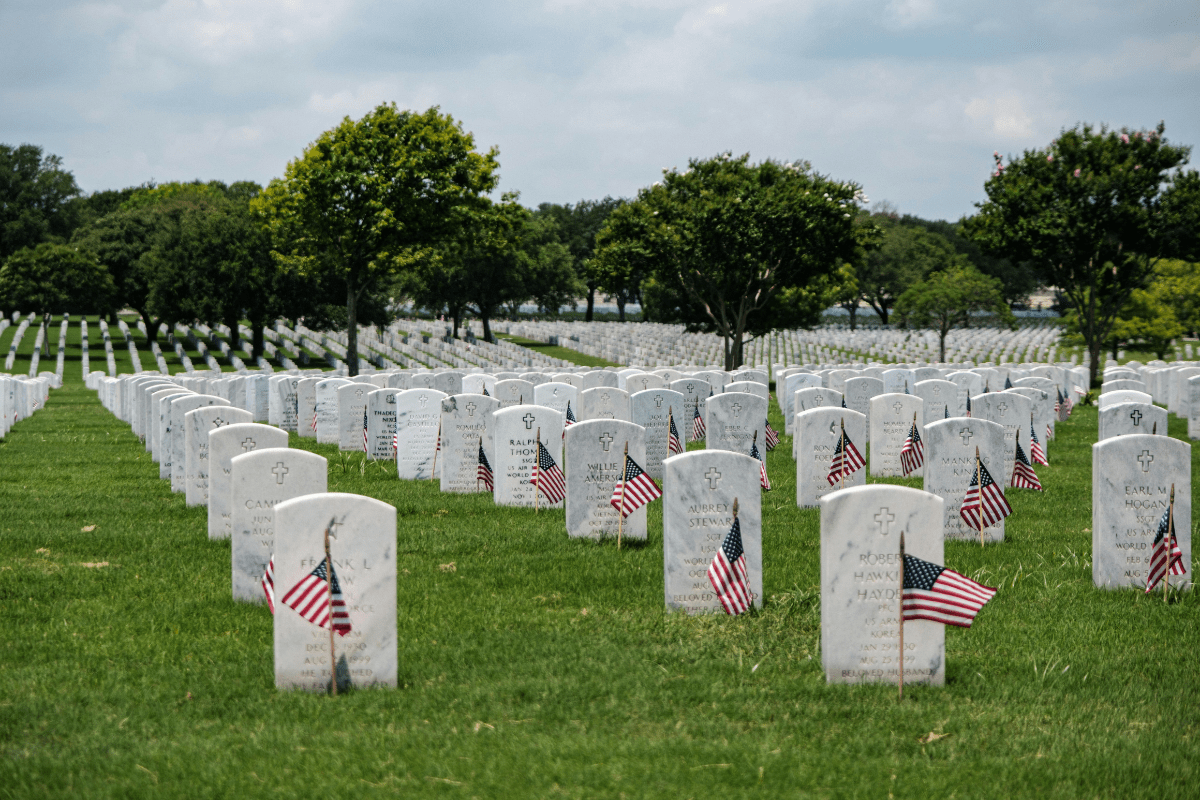
    My maternal grandmother is buried at an armed services cemetery on Long Island because her husband served in the military. All the tombstones there are the same rectangle shape and the same color, white. The uniform aisles of tombstones evoke something inside of me that brings me to honor those who gave their lives and the family members of those who served. Every visit is like a miniature Memorial Day. 

    Today, we are called to remember and honor the sacrificial love of countless men and women who gave everything so we could live in our beautiful country. The challenge is to honor them even when it is not Memorial Day. 

    RELATED: What Should Catholics Do on Memorial Day?

    When I visited the cemetery as a child, I was so reflective of my grandparents’ lives as well as grateful for the love of my parents. I was more attentive to my relationship with them because I was reminded of how short and fragile life is. 

    But then, I would go back to my routine until the next holiday and forget how important it is to remember those who came before me so that I could live (literally in the case of my grandparents being my ancestors). On this Memorial Day, we are invited to take that focus towards those who died in service. How can we be more intentional about giving them honor and respect?

    Our Catholic faith offers two great connections that are easy and powerful. One, pray for veterans, those who died in the line of duty, and those current service men and women at Mass on Memorial Day weekend. The Eucharist is the memorial of Christ’s suffering, death, and resurrection. We do not simply call to mind what Christ did; those mysteries are made to present to us. As the Son of God died so that we could live, we can pray especially for those who died for our country so that we could have the freedoms we do today.

    RELATED: How Prayer Cards Help Me Honor the Holy Souls That Have Gone Before Me

    Second, pray a decade of the Rosary or an entire Rosary for our veterans. We can pray for those who have died and those who have returned from the armed forces. We know that so many returning service people struggle to reacclimate into society. Pray that they may find work and know their value. 

    Memorial Day is always the last Monday in May, a month dedicated to honoring the Mother of God. Praying for Mary’s intercession allows us to call to mind the fact that she is guiding all of her children, wherever they find themselves.

    Whatever you do for Memorial Day, make it something that serves as a powerful and lasting reminder of just how blessed we are to have people in our age and in our history who live out the sacrificial love of Christ. May we honor them by respecting that love and mirroring it in our own lives as best we can.