Tag: fatherhood

  • Praying for Presence: How the Examen Helps Me Focus

    Praying for Presence: How the Examen Helps Me Focus

    When I was a kid, there were nights at the dinner table when my dad would get quiet and start staring off into the distance. My sisters and I would joke, “Dad’s thinking about work again!” and the chorus of giggles would break him out of his trance and bring him back to dinner. 

    Now, at 41, I’m the one who’s prone to the “thinking about work” face at dinner and many other times as I try to shift from employee to father at the end of the workday. 

    As a civil defense attorney, I’ll regularly handle 200 or more cases at any given time, each with its own facts, medical records, litigation status, and hearing schedule. 

    As a father, I have four kids who are growing up way too fast — each with their own interests, likes/dislikes, friends, school assignments, extracurriculars, etc. 

    As a husband, I have an incredible wife who has kept me around for 12 years and counting, but we’re no longer carefree 20-somethings with little responsibility and an excess of free time. It’s frighteningly easy to lose track of each other amidst our sea of responsibilities and commitments. 

    RELATED: How I Use Ignatian Discernment to Make Decisions Big and Small

    Alternating between those three main roles in my life, it can be difficult to be fully engaged in the present moment. There are dinners and vacations where I have replayed court hearings in my head, pondering how I could have performed better. There are file reviews at work where I continually think of kids’ sports schedules or weekend plans. There are times at work and with the family when I’m thinking of household repairs. 

    One thing that’s helped me with this is the Examen, a prayer formulated by St. Ignatius Loyola.  I first came across the prayer when I was a teenager considering a Jesuit vocation. The whole of Ignatian spirituality, with its emphasis on finding God in all things, was such a revelation to my young mind, but this prayer made an impression and I recently resumed the practice of praying it at night. The basic outline of the prayer is a 5-step process:

    1. Be aware you’re in God’s presence. 
    2. Ask for grace to see God’s work in your life.
    3. Review the day in detail. 
    4. Reflect on specific actions and see whether they brought you closer to or farther away from God. 
    5. Make a resolution for tomorrow.

    When a priest gives a homily at Mass, he takes the Gospel message and makes it applicable to the general congregation. When I pray the Examen, I try to feel I take it one step further and make it applicable directly to my life — my wife, my errands, my kids, my schedule, my work, my supervisor, my commute, and all of the nitty-gritty that makes up my life. 

    I think hidden within my lack of focus is the false belief that whatever I’m focused on is the most important, most pressing matter. Praying the Examen gently corrects this warped way of thinking by reminding me that everything is important, because everything relates back to God. 

    RELATED: Growing in Gratitude, Thanks to the Examen

    The process of he fourth step, reflecting on my actions and whether they brought me closer to or farther from God, changes every day, but I’ll sometimes ask:

    • Was I short with someone on a work call where I was just trying to get another task off the to-do list?
    • Were my “blinders” on while I tried to go through my work day, missing opportunities to hear and see those souls that work alongside me?  
    • Should I have stopped by the desk of a colleague who was widowed last year and seen how she’s holding up? 
    • Did I pay attention to my kids when I came home? 
    • Did I focus on the stories they so eagerly conveyed to me, treasuring them as the gifts they are?
    • Did I miss an opportunity to show more initiative, to ask questions, to be silly, to initiate play? 
    • Have I taken active steps today to work on my marriage?
    • Have I listened to things my wife has expressed frustration over and given her empathy, as well as whatever support I could?
    • Have I made efforts to connect with my wife and share myself, and not just go through the day on our parallel routes?

    For me, the biggest benefit of the Examen is not just the act of praying it towards the end of the day, but rather the way it shapes my mind throughout the day. Getting in the habit of praying it has “trained” my brain to start considering those questions as I am going about my day. As I live in the present moment, I know that God is there and I know that the only way I can respond to him is by being present in that moment, noticing what he is offering me in that moment, and responding with love. 

    With regularly praying the Examen, my “thinking about work” face pops up less often. When I’m with my wife and kids, I’m with them — attuned to all the beautiful intricacies of the present moment. 

  • Breaking the Cycle: How I Stopped Worshipping My Phone

    Breaking the Cycle: How I Stopped Worshipping My Phone

    Dad using smartphone while toddler son playsA few weeks ago, my wife and I were running errands with our 1-year-old and 3-year-old. Since they were tired and a little cranky, she ran into the grocery store to get bread while I waited in the car with the boys.

    I pulled out my phone and started to answer emails and scroll through social media. 

    My older son, Benedict, began to ask me questions about random things — and I continued to scroll on my phone as I answered him. After about two minutes, Ben said, “Daddy, get off your phone. I’m talking to you.” He wasn’t stating it angrily. His tone was more sad that his father was not paying attention to him. At that moment, I felt like I was choosing my phone over my son. I was ashamed, but I felt something else: convicted to love him more. So, I put my phone down in the car, and I pledged to put it down more often. 

    LISTEN: Father Dave Talks Mental Health and Social Media

    We all know that people of all ages have become addicted to their phones. They have become an extension of our bodies. According to Consumer Affairs, “on average, cell phone users look at their phones 144 times a day,” and the average American spends 4 hours and 39 minutes on their phone every day. That means we spend almost 70 days staring at that small rectangular device in our pockets over the course of a year. 

    In many ways, I worshipped my phone. What we worship is what we spend the most time thinking about and what we care most about. Worship is what orients our time, energy, and attention. 

    When Ben called me out about my phone, it didn’t feel good, but choosing to separate myself from my phone certainly did. I realized that my phone was keeping me from loving my family more and distracting me from opportunities to pray more often. So, I began to place my phone in my room when I got home from work until the kids went to bed. This freed me to be so much more attentive to my kids and my wife. I was looking them in the eyes; I was more willing to simply play on the floor with my sons. 

    RELATED: God First: Discerning Where Idols Are in Our Lives

    I also found myself freer from the worries of that particular workday and more present with my family, rather than thinking about what others were saying on social media or the score of the sports game. I became more concerned with the person in front of me rather than a screen, and, quite frankly, more happy because I wasn’t living through my device; I was living for my loved ones. 

    I also began to charge my phone on my dresser rather than my nightstand to avoid numbingly scrolling through social media or the internet at night. This made me more eager to speak to my wife about our day or to pray for an extended period before bed. The unproductive time I would have spent on my phone became a time for true worship. 

    The combination of healthier relationships in my family and more intimate prayer time has allowed me to further appreciate the need to be detached from my phone. It also helped me understand that by loving God first, along with my family, I was placing the one who is to be worshipped alone in his proper place. 

    This week, consider your phone habits. Look up your screen time and reflect on if those around you would claim that you occasionally choose your phone over conversation with them. If so, make a commitment to put it down. Then watch and see how your worship of God and relationships can flourish.

  • Turning to St. Joseph as a Rookie Father

    Turning to St. Joseph as a Rookie Father

    In 2021, as a rookie father of only five months or so, I often found myself turning to St. Joseph, the patron saint of fathers, during this time of change in my life. Although Jesus’ stepfather never says a word in the Bible and is only mentioned a handful of times, his witness to and relationship with the Son of God should be something each disciple ponders anew in order to gain depth and insight into who Jesus is. In the moments when I have fled to him for help, Joseph has proven to be a true guide for strength and prayerfulness.

    Coincidentally, Pope Francis named 2021 the “Year of St. Joseph.” Often, popes decide to dedicate an entire year to the patronage of a saint or theological principle in order to orient our ordinary lives completely to God. The Year of St. Joseph called for the faithful to trust in the Father’s promises. Joseph never drew attention to himself, but his importance in salvation history is unquestioned. He simply does as God asks, and we are called to humbly follow his example. 

    HOMILY: St. Joseph: Righteous and Pastoral

    My wife was pregnant between the months of January and October 2020, which was a period filled with ebbs and flows of joy, exhaustion, excitement, and anxiety. Worries about caring for the financial needs of the child along with the health of the baby were mingled with the utter amazement that a soul was traveling with us through it all. Through the advice of a close friend, I began to turn to Joseph each day and began a more intentional relationship with the man who was responsible for the safety and care of the Blessed Mother and the God-child. 

    My friend explained that each moment we have as fathers, whether before or after the birth of our children, and whether it is beautiful or challenging, is an opportunity to learn from St. Joseph. Joseph knew what it was like to wait for the birth of his child, and he knew what it was like to embark upon an unknown pilgrimage into the future. Joseph is the king of dealing with unpredictable and unforeseen situations. From the pregnancy of Mary before they lived together (Matthew 1:18), to having no place for her to give birth in Bethlehem (Luke 2:7) all the way through the flight from Egypt in fear for their lives (Matthew 2:13-14) and providing for his family with his small carpentry shop.

    RELATED: A Closer Look at St. Joseph

    Journeying from Nazareth to Bethlehem must have been arduous for Mary. For Joseph, it was a time when he was called upon to do his best to help his wife while also coming to terms with the fact that there are times that we might just feel helpless. We simply must be there for our loved ones through difficult times. 

    Joseph experienced this firsthand because he and Mary had no other choice, they had to go to Bethlehem for the census (Luke 2:4). He had to watch as she struggled through the terrain and possibly the extreme heat or bitter cold. As a first-time dad, I saw this in the times when there was nothing I could do to take away the pain or discomfort of pregnancy and labor. In these moments, Joseph as a “just man” (Matthew 1:19), would have turned inwardly to God in deep prayer. He would have brought his wife’s struggles to the Father, trusting that God was immensely and intimately close to them. 

    Trust and faithfulness to prayer must have been the defining trait of their marriage, and something that my wife and I are attempting to emulate in certain ways by turning more to God, giving him thanks, and asking for his aid. Mary and Joseph are relatable to every couple because their “plans” were never neatly organized but consistently met with challenges and hurdles. While they are the most exceptional couple of all time, they are also the most practically helpful couple of all time. The manner in which they turned to prayer was completely natural and never forced.

    RELATED: St. Joseph and a Small Lenten Miracle

    Traveling through pregnancy, my wife and I tried to do our best to come together to pray before important doctor appointments or in the midst of unclear or challenging news. The unknown pushed us to unite with each other, and pulled us closer into the love that God has for us. 

    Through the example of Joseph, I learned that life has uncertainties and challenges, but that following his lead will allow you to perceive God’s fingerprints in every present moment – no matter what might come. Joseph’s silence in the Bible, humility in following God, and trust in God’s plan made him the best suited stepfather to Christ. My prayer is that I may take his witness and become the best father I can be.

    Originally published March 19, 2021. 

  • Do This in Memory of Me

    Do This in Memory of Me

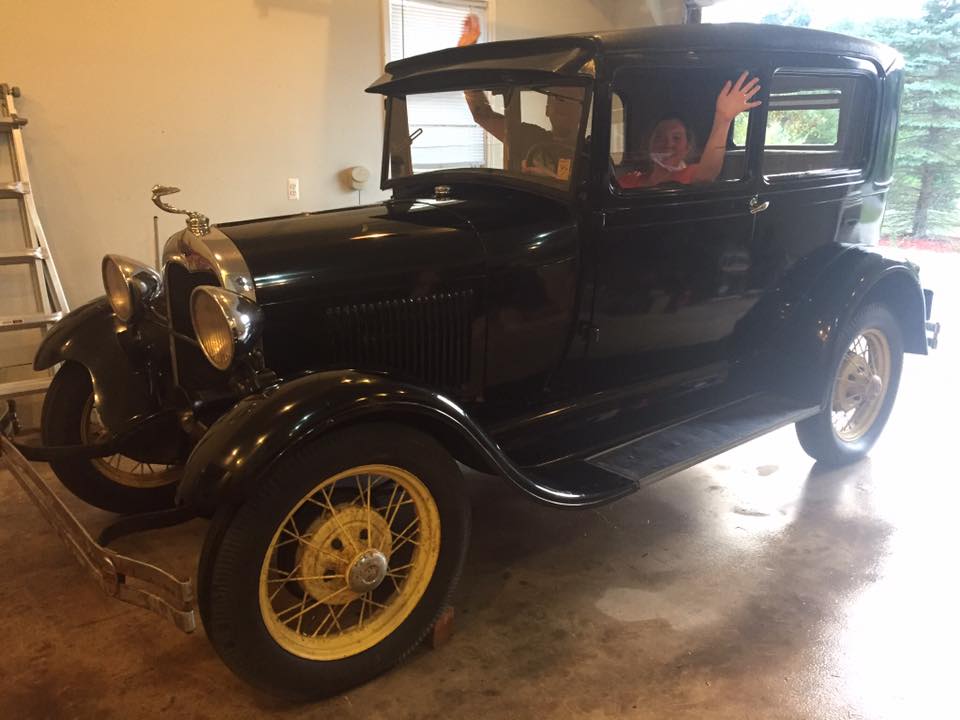
    John’s dad’s 1929 Model-A Ford Tudor Sedan

    “Will you take care of my car for me after I’m gone?” My father asked me while we sat in my sister’s living room. I didn’t know it at the time, but that would be one of the final face-to-face conversations he and I would have before he passed away less than a month later.

    The car that Dad was referring to was his beloved 1929 Model-A Ford Tudor Sedan. He had bought it for $125 back in 1962 when he was 14 years old and then spent the next two years restoring a car that he couldn’t yet legally drive himself. When kids his age were drooling over the latest muscle cars and building hot rods in their garages, my father was restoring a 33-year-old family car. It would be the modern-day equivalent of seeing a kid put all of his blood, sweat, and tears into a 1986 Ford Taurus station wagon.

    As a professional auto mechanic his entire life, my dad owned hundreds of cars. The Model-A was the only car he would never sell. The car was at his high school graduation, it was at my parents’ wedding (as well as the weddings of many of their friends), and it is pictured on my parents’ tombstone. So, when asked if I would take custody of his car for him, how could I say anything but yes?

    At the time that my dad died, the week before Father’s Day in 2016, his Model-A had not been on the road in close to 15 years. During those years, my mom was diagnosed with a terminal disease, and Dad became her primary caregiver. Shortly after her passing, his health quickly declined. For all of that time, the ’29 Ford sat in storage, neglected, rusting, and collecting dust. By the time I took over its care, the car’s engine was completely seized up, and no amount of pulling on its hand crank would break it loose.

    Luckily, in Dad’s collection of extra parts, he had a spare engine/clutch/transmission assembly that matched what was in the car. My 11-year-old daughter, Bella, and I spent the summer of 2017 rebuilding the spare engine and getting it running on a test stand. Then last fall, we swapped out the seized engine in the car for the one we now had running. By late November, we took the car for its maiden voyage around our neighborhood; the first time it had driven under its own power in nearly a decade and a half.

    RELATED: Virtual Father’s Day Retreat

    John and his daughter Bella getting ready to take his dad’s car for a spin.

    This whole project has become about so much more than the car. It has been a means of grieving the loss of both of my parents, a bonding experience for my daughter and me, and, believe it or not, a basis for theological reflection as well.

    That last angle didn’t occur to me until sitting in Mass one day recently when the priest referenced the famous exchange between Jesus and Peter recorded at the end of John’s Gospel: “Do you love me?”… “Feed my sheep.” (John 21:17)

    Dad’s question came echoing back to me: “Will you take care of my car for me after I’m gone?” Like Peter, I was quick to respond, but I doubt either one of us knew what we were signing ourselves up for. In both cases, by the time we knew enough to ask informed questions, the person we would have asked was no longer with us.

    By the time Jesus’ first disciples were out in the community continuing his ministry, they surely encountered and experienced many things that they felt like they were unprepared for. At Pentecost, the Holy Spirit descended upon the first disciples to continue to inspire and guide them in following their Christian mission. Dad didn’t leave me with nearly as powerful of an advocate as the Holy Spirit, but at least I have Google and YouTube to help me out.

    As I reflect on these unexpected parallels between an old Ford and the Catholic faith, I’m also struck by how they are both handed down through word and tradition from one generation to the next. We know that Jesus’ original 12 Apostles passed on the faith through their writings and through their actions. As we work on the Model-A, Bella often comments, “I love how the car still smells like Grandpa.” She’s not wrong — it does smell like him, or he smelled like it. They both had that unique potpourri of gear grease, gasoline, and exhaust that all old mechanics have. Bella still has that firsthand experience to remember what her grandfather smelled like. But her kids will not. They will have to come to rely on her descriptions, much like we have come to rely on all of those generations of Christians who have gone before us.

    I still don’t view the Model-A as “my car.” I tell people it’s my dad’s car — I’m just taking care of it for him. Someday, down the road, Bella will take over as its primary caretaker. She’ll teach her kids about their Catholic faith and how their great-grandpa bought a car for $125 when he was 14 years old. Based on what I’ve seen thus far, I think I’ll be leaving both the car and the faith in good hands.

    Originally published June 11, 2018