Tag: fasting

  • Advent Reflection: Simple Devotional Practices to Bring Peace Amidst Holiday Fatigue

    Advent Reflection: Simple Devotional Practices to Bring Peace Amidst Holiday Fatigue

    It seems that every year, the unofficial start of the secular Christmas season creeps up earlier and earlier. Just after Halloween, my husband shared with me how one of his coworkers had already set up their tree and décor because they wanted to “get the most out of the season.” While I often feel the urge to blast my favorite Christmas tunes and pull out the cheerful decorations when I see neighbors and local businesses doing so, my Catholic instincts tell me otherwise

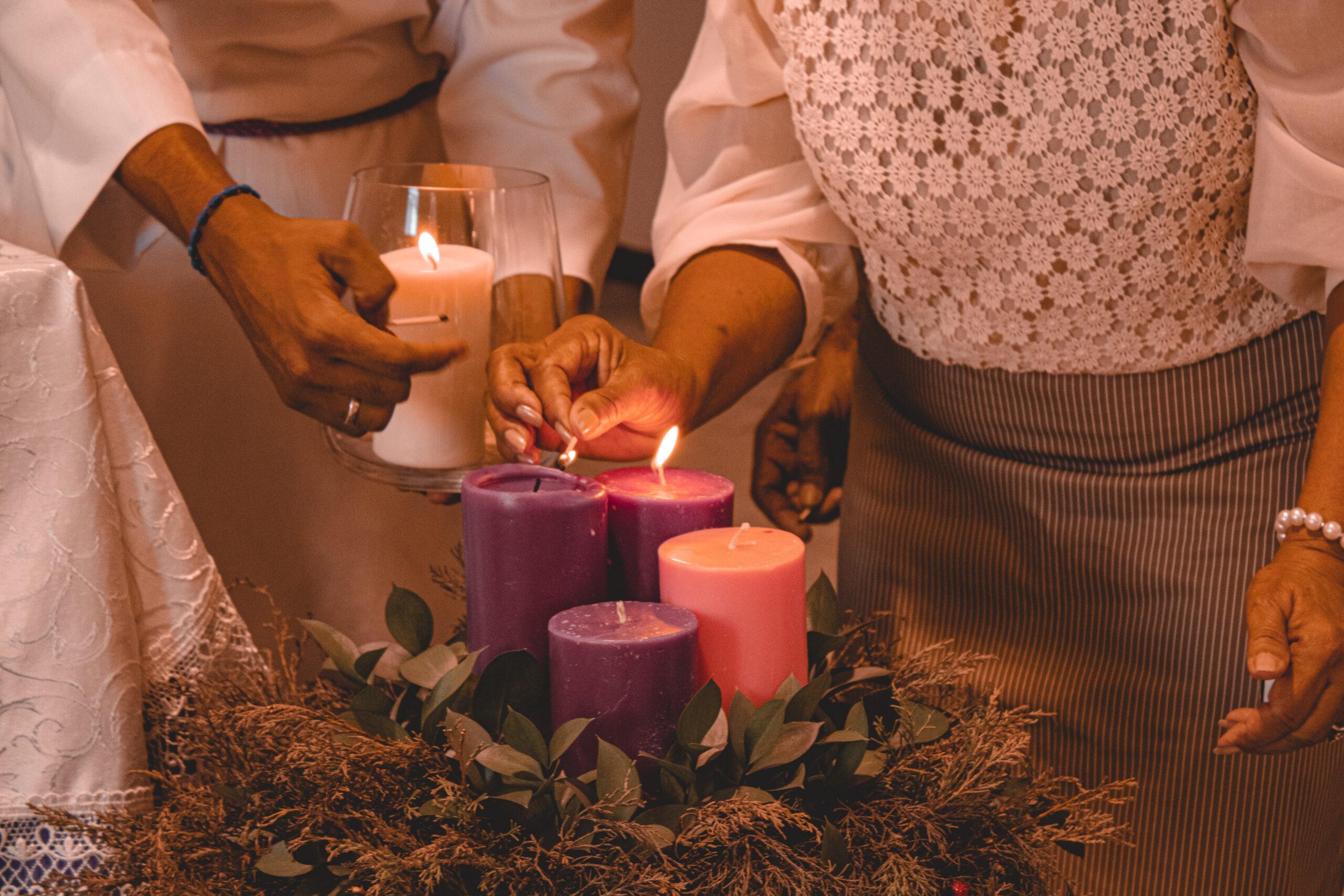
    The Church has given us the season of Advent to awaken ourselves to Christ’s coming and turn our minds from the world’s distractions. When I was younger, before Advent began, my parents encouraged my siblings and me to reflect on what spiritual gifts we could give to the Christ child on his birthday. Through their instruction and the Church’s guidance, I came to see Advent as a time to focus on spiritual treasures rather than earthly ones, helping me understand how these weeks leading up to Christmas are meant to gradually lead us to the birth of Christ. 

    RELATED: 10 Meaningful Advent Traditions to Try This Year

    Though it is difficult to refrain from merrymaking, and sometimes feels Scroogelike to resist, I’ve found great merit in celebrating the Advent season before Christmastide. While the world tells us to indulge in early celebration, the Church invites us to prepare during Advent.

    The Catechism urges us to gird ourselves with a spirit of anticipation, reminding us that, “The coming of God’s Son to earth is an event of such immensity that God willed to prepare for it over centuries” (Catechism of the Catholic Church, 522). The Advent season stands apart as a time to recall the ache and hope of the world for a Savior and look forward to his second coming (Catechism of the Catholic Church, 524). There is a saying that goes, “The greater the fast, the greater the feast,” indicating that sacrifice bears meaning, allowing us to create space for the joy of redemption. By keeping the weeks before Christmas simple, prayerful, and full of hopeful longing, we bear witness to the magnificence of this feast. 

    If you have struggled this year to keep Advent quiet and preparatory, the season is not over. Here are a few ways you can still partake in the preparation during these final weeks.

    Pray the St. Andrew Novena

    While the St. Andrew Novena begins on the feast of St. Andrew, November 30, and ends on Christmas Eve, there’s no reason why you can’t jump into it right now. The beautiful prayer emphasizes the humble reality of Christ’s arrival into the world on a cold dark night in Bethlehem, inviting us to unite our personal petitions to the hour of Christ’s arrival. Here is a link to the full prayer, along with instructions on how to pray the novena. 

    Meditate on the O Antiphons 

    The O Antiphons are verses sung during vespers in the Liturgy of the Hours between Dec. 17 and Dec. 24. Each verse introduces a title of Christ, which can also be found in the well-known Advent Hymn, “O Come O Come Emmanuel.” They give voice to the longing for Christ which Advent ought to rouse, allowing us to declare our need for a Savior. If you don’t have access to the full Vesper prayers, pray and meditate on the O Antiphons themselves and consider singing the appropriate verse from “O Come O Come Emmanuel.” You can find the antiphons, along with relevant Scripture verses and suggestions for meditation here.  

    RELATED: Why I’m Fasting for Peace During Advent

    Fast before Christmas 

    While Lent is often seen as the liturgical season for fasting, the Church traditionally observed another 40-day fasting period beginning after Nov. 11, or Martinmas (the feast of St. Martin), to prepare for Christmastide. While fasting and abstinence aren’t required for Catholics during Advent, they are effective ways to create space in our hearts for Christ’s arrival at Christmas. Whether you choose to abstain from meat on certain days of the week, give up TV, social media or some other pleasure, disciplining our bodies alerts our spirits to Christ’s voice calling us to prepare room for him in our lives. 

    When I was young, one way my family celebrated Advent was to prepare a bed of straw for Jesus. Any time we made a personal sacrifice or did a good deed for another, we cut a piece of yellow yarn to place in the center of our Advent wreath so that by Christmas Eve, Jesus had a warm cradle of “straw” in which to rest. While there is no harm in attending holiday parties or tuning into some Christmas music, let us strive this Advent to embrace a spirit of anticipation rather than indulgence, so that we might fully enter into the joy of salvific redemption during the Christmas season. 

  • Why I’m Fasting for Peace During Advent

    Why I’m Fasting for Peace During Advent

    In 2023, Advent arrived at a time when violence in Gaza was often on my mind. Harrowing news and calls for a ceasefire filled my Instagram feed, forcing me to consider what it would mean to respond authentically to the reality of such suffering. As a Catholic, I knew prayerful self-denial was an option, but I had resisted the idea. What good would a manufactured drop of my own suffering do amid the ocean already in existence? Compared to the suffering that war brings, though, that concern felt selfish. “Effective” or not, it is certainly fitting to offer proof of love through sacrifice, and as Lenten as that sentiment feels to me, Advent can be a time of “offering up” as well. 

    I’ll admit that I didn’t choose Advent for purely spiritual reasons. The liturgical season is shorter than Lent, and at 22 days, Advent 2023 was the shortest possible duration. I also knew that the short winter days would be a help: I’d decided to go without food from sunrise to sunset. I was particularly inspired by the fasting practices of Islam. In addition to it being the faith of those who bore the brunt of the violence, my fast was inspired by Ismatu Gwendolyn, a Muslim public scholar and activist, who had engaged in a 40-day fast in response to the violence in Palestine and shared about the experience.  

    RELATED: Fasting From Injustice

    Our Muslim siblings go without food and drink from sunrise to sunset during their holy month of Ramadan as a practice of devotion and spiritual discipline. As you can imagine, this is a far more intensive manner of fasting than the standard two small meals and one large meal that constitutes a standard day of Catholic fasting, especially when considering our reduced consumption is only required on Ash Wednesday and Good Friday. Despite softening the practice for myself (in addition to a shorter fasting period, I did not prohibit myself from drinking liquids during daylight hours), I still very much felt the deprivation of nourishment. What began as a fast for peace became an opportunity to better understand how more than a day of hunger feels.  

    What surprised me the most was how the lack of nutrients manifested itself. I didn’t often feel my stomach rumbling or find myself wanting food to combat the sensation of an empty stomach. What I did feel were the cognitive effects. This wasn’t a matter of being distracted by hunger; operating on less fuel, my brain simply couldn’t function as well as it normally did. I wasn’t as present. It was harder to communicate. It was harder to think. As an aspiring graduate student, I was alarmed by the brain fog I felt, knowing that clear thinking and eloquent expression are fundamental in academic environments. 

    RELATED: The Fast I Choose: No Matter the Season

    I found myself thinking of all the children who sit hungry at school, struggling to focus and learn. According to the USDA, in 2023, “7.2 million children lived in food-insecure households in which children, along with adults, were food insecure.” I thought about how these children may be met with punishment, rather than compassion, for living the effects of hunger. I thought about the long-term effects of that response. 

    How difficult it must be to struggle through elementary school when hunger prevents you from reaching your full potential. How difficult to live through any of the indignities of poverty – homelessness, insecurity, exploitation – with a diminished mental strength. How difficult to not only live under the constant threat of death from bombs or bullets, but also to starve through it. 

    RELATED: Swords into Plowshares: Finding Peace in Advent Today

    I want to emphasize that what I did is not novel: Muslims undergo their Ramadan fast yearly. Christian history reveals more extensive traditions of fasting as well, including during Quadragesima Sancti Martini, or the Forty Days’ Fast of Saint Martin’s, which took place during the weeks leading up to Christmas. Additionally, it feels odd to write about my experience when there are so many people for whom hunger is a daily experience and its effects a constant threat to livelihood. To choose to be hungry is, as a spiritual practice, a privilege. Nonetheless, experience is a powerful teacher: I’m not sure I would’ve understood the mental effects of hunger without experiencing them first-hand. This fast broadened my understanding of hunger and consequently deepened my compassion for those who have no choice but to go without their daily bread. 

    During Advent, we remember the arrival of a God who humbled Himself to live among us, who came to proclaim good news to the poor. If you, like me, have always been blessed with food security, I invite you – provided, of course, that it is healthy and safe for you to do so – to seek out hunger this Advent. Offer your sacrifice up for an intention. Consider donating the money saved on food to your neighbors in need. Prepare for the coming of a Savior who said “I was hungry and you gave me food” (Matt. 25:35) by sharing in and learning from his reality.

  • WATCH: Lent in Three Minutes

    WATCH: Lent in Three Minutes

    What is Lent all about? Why do Christians receive ashes on Ash Wednesday? Why 40 days? If you’re looking for answers, you’ve come to the right place. In an updated version of our classic video (with a bonus extra minute — because there’s a lot happening here!), Busted Halo explains the significance of this season of prayer, fasting, and giving, and how you can make the most of this time of repentance and renewal.  

    Visit Bustedhalo.com/lent for more Lenten inspiration.

    To download this video go here and click the download arrow or choose save or download (top right). Please note, all Busted Halo videos are free to use in parishes, schools, or for other educational purposes. In fact, we encourage it! 

    (Originally published January 30, 2018)