Tag: family

  • 3 Ways to Practice the Art of Listening

    3 Ways to Practice the Art of Listening

    Photo courtesy of Cathopic

    Anyone who knows me well can tell you that I’m a very opinionated person. While I pride myself on being open to considering different points of view, the truth is, I still struggle mightily with listening to other people. However, I was recently reading the book by Mother Mary Francis, P.C.C.,But I Have Called You Friends: Reflections on the Art of Christian Friendship and I came across the following passage, which made an immediate impression on me: 

    “The person of intelligently strong convictions is ready to have them modified, expanded, or changed according to the counterevidence presented. Any persons of opposite convictions are friends to be listened to, not enemies to be warded off.”

    As I read and reread that paragraph several times, I became decidedly uncomfortable. I began to ponder how often my convictions have gotten in the way of treating people with charity, even family members. My parents enjoy watching cable news. I do not. “Hot button” political issues tend to get my hackles up, so if I’m in the room when the talking heads happen to be on the TV, arguments too often break out. The question of student loan forgiveness, for example, has provoked more than a few heated exchanges. My immediate impulse when contradicted, is to get defensive or go on a counterattack. 

    RELATED: Two Ears and One Mouth: Why We Should Listen More Than We Talk

    In our 21st-century outrage culture, the art of listening is so important but is rarely practiced. Sadly, none of us is immune to the temptation to scapegoat people, whether family members or total strangers. It can be too easy for me to label people who don’t share my political convictions, religious beliefs, or cultural presuppositions as “enemies.” When I fail to treat the opinions of others with respect, empathy is quickly lost. 

    There’s nothing wrong with holding strong convictions or defending your principles. Respectful listening doesn’t mean that you remain passive or completely disengage from a debate. Authentic dialogue is a form of active listening. True respectful conversation can be learned by doing it, through patient practice. I’ve found three simple and practical strategies that have been immensely helpful in keeping me mindful of my biases and of the respect owed to those who don’t share my opinions.

    LISTEN: How to Have a Crucial Conversation

    1. Be present

    The first step in learning to listen is to eliminate distractions and simply be present. I can’t count how many times I’ve failed to be truly present in a conversation or debate. We’re all addicted to our smartphones these days, and when someone else is speaking, I can be sorely tempted to take out my phone and scroll through my social media feed or check my email. Not only is this an incredibly rude thing to do, but also I’m robbing myself of the chance to learn — to truly understand a different perspective from my own.

    2. Don’t interrupt

    “A fool takes no pleasure in understanding, but only in expressing personal opinion” (Proverbs 18:2). Ouch! Personally, this biblical one-liner hits a little too close to home. I’m a self-identified chatterbox and I know quite well that I have a bad habit of interrupting during conversations, trying to finish other people’s sentences or jumping in early with my counterarguments. This is disrespectful and a form of pride — many of us like to hear ourselves talk! Respectful silence shows that you value your discussion partner and are truly interested in what they have to say. 

    3. Ask questions

    Unless you ask questions, you’re not making enough of an effort to understand someone else’s position. If someone puts forth an argument or an assertion that makes my blood boil, my habitual reaction is to go on the attack. But when I began to slow down and ask questions (“Why do you believe that?” or “Could you please tell me more about your feelings on this?”) I found it easier to keep my emotions in check. I’ve even tried to rephrase my counterarguments in the form of questions. (“Have you considered this perspective?”) This kind of measured response signals respect for the opposing point of view. 

    RELATED: Learning and Listening: Identifying My Blind Spots and Committing to Growth

    True understanding

    If, while the other person is speaking, you’re preoccupied with coming up with a witty rejoinder, or if you start interrupting, or if you retaliate without asking any questions, then you’re not making the effort to listen or cultivate genuine mutual understanding. Listening to understand rather than to respond is difficult, but it’s worth it. The epistle of St. James admonishes Christians to remain modest and restrained in speech: “You must understand this, my beloved: let everyone be quick to listen, slow to speak, slow to anger” (James 1:19). 

    Honestly, I’m still a work in progress when it comes to keeping my temper during intense discussions. But I have begun to notice changes for the better. My family in particular, have commended me for the fact that I now make a point of keeping my cell phone in my pocket during conversations. They’ve noticed that I interrupt less and ask more questions. Our talks about current events have become more engaging and mutually fruitful, as we try to understand one another rather than simply “win” an argument.

    Also, as I’ve made an effort to understand perspectives other than my own, my worldview has started to become less cramped and insular. I’ve learned to stop labeling people of different beliefs as “enemies” (or worse “sinners”) whose views can be easily discounted. After all, they are fellow children of God with infinite dignity who should be respected and loved. 

    As the scribe correctly responds in Mark’s Gospel, “‘to love [God] with all your heart, with all your understanding, with all your strength, and to love your neighbor as yourself’ is worth more than all burnt offerings and sacrifices” (Mark 12:33).


  • 3 Ways to Maintain Joy Throughout the Easter Season

    3 Ways to Maintain Joy Throughout the Easter Season

    Mom and daughter picking flowers in a flower field

    During the height of the COVID-19 pandemic, I began to suffer a deep depression, unlike anything I had known previously. I’m a professor, and during the first months of the pandemic I was undergoing a difficult tenure and promotion process at my institution. Moreover, like many others during the pandemic — my workload increased simultaneously. I was working full-time remotely while taking care of my two young children at home. I remember thinking, Of course this hardship begins during Lent. I prayed, I fasted, and I gave. Yet when Easter came, I didn’t feel the joy I thought I should have. Don’t get me wrong: My family celebrated Easter and went to Mass, but this season didn’t feel fitting to my heart. We celebrated for a day, took pictures, and then I would argue that my soul receded back into a Lenten modality. I felt I needed to do more, to work harder, to be worthy of the joy that Eastertide as a season brings with it.

    As we moved farther afield from the earliest stages of COVID-19, my depression slowly abated. I ultimately received tenure, yet I still struggled with the mixed emotions I had from the process. Eventually, I was diagnosed with clinical depression and sought therapy. Through this process – and through friends, family, and the Church – I began to discover new ways to instill meaning behind my suffering. Contemplating how much my identity was tied to my profession led me to seek ways to rely more on my faith and renew my sense of identity as an image-bearer of God rather than a worker only. I began to lean into the liturgical calendar rather than the academic one to define not only my life but also my family’s life, including fostering joy during a time when I didn’t necessarily feel joyful.

    Easter isn’t just one day; it is the second-longest liturgical season in our calendar, lasting 50 days for Catholics. We are to practice 50 days of joy in the knowledge of the resurrection. Keeping joy, as I learned while I was suffering from depression, isn’t an easy task. While suffering may mark the first part of the Easter story, it isn’t the last part that is essential for all of us faithful to remember. 1 Peter 1:3 reminds us to praise God and to recognize that “In his great mercy he has given us new birth into a living hope through the resurrection of Jesus Christ from the dead.” Easter is about a “living hope,” not one that is gone in a day, but one that lives in us.

    Lenten practice, in my experience, feels like work on the soul, and I would argue that Easter practice ought to, as well. It simply ought to feel like a different kind of work, a work toward proclaiming joy — and resting in it — for 50, long, well-earned days.

    Now, my family celebrates Eastertide with intention, just as we do Lent. Here are a few practices we’ve adopted that have lightened my soul and altered our family culture around the Easter season:

    We practice gratitude daily.

    In a personal journal, I write down at least two things that I’m grateful for each day. These can be as small as walking the dog or enjoying the sunshine. When I pick my children up from school, I ask them to practice this with me. “What brought you joy today?” I inquire. Because I have elementary-age schoolchildren, I delight in their stories of races won and lost at recess, of learning new science facts in school, and of lunchtime antics between their many friends.

    We create an Eastertide family calendar.

    We began this practice with Advent, and we’ve learned that liturgical calendars based around the Easter season help us partake in at least one joyful, praising activity each day. For Eastertide, some of these activities include: reading a Catholic book together, singing worship songs, dancing, celebrating Saints with Feast Days during the season like Saint Catherine of Siena, finding and planting flowers, serving others in the community, and praying. We build these calendars around what works in our home, and each day the children mark off what we’ve accomplished. “We can’t go to bed without dancing!” they’ll exclaim, and they’ll be right.

    Even on days when I don’t feel ready to praise, the calendar reminds me — and my family — that Easter is the season of joy, of living and sharing in the happiness that is Christ’s resurrection.

    We go to Adoration.

    My parish has scheduled times for Eucharistic Adoration, and our family goes together. Being inside the Church, praying there, basking in the beauty of the Eucharist and the prayerful community that gathers together reminds us that we are not alone in maintaining and celebrating the joy of Easter. We pray in the car before going into the Church, and then we pray inside. I allow my children to walk quietly around and appreciate the stained glass windows in our parish. Every time we’re there, we leave with our spirits lifted, knowing that we chose to spend time with God. It isn’t always quiet, or perfect, but it is joyful — and the questions they ask (such as “Why would Jesus suffer?) remind me of all that I have to be grateful for as a Catholic.

    Lent is a time of spiritual growth, yet so, too, is Eastertide. For those like myself who have suffered, and still deal with the ramifications of depression, Eastertide as a practice may even be more difficult than Lent. Yet as Pope Francis reminds us in Evangelii Gaudium, “The joy of the Gospel fills the hearts and lives of all who encounter Jesus. Those who accept his offer of salvation are set free from sin, sorrow, inner emptiness, and loneliness.”

    In celebrating the full 50 days of the Easter season, we accept the offer salvation provides us. Moreover, we evangelize to others the joy of the Gospel because they see us living, and practicing daily, a sustained encounter with Jesus. As humans, we all suffer, yet we all also experience moments of joy. For me, especially when experiencing the worst parts of my depression, Eastertide helped me remember Jesus’ love and cultivate his promise fulfilled in my life — even on those days when I least wanted to do so. Indeed, in the midst of one of my most salient times of isolation and despair, joy found root in my soul again — and it occurred because of committed and renewed Eastertide devotional practice. Psalm 32:11, one of my favorites, echoes this joyful message: “Be glad in the Lord, and rejoice, O righteous, and shout for joy, all you upright in heart!”

    Originally published April 12, 2023.

  • How Memorizing Prayers Together Brought My Family Closer to God

    How Memorizing Prayers Together Brought My Family Closer to God

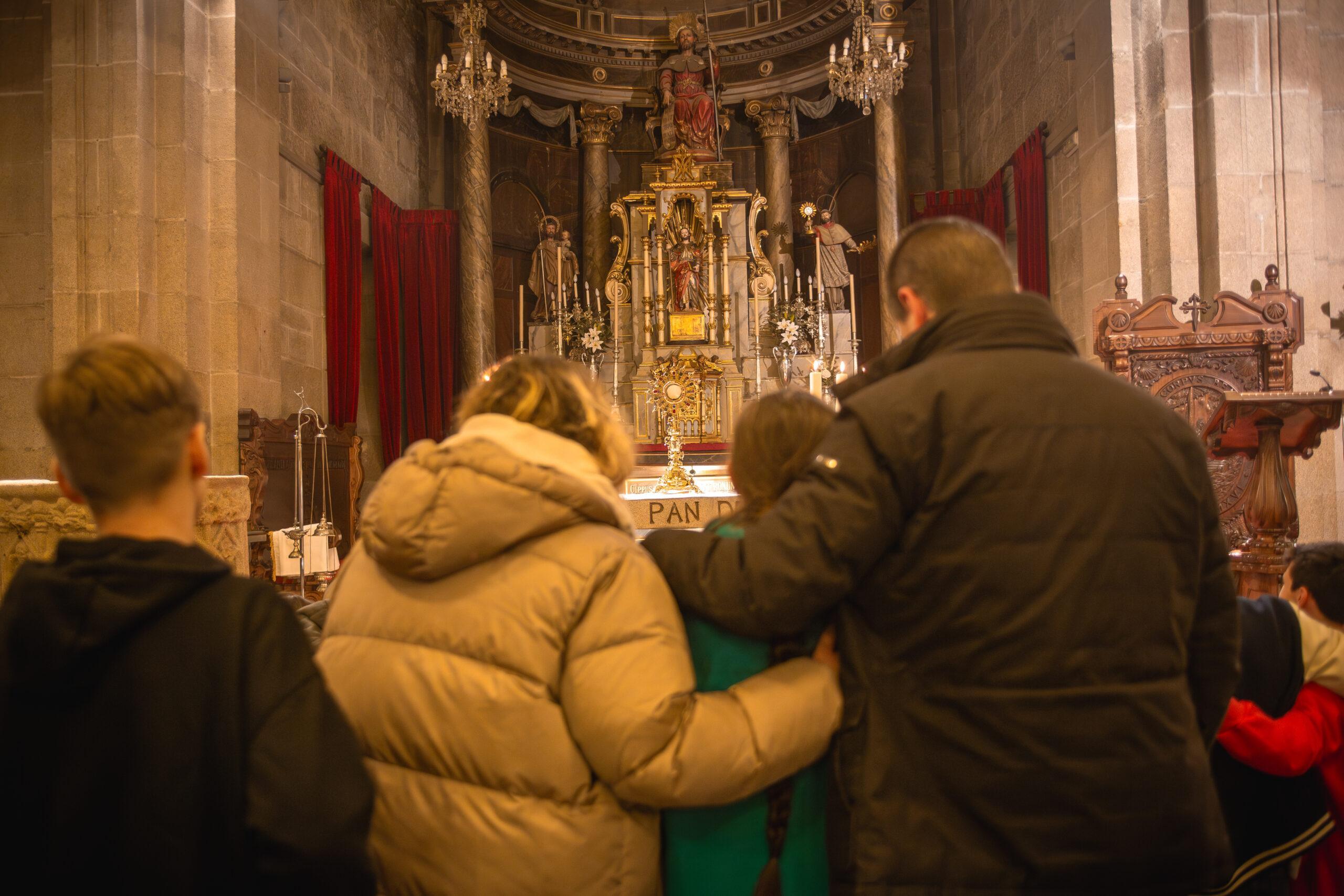
    Family kneeling before an alter in Church praying before the Eucharist
    Photo by Yandry Fernandez Perdomo on Cathopic

    Last fall, signs outside our parish and notices within our weekly bulletin reminded my family that the month of October in our Catholic faith is dedicated to the Rosary. Every time when we walked into Mass, we heard other parishioners reciting the Rosary before the service started. It may sound cheesy, but my husband and I felt a spiritual calling in October to participate in those prayers more actively. Notably, this isn’t a reflection on how my family learned to say the Rosary together during October. It is, however, an account of how we began to try.

    In this process of learning the prayers for the Rosary, we felt “behind” where we imagined other families we knew to be. In October, my family already knew “The Hail Mary” and “Glory Be,” but those were our only starting points. We began by adding “The Salve Regina” to our nightly routines, learning one line per night in our living room before the kids would dash off to brush their teeth and crawl into bed. 

    RELATED: Three Things I’m Doing to Teach My Young Children About the Mass

    In the process, we found that attempting to memorize new prayers together was unexpectedly spiritually rewarding for every member of our family—my husband, my two elementary-school-age children, and me. Before last October, we’d recite those prayers we already knew each night before bedtime, but we’d never attempted anything long. We’d also never practiced the memorization and recitation process nightly together. We had learned those prayers individually or with our church classes. Of course, the things that are spiritually rewarding in our lives are never quite as easy as we’d like them to be, and this process has been no different. It’s now Lent, and we’ve still yet to say the Rosary together without reading at least part of it from a book or a screen. 

    A little like brushing their teeth each night, my children often balk at reciting the prayers. Likewise, sometimes when there’s a football game on, so does my husband.  I also admit that if I’ve had a long day at work and would rather relax with a book and have some solitude, adding the drama of begging everyone to come together to learn prayers isn’t exciting for me. Still, once we start reciting the prayers and learning the lines, a sense of accomplishment and even a spiritual weight visits our living room that is worth every bit of nudging our family might have needed to start memorizing together. The kids might be fighting about whose cookie looks bigger for dessert, or what TV show they’ll watch in the morning, yet they’ll calm down once we’ve launched into saying the prayers a few times. Solemnity almost always takes hold, so to speak. 

    As part of our practice, we say each line of the prayer we’re covering that day five times together, adding whatever lines we learned the day before to it. Then we have each person say the prayer to the point they’ve learned it on their own. My children love taking center stage in the living room, standing on a certain part of the rug where there’s a big flower: This is their stage. They also enjoy checking and correcting my husband and me when we inevitably fumble certain lines or words in the prayers. Like the kids, we stand up on that same flower in the rug, making the recitation a more active, bodily endeavor. Even so, it still took my family three months to remember the “Salve Regina.” In part, this is because we didn’t recite the prayer every day, despite our best intentions. Yet when we’d get off schedule for a few days (like when my son got sick with the flu), we always picked back up where we left off as soon as we could. Now that we’ve finally learned “The Salve Regina,” the prayer is part of the fabric of our lives. We’ll say it together before I drop the kids off at school, or if they’re having an anxious moment, we’ll hold hands and pray it together. My 8-year-old daughter and I will also recite the prayers we’ve learned as I brush her hair in the morning.

    RELATED: What My Family Learned From Inviting Our Local Priests to Dinner

    As we’re approaching her First Communion this Easter, we’ve turned our focus to memorizing “The Apostles’ Creed.” The Rosary begins with it, and the Creed serves as a foundational statement of Catholic beliefs, focusing on our faith’s mysteries. When we practiced “The Apostles’ Creed” last week – again, before bed, in our living room betwixt the chaos of getting school clothes ready for the next day and lunch boxes packed – my daughter asked about the phrase in the creed stating that Jesus was “conceived by the Holy Spirit.” We realized she had no idea what the word “conceived” meant, and to be honest, my husband and I faltered for a moment in answering her. Theological explorations are not often at the forefront of our minds during our household bedtime routines. Even though we were saying the words together almost daily for months, it wasn’t until my daughter was able to repeat them without struggling that she began to ponder their meaning. How exactly was Jesus conceived by the Holy Spirit AND born of the Virgin Mary, not one or the other, she inquired?  

    After thinking through it—and, yes, Googling it—we explained that even though Jesus was born of a human mother, Mary, he possesses a divine nature, as his conception occurred through the Holy Spirit rather than a human father. Jesus is fully divine and fully human, both God and man. While we may worship this truth together at Mass and while my daughter may have learned this in her religious education classes, the lightbulb that went off in her head while we were discussing this mystery as a family was amazing to not only watch but also to participate in with her. Wow, we seemed to realize as a family, these words we’re repeating are astounding when one truly thinks through them and feels their power. 

    This was a special moment – and a rare one in our family routine – and it felt exhilarating to experience it. In fact, we encounter struggle more often than not. While we are almost done learning the Creed now, my husband is farther behind than the rest of us, and it’s not for lack of trying: memorization is simply harder for him. My daughter has a speech impediment, and the words don’t come easily to her either. Because every member of the family is different in how we learn, this can prove an impediment to keeping the energy and momentum needed to inspire daily practice. 

    RELATED: Children and the Church: Recognizing the Welcome

    Keeping this in mind, my husband and I try to keep an atmosphere of lightness. We never shame anyone if someone is struggling, but we encourage each other to make it to the end of that section no matter the attempts it takes. The laughter that inevitably happens as we mix or miss words is good for our family’s soul. Plus, it teaches our children to be kind to each other – and to us – because we’re all learning the prayers together simultaneously. Through memorizing and reciting prayers, our entire family can be described for one of the first times ever as spiritually curious. While we may have been fighting moments earlier before trying to pray about who did or did not do the dishes, we open ourselves to God being with us when we pause for this practice. Our hearts, minds, and days almost always settle. While it may not happen right away, after the final recitation, there is usually a sense of pervasive and palpable calm, and that is worth every up and down in getting there.

    It bears mention here that in Catholicism, memorization entails a spiritual recollection that is supposed to work in concert with the intellectual aspect of memory. For example, the liturgy of the Catholic Mass is a memorial, or “a remembering of” the re-presentation of the sacrificial act of Jesus’ death on the Cross. During each Mass, our salvation becomes present before us on the altar through the Sacrament of the Eucharist. In other words, Mass is not a mere recollection but an active participation in this past salvific event, making the past present in a sacred and transformative way.  

    As my family prepares for my daughter’s First Communion, we have learned that memorizing prayers has brought us closer to God’s divine mission on our couch at home in addition to on our parish’s pews. Memorizing together helps us connect with the Church’s past and lay claim to our own future within it. The often-fumbled words, the shared laughter, and the earnest attempts to understand the words we’re reciting have led us to find grace within our family’s spiritual life and to connect that grace with the broader Church family we also belong to and are learning more about through its prayers and creeds. 

    Indeed, in nurturing our children’s spiritual growth, my husband and I have inadvertently discovered a path to our own. Our family recitation and prayer time has become a conduit for grace, an opportunity to be present with one another and God. As my daughter prepares for her First Communion, “The Apostles Creed” stands not just as a set of words now memorized but as a testament to our shared journey, a journey that has drawn us closer to each other and the Church’s doctrines, and most importantly, closer to God.