Have you ever wondered why there’s a specific celebration for Corpus Christi (Latin for “Body of Christ”)? Don’t we celebrate the Body and Blood of Christ at every Mass? Here are a few facts about this Holy Day. (We also created a handout with some of these details, below, that you can download and share at your parish.)
Date:
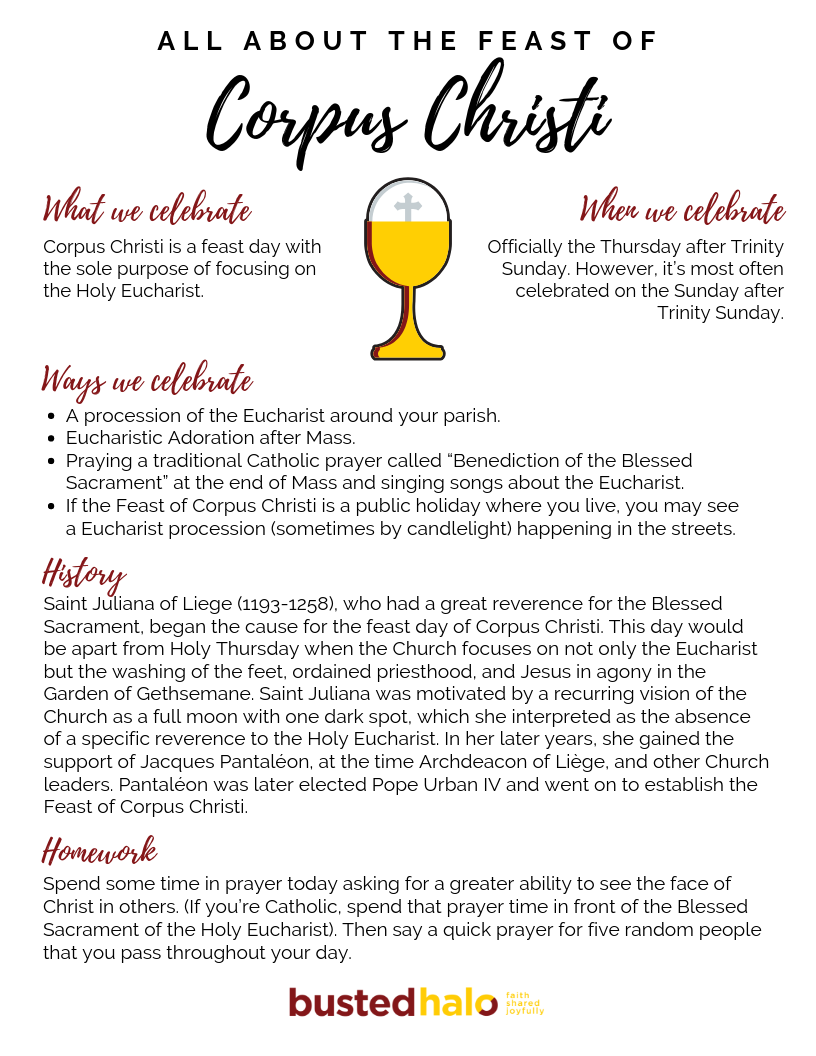
Officially the Thursday after Trinity Sunday. However, it’s most often celebrated on the Sunday after Trinity Sunday.
Established:
By Pope Urban IV on September 8, 1264
What we celebrate:
Corpus Christi is a feast day with the sole purpose of focusing on the Holy Eucharist.
History:
Saint Juliana of Liege (1193-1258), who had a great reverence for the Blessed Sacrament, began the cause for the feast day of Corpus Christi. She thought that the Eucharist deserved its own exclusive day of reverence and recognition. This day would be apart from Holy Thursday when the Church focuses on not only the Eucharist but the washing of the feet, ordained priesthood, and Jesus in agony in the Garden of Gethsemane. Saint Juliana was motivated by a recurring vision of the Church as a full moon with one dark spot, which she interpreted as the absence of a specific reverence to the Holy Eucharist. She worked more than 40 years for the cause until her death. In her later years, she gained the support of Jacques Pantaléon, at the time Archdeacon of Liège, and other Church leaders. Pantaléon was later elected Pope Urban IV and went on to establish the Feast of Corpus Christi.
How we celebrate:
There may be a procession of the Eucharist around your parish.
Eucharistic Adoration may be held after Mass. (Stick around and see what it’s all about!)
You might hear a traditional Catholic prayer called “Benediction of the Blessed Sacrament” at the end of Mass. There will also be songs about the Eucharist and lots of incense.
If you live in one of the countries where the Feast of Corpus Christi is a public holiday, you may see a Eucharist procession (sometimes by candlelight) happening in the streets.
Homework:
Spend some time in prayer today asking for a greater ability to see the face of Christ in others. (If you’re Catholic, spend that prayer time in front of the Blessed Sacrament of the Holy Eucharist). Then say a quick prayer for five random people that you pass throughout your day.
Here’s some inspiration for your prayers from Pope Francis: “The Eucharist affects the way we see others. In his life, Christ manifested his love by being with people, and by sharing their desires and problems. So, too, the Eucharist brings us together with others — young and old, poor and affluent, neighbors and visitors. The Eucharist calls us to see all of them as our brothers and sisters, and to see in them the face of Christ.”
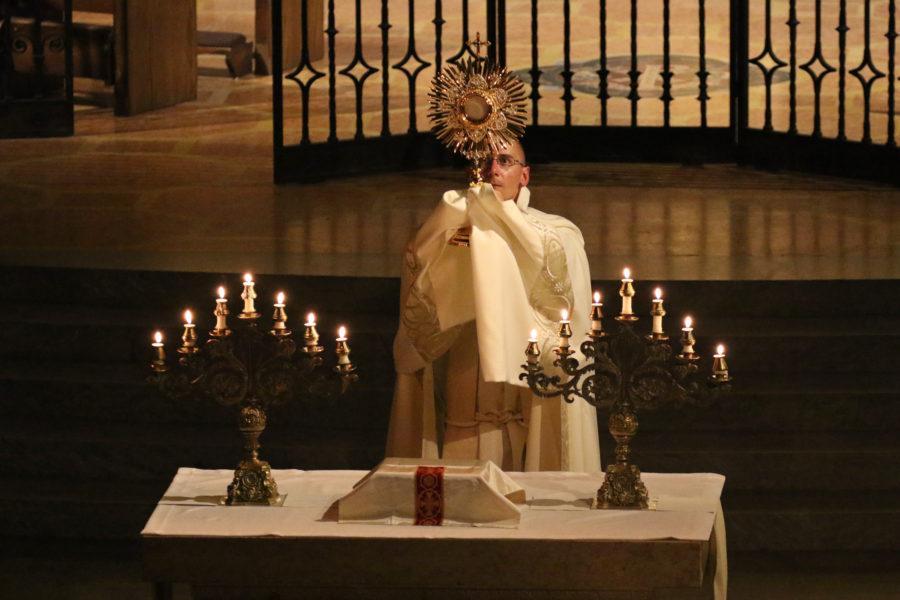
Eucharist Adoration at Immaculate Conception Seminary in Huntington, New York. (CNS photo/Gregory A. Shemitz, Long Island Catholic)
My first experience with Eucharistic Adoration occurred in sixth grade at my Catholic elementary school when my homeroom teacher took my entire class to the church to pray in silence in the presence of the Blessed Sacrament. If you’re thinking it was difficult for 35 12-year-olds to sit still and pray in silence for an hour, then you’d be right. We squirmed and fidgeted and poked our neighbors to avoid giving our undivided attention to the Lord. Our behavior earned a mild scolding from our soft-spoken teacher, who reminded us of Jesus’ own words in the Garden of Gethsemane the night before he was crucified: “So you could not keep watch with me for one hour?”
After that, I didn’t go to Adoration again for many years. First, there was the challenge of carving out an hour in the middle of the week to get there, when so many other activities and errands felt more pressing. Secondly, I was worried that Adoration might only be for super holy people — ones who spend time with God in perfect, prayerful contentment. My mind is full of worldly concerns and distractions, so maybe Adoration wasn’t for me. Finally, my inner, fidgety sixth grader was concerned Adoration might be, well, boring. I assumed a Holy Hour would look like waiting for a big revelation from God and hearing nothing but crickets.
After moving to Colorado, though, I discovered that my new parish had a perpetual Adoration chapel, which meant I could sit with the Blessed Sacrament at any time of the day or night. And despite my years of doubts, I somehow found myself wanting to try again. Here are some things I that helped me commit to a weekly Adoration practice:
It’s not all about me
Like Mass, Adoration isn’t necessarily about what we will get out of it. True, the graces dispensed by God help us grow in holiness, but the primary purpose of Adoration is right there in the name of the act: to adore the One present to us in the Eucharist.
Just be
Remember that you don’t actually have to do anything. The Catholic faith recognizes that the greatest gift God gives us is himself, and Adoration is another way for us to recognize that gift outside of receiving the Eucharist at Mass. So, don’t overthink it. Just receive the gift.
Pray (with a little help)
If it’s been awhile since you’ve entered the Adoration chapel and you’re worried you might be a little bored (that’s understandable!), or you have no idea where to start (it’s okay!), I’ll offer the following suggestions:
Pray the rosary. To contemplate the mysteries of Jesus’ life in the rosary is to contemplate the mystery of the Eucharist given to us and the Blessed Sacrament we praise in Adoration. So, pairing these prayers is a great habit to get into.
Write in your prayer journal. Writing in a prayer journal is a great way of making your relationship with God seem more tangible, since we’re getting the words out of our heads and onto the paper. Think of the practice as writing a letter to God. Take all your worries of the day and lay them down during Adoration. Or write to him about everything that’s going well in your life right now.
Listen to praise and worship music. Music can be an extremely effective way to focus our thoughts on God. Just make sure you have headphones that will keep everyone else in your vicinity from hearing your music if they’d rather spend their time in meditative prayer. I usually find that slow, reflective melodies work best for this environment — anything by Audrey Assad usually does the trick for me.
Read. While Adoration isn’t really the time to break out that thriller you’ve been working your way through, it is a great opportunity to pull out a book by one of the saints (such as “The Diary of St. Faustina,” St. Francis De Sales’ “Introduction to the Devout Life,”or St. Thérèse’s autobiography “The Story of a Soul.” Or prayerfully consider a few lines of the Catechism. You may also choose toread a set of devotional essays like Caryll Houselander’s “The Reed of God,” which is full of meditations on Mary. And of course, don’t forget the Bible!
You don’t have to sit still during your Holy Hour in order to make it count. It’s okay for it to be a natural extension of the rest of your prayer life. So, if there’s something that really helps you focus your prayer, bring it to Adoration. Most of all, remember to receive the gift of Christ in the Eucharist and just be present to God.
Growing up in one of Canada’s English-speaking provinces, I experienced a faith that was passed on to me at home, at Mass, and at Catholic school. This exposure was consistently in English, apart from a few basic prayers taught and subsequently memorized in French. In my 20s, I moved around quite a bit, spending time in the United Kingdom and the United States. I found a new parish wherever I went, and always in an English setting.
Eventually, I moved to Montreal, a vibrant, multicultural, and multilingual (with French as the official language) metropolis in Canada, and I have been blessed with the opportunity to now call this city home. My husband and I live in one of the city’s historically Italian residential neighborhoods. Although it is a very diverse community today, there is still a significant Italian presence, and our local parish offers Masses in either Italian or French, accordingly. I am at a proficient level in French, and I have a basic understanding of Italian. Since further connecting with my Italian heritage and rekindling my French language skills were both on my bucket list, I viewed these Masses as an exciting opportunity.
The experience of participating regularly (that is to say, not just occasionally while on vacation) in a non-English Mass has been enlightening and refreshing, but of course, took some adapting. Following all the points made in the homily, for instance, was a particular challenge for me at first. Still, there are lots of people locally and worldwide who have to adapt to attending Mass in a different language than their own. I had never really given much thought to this fact, but now I have a much greater awareness and appreciation of individuals in such a scenario.
Before the Second Vatican Council in the first half of the 1960s, Masses around the world were celebrated in a common language, Latin. It was only after this important ecumenical council that the faithful were able to attend Mass in the language of the local community. Despite this change to the vernacular, the format of the Mass remains the same in whichever part of the world and in whichever translation.
This consistency provides a visible sign of the universality of the Church. In fact, the word “catholic” literally means universal. The Catholic Church is indeed a vibrant community of believing women, men, and children connected in faith across the globe. The universality of the Church in the context of the Mass has become clearer to me since moving to Montreal and joining a parish community that functions in a language that I had not been accustomed to using at Mass.
I would like to share two actions that helped me to adapt to a non-English Catholic Church community more readily.
First, I take more time to prepare for Masses. Before each Mass, I read through the Sunday readings and corresponding reflections in my English-language Missal. (I use the Canadian edition.) At the Italian-language Masses, the parish provides printouts at the entrance of the Church, which contain the corresponding readings for the day and other key parts of the Mass, including the Creed and Prayers of the Faithful, in Italian. This resource is very helpful to follow along and participate more fully in the celebration. To better streamline my adaptation to the French-language Masses, I subscribed to a monthly resource providing the Readings for all the Masses, including the daily Masses as well. About a year ago now, I started as a lector during the weekday French Masses, and the preparation involved in that context has also helped me adapt more seamlessly.
Second, I seek out alternative ways to celebrate the faith in English (or the language that I am used to attending Mass in), in addition to personal/family prayer. Shortly after moving to Montreal, amidst the first year of the pandemic, I became aware of an online prayer session hosted by the Sisters of the Congregation of Notre Dame. This virtual English-language prayer session in the Lectio Divina format gathers a small group of young adults (or those young at heart) once a month to pray together using one of the readings from the upcoming Sunday Mass. Lectio Divina is a beautiful way to pray with Holy Scripture. The Scripture passage is read three times and participants are invited to reflect upon what the passage is saying today and to share these thoughts with the group. Sometimes a reflection may be about certain emotions that have moved our hearts. Other times, it relates to a specific character in the passage, and other options could be seeing the pertinence of the text in the context of a current personal circumstance.
Regularly participating in the Mass in a different language has presented me with some graces, despite the natural challenges associated with adapting to the less familiar. The extra preparation that I do in advance of Mass gives me more time to think deeply about the readings. I can be more attentive and focused throughout the celebration.
I highly recommend attending Mass in a different language if the opportunity arises, perhaps while traveling or if there is a local parish that celebrates Mass in another language. A change from the familiar, a switch from the routine, can be a valuable blessing to heighten one’s focus or reduce distractions during the Mass and to develop or renew one’s awe and appreciation of the various rites.
To sum up, the Church is indeed universal. Participating in the Mass, in whichever language, is a powerful sign of the unity that connects Catholics around the globe. Each time we gather around the Eucharistic table for the fulfilling nourishment that only Christ can provide, we partake with others worldwide who are receiving the same sacrament.

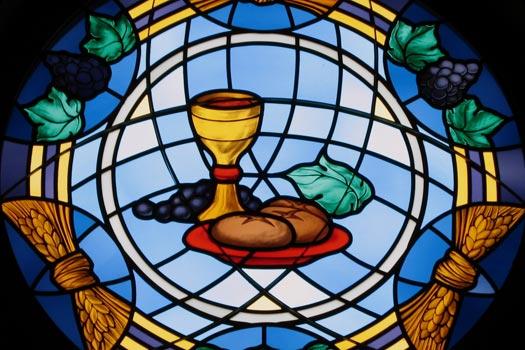
 Have you ever wondered why there’s a specific celebration for Corpus Christi (Latin for “Body of Christ”)? Don’t we celebrate the Body and Blood of Christ at every Mass? Here are a few facts about this Holy Day. (We also created a handout with some of these details, below, that you can download and share at your parish.)