
Tag: blessed mother

  • Our Lady of the Assumption: Her Importance and Influence in Everyday Life

    Our Lady of the Assumption: Her Importance and Influence in Everyday Life

    Statue of the Virgin Mary holding the Infant Jesus overlooking a schoolyard.
    Photo by jlopez on Cathopic

    One day, I asked students at the school where I work, “What’s the name of our school?” They responded in chorus with the expected exuberance of 23 first graders, “OLA!” 

    “What does OLA stand for?”

    This response wasn’t quite as resounding as the first, “Our Lady of the Assumption!” Their eyes shone bright with proud enthusiasm.

    “On what date do we celebrate Our Lady of the Assumption?” 

    Blank stares… then

    “Wednesday!”

    “Christmas!”

    “New Year’s!”

    One clever set of eyes darted about for clues and found a hint on a plaque hanging on the brick facade near where we stood outdoors, on our way inside from recess. She confidently blurted out “1952,” the only numbers on the plaque (the year the school was founded). Other parroting voices trailed in echo. 

    From that day on, the first graders could recall August 15 as Our Lady’s Day of Assumption as readily as they recalled their own birthdays. Whenever they did, I felt an inner joy and a renewed connection to Our Lady. 

    RELATED: Understanding and Celebrating the Feast of the Assumption

    In addition to the date, the children would eventually learn the Church’s teaching on the Assumption: “The Most Blessed Virgin Mary, when the course of her life was completed, was taken up body and soul into the glory of heaven…” (Catechism of the Catholic Church 974).

    Of Our Lady’s devotions and prayers, there are the Rosary, seven sorrows of Our Lady, Our Lady of the Miraculous Medal, etc. Similar to their attractions to certain of her apparitions, many Marian devotees are partial to specific feast days. Often, one chooses a particular devotion because of an experience where Jesus opens a door, and his mother appears from behind it. That was the case for me and my devotion to Our Lady of the Assumption. 

    A few years ago, I felt a nudge from God that it was time to seek employment outside the home after a hiatus to raise my children. To take the guesswork out of where God was calling me, I prayed the Lord would open one and only one door for my employment. Eventually one opportunity arose and the Blessed Mother seemed to confirm it in a dream. 

    WATCH: Mary in 2 Minutes

    In the beginning of employment at OLA, the name of where I worked held no significance for me. But when I had a hard time adjusting to my job, I found solace when my eyes landed on the sign that announced Our Lady of the Assumption, as I drove into the parking lot to start the day. In solid block letters announcing her title, I found consolation on difficult days and the comfort in knowing she had chosen this place for me. 

    There was a time, just after I converted to the Catholic faith as an adult, I didn’t know a thing about the Blessed Mother. After some buds of our relationship began to blossom, I attempted to keep Marian dates straight to honor her. Once, I mixed up the dates of the Immaculate Conception — December 8 — and Assumption — August 15 — by mistakenly combining the two days into one and confidently marking December 15 on my calendar as an important feast day.

    While my family teases me for my inability to recall anything verbatim, not even a single lyric of a beloved song, I somehow memorized all the mysteries of the Rosary practically overnight. Through the Rosary, and the maternal mentors God has placed in my life, Our Lady weaves threads of her care. From guiding me to a counselor during the rocky times of marriage to selecting our children’s high school – titled after another of Mother Mary’s namesakes  – her gentle presence in my life became palpable.

    Last year, on August 15, as I attended the Solemnity of the Assumption Mass at the church and school that both bear her name, I marveled at how a last minute schedule change had brought me to this landmark Mass. Mother Mary indeed wanted me there to reassure me of her call for me to this place of employment. 

    RELATED: Why Does Mary Have So Many Different Feast Days and Names? 

    I randomly recalled that when my children were in elementary school, I would attend this Mass at their school every year to pour out all my hopes for the new school year to Our Lady. One year, after the August 15 Mass, my then-13-year-old daughter had announced that she was going to teach religious education classes. I immediately knew this was a grace from Our Lady. The fruit of Mother Mary’s intercession continued as my daughter taught catechism and Vacation Bible school classes the following years; she went on to obtain a college minor in teaching, and took a gap year after graduation to volunteer as a teacher. Our Lady of the Assumption’s intercession continues to bear great fruit in my family’s lives.

    My new place of employment was her nod to me as my mother, and yet another thread confirming she claimed me as her own. At the place that bears her name, this mother of all mothers is schooling me in true discipleship. Lesson plans in love, sacrifice, and humility often shine a mirror on warts I never saw before; some days the virtues she’s trying to instill in me scratch against my pride and leave scrapes that feel like cuts. But when I look at my paycheck, I’m reminded that of all the places to work, I labor for Our Lady, and there is no one kinder and gentler to tutor me in the virtues.

    One chooses a saint as his/her own because of an experience of his/her intercession. It’s a mystical, reciprocal companionship. A devotion to Our Lady’s feast day is similar. Of her feast days, I have to say Our Lady of the Assumption, where she schools me in lessons in love, is my favorite. Wherever I go, whenever I see a church or school named Our Lady’s Assumption. I feel the warmth of a mother’s arms; I’ll always honor her on this and other special occasions.

    Our Lady of the Assumption, pray for us!

    Originally published August 14, 2023.
  • Marian Consecration: The What, Why and How

    Marian Consecration: The What, Why and How

    Marian consecration. Even for practicing Catholics who already know a thing or two about devotions to a saint, the phrase might stir up some confusion. 

    I get it, and I want to help clear up some of the mystery!

    I myself stumbled across consecration at a time when I wanted to deepen my faith. I had chosen Mary for my Confirmation name and prayed the Rosary every once in a while, but I felt a call to form a more personal relationship with her. In 2016, I saw that a women’s fellowship group was leading a retreat for Marian consecration. I leapt at the promise that it would be a game-changer and decided to participate. 

    WATCH: Mary in Two Minutes

    If to consecrate means “to set aside for a particular purpose,” what does it mean, exactly, when the term is applied to our relationship with Mary? Put simply, Marian consecration is an entrustment of oneself to Our Lady. But if that “simple” idea still sounds vague and mystical, know that consecration involves the following concrete steps: 

    1. A substantial period of prayerful preparation (typically 33 days). Often, parishes will host small groups that commit to making the consecration together over this time period, but you can also make it alone at any time. 
    2. A final prayer — the Act of Consecration itself — to be said on the day of the consecration (preferably a Marian Feast Day).
    3. A persistent spirit of trust in Mary’s motherly care and intercession, to endure for the rest of your life.

    As Catholics, we recognize that when, from the Cross, Jesus gave Mary to the disciple John, and John, in turn, to Mary, Jesus made her our spiritual mother. As such, Mary’s equipped in a special way, over and above all the other saints in heaven, to lead us to holiness. “Mary’s task is to give spiritual birth to Christians, to feed and nurture them with grace, and to help them grow to full stature in Christ.” Fr. Michael Gaitley writes, in his popular guide to Marian consecration, “33 Days to Morning Glory,” “In short, Mary’s job is to help us grow in holiness. It’s her mission to form us into saints” (25). 

    RELATED: I Never Connected With the Rosary… Until I Became a Mother

    Moreover, Fr. Gaitley explains that Mary is united to the will of God more closely than any other human being throughout all of time. If we want to know and follow the will of God in our own lives, there’s no better person to entrust the care of our souls to than Mary herself. A friend of mine once said, “The question isn’t really, ‘Why should you consecrate yourself to Mary?’ but, ‘Why shouldn’t you?’” 

    But does that mean that we’re making Mary more important than God Himself?

    I can see why it might seem that way, especially to someone who’s new to the idea of consecration. But the answer is an emphatic no. Mary’s goal, while alive, was simply to live in union with God, and now that she’s in Heaven, she has the same goal for each of us. If we consecrate ourselves to Mary, it’s not with the intention of replacing God but rather, of allowing Mary to bring us closer to him, as other servants of the Lord, committed to doing his will in the world. 

    Okay, this sounds good, but where do I start?

    Since there’s a particular kind of preparation associated with making a consecration to Mary, you’ll need some guidance through the process. If your parish hosts small groups for Marian consecration, you might find it helpful to join one, because of the benefit of being able to pray and process your reflections with others. But you can also make it by yourself!

    Either way, you’ll need a book. If you want to go “old school,” you can use St. Louis de Montfort’s “True Devotion to Mary,” but I prefer Fr. Gaitley’s conversational, approachable style in “33 Days to Morning Glory” (which I’ve already cited above). He does a great job of breaking down consecration into related themes that build on one another, and offering short prayers to meditate with each day. Plus, he organizes each week of the retreat according to the theology of a particular Marian saint: Louis de Montfort, Maximilian Kolbe, Mother Teresa, and John Paul II. 

    LISTEN: Fatherly Advice: Relating to Mary

    At the heart of any Marian consecration, though, is a total gift of ourselves to Mary: an offering of all of our prayers, intentions, works, sacrifices, and gifts, for her to use as needed to help form us into saints. 

    I consecrated myself to Mary for the first time on the Feast of the Immaculate Conception in 2016, and have since re-consecrated myself (you can renew the offering as many times as you’d like!) twice more — in 2017, on the Feast of Our Lady of the Rosary (October 7) and in 2020, on the Feast of the Visitation, which also fell on Pentecost (talk about a perfect day for a consecration, combining a Marian feast day with the celebration of the Holy Spirit’s descent!). Each time, I’ve felt myself grow in my own understanding of how Mary wants to be a mother to me, and of how she leads me to her son. Most of all, I’ve grown in a spirit of trustful abandonment regarding God’s will for my life, as I’ve prayed to emulate Mary’s fiat. Last year, I purchased a bracelet to remind me of my consecration, and I wear it each day as a tangible reminder of the offering I’ve made and of Mary’s unceasing care for me.  

    If there’s one thing I recommend that you do for your faith life this May, particularly if you’re serious about becoming a saint (as we all should be!), it’s consecration to Mary. You won’t regret it. 

    Originally published May 16, 2022.

  • Love Amidst Pain: A Reflection on the Journey to Calvary Through Mary’s Eyes

    Love Amidst Pain: A Reflection on the Journey to Calvary Through Mary’s Eyes

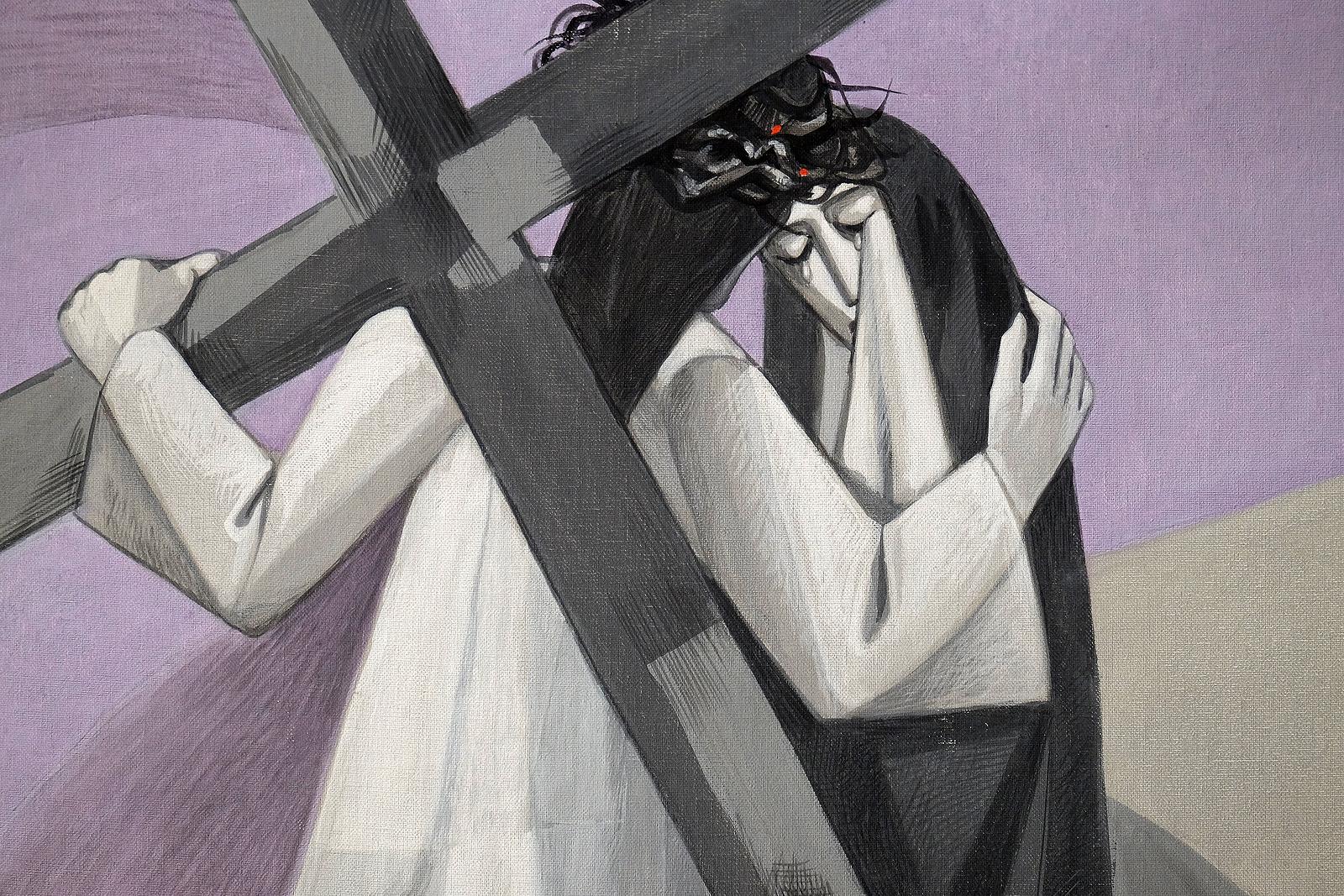
    Abstract of holding the crossAs my infant son struggled with a difficult medical condition over the last few years, I found myself in the midst of caregiving like I had never experienced before. During that time, I stumbled across an old devotion: the Seven Sorrows of Mary. So, finding a connection with the Blessed Mother in my sorrow and hers, I found myself meditating on the Passion and Death of Jesus in a new way. 

    Amid Mary’s great Passion-related sorrows, we can find consolation, just as in the middle of a dark night, we find illumination in the stars. That consolation is that Jesus could see Mary standing there along the road to Calvary. Her presence was a comfort to him, as it was for me facing grief and sorrow in my own life.

    RELATED: Maternal Love and the Cross

    Their meeting is not recorded in the Bible, but we know it happened by tradition. Their meeting was likely brief, just after Christ’s first nasty fall, and in that moment, Mary witnessed all the wretchedness that the people around her son put him through. Yet, what was wretched for her was also a moment in which Jesus could see that he wasn’t alone. Her presence showed him that someone loved him, that someone grieved his fate, and that Mary shared his suffering in her heart.

    So even though Mary witnessed all the grotesque details of Jesus’ torture, she perhaps saw too the glimmer of relief in his eyes — just for a moment, that she was there.

    Sometimes, our presence is not enough to console someone we love. But in certain, beautiful moments, it can. Even during the most difficult times, God offers us small graces. Like Mary, then, we can keep going.

    Right after Mary and Jesus were forced to part, the soldiers recognized that he might not make it all the way to Golgotha alone. I wonder if Mary saw Simon of Cyrene from behind, and saw him help Jesus carry the cross as she longed to do. This too, was both a sorrow and a consolation, for now he had some help, but he was getting farther and farther from Mary, and closer and closer to death.

    RELATED: Turning to Mary in Difficult Times

    Isn’t it funny how intimately sorrow and consolation are linked? The other side of sorrow is joy, and the other side of love is loss. As a caregiver, I’ve learned acutely that in life, we walk the razor-thin edge between the two sides, feeling both in their time as we wobble between them. It’s the sorrow of sitting at the bedside of a suffering loved one, intermingled with the joy of being in their presence, the joy of loving them with a depth that only such suffering uncovers. To flee one – sorrow or joy – is to flee the other. We can accept joy in our lives only when we accept sorrow. We can accept love only when we also accept loss.

    This is the drama of our fragile, human lives. It is my drama in caregiving, and, I imagine, in all the permutations of life in which we live our days for the sake of another. Perhaps it is why Jesus told us to take up our crosses, that we may take up our joys in their time as well (Matthew 16:24). Perhaps it is why the man who avoided suffering “went away sad” (Matthew 19:22).

    Mary’s sorrow is different from sadness. It is founded on faith, given momentum by hope, and is the interwoven brother of love. Sorrow is deep, like roots that probe deeper and deeper so that the tree above can bear abundant fruit. It is like the chaff that grows up with the grain; to remove sorrow now would threaten the harvest, but one day, God will separate the two (Matthew 3:12). Sorrow will be forgotten, and we’ll be left with the abundance and joy of Easter.

    Editor’s note: This article is an edited excerpt from Theresa’s book, “Caring for a Loved One with Mary: A Seven Sorrows Prayer Companion” (OSV 2023).