
Tag: bible

  • 6 Bible Verses That Shepherd My Parenting

    6 Bible Verses That Shepherd My Parenting

    Parents and a toddler preparing food togetherWhen I became a Christian, I felt like God was inviting me to come to him for parenting support, through prayer and reading his word. 

    When I first looked at what the Bible said, I didn’t see much advice for parents. Apart from the often-quoted Proverbs 22:6 “train up a child in the way he should go,” there doesn’t seem to be a lot of advice that directly speaks to our parenting challenges. However, a deeper look reveals that many verses can support parents raising their children. 

    RELATED: How Memorizing Prayers Brought My Family Closer to God

    Loving our children is a reflection, on the micro level, of how Jesus loves us. As imperfect humans with a tendency to sin, it’s a lot to live up to, but thankfully God gave us his Holy Spirit to be with us. 

    Here are six Bible verses to meditate on and memorize to help us along our parenting journey. I try to read and reread these as often as I can so that when I’m in a sticky parenting situation, God’s words of advice remind me to parent in the spirit and not in the flesh. 

    1. Remember the fruit

    But the fruit of the Spirit is love, joy, peace, patience, kindness, goodness, faithfulness, gentleness, self-control; against such things there is no law (Galatians 5:22-23).

    There are many parenting moments where I don’t feel peaceful or patient, when my words aren’t kind or gentle. Having this verse at the forefront of my mind can interrupt any negative patterns of thinking. It’s so easy to forget, which is why I like to read this one often; I even spent a week meditating on it. You could put it in a prominent place like your bathroom mirror, or on the fridge. 

    2. Pray without ceasing

    Cast all your anxieties on him, because he cares for you (1 Peter 5:7).

    When I first became a Christian three years ago, I gave up new-age practices after God showed me to rely solely on him. However, my parenting actually deteriorated for a while as I did not share my problems with him! It felt much harder to rely on a God I could not see. It took an inspiring sermon on the power of prayer to really make me sit down every day, and make sure I gave every anxiety to God. After that, I felt much calmer as a parent. 

    It can be all too easy to get caught up in my worries and not involve God. The Bible is full of reminders such as; “pray without ceasing” (1 Thessalonians 5:16) and “do not be anxious about anything but in everything by prayer and supplication with thanksgiving let your requests be made known to God.” (Philippians 4:6)

    3. Speak gently

    A soft answer turns back wrath: but a harsh word stirs up anger (Prov. 15:1).

    When I want to make a request or set a limit with my kids, it can be easy to let my own emotions come out in my tone of voice. Sometimes I get frustrated about the state of the kitchen or my irritation rises as a simple request is met with complaints or arguing. Nevertheless, using a gentle, loving tone, even when we need to hold a firm limit can help to build the sense of connection children need to cooperate with us. 

    LISTEN: Tackling Kids’ Tough Questions of Faith

    4. Stay quiet

    No human being can tame the tongue. It is a restless evil, full of deadly poison (James 3.8).

    I have found this particularly helpful as my daughter has gotten older and more prone to debating or questioning me. Sometimes rising irritation can lead me to say things that I may regret later. In those moments, I try to remember the book of James which has many reminders about staying quiet. 

    5. Stop complaining

    Do all things without grumbling or disputing, that you may be blameless and innocent, children of God without blemish in the midst of a crooked and twisted generation, among whom you shine as lights in the world (Philippians 2:14-15).

    Before coming to Christ, I must admit I complained a lot, often about the state of the house and the amount of items on my to-do list. I thought of it as a healthy expression of my feelings, but in reality, there were times when my moaning just created a bad atmosphere. This verse helps me, as it acknowledges that yes, this world is fallen and broken, so there will be many struggles. But we are servants of Christ so it’s our job to shine.

    6. God makes the impossible possible

    With man this is impossible, but with God all things are possible (Matthew 19.26).

    There have been moments when things seem impossibly hard, and I feel there is no hope. When I find myself caught thinking I’m not a good enough parent, or this is never going to change, I just remember that I’m not doing it alone.

  • Learning About Sacrifice, With the Help of St. Mark

    Learning About Sacrifice, With the Help of St. Mark

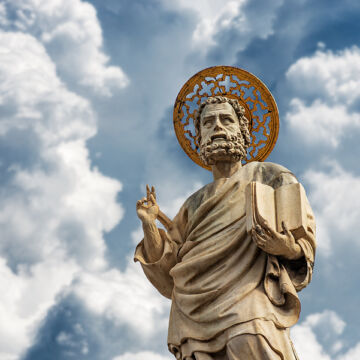
    Image of statue of St. Mark with sky in background.
    Photo by Alberto SevenOnSeven on Bigstock

    Sacrifice is key. We know that Jesus requires this of his followers, but I also heard this statement repeated many times when my wife and I were engaged.

    If I am honest, I think this kind of statement is kind of threatening. I know it to be true based on the life, witness, and words of Christ, but sacrifice is difficult. Approaching my fifth wedding anniversary while having two children (and one on the way) has validated the importance of sacrifice even more concretely in my life. Much of this investigation into sacrifice, however, has been enlightened by St. Mark. 

    The feast day of St. Mark falls on April 25 each year. This critically important saint is often overlooked because he was not one of the 12 Apostles. He does not appear in the stories about the earthly ministry of Jesus, but he wrote one of the four Gospels. 

    RELATED: How to Make Friends With a Saint

    I admit I used to know nothing about St. Mark; he was just a man who wrote a Gospel. My appreciation for him climbed last year when I decided, for the first time, to read the Gospel of Mark straight through from beginning to end. I often read the Gospel of the day, but after hearing a podcast about the importance of reading these accounts as they were written, I took up the task. I started with Mark, well, because it is the shortest Gospel!

    I learned that from the earliest days of the Church, Mark was known to be the interpreter of St. Peter. He became close to Peter and was able to write his account of Jesus’ life based on listening to Peter’s stories.  His writings are viewed as the preaching of St. Peter. We also know, from Acts 12, that Mark was once the companion of Paul and Barnabas as well. 

    Taking the time to read the entire Gospel of Mark transformed me. What became more palpable very quickly, was that Jesus was sent to sacrifice his life for me. I felt this in the way that Jesus spoke about his passion in the Gospel of Mark. I could picture Peter speaking these words to Mark and being moved by them as he heard them for the first time. It became more real for me because I realized that this message was literally passed down through the generations in a powerful and transformative way.

    RELATED: How to Be a Saint-in-the-Making

    At the start of the third chapter of Mark, people begin to plot Jesus’ death. All Jesus did prior was heal the sick, restore the possessed, and preach the truth. And yet, humanity rejected him. He was to be killed because of who he was. Still, he continued to place himself in the spotlight with more public healings and more intense preaching. Christ did all of this with the knowledge that he came to suffer.

    This reaches a shift in intentionality at the midway point in the Gospel. Peter confesses that Jesus is the Son of God and Jesus goes on, three times, to tell the Apostles that he will be arrested, suffer, die, and rise. Jesus states that he “must suffer” (Mark 8:31). 

    I became more and more intrigued by this truth as I reached the details of Jesus’ passion. It seemed more real to me and more powerful. If he tells us that in order to follow him we must also take up the cross (Mark 8:34), then why do I view sacrifice in such a negative way? The sacrifices that I am being invited into actually make me like Jesus. Mark, specifically, taught me this because of his intense focus on suffering and sacrifice. Sacrifice is an opportunity, it should not be a fear.

    RELATED: What I’ve Learned About Marriage When the Unexpected Happens

    My first practical thought was: Can I be more intentional about sacrificing in my marriage? I do my best to do this by helping around the house after work, but I think I view these tasks as things I just have to do. Mark’s insights helped me to see that I can offer difficult times (even if they are simple) as avenues of grace for my loved ones. Doing the dishes or folding the laundry late at night when I am tired and drained aren’t just nice things to do. They can be sacrificial and intentionally done to give me access to Jesus’ sacrificial love. 

    Second, I thought about my two boys. Being a parent of a 3-and-a-half-year-old and a 1-and-a-half-year-old can be chaotic. Noise, messiness, and lack of sleep are all side effects when the needs of your children demand all of your attention. My wife, Joanna, experiences this more than I do since she is home with them, but being consistently present to her children all day is a sacrifice. Rather than look to escape into my phone or have “me time,” Mark has inspired me to be more present during these special times with my kids. 

    The beauty of Christian sacrifice is that its focus is not on rigor. Sacrifice opens us up to love and makes us who we are meant to be. The tired tasks and intentional presence I strive to have with my children make me a better husband and dad. They do not make my life darker but brighter. Thanks to St. Mark, I am becoming less fearful of sacrifice and more grateful for the impact of Christ’s sacrifice in the concrete aspects of my life.

  • Models of Marriage: Remember These Lessons From Biblical Power Couples This Valentine’s Day

    Models of Marriage: Remember These Lessons From Biblical Power Couples This Valentine’s Day

    Holy Bible open with pages folded in the middle to make a heart shape and cross charm haning from the heart.
    Photo by May_Chanikran on Bigstock

    In the Sacrament of Matrimony, we are called to love each other fully in word, spirit, and deed, not only on our wedding day, but every day of our lives. That’s why the celebration of love just once a year on Valentine’s Day – the origins of which include a Roman fertility ritual and the execution of the martyr Valentine on February 14 – felt counterintuitive to me. It didn’t help that Valentine’s Day evolved into a consumerist holiday benefiting greeting card and chocolate corporations. But, after I got married, I realized that we can reframe this day in a Catholic way: Valentine’s Day can be an opportunity for couples to reenergize their commitment to each other. 

    The best place to begin this re-commitment is the Bible. Though many relationships in the Old and New Testaments reveal the pitfalls of sinfulness and the reality of our human brokenness, many also demonstrate how spouses can be wholly committed to each other. These holy unions, while far from perfect, are built on similar foundations, and we can use these lessons as models for our own marriages.

    LISTEN: Saints of Our Lives: Saint Valentine 

    Trust triumphs over darkness.

    Every marriage faces hardships, but we can survive life’s struggles together if we put our trust in God. Early on in my marriage, for example, my husband and I found it challenging to spend quality time together, as he had a rotational work schedule that made him spend most weekends at work. Our days off hardly ever coincided, and planning for family gatherings was a logistical nightmare. We realized that to deepen our union, we had to take time in our daily lives to fully enjoy each other’s company, which took commitment and communication. But these were lessons that benefited us in the long run. And now, in our fourth year of marriage, my husband’s schedule was finally adjusted to reflect a standard work week. Weekends together now feel like long-awaited blessings, and we soak in every minute of our time together. 

    There are many struggles that can strain a marriage. Several couples in the Bible faced a particular challenge: infertility. Many modern married couples, including some of my close friends, also suffer this specific struggle in private silence. Abraham and Sarah (Genesis 15-23), Isaac and Rebekah (Genesis 24-27), Elkanah and Hannah (1 Samuel 1–2:21), and Zechariah and Elizabeth (Luke 1:5-24) relied on God to direct the course of their lives. Through prayer and patience, they remind us that we are never alone in our struggles. God is with us to comfort and carry us. Ultimately, God blessed these couples with children – and some exceptional ones, too, like Jacob, Samuel, and John the Baptist. 

    However, whether or not children are part of God’s plan for us, we can strengthen our resolve as married couples by trusting in his will – and accepting it. We must be patient when our marriages are tested, keep praying even when things seem impossible, and remember that God’s blessings are always worth waiting for, in whatever form they come. 

    RELATED: Why Is Valentine’s Day Such a Big Deal?

    Kindness is key.

    There’s a saying I’m particularly partial to: “Happy wife, happy life.” But there is truth in this: If spouses aim to keep each other happy, marital life is more peaceful and joyful.

    One way to maintain authentic happiness is through kindness. Being kind to each other goes a long way, as we see in the story of Boaz and Ruth (Ruth 1-4). Ruth, who had been living in the land of the Moabites, lost her spouse and had no one to turn to. She and her mother-in-law Naomi returned to Israel, and Ruth sought out work. She found herself in Boaz’s fields, and though she was a foreigner, Boaz permitted her to work there. He ordered his men not to touch her and to treat her with respect. Boaz gave her lodging and invited her to share meals with him. In return, Ruth was grateful for all the help she could get. Eventually, Boaz and Ruth wed. 

    This power couple shows us that kindness means accepting and respecting each other. It means being patient with each other, helping with chores, taking on more when your spouse is stressed or exhausted, listening, and forgiving. Kindness is loving the person – and showing it.

    RELATED: 6 Tips for Being Better Prepared for Marriage

    Shared goals give purpose.

    Shared values and vision provide purpose for a couple’s shared life. Working towards something together is often more meaningful and enjoyable than going at it alone. My husband and I, for instance, agree that we want to live a life as simply and naturally as possible. This means having adventures in the great outdoors, prioritizing time with our family, and attending to daily joys together, like cooking and dog walking. In the long run, we hope to have our own homestead, raise chickens, and build a family in faith. In the New Testament, Priscilla and Aquila also shared a vision, playing an integral part in the spread of the early Church (Acts 18:2-3, Acts 18-19, Acts 26; Rom 16:3-5; 1 Cor 16:19; 2 Tim 4:19). After Claudius had evicted Jews from Rome, the couple settled in Corinth. There, they met St. Paul and followed him to Ephesus to evangelize, housing disciples and training them in the faith. The couple was so in sync with each other that Priscilla and Aquila are never mentioned separately in the Bible. In this way, they teach us that married couples are strongest when they are working together. This doesn’t mean spouses should always be glued to the hip, but that the strongest marriages are those unified in values and vision. 

    RELATED: Chastity, Poverty, and Obedience in Marriage

    A good Christian marriage is a holy one.

    To find a true, authentic model of Christian marriage, we need look no further than the ultimate power couple: Mary and Joseph. There were many tests in their marriage: Mary’s pregnancy before being betrothed to Joseph; King Herod’s decree of infanticide which drove them to flee to Egypt; losing their son Jesus in Jerusalem during the Passover festival. And there were no doubt many private hardships that Mary pondered in her heart (Luke 2:19). But through it all, Mary and Joseph strove to lean on each other to uncover God’s purpose for them and follow his path, wherever it would lead them. And this ultimate partnership – this ultimate true love – enabled them to create a holy home, one which raised the Son of Man and Son of God.   

    These power couples from the Bible can inspire us to recommit ourselves to our spouses this Valentine’s Day. Though it is conventionally a secular holiday, we can celebrate it in our own Catholic way, by reflecting on our role in our marriages, recommitting all our strength, faith, and love to our chosen ones, and dedicating our union to God. Plus, it is a good excuse to just have a little fun. We usually crack open a bottle of champagne and cook a meal together. (So, despite my prior jab at the consumerist aspect of the day, husbands and spouses alike, take note: flowers, chocolate, a date night, or a wonderful home-cooked meal will still be happily accepted.)