
Category: Life & Culture

  • What Do Lent and Valentine’s Day Have in Common? More Than You Think

    What Do Lent and Valentine’s Day Have in Common? More Than You Think

    Grey heart made of ash and dustAsh Wednesday and Valentine’s Day can seem like contradictions. One day celebrates romantic love, while the other reminds us that our bodies will one day turn into dust. This year, February 14 will be filled with both Cupid and ashes.

    Ash Wednesday marks the beginning of the Lenten season of repentance and the preparation for the holiest days of the Church year. I always find that the beginning of Lent comes up so fast that I do not spend enough time reflecting on how I should spend this season. My tendency towards the eleventh hour isn’t new – if I am honest, I also tend to buy my Valentine’s Day gift for my wife at the last minute as well. So this year, I want to make the start of Lent and Valentine’s Day more impactful by considering what they mean — together.

    RELATED: Why Ash Wednesday Isn’t a Downer

    This year’s simultaneous occurrence of these two important days on the calendar has been a fruitful coincidence for me because it prompted me to start thinking about the day sooner than I usually do. So often, I live in a state of distraction – going from one day to the next without being intentional about the coming days. Once I investigated the significance of Valentine’s Day and Ash Wednesday, I found that their alignment offers a powerful opportunity to see that love means that we die to ourselves. 

    St. Valentine was a priest (possibly a bishop) who lived during the third century. He was a man of tremendous faith. During his time, Emperor Claudius struggled to employ soldiers in his army. He thought this was because men would rather marry than serve him. So, Claudius outlawed marriages in order to spike the numbers in his army.

    In response, Valentine often married couples in secret so they could enter into the sacred bond of lifelong love together. When he was later imprisoned for doing so, he healed the jailer’s daughter of blindness, befriended her, and would often sign his letters to her, “your Valentine.” Valentine was eventually beheaded for his defiance of the emperor and died as a martyr of the faith. 

    LISTEN: Saints of Our Lives: St. Valentine

    Learning about the life of St. Valentine has compelled me to reflect on what I do for Valentine’s Day and how I approach the everyday aspects of my marriage. Specifically, how can I sacrifice more for my wife? Instead of viewing ordinary tasks as a simple responsibility, I have begun to see that doing the dishes or laundry after a long day of work can be an offering of love to her because she so often does them for me. Simply carving out time to write a letter to her on an ordinary day is another practice that I know will make our relationship more rooted in the sacrifice of St. Valentine. 

    Love costs us something: our time, our energy, our sacrifice and effort. Lent is meant to cost us small offerings so that we can gain further insight into Jesus’ sacrifice. That is why we receive ashes on the first day of Lent. I would argue that Valentine lived from the consciousness of his own ashes. He knew that to follow Jesus meant that his entire being would be an offering to God.

    This Lent, I know I am being invited to do something similar. So, rather than giving up ice cream and sweets, I want to be committed to sacrificing in ways that explicitly proclaim the love that motivates the sacrifice. This Valentine’s Day will be made up of no extravagant gifts; my wife and I have decided to make Lent an extended Valentine’s Day of sacrifices for each other. 

    RELATED: In Defense of the Lenten Sacrifice

    Just like making time to sacrifice for my wife, this Lent I want to make the sacrifice of waking up 15 minutes earlier each day to pray. I want to commit to being more present at Sunday Mass, especially during the reception of Holy Communion. I hope that these practices will be more concerned with loving Christ and less concerned with giving things up because that is “what you do during Lent.” 

    This Valentine’s Day, and Ash Wednesday, practice sacrificial love that continues throughout Lent. See that love is most pure when it acts out of intentional choices for the other. Then we will experience that St. Valentine and ashes truly belong together. 

  • Post-Cana: Ways to Foster a Meaningful Marriage

    Post-Cana: Ways to Foster a Meaningful Marriage

    Couple In Love Holding Hands Each OtherIt was another Saturday night in our house: The kids were asleep, the dog had been fed, the dishes were done. Finally, it was just us. Turning to my husband, I asked like I normally did, “Want to watch something?” He grabbed the remote, I grabbed us each a glass of wine, and we scrolled through our movie choices. Tired from a day of wrangling kids, we spent half the time staring zombie-like at the film and the other half absorbed in our own chores: some last minute work emails and folding laundry. Physically, we were together on the couch, but emotionally and mentally, we were miles away. We were stuck in a robot-like ritual. This needed to change.

    The next Sunday, in our parish bulletin, an ad for a marriage enrichment night appeared. Normally, my eyes would have skimmed right over the notice. After all, our marriage wasn’t in jeopardy. We were trudging through life just like everyone else, right? Weren’t church marriage seminars for curmudgeonly couples who had nothing better to do on a Friday night? Then, I realized we had nothing better to do on a Friday night. Plus, my husband pointed out, it was cheaper than a movie date and included dessert and coffee. We signed up.

    RELATED: Being Grateful in Relationships

    I’d like to say that going to that seminar offered us the magic elixir to a perfect marriage and roused us back into the honeymoon phase, but that would be misleading. What it did offer us, aside from a kid-free night and a plate of cookies, was a starting place. By attending the seminar we confirmed to ourselves and each other that both our marriage and our faith were important and intertwined. It reminded us about the vows we took and the sacrament we received. Our “we,” we were reminded, was not “just us.” Our marriage was a covenant — with one another and with God — making us part of something bigger.  

    In preparing for marriage, we had done a lot of goal setting and planning. Now, several years and two children into this commitment, our daily discussion of goals seldom went beyond planning what we would like to eat. The next week, instead of turning on the television, we turned to a sheet of paper and each wrote where we would like our family to be in the next one, five, and 10 years. Some of these ideas, like our desire to travel more and potentially homeschool our kids, had been mere musings we mentioned in passing. Now, written down and shared, they seemed more real. This led us to our next step, which was an in-depth discussion about how to make these ideas happen. Instead of watching others’ lives unfold on the screen, we were planning our own.

    RELATED: 6 Tips for Being Better Prepared for Marriage

    A couple Sundays later, my sister unexpectedly stopped by our house as we were getting ready for church. “Leave the kids with me,” she said. My husband and I looked at each other. Just us? While we consider celebrating Mass an important family experience, our children (1 and 3) often demand our attention and care during the service. This unexpected “date” allowed us to concentrate on the Mass and celebrate it together. And the brunch we ate after involved meaningful conversation…and no juice spills or temper tantrums. Although we intend to continue to attend Mass as a family, it was another important reminder about the commitment we made to each other and God in this sacrament of marriage.

    Our lives are still hectic and exhausting. The laundry will never, ever be done. And we still enjoy watching television after the kids go to bed. But we’ve realized that the quality of time we spend together is just as, and sometimes even more, important than the quantity. By being purposeful and thoughtful with our time together, we’ve recognized that our marriage is more than “just us.”

    Originally published February 8, 2017.

  • Adjusting My Unrealistic Expectations: Three Essential Takeaways from the Search for My Soulmate

    Adjusting My Unrealistic Expectations: Three Essential Takeaways from the Search for My Soulmate

    I am your sister in Christ; I am also your friend rooted in reality. Between the ages of 22 and 25, I prayed fervently to St. Anne, St. Anthony, St. Joseph, Our Lady of Perpetual Help, and all the other friends in heaven who promise to make spousal matches. I was looking for a St. Joseph of my very own, after briefly discerning religious life during college and realizing it wasn’t for me. Once I knew that I wasn’t called to live in a convent, I began the search for the perfect Catholic gentleman. I wanted an intellectual (would we meet reaching for the same Chesterton book?), someone my parents would adore immediately, and most likely someone I would meet at Mass or Theology on Tap. I attended so many Catholic networking events in the cities where I lived during that time, certain it would be where I would meet my future husband.
    RELATED: My Spouse Isn’t Religious, but God Is Still in My Marriage

    When I turned 25, I did meet someone… a gruff, burly man working in entertainment in Los Angeles, who just happened to be Jewish, with no interest in converting to the Catholic faith. But we had other values in common, like family, community, and love for nature. Seven years later, none of that has changed, and we are newlyweds. Our journey was not necessarily what I imagined for myself at 25 – and our wedding was not either. We got married in the time of COVID, with our parents watching via video stream and our handful of witnesses wearing masks and standing six feet apart. My expectations came crashing down hard when we had to postpone our original wedding date, but the joy of our tiny marriage was real because of who I married.

    But I’m not here to tell you the details of my story (albeit it is pretty good and full of divine intervention). Instead, I want to share with you what I’ve learned about relationship expectations as a faithful Catholic called to marriage, which is that – to the surprise of some – virtue requires us to open our hearts and pick our battles (proof: St. Therese of Lisieux’s life in the convent). 

    Here are a few suggestions for how to adjust potentially unrealistic expectations you may have of the person you hope to marry.

    1. Your future spouse probably has hobbies that are different from yours and those of a monk.

    While I didn’t grow up gaming and honestly don’t really get the appeal, my husband has a weekly video game night with a bunch of guys he connects with virtually, and they play as a team. It is one of his best stress-reducers after a long work week. And who am I to judge? It’s not violent, and if it was, we could have a conversation about whether or not that particular game affects his demeanor. As a lifelong soul searcher, sure, I would love to see him pick up “Confessions” by St. Augustine on a Friday night instead. But if I’m choosing to do my nails or watch “Under the Tuscan Sun” in my free time, then why shouldn’t he be able to use his time in the way that he chooses? For the record, my husband is also a ceramics artist, a gardener, and the best cook I know.

    RELATED: What Is Marriage Prep Like for Those Marrying Non-Christians

    2. He or she might not be who your parents – or even your best friend – always had in mind for you.

    My parents expressed skepticism when I told them I was certain my vocation was to marry a non-Catholic man. I met my husband at the wedding of two Catholic friends who also found the match odd and frankly, disappointing. I felt downtrodden by the uncertainty of others, even when I was certain in my own heart. I wanted everyone to recognize our chemistry instantly and thought affirmation would come easily if it was my vocation. But Christ was the first to teach us that true vocation is not always easy. Over time, my parents and friends were able to see the love between us, and the same beauty and goodness that I see in my husband. While they usually want what is best for us, the important thing to remember if others aren’t sure about your partner is to ask yourself earnestly – what do you want?

    3. Perfection doesn’t exist outside of Jesus Christ and Our Lady.

    If I asked you to list your sins, we call that Confession. If I asked you to make a list of the sins you don’t want your future spouse to commit, we would probably call that unattainable (aside, of course, from the biggies like infidelity). Every human being is marred by original sin, and no matter how hard we try to overcome our flaws, any married couple can tell you that they are present daily. God willing, you will find someone who loves you for you and all your shortcomings – I am lucky enough to have done so. And in the same way you wish to be loved despite your imperfections, you must learn to love another despite his or hers. 

    RELATED: 4 Questions to Ask in an Interfaith Relationship

    Everyone has their own non-negotiables based on lived experiences, and it’s okay to keep those in mind as you look for a spouse. But if we find that we cannot change our beloved, can we love them anyway? (Spoiler alert: you won’t change anyone overnight or maybe ever, especially when it comes to picking their socks up off the floor.) While my husband is not actively involved in my faith life, I know that he loves me because of who I am in my entirety, including my spirituality and religious grounding, which is the soil from which the rest of my character springs. And I see the Holy Spirit emanating from him when he cooks me an incredible meal or gazes at the mountains. He often teaches me with his generosity, from organizing neighborhood trash cleanups to buying hats and socks to hand out to LA’s homeless. 

    The overarching theme here is not letting an unattainable ideal or an impulse to check all the boxes prevent you from finding true love. There are incredible people out there, both inside and outside the Catholic Church. Chemistry is important (in my experience) as is a shared value system and vision for your lives together, plus of course conversations on the big three: sex, children, money. 

    But open your heart to see the true person in front of you. You could be so pleasantly surprised at where it leads.

    Originally published Feb. 3 2021.

  • ‘Jonathan & Jesus’ Is a Story of Surrender We Can All Learn From

    ‘Jonathan & Jesus’ Is a Story of Surrender We Can All Learn From

    “Jonathan & Jesus” docuseries | Steven Schwartz

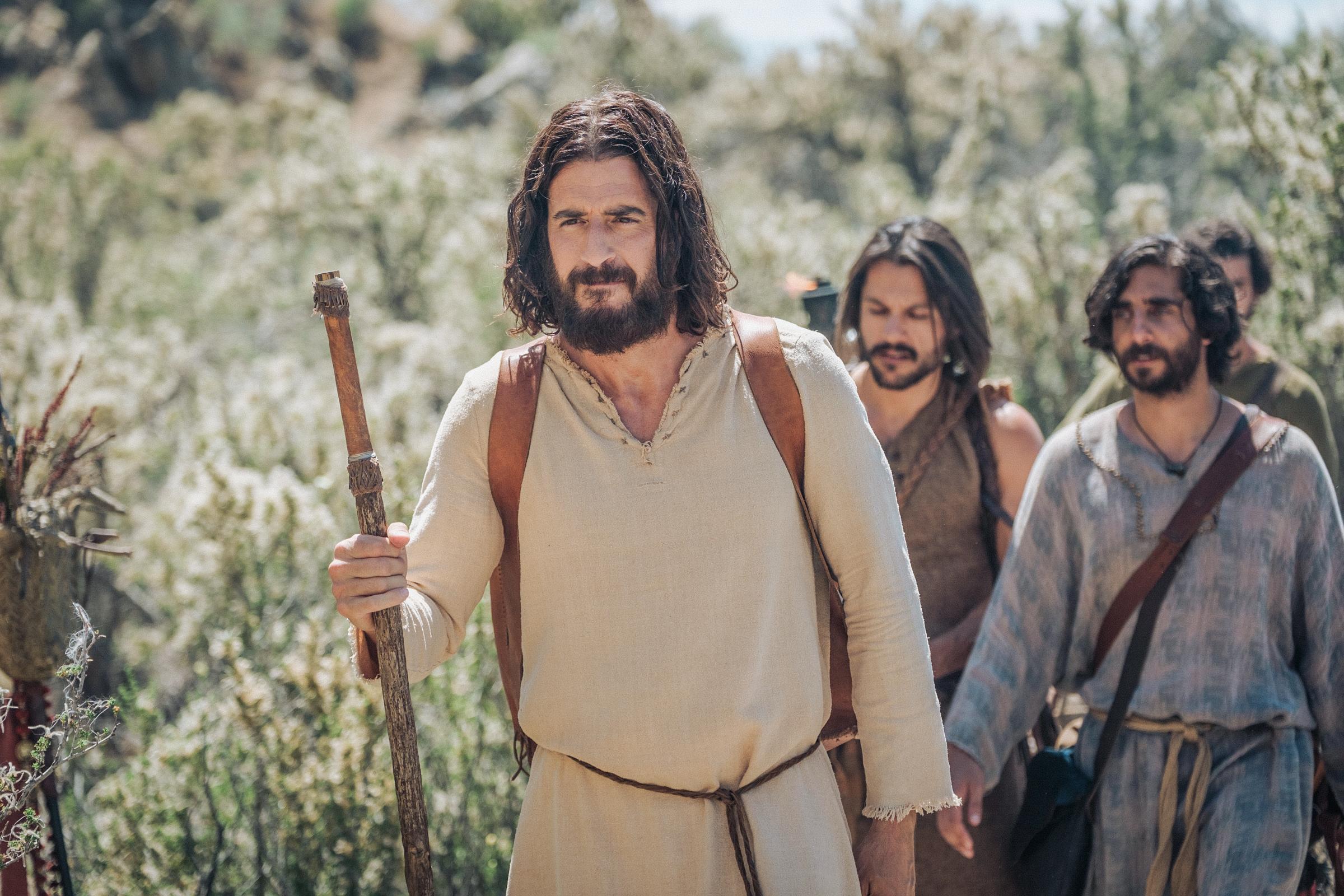
    Let’s get this out of the way first: I’m an unapologetic fan of “The Chosen,” the series about the life of Christ that went from a crowdfunded upstart to an unexpected worldwide phenomenon; its fourth season is about to hit movie theaters in February before being released to streaming in March. I think Jonathan Roumie’s performance as Jesus in the series is staggeringly good. I’m also someone who’s worked in the entertainment industry for much too long, often with those magical creatures we call actors (not, for full disclosure, with Jonathan Roumie). So, I acknowledge I’m not the most objective viewer of the newly released “Jonathan & Jesus” docuseries.

    Yet I admit when I initially learned about “Jonathan & Jesus,” I had a moment of “oh, dear.” My first thought: How does this, even when made with the best intentions, avoid looking like an ego trip?

    I’m happy to say that “Jonathan & Jesus” doesn’t play at all like an ego trip. It’s not an easy watch – that’s not criticism, that’s praise – because it is a journey through the life-changing nature of Roumie’s experiences, from deeply blessed to personally overwhelming to just plain cool, during the early days of the ascendency of “The Chosen.” It’s also an interrogation of the meaning and impact of Jesus, not only on the actor playing the role, but on everyone in our world.

    LISTEN: Jonathan Roumie’s Prayer Challenge

    While the burgeoning of “The Chosen” phenomenon and Roumie’s landing a lead in “Jesus Revolution” between the shooting of seasons two and three of “The Chosen” serve as an ongoing throughline, each episode of the docuseries has its own focus, roughly sketched as (1) Jesus as God and historical/cultural touchstone, (2) Christianity, division, and unity, (3) celebrity and humility, and (4) control versus surrender. “Jonathan & Jesus” is ambitious and immersed in big questions throughout, touching on subjects both complicated and diverse. 

    A journey through the meaning of Jesus as the Incarnate Word of God, the primary cause of Western Civilization, and a pop culture motif took me on an emotional rollercoaster. First, I felt vaguely uncomfortable seeing some of the more mundane depictions of Jesus portrayed in pop culture, from “Family Guy” to the Buddy Christ image from Kevin Smith’s “Dogma.” That gave way to a sense of the transcendent as a historian standing in the shadow of the Roman Colosseum considered that at the time the Colosseum was built, it would have been ludicrous to think that the Roman Empire would soon be ruins, but a nascent faith beginning with Jesus and a small group of followers in Judea would survive, thrive, and be, millenia later, the largest faith in the world. 

    Discussions between Roumie and preachers and influencers of various Christian denominations reminded me how we’re so unfortunately quick to criticize each other, focusing on the things that divide us as Christians instead of the God who unites us all. Interviews with scientists, ministers, writers/podcasters, human rights campaigners, and musicians revealed the pivotal moments in which these people chose to surrender their lives — expectations and illusions of control included — to God in faith and the monumental results of that choice. Given my own constant struggle with surrender and what it really means in practice, seeing these stories is a nudge to keep on trying. (If you’re like me, you regularly turn your eyes heavenward and say, “Is this it, God, am I surrendering right yet? Because I don’t think I am!?!”) And yes, you will come away from this doc wishing that Jonathan Roumie, Sheila E., Brandon Flowers, and Alice Cooper could tour as the world’s most unlikely supergroup.

    Photo courtesy of The Chosen / Mike Kubeisy

    RELATED: Spiritual Streaming: 5 Catholic-Themed Films for Your Next Movie Night

    With all these matters raised and considered, the series is in some ways a choose-your-own-adventure; which parts of it stick with you will vary significantly from viewer to viewer. At the close of the final episode, the person who watched with me said, “The things some of those Christians he interviewed were doing…feeding migrants under bridges and saving trafficked women…how am I ever going to get to heaven?” Meanwhile, I was most affected by the unflinching honesty of the life-of-an-actor segments, which take the viewer from the dire situation Roumie was in just months before “The Chosen” came along to interviews with his sister, Olivia, and Dallas Jenkins (creator of “The Chosen”), discussing how both fame and the conflation of a human actor and the Son of God in the mind of fans can be disorienting, scary, and exhausting—even for a grounded person with a deep faith to sustain him. In my professional life, I’ve seen both actors eking out a living juggling acting gigs with low-paying survival jobs and actors dealing with sudden fame due to one big role (never mind the role of Jesus, which adds knotty moral questions to the already complex issue of fan adulation). These segments felt painfully real and raw to me, a look behind the curtain that we rarely get about the challenges of life as an actor. 

    Does the docuseries fully get its arms around all these subjects? Not precisely, but to my eyes that’s exactly the point. These subjects can be explored, dissected, studied, grappled with, and prayed over, but as Anthony Bova, Roumie’s acting coach, says in the plainest way possible: “…the whole Jesus Christ thing, that’s tough. Because…I mean, whadya do with that?” That statement works as both an acting coach throwing up his hands at the challenges of a role (the job of playing the perfect human is restricted to exactly one role in all of literature, and it’s this one) and a person questioning how much any of us can represent Jesus, even if we’re mandated as Christians to try. So fair enough, Anthony. That’s a question millions have asked over the ages.  

    RELATED: Less Worry, More Trust: Praying the Surrender Novena in Times of Change

    But along comes a scene near the end of the docuseries to show us what we do with the “whole Jesus Christ thing.” It takes us back to 2018, to a part of Jonathan Roumie’s personal story of surrender that many “Chosen” followers have heard about but not seen. I’m not going to go into detail; it is a losing proposition to try to find adequate words to describe someone at the end of his rope encountering the ineffable, and in any event, the powerful moment deserves to be experienced, not described. I’ll just note that if you want to see God starting to lift up someone who has fully surrendered after a long struggle in the wilderness, well, there it is. 

    So no, none of us can get our arms fully around these subjects. Not you, not me, not Jonathan Roumie. Three hours of screen time (or two thousand years of Anno Domini) cannot unlock the unfathomable. What “Jonathan & Jesus” shows us, viscerally and in multiple different testimonies, is what we can do: surrender to the unfathomable. And then the one who is the ultimate subject of this docuseries – the one whose credit is larger, in bold and after the ampersand in the title treatment of the trailer — can get his arms fully around us and take us on his journey.

  • How to See Life’s Interruptions as Blessings

    How to See Life’s Interruptions as Blessings

    I once went on a retreat in Northern Colorado to a Benedictine abbey where I noticed a bell would ring throughout the day. I later learned that the bell was to let the sisters know it was time for something they were called to do or attend to (prayer, farm chores, someone at the front door of the abbey, etc). When the bell rang, they had to stop what they were doing to tend to whatever the bell’s purpose was for; as that interruption became the top priority. 


    We have an actual bell in our house, but no one is allowed to ring it because it’s really loud and my kids would never stop. Ever. 

    RELATED: Praying for Patience: What I Learned From God’s Time vs. My Own

    At the time, I thought the bell at the abbey felt a lot like parenting. Having kids is one long season of interruption, setting aside whatever we’re doing to attend to the needs of others, and parents learn to roll with it no matter how frustrating that feels at times. But, there are many moments when my time (what little I have) gets taken from me, and it’s a continuous struggle to want to share or give that time away. 

    Often, in the evenings, I finally get a chance to sit down after a long day of continually serving my family only for someone to need something. Maybe it’s something I can’t really ignore, like someone getting soap in their eyes in the shower, a misunderstood homework assignment, or the baby waking for an unscheduled after-bed diaper change. Often, it’s something I want to ignore but realize is important to one of my kids, like a requested bedtime story, or help with nail polish. On the weekends, my husband will often ask me to help with a project; thwarting any opportunity for me to do things I’d hope to do. Even when it’s not something urgent, my time is often interrupted by thoughts or reminders of things I didn’t do. I’ll start to read a book, then remember I forgot to wash uniforms for school the next day, which leads to discovering a load of towels in the washer which can’t be moved because the dryer is full. 

    RELATED: The Work of Rest: How I Find Time for Spiritual Reflection in My Busy Life

    Those with the vocations of parenthood and religious life aren’t the only ones who have “bells” to answer; everyone does. We are all called to serve others every single day; what better way to know when to serve than to be interrupted with a reminder? While at the abbey, I learned the importance of our Christian call to love and serve and how that’s a large part of my vocation as a mom. When I get frustrated at interruptions, I remember the bells at the abbey. I remember my vocation. Every request from one of my family members is a daily reminder and call to serve. It’s kind of my job. 

    The bells of the abbey remind me that despite whatever curveballs I get in family life, the object is to keep going. Especially when I don’t want to. Find the good in the interruption, the gift, the message, whatever it is God is trying to show us. Look for the lighter side of what I’ve had to adjust and why I had to. That’s what the bell means. 

    RELATED: Learning to Live in the Moment, Even When You’re Busy

    So, how do you stop regarding all the unpleasant things as interruptions?

    I don’t know. 

    Like everything else, I suppose it’s about practice, persistence, determination. I’m not very good at it, but I’m trying to be. I’ve been working on a few things that help like:

    • Stop and take a breath.
    • Pray for help: Holy Spirit, give me the patience to handle each interruption with patience so I may offer it up to God.
    • Prioritize my to-do list after the interruption.
    • Remember the importance of my Christian duty to love and serve others. (I know, this is so hard sometimes. I’m terrible at this a lot, too).

    We all know living the holy life isn’t easy. It takes a lot of humility and self-sacrifice, and maybe life’s interruptions are God’s way of reminding us of that. If serving others is an act of the highest form of love, then we honor God every time we answer that “bell,” especially if we don’t want to, but choose to anyway for the sake of the one ringing it. 

    RELATED: 10 Ways to Serve Others When You Have Young Kids

    I try to remember that God is always working on my soul. Interruptions are a part of life and I doubt we’ll ever see an end to them. So, I find that with the right perspective, it’s a lot more bearable. As it stands, our metaphorical bell of perpetual interruption serves as a good enough reminder of my duty as a mom to serve my family. Maybe one day I’ll learn to fully embrace the bell. The metaphorical one, not the real one in my house. It’s really loud and it would never stop ringing. Ever.

    Originally published January 11, 2021.

  • 3 Ways to Deepen Your Faith by Reading the Saints’ Diaries

    3 Ways to Deepen Your Faith by Reading the Saints’ Diaries

    While struggling to find bright spots of hope and light in a world of uncertainty during the pandemic, I had the happy fortune to stumble upon a treasure trove of spiritual reading: I picked up a copy of Saint Teresa of Avila’s “Story of Her Life,” and began to read. Before long, I noticed that I felt much happier and whole after reading her diary than I felt after reading dramatic novels. I haven’t abandoned the novels, but I have begun to appreciate the beauty of the diaries of such female saints as Saint Maria Faustina, Saint Therese of Lisieux, and Saint Teresa of Avila. (If this has sparked your interest, there are other saints’ diaries, as well as saints’ letters, that are widely available.)

    The diaries are spiritual reading, and they confer all the benefits of spiritual reading: meditation on God, theological food for thought, and so on. Yet in addition to the obvious benefits, I would like to share three less-obvious reasons why the saints’ diaries can be such a valuable asset to our modern faith life:

    1. Faith-filled foundations

    Unlike modern movies and novels, in which I intentionally try to discover the producer’s worldview in order to better assess the story’s message, the diaries’ worldview is refreshingly straightforward. The undercurrent in these saints’ diaries is: faith! It’s a faith that’s so different and so much deeper than what we commonly see today that it’s absolutely fascinating. Unlike a story set against the backdrop of nihilism, these diaries focus on themes of faith, hope, and love as part of everyday life, such that reading them feels like theology by immersion, rather than step-by-step instruction. 

    RELATED: 7 Saints to Help With Your New Year’s Resolutions

    After her father’s death, St. Teresa of Avila “suffered much in prayer; for…I was not able to shut myself up within myself — that was my whole method of prayer.” She prayed like this for years, but what strikes me most (in addition to her transparency and relatability) is her conclusion. When reflecting on her own surprise that she didn’t give up prayer (despite her suffering), she concludes, “I know well that it was not in my power then to give up prayer, because [God] held me in His hand…that He might show me greater mercies.” I read her words and wonder with desire at the strength of her belief. When I read the saints’ diaries, I hope to discover the faithful assumptions that the saints made about God’s presence on the world — even through suffering — so that I might try them out, and perhaps have the privilege to believe them too.

    2. Relatable and humble

    The diaries tell the stories of the saints’ lives through their own eyes. Moreover, each autobiography was written (obviously) before the saint was canonized. She didn’t write to tell others, “Here’s my success story; do what I did.” Instead, most of these diaries were written in obedience. For example, St. Therese of Lisieux never intended to write about her life. But when her superior asked her to do just that, she obediently picked up her pen. What this means for us readers is that these books are not didactic tomes, but rather real women’s accounts of God working in their lives. 

    As an example, St. Therese doesn’t wax on about hefty theology willy-nilly. Instead, she shares tidbits from her happy early childhood, when her father and mother taught her the faith. On learning of the splendor of heaven, she told her mother, “I wish you were dead!” out of sincere desire that her mother should have such joy as eternal life with Jesus. When her mother died young (St. Therese was 4 years old), it changed Therese’s life forever, and in her diary she shares the progression from that grief to begging to enter the convent as a teenager. She writes of God in a very personal and emotional way, her writings born from lived experience and a true and sincere relationship with Christ. She is a young woman to get to know through her diary, someone relatable, accessible, and completely honest.

    RELATED: Dealing With Doubt: What We Can Learn From Famous Doubters

    St. Faustina writes about awkward moments, such as, on at least one occasion, the difficulty of keeping silence when she had been instructed to do so during a retreat. It was hard! One of the visiting sisters came to her room with something to tell her, but St. Faustina didn’t answer her. “I didn’t know you were such an eccentric, sister,” her visitor said, and left. Yikes! If this is not relatable theology, what is?

    3. Digestible 

    Like just about everyone today, my free time is limited. Often, I pick up a book with good intentions and never get around to finishing it. It sits at my bedside or on my shelf and I feel like I should finish it, but the timing never works out. The saints’ diaries are wonderful in this regard because they are spiritual and uplifting, but they were never written to be read cover-to-cover in a short period of time (or at all!). There are sections of these diaries that fizzle into a collection of thoughts or notes taken day-by-day that weren’t designed to be consumed like a novel. In a sense, this structure gives the reader “permission” to put the diary down. Unlike other theological texts, such as those of St. Thomas Aquinas, in which one paragraph and one chapter leads logically to the next and the next, the saints’ diaries can be disjointed in a wonderful way. I like to pick them up and read enough to uplift my soul and give me food for thought, and then — if I wish — set the book down until a future week, month, or year, when I’d like to “pick the brain” of Saint Teresa of Avila or Saint Maria Faustina. Of course, there are some sections that truly are engrossing, in which the story of the saint’s life compels me to keep turning pages. In that case, I go for it! My point here is simply that the diaries are flexible enough to healthfully work with the life of the reader, just like a good friend.

    RELATED: Lessons from St. Teresa: How to Be the Eyes, Hands, and Feet of Christ

    If you haven’t given the saints’ diaries a chance, pick one up and start reading. You may be surprised how much you learn and how much your heart moves. Then, when you set the book down, you may observe your day-to-day life and see — as the saints saw in theirs — God’s hand at work.