
Category: Life & Culture

  • How My Puppy Helps Me View Every Moment as a Chance to Encounter God

    How My Puppy Helps Me View Every Moment as a Chance to Encounter God

    puppy sonia while hiking looking back at the camera with a background of fall foliage and mountains
    The author’s puppy Sonia

    If dogs had resumes, they would boast a long list of services. As personal trainers, they get us off the couch to exercise. As wellness gurus, they lower blood pressure and help us de-stress. And as therapists, dogs provide comfort and companionship, especially in times of sorrow and loneliness. 

    One occupation that should be added to this list is spiritual guide. My husband and I had been talking about getting a dog for a few months, as we both wanted a canine companion for all our hiking adventures. Even though I enjoyed many pets of all kinds throughout my life, it wasn’t until my husband and I adopted our 6-month-old schnauzer/shepherd/malinois mix on May 16, 2021, that I realized I could strengthen my own faith through my relationship with her. In just our few months together so far, our “pandemic puppy” Sonia has already taught me to encounter life in the way that God intends for us: with joy, praise, and gratitude. 

    RELATED: A Gratitude Meditation

    Approach each day with an abundance of joy.

    Wake up at 5:30 a.m., walk the dog, make breakfast, take the subway, go to work, take the subway, walk the dog, make dinner, walk the dog, sleep… And get up the next day to do it all over again. Having a routine is a good thing, but I can easily find myself simply going through the motions. I sometimes feel stuck in a cycle, stressed, or exhausted. I just want to make it to the weekend. 

    However, this mindset does not reflect a life rooted in faith. When we approach each day through the lens of joy, we can see all the ways in which God works in our lives. Suddenly, the seeming invisibility of God’s grace becomes visible.

    My puppy reminds me to take on each day with deep, spiritual joy. She inches her way towards my pillow and licks my face to celebrate the morning. She looks deeply into my eyes, glad to start each new day with me, no matter how much I grumble to roll out of bed. What a reminder for me to gaze in the same way at her. At the world. And most importantly, our Lord. Sonia walks to the park each morning with a skip in her step, wagging her tail. That’s when I remember to remain joyful in the Lord’s presence each and every day.

    RELATED: Will I See My Pets in Heaven?

    the author's puppy Sonia looking very cute on a fall hike

    Appreciate where you are in the present moment.

    My husband and I have gone camping with Sonia four times since we adopted her, most recently during the prime of autumn, when peak foliage cascaded through the Catskill Mountains. Every day after a campfire breakfast, we went on a six-mile hike through forests and meadows, around lakes and waterfalls, and up mountain peaks. Sonia was curious about frogs and fallen leaves; I was moved by God’s ability to restore and heal me in the woods.

    It was bittersweet to return to the city after a week in the wilderness without Wi-Fi, and I was nervous that Sonia would not adjust well. I was afraid that my garden and city park would suddenly seem boring and small to her.

    But perhaps I was projecting my own reticence to return to reality onto her, because when we got back to Brooklyn, she literally pulled me to the park, ready to romp with her canine friends, chase squirrels, and collect sticks. Nothing had changed, only where we were. I realized that every moment is precious, no matter where I am. This is the inner spiritual wonder that God wants us to feel. There is grace in every moment, even in times of longing or suffering. 

    RELATED: A Gratitude Retreat

    Be grateful for the people you’re with.

    A sweet, spunky pup who was found malnourished in Tijuana, Mexico, Sonia fortunately felt comfortable with us when we first met her. She quickly became an indispensable part of our family. As such, whenever my husband or I return from work, she greets us as if we hadn’t seen each other in years: wagging her tail, widely smiling, barking happily. In fact, she warmly welcomes all of our family and friends, even our cat, Shadow (who has yet to reciprocate Sonia’s friendly advances). This generosity of spirit reminds me to praise God for every person I encounter in my day: my husband, my family, my coworkers, and neighbors who stop me to chat. It’s through the people in our lives that God works his graces and shows his love. We should be grateful for their presence and consequently God’s presence in our lives through them.

    Adopting a puppy came with challenges, but it was a big blessing in our lives. I thank God every day for Sonia and know that I should approach my life and the people in it with deep gratitude and joy. Moreover, I should encounter the Lord in the big-hearted, unconditional way that Sonia loves me.

    Originally published November 22, 2021.

  • Busted Halo Honored With Catholic Media Association Awards

    Busted Halo Honored With Catholic Media Association Awards

    Busted Halo received two awards and four honorable mentions at the Catholic Media Association’s annual Catholic Media Conference, recognizing our expertise in digital content development, broadcasting, and social media.
    As a media ministry that seeks to use a relevant and accessible voice to help people understand the Catholic faith, put it into practice in their everyday lives, and share it with others, Busted Halo is thrilled to be recognized for our accomplishments in spreading the joy of the Gospel in the digital space. We are grateful to the Catholic Media Association for acknowledging the talent and dedication of the Busted Halo team.

    First Place

    Best Blog – Expression of Faith: Busted Halo

    Second Place

    Best Use of Live Video in Social Media: Father Dave Answers Your Questions of Faith

    Honorable Mentions

    Best Multimedia Package – Eucharistic Revival: Busted Halo’s Guide to the Eucharistic Revival

    Best E-Newsletter: Busted Halo

    Best Podcast – Expression of Faith: The Busted Halo Show With Father Dave Dwyer

    Best Podcast – Social Justice Issues: The Busted Halo Show With Father Dave Dwyer

    Click here to view all the 2024 Catholic Media Award winners.

  • How I Found Friends Through Faith: Trusting God to Bring Meaningful Connections

    How I Found Friends Through Faith: Trusting God to Bring Meaningful Connections

    Two girls read a book together.After college, there was a period in my life when I dreaded the weekends.  
    I anxiously awaited the long hours of unstructured time I would spend trying to distract myself from my loneliness. It wasn’t that I lacked friends, it was the physical distance between us that left me without plans on the weekends. As I adjusted to moving back home while working full-time as a college librarian and not having connections at my fingertips like I had when I was a student, I hungered for community with peers.

    My instinct during this time of loneliness was to take advantage of as many opportunities as possible to foster social connection. I joined a women’s group at a parish in Chicago and volunteered as a literacy tutor. I invested in hobbies that would sustain my body and mind – I went to exercise classes and rollerbladed, I started a gratitude journal and listened to audiobooks. 

    LISTEN: How Can I Be Strong in Faith While Missing Community? 

    Though these pursuits were healthy and helped me discover what fulfills me, I could not stay present and enjoy them when my focus remained on what I lacked. I stayed in motion but hadn’t found my place, becoming bitter and cynical when these activities did not produce the community I craved. Rather than reframing this period of loneliness as an opportunity to try new experiences and reevaluate my priorities, I saw it as a burden that I didn’t deserve to carry. I concentrated too much on what I wanted to gain from these activities rather than on what I could give to God and others through them.

    As this period continued, I knew I needed help. While I received support through mental health counseling, I also brought this ache to my spiritual life, turning to saints who had both experienced pain and found profound peace in trusting God. I asked our Blessed Mother Mary for help finding good and holy friendships. I prayed a novena to St. Therese the Little Flower, asking for the courage to pursue true friendships. On the last day of the novena, I joined a woman whom I had briefly met at Mass for a drink. It was the first new friend I had made in a long time, and the conversation we had affirmed me that a new, meaningful connection was possible.

    RELATED: Three Female Saints and Mystics Who Guide Me to Freedom

    As I struggled to let go of my need for control and rely on the saints’ intercession, opportunities for friendship and community began to present themselves more naturally, but without the same sense of pressure. I was invited to volunteer with an organization that hosts afterschool programs for girls, and I met other like-minded women who also volunteered there. Saying yes to this invitation and engaging with the connections I made there allowed me to intentionally invest in the community, striving for quality of interactions over quantity.

    I learned to rely on friendships that are spread across far distances, acknowledging that even if I don’t talk to these people every day, they are still the friends I have on speed dial whether I need to laugh or reach out for support. I planned weekend trips and organized a virtual book club with these friends to help us stay tethered. I worked to be grateful for the friendships I do have, and the community that I have within my family. By letting God into the work of bringing new people into my life, I slowly let go of the notion that I need a sprawling group of connections in order to feel whole.

    RELATED: Finding Fellowship: How I Built Community at a New Church

    As I look back to see what God was doing to my heart during this time, I can see him helping me rethink what community looks like. The biggest misconception I held was the belief that community is static, and that I will reach a stable point where I am completely fulfilled by all my activities and social interactions. Community is not a finish line or a goal to achieve – it is a growing organism that is never fully formed. God was showing me that community is always in flow, evolving as new connections form and others wilt, but he is the only one who will always be beside me.  

    The philosopher Aristotle wrote that, “Without friends, no one would want to live, even if he had all other goods.” The longing for community transcends generations, centuries and cultures. I do not take for granted the communities I’ve found through various avenues, but I know they may change and fade. There will be other seasons of loneliness, loss and grief that I will need to learn to endure with grace. Yet, it is these seasons that make my friendships so valuable, and allow me to renew my dependence on God, realigning myself with his dream for my life. 

    Originally published May 23, 2022.

  • Summer Spirituality: Building a Habit of Prayer In Ordinary Time

    Summer Spirituality: Building a Habit of Prayer In Ordinary Time

    Rosary beads hangingI find Lent and Advent easy to commit to, in many ways. The practices throughout these seasons have been ingrained in my mind since I was a small child. There is a clear beginning and ending, and I know what to expect from each period. These are the times that I am supposed to be working on my faith – so I sign up for a reflection book, make a commitment to pray the Rosary, or take on some other faith-related exercise. Summer is a different story.


    The nice weather and fluid schedules often lead me to feeling lost in my spiritual life. I can easily go days without praying for more than a few minutes at a time. Since I usually do not make a conscious choice to commit to a prayer practice, I allow the summer to slip by without growing much in my faith. I realized that I needed to add a spiritual element after my experience a few summers ago. I found that I hardly ever prayed, other than right before bed. It is a blessing to be able to relax more and spend more time outside, but if I am honest, those good things often took the place of the greatest thing: my relationship with God. 

    RELATED: How My Family Is Spending Our Summer With God

    I realized I became less patient and less kind towards my family members and others during the summer because I was not connected to the experience of God’s love in prayer. My lack of commitment to spending time with God and my relationship with him led to less intentionality in my other relationships. Neglecting prayer can become fuel for ignoring others. 

    With this in mind, I tried something different last summer. I decided to make a commitment, as I would at the beginning of Advent or Lent, to deepen my prayer life and intimacy with God. I would carve out the summer from the middle of June to the end of August and make these six weeks a time of dedication to God and growth in my spiritual life. 

    My idea was to imitate Jesus’ actions of going off and praying on his own throughout the Gospels. I wanted to make each day of the summer a “mini-retreat”, like Jesus often would when he went to the mountains or a deserted place to pray (Mark 1:35; Mark 6:46; Luke 6:12). Specifically, I wanted to spend time contemplating the “solitary place” that Jesus went to. So, I decided to pray every morning, in the same place, and in a similar way. 

    WATCH: Great Catholic Sites to Visit on Summer Vacation 

    I set an earlier alarm every day, sat on the same spot on the couch, and located a crucifix on the wall to center my focus. I found that the first step of waking up early is the most important. In order to increase my odds, I moved my phone charger to my dresser so that I would have to get out of bed to shut off my alarm each morning. Before doing so, I was too prone to hit the snooze button. Then I would wake up when the kids woke up and lose out on my time for prayer. The early mornings served as a great stage to offer my entire day to God.

    Second, I sat in the same space each day to increase the context of my prayer. The routine of sitting in the same space each day slowly sanctifies that space and triggers in my mind that I am about to enter into something special and holy. Once I adopted this habit, it became easier to pray, and I began to enter into deep prayer more quickly. The scene was simple and ordinary, but I slowly began to work the muscles of prayer each morning, in a similar way. The space and the entire process led me to become more used to praying in silence each day. I began to crave it. 

    Finally, I wanted to move a crucifix to my place of prayer so that I could focus on something when my mind began to drift. I got in the habit of beginning my time gazing at the cross and asking Christ to guide me in being alone with him. Then I would read the Gospel of the day, reflect on a key phrase or action of Jesus, and end with some time of quiet prayer looking at the cross again. 

    RELATED: 5 Tips for a Spiritual Summer

    I found that it was the commitment to making summer prayerful that made all of the difference. Once I was intentional about how I would spend the very first parts of my day, I was able to encounter God in ways that I never had before in silence and in the solitary space of my own living room. I was also able to be more of the man that I am being called to be: more patient and kind with my family. While far from perfect, prayer is continuing to radically change me. 

    Summer is not simply a time for rest and relaxation in the sun. Like all seasons, it is a chance to grow in intimacy with God. This summer, make your own commitment to prayer and watch him move to meet you every single day. 

  • From Pen to Prayer: How the Lost Art of Letter Writing Connects Me to God

    From Pen to Prayer: How the Lost Art of Letter Writing Connects Me to God

    Paper and pen set out on white table. Behind it is a few light pink flowers and a white cup of tea. At the back of the image is a white sheet or curtain draped upon a table.
    Photo by Sixteen Miles Out on Unsplash

    My friend Tanna lives in Louisiana. No, that’s not the start of a children’s nursery rhyme. I met Tanna back in high school when we both partook in an immersive sustainable farm program in Upstate New York. Together, we got up at the crack of dawn, milked cows, collected eggs, repaired fencing, and overall experienced the beauty and hardships of farm life. 

    Though there were other girls in the program, Tanna and I “clicked.” We stayed friends, even visiting each other’s homes over the next summer and exchanging emails. After college, however, we kept in touch less often. Things got busy; life happened, as they say. A decade went by before we both desired to rekindle our old friendship more seriously. We connected through Facebook; Tanna sent me a direct message when she learned that the beloved farm where we met unfortunately closed during the pandemic. It was this loss of our shared idyllic memories that prompted us to rekindle our friendship. 

    LISTEN: Keeping Friendships Strong

    We could have done so digitally, but we decided to handwrite to each other instead. When we were at the farm, we used to send letters to our family and friends almost every day. Letter writing seemed like a fun alternative to emails, which we both got enough of working in the higher education sector. We both love writing, so we half-jokingly agreed that if we both become famous writers one day, someone would publish our correspondences as a book, like the letters of Henry James and Edith Wharton, or “Words in Air: The Complete Correspondence Between Elizabeth Bishop and Robert Lowell,” two American poets. 

    I think it goes without saying that the immediacy of sending and receiving a text message or email has unilaterally killed the art of letter-writing. Even so, Tanna and I are a year into our penpal experiment, and we are loving it so far. Besides renewing an old friendship, it’s also given me insight into how we can approach our own relationships with God. 

    Good things take time and effort

    When I write my letters to Tanna, I make it a special affair. I brew myself a cup of tea, curl up under a blanket, and wait until the dog settles on the bed. I take a few sheets of beautiful stationery and pick up my favorite pen. Then, I think about what I want to say before I set pen to paper. 

    Writing a letter takes intentionality. I purposefully carve a sacred quiet space to not only enjoy doing it but also to make the letter itself good and meaningful. Because I take the time to craft the letter carefully, it is more thoughtful and well-written than a rushed email or quick text.

    RELATED: How to Start a Prayer Journal

    I realized that I should try to do the same thing for my relationship with God: Be more intentional in my prayer. Life undoubtedly gets busy, and I don’t always have the time to make everything just so (after all, my sacred letter-writing practice is not a daily one). Quiet solitude is usually not within grasp in the midst of our bustling daily routines. However, I know I can set aside time to dwell in the Lord’s presence a little more intentionally. When I’m walking the dog in the morning, when I’m making breakfast, or even when I’m transferring subways – those are all moments I can open my heart up to him.

    After all, he wants us to talk to him and lean on him. He wants us to share all our worries, fears, triumphs, and tribulations. Nothing is too small for God to hear: “Ah, Lord God, it is you who made the heavens and the earth by your great power and by your outstretched arm. Nothing is too hard for you” (Jeremiah 32:17). Giving ourselves the time to give God our hearts is what will bring us closer to him – with or without tea and blankets. 

    Good things are worth the wait

    Letter-writing is a practice of patience. I’ve learned to embrace the silences in between letters with joyful anticipation. I know a letter response will come, so I am not anxious about when I receive it. In fact, it’s fun to have a hopeful eagerness when checking the mailbox: Is it coming today? Has the post even arrived yet? When a letter from Tanna finally does get here, I eagerly tear open the envelope and begin reading before I’ve even had a chance to sit down.

    I wish I applied the same thinking to my relationship with God. There have been times in my life when I felt frustrated with what I interpreted as his silence. For instance, there was a season of my life when I questioned whether God truly called me to write. I don’t make a full-time living wage from writing. My job and other responsibilities can make finding time to dedicate to the craft challenging. If this was truly meant to be for me, then why would it be so hard?

    RELATED: 3 Tips for Stepping Outside Your Age Bracket When Making Friends

    But, as my husband always tells me, sometimes time and silence are the best things for us. Those seasons can be fruitful – as long as we don’t give up on listening for God’s guidance. Having truncated pockets of time, for instance, made me prioritize projects and focus on writing magazine articles and essays. Praise God, I’m close to my hundredth published piece! God is good, but he will answer us in his own way and on his own time. We just need to practice patience. Knowing that God will take care of us and lead us down the right path can help quell the anxieties we feel in the more silent seasons. And it’s always worth the wait: “At the right time, I, the Lord, will make it happen” (Isaiah 60:22). 

    Receiving letters from Tanna is a wonderful way to rekindle my friendship with her. I still feel like we “click” because we have similar interests and picked up where we left off from high school. Because writing a letter is intentional, effortful, and a time investment, we don’t waste paper and ink on surface-layer topics (What did you do this weekend? What do you like to watch?) and dive right into the deep end of our hearts (What are the stresses and anxieties we feel? What are our hopes and dreams?). The handwritten words feel more meaningful than a text message or email. This is especially true because Tanna’s cerebral palsy makes writing more challenging for her – and yet, she perseveres and wants to do it anyway. That melts my heart every time I read a letter from her.

    God also sends us proverbial handwritten letters. He invites us to his heart in every Mass through the Eucharist. And, he longingly waits for us to turn to him each and every day – even when we turn our backs on him. He is eternally patient. We only need to give ourselves the time to write back to him.

  • A New Perspective on Our Faith: A Look at First Reconciliation Through My Daughter’s Eyes

    A New Perspective on Our Faith: A Look at First Reconciliation Through My Daughter’s Eyes

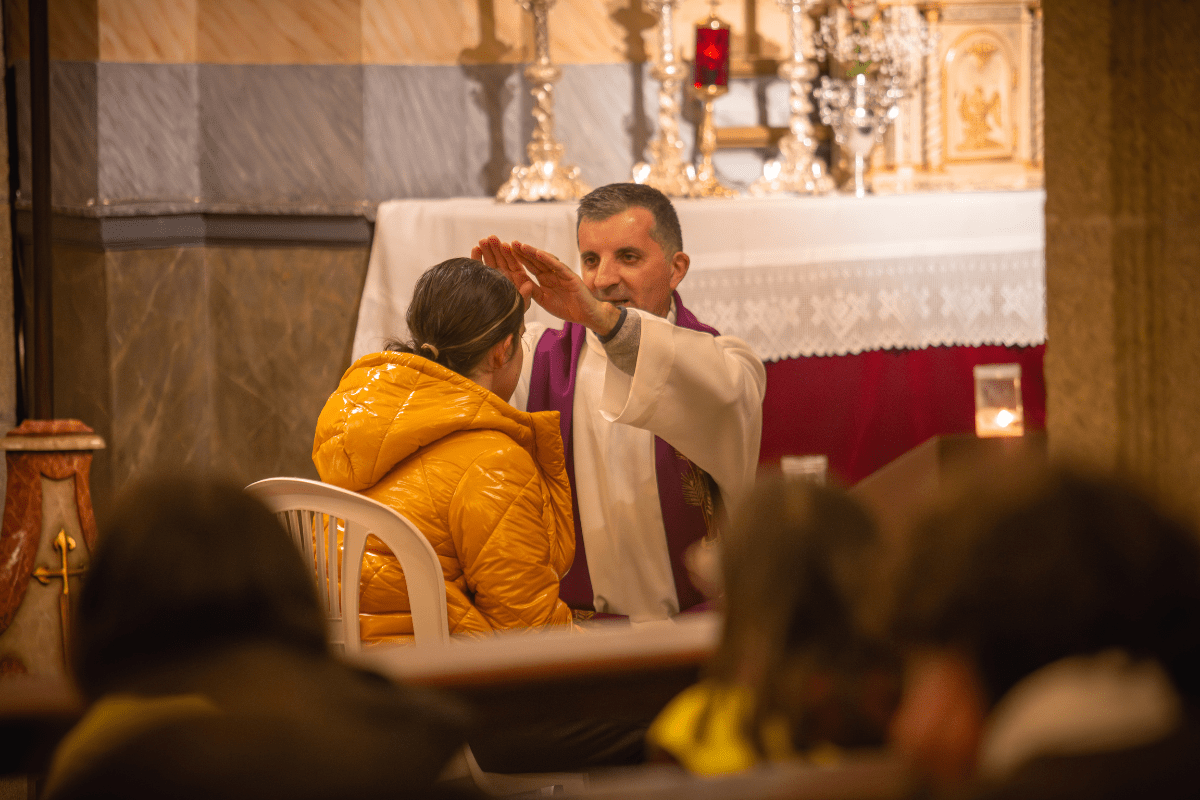
    A young girl goes to confession
    Photo by Yandry Fernández Perdomo on Cathopic

    My daughter is in second grade, which means it is the year of her First Communion. When she began her religious education classes at our parish this year, her dad and I were focused on preparing her for this milestone. We had prayers to practice, doctrines to discuss, and — as my daughter kept reminding me — a dress to dream about and purchase.    

    While the weekend of her First Communion was beautiful, what I found in the time leading up to it was that it was not that sacrament that my daughter was focused on most. It was the Sacrament of Reconciliation she was particularly curious about.

    What would she tell the priest? My daughter wondered. Would she talk to our parish priest specifically, the one she knows, the one who plays the harmonica and likes chocolate? Would he dislike her after she told her sins to him?  

    LISTEN: Preparing Your Kids for First Reconciliation and First Communion

    At dinner, my daughter would pretend to whisper her sins to her older brother, and he would laugh. If you knew her, you would know that this was a sign of how nervous she was about the experience, joking to cover up her worries, playing pretend to imagine the experience.

    As someone who converted to Catholicism at age 28, I felt as if I couldn’t always field my daughter’s questions or worries in the best way. I had never been a child participating in the Sacrament of Reconciliation, and children see the world through different lenses than adults. How was I to guide her and ease her nervousness?

    I talked with her about my experience with First Reconciliation, which she joked must have been hours long because I was almost 30 when I went. Just think about all of those sins I had to recount, she jested. While I didn’t recount all of my sins with her as I did during my first Confession, what I did share with her was the feeling of relief I experienced after it.

    I told her I was nervous like her when I went the first time, and I still get nervous, every time. Somehow, though, my soul always feels healed afterward. God’s grace, working through the priest, transforms my heart, and I feel lighter. The sacrament is a gift, and the nervousness we feel before we go to Confession is natural because, unlike Christ, we aren’t perfect. We sin, and so we try to reconcile ourselves and our hearts with him. This is how I tried to explain it to her at least, focusing on the feelings after the Confessional experience rather than what seemed to be the worries plaguing her heart before it.

    RELATED: Busted Halo’s Guide to Confession

    On the day of her First Confession, my daughter dressed up, not in her communion dress, but in one of her other favorites. To her, that Saturday felt as momentous as the next day, the day of her First Communion, would be. After all, one could not happen without the other. We practiced her confessional prayer before we left. We also discussed how she didn’t need to share anything she divulged about her sins in the confessional with her parents, her brother, or even the family dog unless she wanted to. 

    When we arrived at the parish and waited in line with the other children, she hopped from one foot to the next. There was a palpable sense of nervousness in the air. Some of the kids remarked noisily about their feelings, others simply stared, wide-eyed. On the car ride over, my daughter had wondered aloud if her confession would be longer or shorter than others, which might explain why she had inquired so persistently about the length of my first one.

    As she ventured into the booth during her turn, I thought about the times as a family we had gone together and she had waited on me. What must it be like, as a child, to know your parents are receiving forgiveness for their sins? 

    Throughout this year, my family has made it a point to go to confession together during each liturgical season, and I have been cognizant of my daughter’s eyes on me, searching and following, contemplating her own future steps in the Church as she grows up in it — and she sees her family growing up in it, too. 

    I speak with her often about how, as a child, she gets to experience the faith in a different way than I did because she receives many of the sacraments over time in her life (i.e. Baptism, Reconciliation, Communion, Confirmation), whereas I received them fairly close together in an RCIA setting. Through witnessing her journey, my faith deepens because I experience the sacraments anew, this time with a child’s gaze. We learn together, I tell her. She teaches me, as much as I do her. 

    WATCH: Confession 101

    With this said, God teaches us all through his sacraments, through these channels of God’s grace. I am reminded of Psalm, 32:8, which reads, “I will instruct you and teach you in the way you should go; I will counsel you with my loving eye on you.” Throughout this year, I have felt God’s loving eye on both my daughter and me. Our journey toward her Reconciliation has been one of growth and togetherness.

    It is likely not a surprise that when my daughter came out of the confessional, she looked lighter. Her smile of relief mixed with joy is one I’ll never forget. We did her penance together. 

    On the way home, I saw she had grabbed my phone and had texted her dad who was working that day. “She was very nervous!” she wrote about herself. Imagine a few thousand cry/laugh emojis attached to this text.

    After I took my phone back, I told her that while she may have been nervous, I was also a little nervous (to which she laughed), but that she did great.

    “We both did great,” she responded.

    In the end, preparing my daughter for the Sacrament of Reconciliation not only laid the groundwork for her to enter more fully into the Church, but also reconciled me closer to her, to God, and the sacraments that drew me to convert to the faith in the first place. 

    It deepened our connection to each other, and most importantly, to God’s love and his wondrous works in the world — in my family’s hearts.

  • Mary: The Background Music to My Spiritual Life

    Mary: The Background Music to My Spiritual Life

    For over two years, every night it’s the same: At the appointed time, I gather my freshly bathed and pajamaed toddler into my arms, all fuzz and snuggles. We turn off the light in his bedroom and settle into the rocking chair. My son knows the drill, so he tucks his fuzzy head under my chin and cuddles into my arms. Then we begin:

    Softly, we rock in the darkness. I recite “Goodnight Moon.” Then five nursery rhymes, another book, four prayers, and a lullaby.

    RELATED: I Never Connected With the Rosary… Until I Became a Mother

    They’re the same words every night, and they’re my child’s bridge between the discoveries of day and the peace of sleep. As we sit together, heart-to-heart, my voice surrounds and comforts him, but I imagine he is not thinking of me. My voice, and our nightly litany, is background music that fades away while he reviews the day and surrenders all his anxieties to calm.

    It is a sweet privilege to be his background music, to be that safety that allows him to bound with courage into the world.

    Sweeter still is the knowledge that although I am not a child anymore, that although I am all grown up, my Heavenly Father has given me this background music, too.

    WATCH: Mary in 2 Minutes

    At one time, the Son of God rocked in his mother’s arms, tucking his fuzzy head under her blessed chin as she cuddled and sang to him. The Blessed Virgin Mary was the background music to his earthly ministry. First, it was the beating of her heart at the Incarnation, when Jesus spent nine months safely in the tabernacle of her womb. Then, her voice was the background music at his foretold birth in Bethlehem, and even during an exiled flight into Egypt that lasted a number of years while powerful men sought to take his life. Mary was there in the background when Jesus performed his first miracle, quietly and confidently telling the Galilean wedding staff, “Do whatever he tells you” (John 2:5). When Jesus’ time had come, Mary was there, in the background, as her Son obediently met his ultimate suffering: his Passion and death. Mary had seen him all the way there. And what a gift, that the Lord passed her on:

    “Woman,” He said, “behold your son.” Her new “son” was to be John, who represents all of us.

    Then: “Behold your mother” (John 19:26-27).

    And our mother she is. 

    RELATED: No Mere Greeting: The Hidden Meaning of the Hail Mary

    It was with a shock that I realized, while rocking my son, that Mary is the background music to my relationship with God in the Church — and quite literally! Every time I pray the Rosary, I pray for her intercession 53 times, but each time, the “Hail Mary” fades away as I meditate on that decade’s mystery, which is a moment in the life of Christ.

    It was a great surprise because I had struggled to feel devoted to Mary ever since I turned 13, when I reached — and passed — the age of her world-saving “yes” to God. But now, as a mother, I can understand her differently. She is the background music to my spiritual life: to my relationship with Christ.

    “She is an echo of God, speaking and repeating only God. If you say ‘Mary’ she says ‘God.’” Writes St. Louis de Montfort in “True Devotion to Mary.” “[Y]ou never think of Mary without Mary thinking of God for you. You never praise or honour Mary without Mary joining you in praising and honouring God.”

    WATCH: The Rosary in 2 Minutes

    In that “Hail Mary” greeting, in the repetition of her prayers, Mary smooths out the wrinkles between me and God, pouring his grace into my life and carrying me — as a mother carries her child — to see the King of Kings.

    And it’s almost like she rocks me, with my head tucked under her chin. Her warmth remains as her voice fades to the background, so all that remains for me to embrace is the light of Heaven: the Son she rocked thousands of years ago, who went to the cross for me, and pursues me even now.

    Now, and at the hour of our death. Amen.

    Originally published May 5, 2021.

  • A Good Dog: How ‘Bluey’ Inspires Goodness for the Whole Family

    A Good Dog: How ‘Bluey’ Inspires Goodness for the Whole Family

    Image Courtesy of Disney+

    A red dog gently bunts a cricket ball to his younger sister; she triumphantly catches it and immediately runs to him to celebrate her big play. He proclaims, “What a catch!” while affectionately ruffling her hair as she giggles with glee. Looking on, a father states to his daughter, “That’s what cricket is all about, kid.” I find myself awash in tears while watching this tender and supportive interaction play out on the screen with my young daughters. 

    What is it about the Australian kids’ cartoon “Bluey” that tugs my heartstrings? Parents and children alike feel drawn to and inspired by the show. Animated dogs are far from a new genre, and yet “Bluey” possesses a fresh, unique sense of childhood’s wonder and joy. “Bluey” follows the adventures of an anthropomorphic family of Blue Heelers living in Australia. Bluey is a spunky 6-year-old pup, and her 4-year-old sister, Bingo, happily takes the role of her imaginative playmate. Often joining in their elaborate games, their parents create a loving, family-oriented atmosphere. We began watching “Bluey” after our dear friends mentioned its charm and it became a fast favorite in our home. Wading through media meant for children is a daunting task as a parent, but “Bluey” provides a welcoming, safe space to which I find myself continually returning. There’s silliness, foibles, and even the sprinkling of light potty humor; and through it all “Bluey” captures the essence of goodness and family life remarkably well. 

    RELATED: 3 Ways God Reveals Himself to Me Through My Young Children  

    “Bluey” depicts the mundane, everyday interactions between a family and their friends. “Bluey’s” narratives do not focus on big sweeping storylines but rather on the sacred space of family life. Holding relationships at its center, the pursuit of goodness and harmony is evident in the depictions of both the adults and children in the series. The stories weave a tapestry of virtue I see reflected in my own family. 

    Giggles cascade across the room as my daughters carefully guide a ladybug to her newly constructed magic carpet. For an unexplained reason, our home has experienced an influx of ladybug visitors and, inspired by a particularly charming episode of “Bluey” called “Slide,” no bug shall be harmed in our home. In “Slide,” Bluey’s sister Bingo and her best friend Lila develop a system for ensuring that when they careen down the water slide, no bugs are squashed. My sweet, caring girls took this message to heart, and we are now the protectors and playmates of all insects. Small acts of kindness for the tiniest of friends, but kindness nonetheless. 

    LISTEN: Tackling Kids’ Tough Questions of Faith

    Goodness, sometimes defined as virtue in action, radiates throughout “Bluey’s” family as they navigate forming relationships that bless not only one another but also their neighbors, friends, and family. Theologian Stanley Hauerwas describes the development of virtue as narratively formed through stories. I see this development firsthand and subsequently try to be mindful as I curate the stories my daughters watch and read. Yet, I have discovered their characters are not the only ones formed through these narratives.  

    Kindness and goodness are depicted not only in the main characters, but also throughout their community; emphasizing our need to both give and receive support. In an episode called “Baby Race,” Bluey’s mom, Chilli, recollects her struggles with comparison early in motherhood. Her anxieties over Bluey’s development are eased when she is visited by a more experienced mom friend who gently informs her, “You’re doing great.” This has become a reminder frequently quoted by my dear friends and me when one of us is feeling the weight of motherhood. Never underestimate the wisdom of a pink poodle and the ripple effect of support. 

    RELATED: Children and the Church: Recognizing the Welcome

    The episode referenced at the beginning of this article, “Cricket,” chronicles the journey of Rusty, a friend of Bluey’s, to become a skilled cricket player. Rusty’s dad is deployed overseas; yet through his letters, he imparts advice on facing fast pitches by writing, “As you grow up, you’ll face harder things than a cricket ball… Just keep your eye on the ball and take care of your little sister for me.” This prompts Rusty to bunt the ball to his sister and celebrate her achievement rather than reveling in his own skill. My older daughter quickly caught onto the thread most pertinent to her life and cooed “Aw! He shared with his little sister.” And that’s the beauty of “Bluey;” she saw a sweet story about sharing with your siblings, while I watched a heartwarming tale about a young dog growing in character and skill, and we both loved every minute. 

    The stories that we watch and read with our children form both parent and child. They offer verbiage to discuss tricky topics, provide games and ideas for imaginative play, and gently teach us all the virtue of goodness. By creating a program that highlights the beauty of the mundane and centers on creating healthy relationships with others, “Bluey” has inspired and captivated audiences. All ages can enjoy a show that depicts how kids and parents can both grow in goodness within their everyday lives. As I read, watch, and listen to various stories with my children, I am learning to embrace each narrative that shapes my character, and that of my children, for good – even those starring a small blue dog. 

  • Learning About Sacrifice, With the Help of St. Mark

    Learning About Sacrifice, With the Help of St. Mark

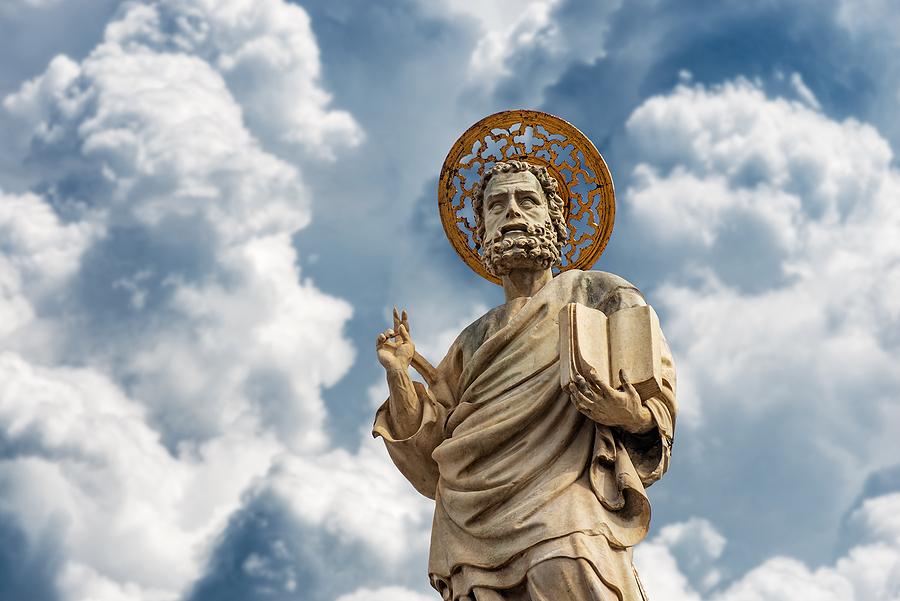
    Image of statue of St. Mark with sky in background.
    Photo by Alberto SevenOnSeven on Bigstock

    Sacrifice is key. We know that Jesus requires this of his followers, but I also heard this statement repeated many times when my wife and I were engaged.

    If I am honest, I think this kind of statement is kind of threatening. I know it to be true based on the life, witness, and words of Christ, but sacrifice is difficult. Approaching my fifth wedding anniversary while having two children (and one on the way) has validated the importance of sacrifice even more concretely in my life. Much of this investigation into sacrifice, however, has been enlightened by St. Mark. 

    The feast day of St. Mark falls on April 25 each year. This critically important saint is often overlooked because he was not one of the 12 Apostles. He does not appear in the stories about the earthly ministry of Jesus, but he wrote one of the four Gospels. 

    RELATED: How to Make Friends With a Saint

    I admit I used to know nothing about St. Mark; he was just a man who wrote a Gospel. My appreciation for him climbed last year when I decided, for the first time, to read the Gospel of Mark straight through from beginning to end. I often read the Gospel of the day, but after hearing a podcast about the importance of reading these accounts as they were written, I took up the task. I started with Mark, well, because it is the shortest Gospel!

    I learned that from the earliest days of the Church, Mark was known to be the interpreter of St. Peter. He became close to Peter and was able to write his account of Jesus’ life based on listening to Peter’s stories.  His writings are viewed as the preaching of St. Peter. We also know, from Acts 12, that Mark was once the companion of Paul and Barnabas as well. 

    Taking the time to read the entire Gospel of Mark transformed me. What became more palpable very quickly, was that Jesus was sent to sacrifice his life for me. I felt this in the way that Jesus spoke about his passion in the Gospel of Mark. I could picture Peter speaking these words to Mark and being moved by them as he heard them for the first time. It became more real for me because I realized that this message was literally passed down through the generations in a powerful and transformative way.

    RELATED: How to Be a Saint-in-the-Making

    At the start of the third chapter of Mark, people begin to plot Jesus’ death. All Jesus did prior was heal the sick, restore the possessed, and preach the truth. And yet, humanity rejected him. He was to be killed because of who he was. Still, he continued to place himself in the spotlight with more public healings and more intense preaching. Christ did all of this with the knowledge that he came to suffer.

    This reaches a shift in intentionality at the midway point in the Gospel. Peter confesses that Jesus is the Son of God and Jesus goes on, three times, to tell the Apostles that he will be arrested, suffer, die, and rise. Jesus states that he “must suffer” (Mark 8:31). 

    I became more and more intrigued by this truth as I reached the details of Jesus’ passion. It seemed more real to me and more powerful. If he tells us that in order to follow him we must also take up the cross (Mark 8:34), then why do I view sacrifice in such a negative way? The sacrifices that I am being invited into actually make me like Jesus. Mark, specifically, taught me this because of his intense focus on suffering and sacrifice. Sacrifice is an opportunity, it should not be a fear.

    RELATED: What I’ve Learned About Marriage When the Unexpected Happens

    My first practical thought was: Can I be more intentional about sacrificing in my marriage? I do my best to do this by helping around the house after work, but I think I view these tasks as things I just have to do. Mark’s insights helped me to see that I can offer difficult times (even if they are simple) as avenues of grace for my loved ones. Doing the dishes or folding the laundry late at night when I am tired and drained aren’t just nice things to do. They can be sacrificial and intentionally done to give me access to Jesus’ sacrificial love. 

    Second, I thought about my two boys. Being a parent of a 3-and-a-half-year-old and a 1-and-a-half-year-old can be chaotic. Noise, messiness, and lack of sleep are all side effects when the needs of your children demand all of your attention. My wife, Joanna, experiences this more than I do since she is home with them, but being consistently present to her children all day is a sacrifice. Rather than look to escape into my phone or have “me time,” Mark has inspired me to be more present during these special times with my kids. 

    The beauty of Christian sacrifice is that its focus is not on rigor. Sacrifice opens us up to love and makes us who we are meant to be. The tired tasks and intentional presence I strive to have with my children make me a better husband and dad. They do not make my life darker but brighter. Thanks to St. Mark, I am becoming less fearful of sacrifice and more grateful for the impact of Christ’s sacrifice in the concrete aspects of my life.

  • The Heavens Are Telling the Glory of God: An Earth Day Reflection

    The Heavens Are Telling the Glory of God: An Earth Day Reflection

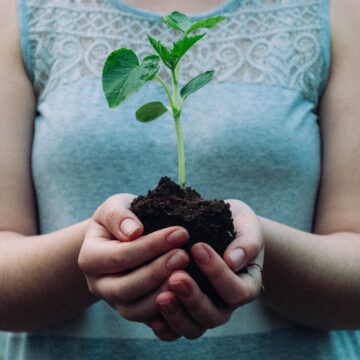
    A white woman in a blue tank top is holding a handful of dirt. A plant is growing out of the dirt in her hands.
    Photo by Nikola Jovanovic on Unsplash

    As we celebrate Earth Day tomorrow, I am reminded of the words of Psalm 19, celebrating God’s glory in creation, which begins with the following phrases:

    The heavens are telling the glory of God;
    and the firmament proclaims his handiwork.
    Day to day pours forth speech,
    and night to night declares knowledge.
    There is no speech, nor are there words;
    their voice is not heard;
    yet their voice goes out through all the earth,
    and their words to the end of the world.

    How exactly do the heavens tell of the glory of God? According to this psalm, they do not have a voice that can be heard through speech, and yet the words of their “voice” travel to all corners of the world because, with gratitude, they proclaim God’s majesty through the nature they are endowed with: trees root into the forest floor, reaching with branches of praise toward heaven, sheltering the things below; rivers rush and teem with aquatic life, a watery vessel for fish to travel; the sun and moon usher in the day and night, balancing the world with warmth and cold; flowers and plants enrich the mind’s eye with dynamic beauty and mystery, inviting the viewing into greater discovery.

    RELATED: Digital Retreat for Deepening Our Relationship With God and Nature

    Through my own experiences of spending time in nature: running, hiking, and gardening, I have witnessed firsthand the Earth speaking to me that everything is a gift. Yet, how often do I consciously call to mind and express gratitude for all that I have in a tangible way, as the Earth does? Not often enough. When we allow ourselves to experience deep and authentic gratitude, we naturally want to give back. We want to bring about something good for all the good that has been given to us; in other words, to co-create with God in blessing the world around us. I invite you to consider the visible ways you can cultivate a continuous inner life of gratitude by taking up the call to be co-creators with God in all seasons.

    In my own life, I have been blessed with an aptitude for words, specifically through my work as a novelist. Through the gift of storytelling, and by crafting characters and stories that glorify God and reveal his presence, I can bring to life a story where he can be found within the pages. In recent years, I have also had the opportunity to co-create with God in developing and implementing lesson plans as a faith formation minister at my local parish. Content creation of faith materials has given me an opportunity to produce something tangible for the benefit of young minds—another expression of my gratitude to God through the gift of teaching.

    RELATED: Bible Verses to Help You Care for Our Planet

    Recently, I have begun caring for three potted rose bushes on my small back deck. Growing up, whenever the winter frost had melted and springtime was beginning, I would begrudgingly stalk outside to help with the gardening in the family backyard, pulling up countless weeds, pouring out bags of fresh dirt, and helping plant new seeds. Once out on my own in a rented townhouse without any backyard garden, I found myself surprisingly missing the springtime chore. I had taken the gift of aiding in the backyard’s beauty for granted, and I now look forward to the day when I will have my own. Today, I look forward to picking out dead leaves from my rose pots come spring, gently pruning the branches to aid in new growth, and watering the base. As I write, the branches have turned green, and the season’s first yellow roses are about to blossom.

    Now it’s your turn. How can you co-create with God from a place of profound gratitude? What gifts and talents has he graced you with that you can use to bring newness of life and beauty to the world? Co-creation arises through baking pies to nourish new neighbors; bringing a spare space to life in decorating for a celebration; sewing clothing to provide warmth for children, and many more expressions of gratitude that create something beautiful that blesses the Earth.

    Originally published April 21, 2023.