
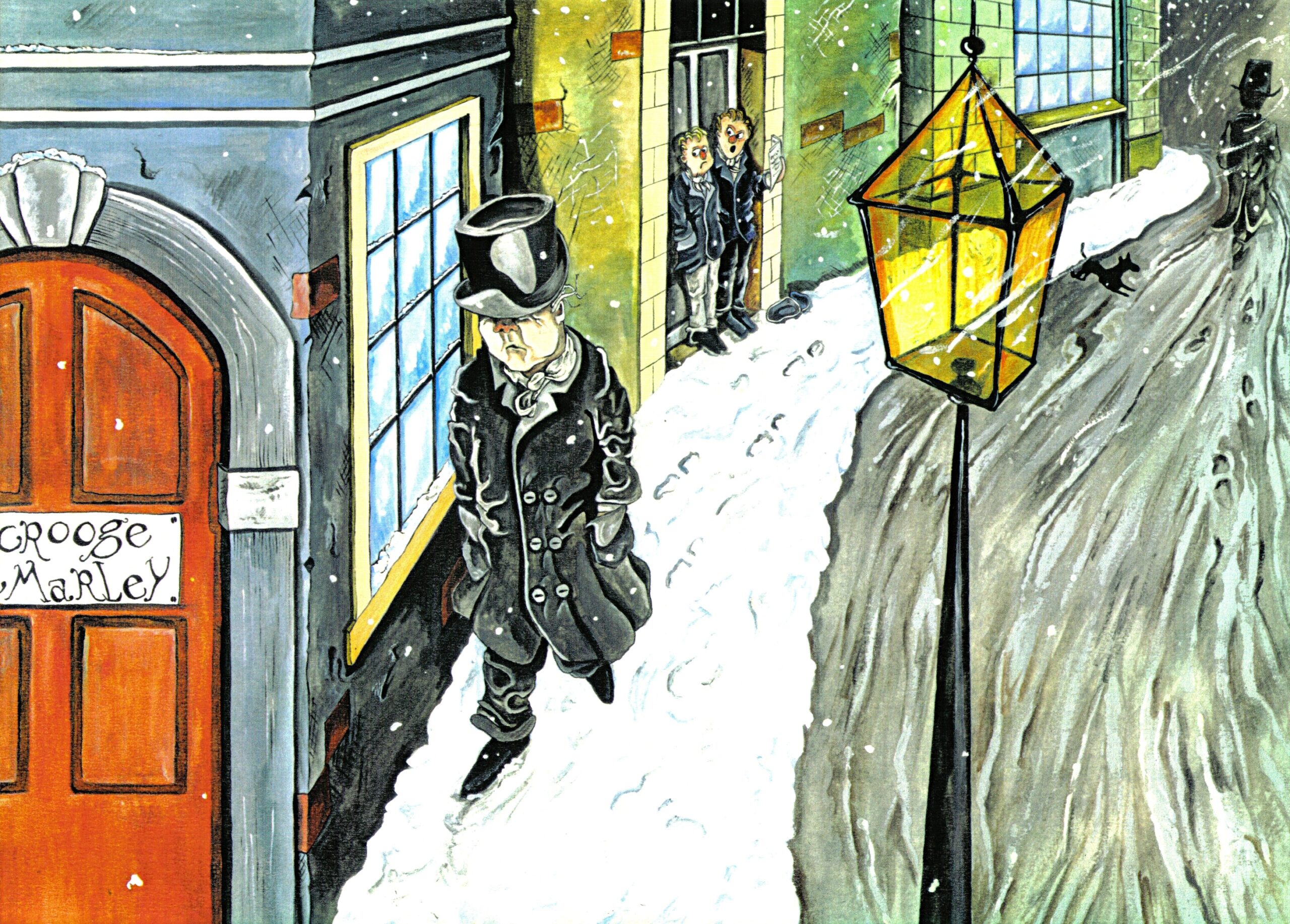
Whether it’s the original novella by Charles Dickens or one of its many screen adaptations, “A Christmas Carol” is enshrined in my mind as a holiday staple. Why shouldn’t it be? Like the songs of the season remind us, Christmas is a time for telling “scary ghost stories and tales of the glories of Christmases long, long ago.” That is what Dickens’ book is – a dramatic event filled with encounters with haunting spirits that, when all is said and done, convince Ebenezer Scrooge of the unrighteousness of his deeds and the need to turn his life around.
Jacob Marley, Scrooge’s deceased business partner, visits him and kickstarts the series of events that lead to a change in the protagonist. Marley’s chains shaken so horrifically are a symbol of his sins. He reminds Scrooge that he, like us, has sin in his soul – a ponderous chain, but through repentance and change, Scrooge’s unhappy fate can be sponged away. Because this Christmas classic deals so acutely with morality, it is no surprise that we can find in Scrooge’s conversion allusions to Reconciliation. In this story, we witness Scrooge’s sorrow, desire to amend his life, and penance for his misdeeds.
WATCH: Sacraments 101: Penance
The parts of Reconciliation
The Sacrament in which Jesus ordinarily forgives sins is commonly referred to as Confession, Reconciliation, or Penance. While the terms are often interchanged, they really refer to different steps we take in the Sacrament.
Confession is what it sounds like: confessing your sins to God through the priest. There is power in naming and denouncing our vices, and God’s grace is working in us and strengthening us along the way.
Next comes reconciliation, part of which entails being sorry for your sins. If you are not sorry for something, you admit there is nothing to forgive. If we have sorrow (contrition) for our sins, then the priest gives us absolution – God’s forgiveness. Even though the penitent is forgiven, they must still try to make amends for the sin. In an act of contrition before absolution, we express our sorrow for our sins and our intention to amend our lives and avoid future sin.
Finally, we are given penance to do. Sometimes this will be reciting rote prayers. Other times, it could be some external activity. For example, when I was young, I was supposed to empty the dishwasher as penance for disobeying my parents. Another time, I was told to play the Wii with my brother because it was something he really enjoyed (though I not as much). Entering the confessional takes initiative, and penance takes effort.
RELATED: 4 Gifts to Give One Another From ‘It’s a Wonderful Life’
The steps of Scrooge’s conversion
At the beginning of Scrooge’s adventures, it’s clear that he does not desire this intervention of his own will. His associate, the late Jacob Marley, offers him hope to escape a doomed fate like his own: Scrooge will be haunted by a triad of spirits united in a single purpose – his conversion. At the outset, Scrooge is reluctant. But, as time goes on, he takes initiative and puts in the effort to externally express his reformed interior life.
The first task of the spirits is to instill guilt or regret in Scrooge. The Ghost of Christmas Past shows Scrooge that he is selfish, that he let the desire for wealth dominate any charity in his life – even toward his lover. In his past, he chose greed over love and commitment. This wonderfully expresses how every sin is self-seeking at the expense of God and others.
The Ghost of Christmas Present awakens Scrooge to the cold, harsh realities of poverty. When shown the home of his employee Bob Cratchit, Scrooge takes an interest in someone other than himself – the sickly Tiny Tim. The spirit reveals that unless the family’s means change, the boy will perish. A wave of sorrow washes over Scrooge, and the fact that he has a direct impact on this cuts him to the quick. Our actions, for good or ill, have consequences.
It could be said that Scrooge is now in a state of contrition. His heart is being humbled and softened, ready to take on a new flame and vigor. But, if there was any question as to his resolve, the terror of the Ghost of Christmas Yet to Come makes Scrooge’s conversion a matter of personal, vested interest.
RELATED: From Humbug to Humble: ‘A Christmas Carol’ Lives on
As Marley’s chains and foreboding words alluded to, Scrooge’s fate is an unhappy one if he fails to amend his life. The final spirit shows our protagonist his grave, and that no one will mourn his death, leading Scrooge to a frenzied plea with the apparition that culminates in what could be considered an act of contrition if given in a sacramental context.
“I am not the man I was. I will not be the man I must have been but for this intercourse,” cries Scrooge in the cemetery, glaring at his own name on a tombstone. “Assure me that I yet may change these shadows you have shown me by an altered life!” He proceeds to promise he will honor Christmas in his heart always and allow the three Christmas spirits to strive within him. Before waking to his new lease on life, he raises his hands “in a last prayer to have his fate reversed.”
To some extent, Scrooge seems sorry for the misery he caused others. To an even greater extent, he was scared to death of a fate worse than fatality. Scrooge’s fear leading him to sorrow and repentance is akin to what is called imperfect contrition in Reconciliation. Imperfect contrition is the fear of punishment (the pains of hell) that our sins deserve. Perfect contrition is sorrow for sin out of love for God and recognizing that sin offends him. Yet, God can use our imperfect contrition to affect his Sacrament in us through the merits of Jesus, whose sacrifice supplies what our hearts lack in perfect contrition. Similarly, the imperfect contrition in Scrooge’s heart leads to a radical transformation for the better.
Displaying contrition, Scrooge also revealed to the third spirit that his past life was in need of change and that he plans to change it. This is his confession, or admission of wrongdoing. For penance, he makes good on his word and avoids sinning in the future by treating others with charity and taking delight in bringing them joy. He chooses to live what is captured by the popular quote attributed to Mother Teresa: “It is Christmas every time you let God love others through you…it is Christmas every time you smile at your brother and offer him your hand.”
RELATED: Busted Halo’s Guide to Confession
Reconciliation
So can we say Scrooge is reconciled? Is he squared away with God? Well, the effort by Marley and the three spirits certainly offers hope that the future can be altered – just as Scrooge’s life could be altered. Dickens certainly wishes the readers to carry such a hope away with them. The beautiful thing about the Sacrament of Reconciliation is that we are given a guarantee of God’s forgiveness.
If we are good to our word (to strive against temptations and to do our penance), we have a hope greater than Scrooge’s. We have God’s word for it: “Go in peace. Your sins are forgiven.”
 Sometimes, it feels like God abandons us. The disciples might have felt this way after the Crucifixion. Or, at least, they felt downcast, their hopes dashed; the prospect of building the kingdom without their leader seemed bleak and pointless. Their whole world had been shaken and flipped upside down. Jesus, their point of reference and the truth by which they viewed existence lay in a tomb.