Author: Veronica Szczygiel

  • How To Talk to Those Who Disagree with You—and Still Love Them

    How To Talk to Those Who Disagree with You—and Still Love Them

    Two people having a conversation at a table.
    Photo by Christina Morillo on Pexels.

    A few years ago, during a Saturday session of my doctoral class called “Critical Issues in Educational Leadership,” we compared charter versus public schools, a controversial topic in the education sphere. Our conversation sparked a heated debate between two students, one of whom was the principal of a public school in Harlem and the other an assistant principal of a charter school in the Bronx. 

    I watched the debate with rapt attention, on the edge of my seat. The verbal sparring was elegant. Back and forth I moved my head, as if I were witnessing two seasoned tennis players duking it out in the U.S. Open finals.

    I don’t remember the exact arguments they made. But what I do remember is that right after the class broke for lunch, one of the debaters said to the other, “Do you want a burger and fries or pizza?” The other replied, “How about we each get something different and split?” And off they went to enjoy lunch as if nothing ever happened between them.

    The ease with which they switched from debaters to friends made me realize how desperately we need to revive congenial civility at a minimum and open-hearted, deep discussions at best. It’s okay if our loved ones don’t think like we do. But, instead of ignoring “taboo” topics, we should be able to talk about them without getting into shouting matches or arguments.  

    So, how can we disagree with others and still love them?

    Normalize discussions where we disagree by approaching each person as a child of God

    Growing up, my parents frequently hosted dinner parties for their friends. At every gathering, without fail, they would eventually tread into what we now consider stormy waters: religion, current events, history, and politics. And every gathering, they would engage in an all-out heated debate. After they aired their opinions, they would laugh and happily accept my mom’s offer of “Who wants cake?”

    Reminiscing on my childhood makes me long for a time when political or other serious discussions could be just another topic of conversation like books, movies, and the weather. I think we can open ourselves to serious topics — and actually enjoy discussing them — by practicing having candid, calm conversations without getting our hackles up. In this way, we are not only hearing each other out respectfully but learning about other points of view, which is at the heart of being a good citizen and a good person.

    A positive start to entertaining sticky conversations is to approach others the way God sees them: as his own precious children whom he knew even before birth (Jeremiah 1:5). If we look at someone we disagree with through the eyes of our loving Father, how can we not be moved to open our hearts? We can let our guard down and be a little more patient, kind, and merciful. 

    In high school, my friends and I would gather daily at a cafeteria lunch table and hash out various controversial topics: abortion, gun control, euthanasia, the Iraq War, and more. Sometimes, things got heated (and sometimes we were nerdy enough to prepare research for our discussions), but I can never recall a time when we crossed a boundary into personal attacks or made anyone feel lesser for thinking differently. In fact, we celebrated that we all disagreed because it made the conversation more stimulating and lunchtime more fun.

    I think today sometimes we forget to separate the perspective from the person. Everyone has a right to their own opinion, even if it differs from ours. 

    When our loved ones think differently about an important issue, it may feel like a personal affront. We want them to believe what we do, especially if what they believe appears antithetical to our Christian beliefs. But more likely than not, they aren’t disagreeing with us because they want to harm us. They have reasons for believing what they believe, and we need to be open-minded to hear them out. Trying to convince someone without listening to them is like shouting down a well: We only hear our own voice echoing back at us.  

    We can approach difficult conversations more calmly when we view each other as human beings who deserve decency and dignity. As children of God, God loves each one of us and invites us to his heart – no matter where we are or what we think. 

    Replace rage masquerading as passion with patience

    Oftentimes, the issues we are passionate about stem from deeper personal experiences, struggles, or trauma in our lives. As such, it can make us feel angry when others don’t see things our way. Channeled appropriately, anger can drive us to positive action. Anger is a normal emotional response that can be healthy when handled well. But if we masquerade our rage as “passion,” then we’re in trouble. Because it’s one thing to be deeply involved and concerned about something. It’s another thing to be belligerent or derogatory about it.

    For example, my mom and I once stood in line to take the East River Ferry to Manhattan. We were speaking in Polish. A man in back of us, angry at the state of immigration, said loudly to his friend, “These Polaks should go back to their own country” and proceeded to expand on the various reasons why immigrants, in his worldview, were detrimental to our country.

    Now, it’s one thing to hold the opinion that immigration systemically weakens a nation. But it’s another to insult or denigrate others because of this view.

    My mom and I decided the best course of action for us was to ignore him. We wouldn’t let him ruin a perfectly beautiful summer day, and arguing with a stranger would hardly be productive. I secretly wanted to wallop him, but, thank God, I had the restraint not to do so. 

    There are some practical things we can do to catch ourselves before our passion turns into proverbial road rage. Take a deep breath. Pause. Say a little prayer. Maybe not every conversation has to come to a close. Maybe we can pick up later when we’ve had time to breathe, especially if someone says something that’s offensive to us. If we feel comfortable, we can pause and tell the person how we feel or wait for another day to do so calmly. More often than not, if they are our friends or loved ones, they will hear us out. 

    At the end of the day, we should remember:

    It’s okay not to have the last word.

    It’s okay not to persuade someone to your point of view. 

    It’s okay not to “win.” 

    Because if all we try to do is “win,” then we lose the greatest thing of all: our capacity for kindness. Patience. Mercy. Love. 

    Our nation is deeply divided. But having conversations – no matter how small – can help narrow the divide, bring healing through understanding, and make our communities and country stronger. And that’s a real win.


  • How My Puppy Helps Me View Every Moment as a Chance to Encounter God

    How My Puppy Helps Me View Every Moment as a Chance to Encounter God

    puppy sonia while hiking looking back at the camera with a background of fall foliage and mountains
    The author’s puppy Sonia

    If dogs had resumes, they would boast a long list of services. As personal trainers, they get us off the couch to exercise. As wellness gurus, they lower blood pressure and help us de-stress. And as therapists, dogs provide comfort and companionship, especially in times of sorrow and loneliness. 

    One occupation that should be added to this list is spiritual guide. My husband and I had been talking about getting a dog for a few months, as we both wanted a canine companion for all our hiking adventures. Even though I enjoyed many pets of all kinds throughout my life, it wasn’t until my husband and I adopted our 6-month-old schnauzer/shepherd/malinois mix on May 16, 2021, that I realized I could strengthen my own faith through my relationship with her. In just our few months together so far, our “pandemic puppy” Sonia has already taught me to encounter life in the way that God intends for us: with joy, praise, and gratitude. 

    RELATED: A Gratitude Meditation

    Approach each day with an abundance of joy.

    Wake up at 5:30 a.m., walk the dog, make breakfast, take the subway, go to work, take the subway, walk the dog, make dinner, walk the dog, sleep… And get up the next day to do it all over again. Having a routine is a good thing, but I can easily find myself simply going through the motions. I sometimes feel stuck in a cycle, stressed, or exhausted. I just want to make it to the weekend. 

    However, this mindset does not reflect a life rooted in faith. When we approach each day through the lens of joy, we can see all the ways in which God works in our lives. Suddenly, the seeming invisibility of God’s grace becomes visible.

    My puppy reminds me to take on each day with deep, spiritual joy. She inches her way towards my pillow and licks my face to celebrate the morning. She looks deeply into my eyes, glad to start each new day with me, no matter how much I grumble to roll out of bed. What a reminder for me to gaze in the same way at her. At the world. And most importantly, our Lord. Sonia walks to the park each morning with a skip in her step, wagging her tail. That’s when I remember to remain joyful in the Lord’s presence each and every day.

    RELATED: Will I See My Pets in Heaven?

    the author's puppy Sonia looking very cute on a fall hike

    Appreciate where you are in the present moment.

    My husband and I have gone camping with Sonia four times since we adopted her, most recently during the prime of autumn, when peak foliage cascaded through the Catskill Mountains. Every day after a campfire breakfast, we went on a six-mile hike through forests and meadows, around lakes and waterfalls, and up mountain peaks. Sonia was curious about frogs and fallen leaves; I was moved by God’s ability to restore and heal me in the woods.

    It was bittersweet to return to the city after a week in the wilderness without Wi-Fi, and I was nervous that Sonia would not adjust well. I was afraid that my garden and city park would suddenly seem boring and small to her.

    But perhaps I was projecting my own reticence to return to reality onto her, because when we got back to Brooklyn, she literally pulled me to the park, ready to romp with her canine friends, chase squirrels, and collect sticks. Nothing had changed, only where we were. I realized that every moment is precious, no matter where I am. This is the inner spiritual wonder that God wants us to feel. There is grace in every moment, even in times of longing or suffering. 

    RELATED: A Gratitude Retreat

    Be grateful for the people you’re with.

    A sweet, spunky pup who was found malnourished in Tijuana, Mexico, Sonia fortunately felt comfortable with us when we first met her. She quickly became an indispensable part of our family. As such, whenever my husband or I return from work, she greets us as if we hadn’t seen each other in years: wagging her tail, widely smiling, barking happily. In fact, she warmly welcomes all of our family and friends, even our cat, Shadow (who has yet to reciprocate Sonia’s friendly advances). This generosity of spirit reminds me to praise God for every person I encounter in my day: my husband, my family, my coworkers, and neighbors who stop me to chat. It’s through the people in our lives that God works his graces and shows his love. We should be grateful for their presence and consequently God’s presence in our lives through them.

    Adopting a puppy came with challenges, but it was a big blessing in our lives. I thank God every day for Sonia and know that I should approach my life and the people in it with deep gratitude and joy. Moreover, I should encounter the Lord in the big-hearted, unconditional way that Sonia loves me.

    Originally published November 22, 2021.

  • From Pen to Prayer: How the Lost Art of Letter Writing Connects Me to God

    From Pen to Prayer: How the Lost Art of Letter Writing Connects Me to God

    Paper and pen set out on white table. Behind it is a few light pink flowers and a white cup of tea. At the back of the image is a white sheet or curtain draped upon a table.
    Photo by Sixteen Miles Out on Unsplash

    My friend Tanna lives in Louisiana. No, that’s not the start of a children’s nursery rhyme. I met Tanna back in high school when we both partook in an immersive sustainable farm program in Upstate New York. Together, we got up at the crack of dawn, milked cows, collected eggs, repaired fencing, and overall experienced the beauty and hardships of farm life. 

    Though there were other girls in the program, Tanna and I “clicked.” We stayed friends, even visiting each other’s homes over the next summer and exchanging emails. After college, however, we kept in touch less often. Things got busy; life happened, as they say. A decade went by before we both desired to rekindle our old friendship more seriously. We connected through Facebook; Tanna sent me a direct message when she learned that the beloved farm where we met unfortunately closed during the pandemic. It was this loss of our shared idyllic memories that prompted us to rekindle our friendship. 

    LISTEN: Keeping Friendships Strong

    We could have done so digitally, but we decided to handwrite to each other instead. When we were at the farm, we used to send letters to our family and friends almost every day. Letter writing seemed like a fun alternative to emails, which we both got enough of working in the higher education sector. We both love writing, so we half-jokingly agreed that if we both become famous writers one day, someone would publish our correspondences as a book, like the letters of Henry James and Edith Wharton, or “Words in Air: The Complete Correspondence Between Elizabeth Bishop and Robert Lowell,” two American poets. 

    I think it goes without saying that the immediacy of sending and receiving a text message or email has unilaterally killed the art of letter-writing. Even so, Tanna and I are a year into our penpal experiment, and we are loving it so far. Besides renewing an old friendship, it’s also given me insight into how we can approach our own relationships with God. 

    Good things take time and effort

    When I write my letters to Tanna, I make it a special affair. I brew myself a cup of tea, curl up under a blanket, and wait until the dog settles on the bed. I take a few sheets of beautiful stationery and pick up my favorite pen. Then, I think about what I want to say before I set pen to paper. 

    Writing a letter takes intentionality. I purposefully carve a sacred quiet space to not only enjoy doing it but also to make the letter itself good and meaningful. Because I take the time to craft the letter carefully, it is more thoughtful and well-written than a rushed email or quick text.

    RELATED: How to Start a Prayer Journal

    I realized that I should try to do the same thing for my relationship with God: Be more intentional in my prayer. Life undoubtedly gets busy, and I don’t always have the time to make everything just so (after all, my sacred letter-writing practice is not a daily one). Quiet solitude is usually not within grasp in the midst of our bustling daily routines. However, I know I can set aside time to dwell in the Lord’s presence a little more intentionally. When I’m walking the dog in the morning, when I’m making breakfast, or even when I’m transferring subways – those are all moments I can open my heart up to him.

    After all, he wants us to talk to him and lean on him. He wants us to share all our worries, fears, triumphs, and tribulations. Nothing is too small for God to hear: “Ah, Lord God, it is you who made the heavens and the earth by your great power and by your outstretched arm. Nothing is too hard for you” (Jeremiah 32:17). Giving ourselves the time to give God our hearts is what will bring us closer to him – with or without tea and blankets. 

    Good things are worth the wait

    Letter-writing is a practice of patience. I’ve learned to embrace the silences in between letters with joyful anticipation. I know a letter response will come, so I am not anxious about when I receive it. In fact, it’s fun to have a hopeful eagerness when checking the mailbox: Is it coming today? Has the post even arrived yet? When a letter from Tanna finally does get here, I eagerly tear open the envelope and begin reading before I’ve even had a chance to sit down.

    I wish I applied the same thinking to my relationship with God. There have been times in my life when I felt frustrated with what I interpreted as his silence. For instance, there was a season of my life when I questioned whether God truly called me to write. I don’t make a full-time living wage from writing. My job and other responsibilities can make finding time to dedicate to the craft challenging. If this was truly meant to be for me, then why would it be so hard?

    RELATED: 3 Tips for Stepping Outside Your Age Bracket When Making Friends

    But, as my husband always tells me, sometimes time and silence are the best things for us. Those seasons can be fruitful – as long as we don’t give up on listening for God’s guidance. Having truncated pockets of time, for instance, made me prioritize projects and focus on writing magazine articles and essays. Praise God, I’m close to my hundredth published piece! God is good, but he will answer us in his own way and on his own time. We just need to practice patience. Knowing that God will take care of us and lead us down the right path can help quell the anxieties we feel in the more silent seasons. And it’s always worth the wait: “At the right time, I, the Lord, will make it happen” (Isaiah 60:22). 

    Receiving letters from Tanna is a wonderful way to rekindle my friendship with her. I still feel like we “click” because we have similar interests and picked up where we left off from high school. Because writing a letter is intentional, effortful, and a time investment, we don’t waste paper and ink on surface-layer topics (What did you do this weekend? What do you like to watch?) and dive right into the deep end of our hearts (What are the stresses and anxieties we feel? What are our hopes and dreams?). The handwritten words feel more meaningful than a text message or email. This is especially true because Tanna’s cerebral palsy makes writing more challenging for her – and yet, she perseveres and wants to do it anyway. That melts my heart every time I read a letter from her.

    God also sends us proverbial handwritten letters. He invites us to his heart in every Mass through the Eucharist. And, he longingly waits for us to turn to him each and every day – even when we turn our backs on him. He is eternally patient. We only need to give ourselves the time to write back to him.

  • Bless Us, Oh Lord, for These Thy Gifts: The Holiness of Mealtimes

    Bless Us, Oh Lord, for These Thy Gifts: The Holiness of Mealtimes

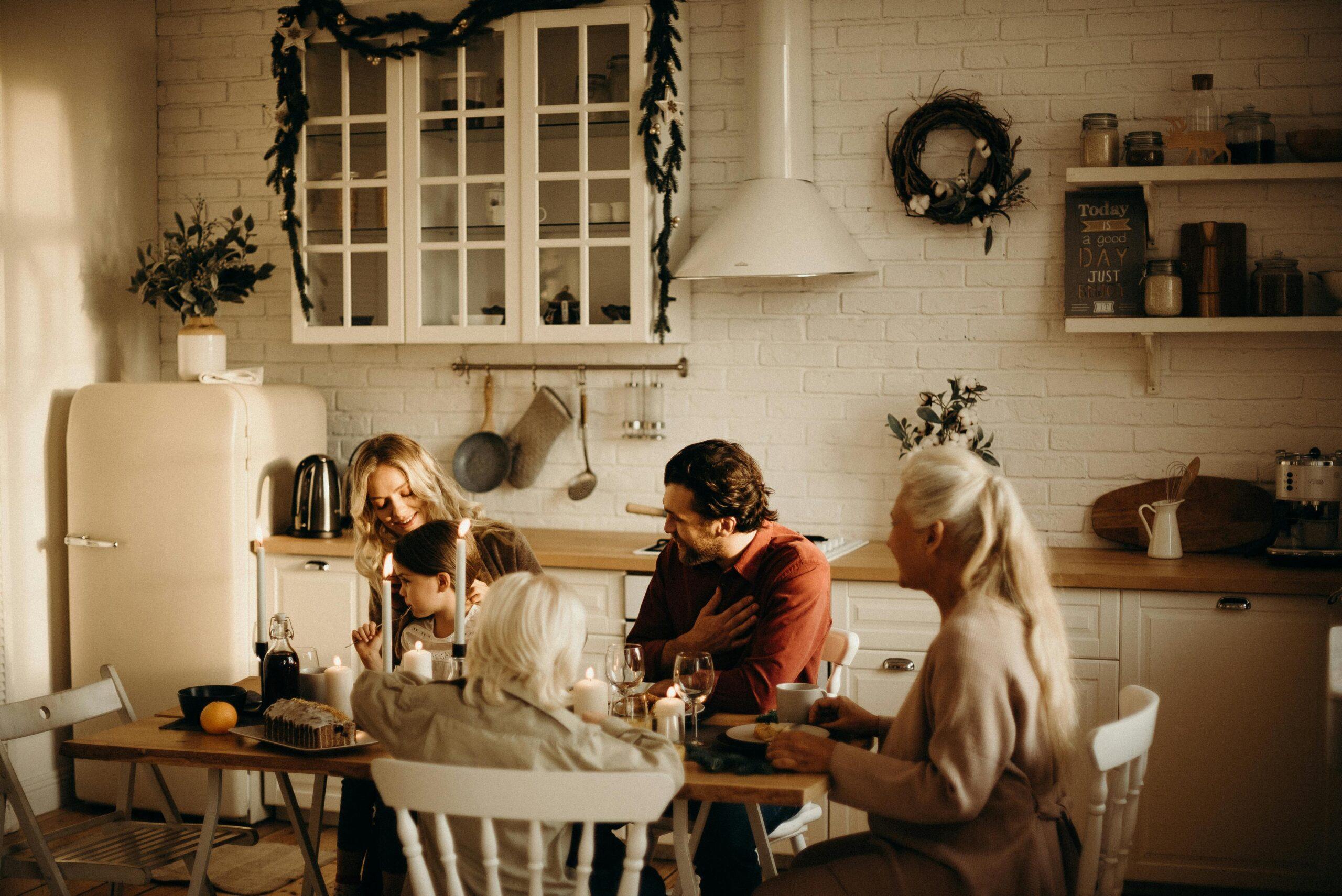
    Family sitting at a table sharing a meal together.
    Photo by Cottonbro Studio on Pexels.

    A few years ago, I was asked to sit on an alumnae panel at my high school to talk about life in college and beyond. At the end of the discussion, the panelists took turns giving the seniors advice about college life.

    Mine? “Don’t study while you eat.”

    For me, the point of a meal is to be fully present with the person you’re sharing it with. (And if you are eating alone, the meal can be a time to mindfully reflect or pray.)

    There is a sanctity in literally breaking bread with others — whether it be for a special occasion or as part of an everyday routine. Regardless, being distraction-free and fully focused on the present moment — and God’s presence in our company — makes each meal full of grace.

    RELATED: How Rice and Beans Became Our Weekly Dinner Tradition

    Gathering together

    During the Last Supper, a Passover Seder, Jesus gathered with his 12 disciples in the Upper Room to celebrate the Jewish feast. Together, they reclined at the table to symbolize that they are a free people. They feasted on food such as eggs (beitzah), bitter herbs (maror), lettuce (chazeret), parsley (karpas), a spiced apples and nut mixture (charoset), unleavened bread (matzah), and chicken or fish. They enjoyed the traditional four cups of wine throughout the meal. 

    Mealtimes emphasize the beauty of a community. Everyone takes time out of their busy lives to come together as one. It’s no wonder that Jesus chose a meal to establish the first Mass, the holiest of meals. In fact, every Mass is a meal. We gather together to listen to God’s word and eat and drink his body and blood in the form of bread and wine.

    That’s probably why I love hosting family and friends for a home-cooked meal. My husband and I have some favorite dishes we cook for guests: Jamaican-style oxtail, lasagna with homemade pasta, slow-cooked honey-soy ribs, and French onion soup, to name a few. But even daily meals where it’s just Arthur and me (and our dog on the lookout for scraps) feel special because it’s a time when we can simply be together and enjoy a moment of stillness in our lives.

    LISTEN: Heather King Talks Food and Faith

    Making announcements

    As Jesus literally broke bread, he told his disciples: “This is my body, which is given for you. Do this in remembrance of me” (Luke 22:19). He did it again as he passed around the cup of wine: “This cup that is poured out for you is the new covenant in my blood” (Luke 22:20). This was one of the most singularly important announcements in the world: that Jesus is fully present in the bread and wine that is shared in Mass, all around the world, from that very first seder meal to today.

    In our own lives, mealtimes are moments for making announcements. I remember, for instance, the night my sister announced that she was pregnant. It was also over a meal that my husband and I announced we were engaged. Mealtime makes perfect sense to share announcements such as these, as well as job promotions, new ventures, travel plans, and so forth, because we are sharing time and food with our loved ones.

    Coming to terms

    Because we are gathered with loved ones, mealtimes can also be a place to process bad news. I remember the meal I shared with my family the day of my grandmother’s wake: a pork cutlet with mashed potatoes and cucumber salad—the typical hearty Polish fare that is my total comfort food. The meal not only gave me the physical strength to bear the painful events to come but also gave me courage, knowing I was in solidarity with my grieving family.

    Jesus himself shared a dramatic pronouncement at the Last Supper: “Truly, truly, I say to you, one of you will betray me” (John 13:21). This, I’m sure, caused quite a stir in the Upper Room. And, while his disciples were shocked that there could be a traitor among such a close-knit group, Jesus planted the seed to allow them to begin to process all the terrible things that were to come on his road to Calvary.

    RELATED: 4 Spiritual Lessons I’ve Learned From Baking Bread

    Imparting wisdom

    During a seder, it is traditional to wash hands as part of ritual and spiritual cleansing. But Jesus also washed his disciples’ feet, saying: “If I then, your Lord and Teacher, have washed your feet, you also ought to wash one another’s feet. For I have given you an example, that you also should do as I have done to you” (John 13:14-15). We, too, can gain wisdom from the loved ones gathered with us. I remember my parents telling their stories of living in Communist-occupied Poland. Due to mismanagement and poor economic policies, the Communist regime rationed food and other everyday supplies so that store shelves were frequently empty. People stood with government-issued ration cards in long lines (“kolejki”), some of which took days, to receive their portions of sugar, meat, flour, chocolate, etc. Stories such as these gave me the prudence to always be grateful for life’s blessings—like mealtimes.

    Jesus teaches us to keep mealtimes sacred. There’s a game that some people play when they go out to a restaurant. Everyone places their cell phones in a pile in the middle of the table. The first person to touch their phone pays for the entire check.

    Perhaps this is a little cruel for the first poor soul to succumb to temptation, but the message is a simple one: When you’re sharing a meal with your loved ones, be fully there for them. Be present. Make it holy. Jesus did when he instituted the Mass. We can, too—and not just on Sundays, but every day of the week.

  • Models of Marriage: Remember These Lessons From Biblical Power Couples This Valentine’s Day

    Models of Marriage: Remember These Lessons From Biblical Power Couples This Valentine’s Day

    Holy Bible open with pages folded in the middle to make a heart shape and cross charm haning from the heart.
    Photo by May_Chanikran on Bigstock

    In the Sacrament of Matrimony, we are called to love each other fully in word, spirit, and deed, not only on our wedding day, but every day of our lives. That’s why the celebration of love just once a year on Valentine’s Day – the origins of which include a Roman fertility ritual and the execution of the martyr Valentine on February 14 – felt counterintuitive to me. It didn’t help that Valentine’s Day evolved into a consumerist holiday benefiting greeting card and chocolate corporations. But, after I got married, I realized that we can reframe this day in a Catholic way: Valentine’s Day can be an opportunity for couples to reenergize their commitment to each other. 

    The best place to begin this re-commitment is the Bible. Though many relationships in the Old and New Testaments reveal the pitfalls of sinfulness and the reality of our human brokenness, many also demonstrate how spouses can be wholly committed to each other. These holy unions, while far from perfect, are built on similar foundations, and we can use these lessons as models for our own marriages.

    LISTEN: Saints of Our Lives: Saint Valentine 

    Trust triumphs over darkness.

    Every marriage faces hardships, but we can survive life’s struggles together if we put our trust in God. Early on in my marriage, for example, my husband and I found it challenging to spend quality time together, as he had a rotational work schedule that made him spend most weekends at work. Our days off hardly ever coincided, and planning for family gatherings was a logistical nightmare. We realized that to deepen our union, we had to take time in our daily lives to fully enjoy each other’s company, which took commitment and communication. But these were lessons that benefited us in the long run. And now, in our fourth year of marriage, my husband’s schedule was finally adjusted to reflect a standard work week. Weekends together now feel like long-awaited blessings, and we soak in every minute of our time together. 

    There are many struggles that can strain a marriage. Several couples in the Bible faced a particular challenge: infertility. Many modern married couples, including some of my close friends, also suffer this specific struggle in private silence. Abraham and Sarah (Genesis 15-23), Isaac and Rebekah (Genesis 24-27), Elkanah and Hannah (1 Samuel 1–2:21), and Zechariah and Elizabeth (Luke 1:5-24) relied on God to direct the course of their lives. Through prayer and patience, they remind us that we are never alone in our struggles. God is with us to comfort and carry us. Ultimately, God blessed these couples with children – and some exceptional ones, too, like Jacob, Samuel, and John the Baptist. 

    However, whether or not children are part of God’s plan for us, we can strengthen our resolve as married couples by trusting in his will – and accepting it. We must be patient when our marriages are tested, keep praying even when things seem impossible, and remember that God’s blessings are always worth waiting for, in whatever form they come. 

    RELATED: Why Is Valentine’s Day Such a Big Deal?

    Kindness is key.

    There’s a saying I’m particularly partial to: “Happy wife, happy life.” But there is truth in this: If spouses aim to keep each other happy, marital life is more peaceful and joyful.

    One way to maintain authentic happiness is through kindness. Being kind to each other goes a long way, as we see in the story of Boaz and Ruth (Ruth 1-4). Ruth, who had been living in the land of the Moabites, lost her spouse and had no one to turn to. She and her mother-in-law Naomi returned to Israel, and Ruth sought out work. She found herself in Boaz’s fields, and though she was a foreigner, Boaz permitted her to work there. He ordered his men not to touch her and to treat her with respect. Boaz gave her lodging and invited her to share meals with him. In return, Ruth was grateful for all the help she could get. Eventually, Boaz and Ruth wed. 

    This power couple shows us that kindness means accepting and respecting each other. It means being patient with each other, helping with chores, taking on more when your spouse is stressed or exhausted, listening, and forgiving. Kindness is loving the person – and showing it.

    RELATED: 6 Tips for Being Better Prepared for Marriage

    Shared goals give purpose.

    Shared values and vision provide purpose for a couple’s shared life. Working towards something together is often more meaningful and enjoyable than going at it alone. My husband and I, for instance, agree that we want to live a life as simply and naturally as possible. This means having adventures in the great outdoors, prioritizing time with our family, and attending to daily joys together, like cooking and dog walking. In the long run, we hope to have our own homestead, raise chickens, and build a family in faith. In the New Testament, Priscilla and Aquila also shared a vision, playing an integral part in the spread of the early Church (Acts 18:2-3, Acts 18-19, Acts 26; Rom 16:3-5; 1 Cor 16:19; 2 Tim 4:19). After Claudius had evicted Jews from Rome, the couple settled in Corinth. There, they met St. Paul and followed him to Ephesus to evangelize, housing disciples and training them in the faith. The couple was so in sync with each other that Priscilla and Aquila are never mentioned separately in the Bible. In this way, they teach us that married couples are strongest when they are working together. This doesn’t mean spouses should always be glued to the hip, but that the strongest marriages are those unified in values and vision. 

    RELATED: Chastity, Poverty, and Obedience in Marriage

    A good Christian marriage is a holy one.

    To find a true, authentic model of Christian marriage, we need look no further than the ultimate power couple: Mary and Joseph. There were many tests in their marriage: Mary’s pregnancy before being betrothed to Joseph; King Herod’s decree of infanticide which drove them to flee to Egypt; losing their son Jesus in Jerusalem during the Passover festival. And there were no doubt many private hardships that Mary pondered in her heart (Luke 2:19). But through it all, Mary and Joseph strove to lean on each other to uncover God’s purpose for them and follow his path, wherever it would lead them. And this ultimate partnership – this ultimate true love – enabled them to create a holy home, one which raised the Son of Man and Son of God.   

    These power couples from the Bible can inspire us to recommit ourselves to our spouses this Valentine’s Day. Though it is conventionally a secular holiday, we can celebrate it in our own Catholic way, by reflecting on our role in our marriages, recommitting all our strength, faith, and love to our chosen ones, and dedicating our union to God. Plus, it is a good excuse to just have a little fun. We usually crack open a bottle of champagne and cook a meal together. (So, despite my prior jab at the consumerist aspect of the day, husbands and spouses alike, take note: flowers, chocolate, a date night, or a wonderful home-cooked meal will still be happily accepted.)