Author: Sarah Zentner

  • Less Worry, More Trust: Praying the Surrender Novena in Times of Change

    Less Worry, More Trust: Praying the Surrender Novena in Times of Change

    Photo by Ben White on Unsplash

    Sometimes, I really miss my childhood. With my parents reliably around to take care of everything for me, I didn’t have to worry about much. As an adult with many more responsibilities, though, I often wish for that same sense of security and the ensuing freedom to rest unencumbered by the anxieties and fears of daily life. I want to be assured that someone else has things under control — especially at a time like this, when we remain gripped by a global pandemic.

    Jesus longs to give us that sense of security, to take care of everything for us in a way that even our parents couldn’t do when we were children: “If God so clothes the grass of the field, which grows today and is thrown into the oven tomorrow, will he not much more provide for you, O you of little faith?” (Mt 6:30). But in order to allow him to provide for us, we need to surrender.

    RELATED: How to Trust God When You’re Filled With Doubt and Disappointment

    Surrender sounds lovely in theory, but it’s difficult in practice. Although letting go of our fears and anxieties seems like it should be simple, it requires that we stop worrying, and that takes great effort. Yet, until we learn to replace our worry with trust, we won’t live in freedom.

    Okay, but how, exactly, do we do that?

    Enter the Surrender Novena.

    I first discovered the prayer at my parish’s Adoration chapel a few years ago, at a time when I was experiencing severe anxiety. Captivated by the freedom promised by a greater childlike dependence on God, I prayed it that spring and then tucked it into my prayer journal to revisit later in the future, when I was sure I would need it again. But then I completely forgot about it.

    …Until a friend of mine shared recently that she has been praying the Surrender Novena on a loop for the last year or so, and that whenever she finishes the nine-day circuit, she begins again. Listening to her describe how the prayer had gradually strengthened her trust and peace over time, I saw that the Surrender Novena could become a powerful tool for spiritual transformation when prayed with consistency — and that it is most necessary when so much in the world around us feels out of our control.

    RELATED: 9-Day Back-to-School Prayer Challenge: A Novena for the Start of the School Year

    Revealed by Jesus to Servant of God Don Dolindo Ruotolo, the Novena of Surrender to the Will of God (as the prayer is officially called) encourages us to lean into the Heart of Jesus with great confidence in his ability to care for us, through all the circumstances of our lives.

    And we don’t have to wait for something big to arise in order to practice this kind of surrender, although I’m sure that in the midst of the coronavirus pandemic, none of us are at a loss for worries. I myself am beginning a full-time graduate program at a time when the university environment looks completely different, and global uncertainty compounds all the usual concerns that come along with making a significant transition. How will the pandemic challenge the cultivation of community when I move to a new city? Will the university be able to sustain the learning environment it’s currently planning? What happens if there’s a resurgence? How will everyone stay safe?

    My friend’s reminder about the novena felt timely — definitely a sign that I should consider taking it up again. So I searched for the old handout in my prayer journal and settled into bed on night one, confident that leaving everything in the Lord’s hands before I went to sleep would be the best way to end my day: “O Jesus, I surrender myself to you, take care of everything!”

    RELATED: The Suscipe: A Prayer for All Occasions

    I woke up the next morning feeling lighter and freer, deeply aware for the first time in a while that I didn’t have to carry everything by myself. As I continued to pray the novena in the days that followed, I increasingly surrendered to God concerns both large and small — the people I love, trips to the grocery store, conversations with friends, and on-campus learning conditions this fall, for starters. Doing so hasn’t entirely eliminated my worries, but it has given me a sense of peace and security, a certainty of being held through it all.

    “Leave the care of your affairs to me and everything will be peaceful,” Jesus promises on day one of the Novena. For anyone desiring to rest in the heart of the Lord, particularly during a time still marked by lingering uncertainty, the Surrender Novena is an indispensable spiritual practice.

    Originally published July 29, 2020
  • Marian Consecration: The What, Why and How

    Marian Consecration: The What, Why and How

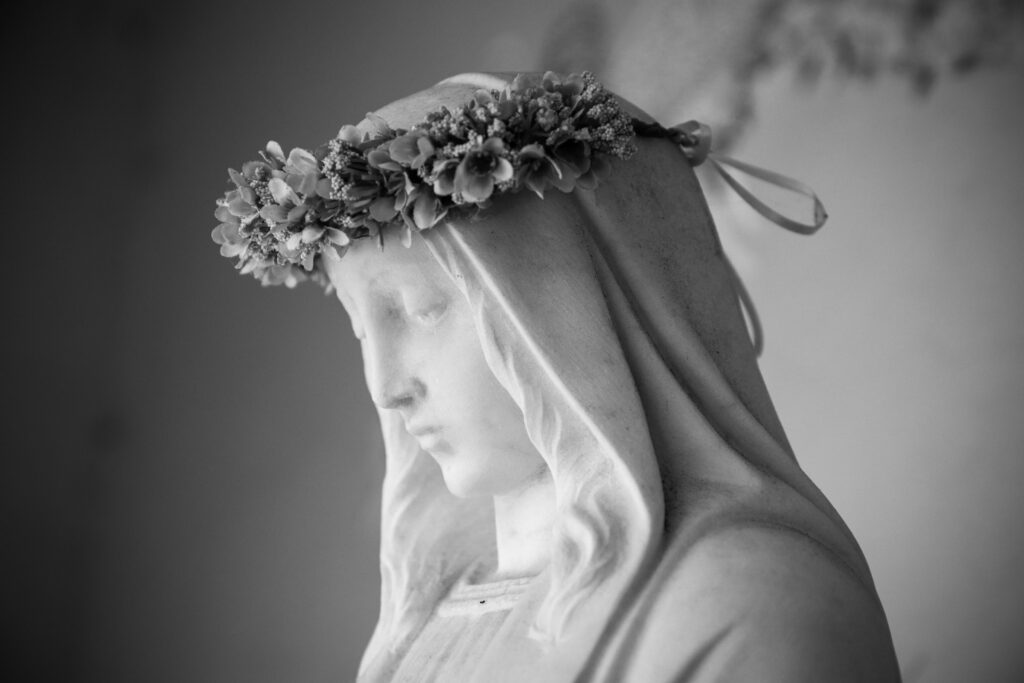
    Marian consecration. Even for practicing Catholics who already know a thing or two about devotions to a saint, the phrase might stir up some confusion. 

    I get it, and I want to help clear up some of the mystery!

    I myself stumbled across consecration at a time when I wanted to deepen my faith. I had chosen Mary for my Confirmation name and prayed the Rosary every once in a while, but I felt a call to form a more personal relationship with her. In 2016, I saw that a women’s fellowship group was leading a retreat for Marian consecration. I leapt at the promise that it would be a game-changer and decided to participate. 

    WATCH: Mary in Two Minutes

    If to consecrate means “to set aside for a particular purpose,” what does it mean, exactly, when the term is applied to our relationship with Mary? Put simply, Marian consecration is an entrustment of oneself to Our Lady. But if that “simple” idea still sounds vague and mystical, know that consecration involves the following concrete steps: 

    1. A substantial period of prayerful preparation (typically 33 days). Often, parishes will host small groups that commit to making the consecration together over this time period, but you can also make it alone at any time. 
    2. A final prayer — the Act of Consecration itself — to be said on the day of the consecration (preferably a Marian Feast Day).
    3. A persistent spirit of trust in Mary’s motherly care and intercession, to endure for the rest of your life.

    As Catholics, we recognize that when, from the Cross, Jesus gave Mary to the disciple John, and John, in turn, to Mary, Jesus made her our spiritual mother. As such, Mary’s equipped in a special way, over and above all the other saints in heaven, to lead us to holiness. “Mary’s task is to give spiritual birth to Christians, to feed and nurture them with grace, and to help them grow to full stature in Christ.” Fr. Michael Gaitley writes, in his popular guide to Marian consecration, “33 Days to Morning Glory,” “In short, Mary’s job is to help us grow in holiness. It’s her mission to form us into saints” (25). 

    RELATED: I Never Connected With the Rosary… Until I Became a Mother

    Moreover, Fr. Gaitley explains that Mary is united to the will of God more closely than any other human being throughout all of time. If we want to know and follow the will of God in our own lives, there’s no better person to entrust the care of our souls to than Mary herself. A friend of mine once said, “The question isn’t really, ‘Why should you consecrate yourself to Mary?’ but, ‘Why shouldn’t you?’” 

    But does that mean that we’re making Mary more important than God Himself?

    I can see why it might seem that way, especially to someone who’s new to the idea of consecration. But the answer is an emphatic no. Mary’s goal, while alive, was simply to live in union with God, and now that she’s in Heaven, she has the same goal for each of us. If we consecrate ourselves to Mary, it’s not with the intention of replacing God but rather, of allowing Mary to bring us closer to him, as other servants of the Lord, committed to doing his will in the world. 

    Okay, this sounds good, but where do I start?

    Since there’s a particular kind of preparation associated with making a consecration to Mary, you’ll need some guidance through the process. If your parish hosts small groups for Marian consecration, you might find it helpful to join one, because of the benefit of being able to pray and process your reflections with others. But you can also make it by yourself!

    Either way, you’ll need a book. If you want to go “old school,” you can use St. Louis de Montfort’s “True Devotion to Mary,” but I prefer Fr. Gaitley’s conversational, approachable style in “33 Days to Morning Glory” (which I’ve already cited above). He does a great job of breaking down consecration into related themes that build on one another, and offering short prayers to meditate with each day. Plus, he organizes each week of the retreat according to the theology of a particular Marian saint: Louis de Montfort, Maximilian Kolbe, Mother Teresa, and John Paul II. 

    LISTEN: Fatherly Advice: Relating to Mary

    At the heart of any Marian consecration, though, is a total gift of ourselves to Mary: an offering of all of our prayers, intentions, works, sacrifices, and gifts, for her to use as needed to help form us into saints. 

    I consecrated myself to Mary for the first time on the Feast of the Immaculate Conception in 2016, and have since re-consecrated myself (you can renew the offering as many times as you’d like!) twice more — in 2017, on the Feast of Our Lady of the Rosary (October 7) and in 2020, on the Feast of the Visitation, which also fell on Pentecost (talk about a perfect day for a consecration, combining a Marian feast day with the celebration of the Holy Spirit’s descent!). Each time, I’ve felt myself grow in my own understanding of how Mary wants to be a mother to me, and of how she leads me to her son. Most of all, I’ve grown in a spirit of trustful abandonment regarding God’s will for my life, as I’ve prayed to emulate Mary’s fiat. Last year, I purchased a bracelet to remind me of my consecration, and I wear it each day as a tangible reminder of the offering I’ve made and of Mary’s unceasing care for me.  

    If there’s one thing I recommend that you do for your faith life this May, particularly if you’re serious about becoming a saint (as we all should be!), it’s consecration to Mary. You won’t regret it. 

    Originally published May 16, 2022.

  • What I’ve Learned About Divine Mercy (and Three Saints Who Can Help)

    What I’ve Learned About Divine Mercy (and Three Saints Who Can Help)

    I never learned to rely on Divine Mercy as much as I did during the year I taught fourth grade. A newly minted Master of Arts in English, I had planned to teach middle school language arts or high school literature, but, as so often happens, the Lord had other plans and called me to interview for a fourth grade position instead. Drawn by the school’s classic Catholic approach to education and the opportunity to guide students toward truth, beauty, and goodness, I was willing to overlook my utter lack of experience in elementary education to accept the position. 

    With plenty of perfectionism to spare, however, as a first-year teacher, I held myself and my students to unreasonable standards. Most often, I expected to override their natural propensity to talk with my stimulating lesson plans, and I hoped to make it through entire mornings without losing any of my carefully planned activities to endless side conversations or botched transitions between classes. When we inevitably fell short, I became irritated with them and with myself. The picture of a merciful educator I was not — just someone who felt consistently burned out by the mental and emotional toll of the first year of teaching.

    RELATED: The Magis: An Ignatian Antidote for Burnout

    I confided in a colleague and dear friend of mine at lunch one day last October, certain that eight weeks of school should have made me a professional at classroom management, and dismayed when they had not. I had shouted at my students too much earlier that day; once again, I hadn’t been able to love them the way God loves me, and I was sure he was upset with me for it, because I was upset with myself.

    She responded to my concerns with an excerpt from St. Thérèse’s writings:

    And if the good God wants you weak and helpless like a child… do you believe that you will have less merit? …. Agree to stumble at every step therefore, even to fall, to carry your cross weakly, to love your helplessness. Your soul will draw more profit from it than if, carried by grace, you would accomplish with enthusiasm heroic actions that would fill your soul with personal satisfaction and pride.” 

    Thérèse knew that our weakness is not a reason to hide our faces in shame, but rather, to rejoice. Our littleness invites God close to us when we offer it up in trustful surrender, rather than pity ourselves. And God delights in taking his little children over and over again into his loving arms. Instead of beating myself up for my next mistake, I could ask God to meet me right there in his tender mercy, and imagine him smiling gently at me as he did so. And then, I could extend his mercy to my students in turn. I felt enormously comforted and encouraged by this realization.

    RELATED: Is Mercy Like Grace?

    In short, this is what Divine Mercy is: God’s promise that he will be there to embrace us every time we fall. God’s response to our failings is always, only, and forever mercy. In response, I am called to place complete and confident trust in his goodness — but this is something I am always working on, always learning how to do. 

    So this year, to celebrate the anniversary of my reintroduction to and adoption of Divine Mercy as a guiding principle of faith in my own life, I’d like to consecrate — to set aside or devote — the entire month of October to Divine Mercy, and I’d recommend that you do it, too! Luckily, there are three saints associated with it whose feast days give us the perfect opportunity to celebrate all month long:

    St. Thérèse: October 1

    St. Thérèse learned to revel in her littleness as a gift from the Father. In celebration of her feast day, enjoy a favorite childhood pastime to recall your own smallness, and continue to cultivate a childlike heart. For me, the day will probably involve coloring books and a favorite childhood novel or film (and also probably cookies — because nothing evokes warm childhood memories like the smell of fresh-baked chocolate chip cookies). 

    St. Faustina: October 5

    Jesus revealed his merciful heart to St. Faustina just prior to World War II, and she kept a record of these encounters in her diary. Today would be the perfect day to begin a new habit of praying the Divine Mercy chaplet daily, for peace in our world today. The chaplet is especially powerful if prayed at 3 p.m., during the Hour of Mercy, and I’ve found that setting a daily reminder on my phone for that time offers a helpful way to get in the habit of praying it.

    St. John Paul the Great: October 22

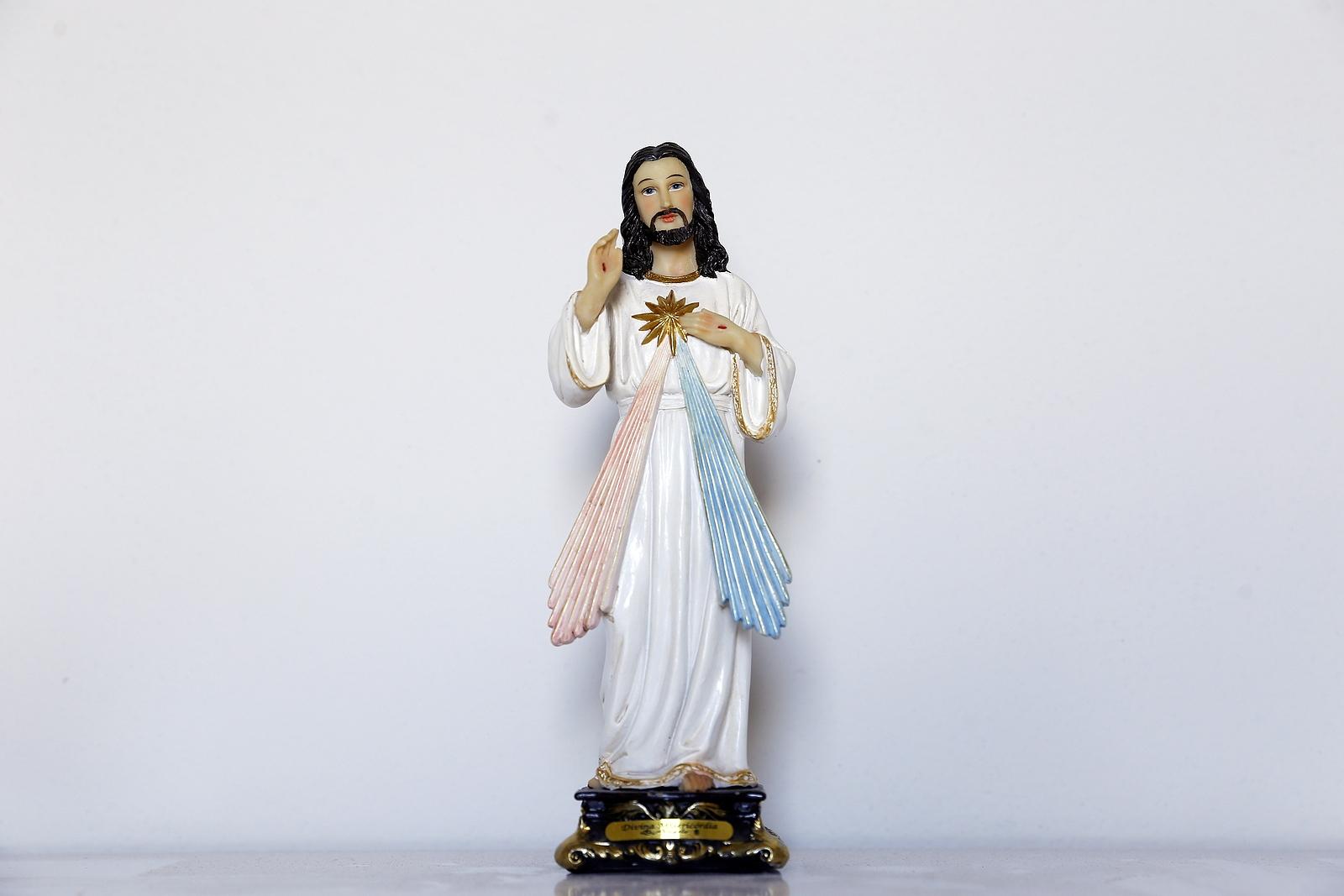
    John Paul II knew that a deep understanding of Divine Mercy is the remedy for all of our ills: “There is nothing that man needs more than Divine Mercy… Anyone can look at this image of the merciful Jesus, his heart radiating grace, and hear in the depths of his own soul what Blessed Faustina heard: ‘Fear nothing; I am with you always.’ And if this person responds with a sincere heart: ‘Jesus, I trust in you,’ he will find comfort in all his anxieties and fears.” Procure an image of Divine Mercy to display in your own home, and turn to it whenever you need a reminder of God’s infinite mercy. Mine is placed above my nightstand, so it’s one of the last things I see before I go to sleep, and among the first things to greet me in the morning. It’s a lovely reminder that God’s mercy is with me and holding me always! 

    Originally published April 25, 2022.

  • A Beginner’s Guide to Eucharistic Adoration

    A Beginner’s Guide to Eucharistic Adoration

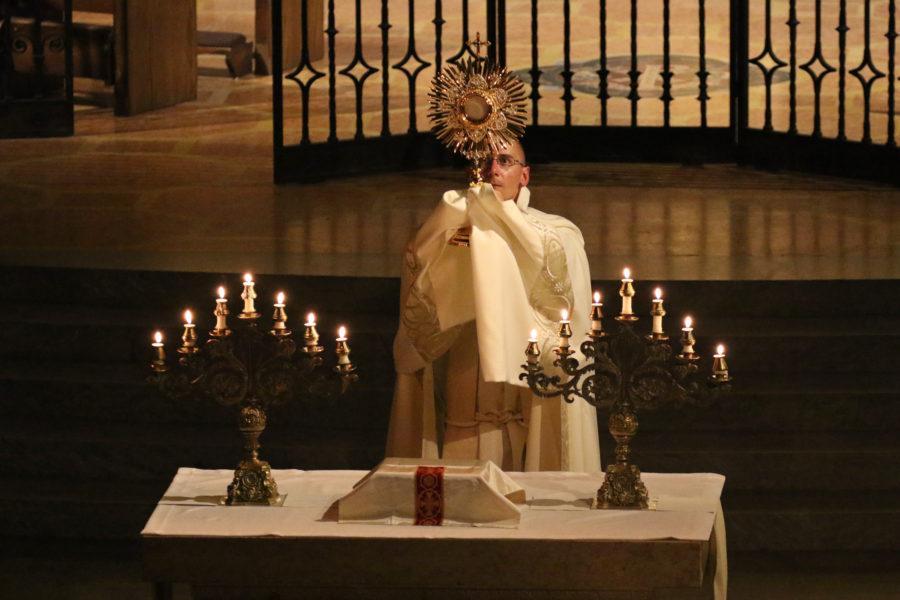
    Eucharist Adoration at Immaculate Conception Seminary in Huntington, New York. (CNS photo/Gregory A. Shemitz, Long Island Catholic)

    My first experience with Eucharistic Adoration occurred in sixth grade at my Catholic elementary school when my homeroom teacher took my entire class to the church to pray in silence in the presence of the Blessed Sacrament. If you’re thinking it was difficult for 35 12-year-olds to sit still and pray in silence for an hour, then you’d be right. We squirmed and fidgeted and poked our neighbors to avoid giving our undivided attention to the Lord. Our behavior earned a mild scolding from our soft-spoken teacher, who reminded us of Jesus’ own words in the Garden of Gethsemane the night before he was crucified: “So you could not keep watch with me for one hour?”

    After that, I didn’t go to Adoration again for many years. First, there was the challenge of carving out an hour in the middle of the week to get there, when so many other activities and errands felt more pressing. Secondly, I was worried that Adoration might only be for super holy people — ones who spend time with God in perfect, prayerful contentment. My mind is full of worldly concerns and distractions, so maybe Adoration wasn’t for me. Finally, my inner, fidgety sixth grader was concerned Adoration might be, well, boring. I assumed a Holy Hour would look like waiting for a big revelation from God and hearing nothing but crickets.

    RELATED: A Convert’s Guide to Adoration

    After moving to Colorado, though, I discovered that my new parish had a perpetual Adoration chapel, which meant I could sit with the Blessed Sacrament at any time of the day or night. And despite my years of doubts, I somehow found myself wanting to try again. Here are some things I that helped me commit to a weekly Adoration practice:

    It’s not all about me

    Like Mass, Adoration isn’t necessarily about what we will get out of it. True, the graces dispensed by God help us grow in holiness, but the primary purpose of Adoration is right there in the name of the act: to adore the One present to us in the Eucharist.

    Just be

    Remember that you don’t actually have to do anything. The Catholic faith recognizes that the greatest gift God gives us is himself, and Adoration is another way for us to recognize that gift outside of receiving the Eucharist at Mass. So, don’t overthink it. Just receive the gift.

    Pray (with a little help)

    If it’s been awhile since you’ve entered the Adoration chapel and you’re worried you might be a little bored (that’s understandable!), or you have no idea where to start (it’s okay!), I’ll offer the following suggestions:

    • Pray the rosary. To contemplate the mysteries of Jesus’ life in the rosary is to contemplate the mystery of the Eucharist given to us and the Blessed Sacrament we praise in Adoration. So, pairing these prayers is a great habit to get into.
    • Write in your prayer journalWriting in a prayer journal is a great way of making your relationship with God seem more tangible, since we’re getting the words out of our heads and onto the paper. Think of the practice as writing a letter to God. Take all your worries of the day and lay them down during Adoration. Or write to him about everything that’s going well in your life right now.
    • Listen to praise and worship music. Music can be an extremely effective way to focus our thoughts on God. Just make sure you have headphones that will keep everyone else in your vicinity from hearing your music if they’d rather spend their time in meditative prayer. I usually find that slow, reflective melodies work best for this environment — anything by Audrey Assad usually does the trick for me.
    • Read. While Adoration isn’t really the time to break out that thriller you’ve been working your way through, it is a great opportunity to pull out a book by one of the saints (such as “The Diary of St. Faustina,” St. Francis De Sales’ “Introduction to the Devout Life,” or St. Thérèse’s autobiography “The Story of a Soul.” Or prayerfully consider a few lines of the Catechism. You may also choose to read a set of devotional essays like Caryll Houselander’s “The Reed of God,” which is full of meditations on Mary. And of course, don’t forget the Bible!

    You don’t have to sit still during your Holy Hour in order to make it count. It’s okay for it to be a natural extension of the rest of your prayer life. So, if there’s something that really helps you focus your prayer, bring it to Adoration. Most of all, remember to receive the gift of Christ in the Eucharist and just be present to God.

    Originally published April 23, 2018.