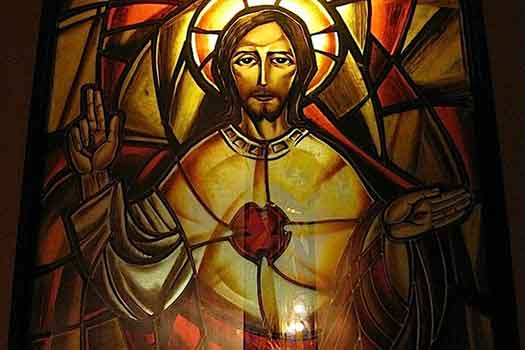
 The Church dedicates the month of June to the Sacred Heart of Jesus, one of the most popular Catholic devotions throughout the world. So what is the Sacred Heart, anyway? When Catholics talk about the Sacred Heart we’re referring to the physical (yes, blood and ventricles and valves … this is an unabashedly embodied faith, y’all) Heart of Jesus as a representation of his Divine Love for humanity. Throughout his earthly ministry, Jesus’ Heart was moved by compassion for the poor, the sick, the forgotten, and the grieving. Pierced by a sword on the Cross as an act of self-giving love and enthroned in Heaven for eternity, this same Heart still beats for us and yearns for us and overflows with mercy for us and aches in solidarity with us. Come along with your favorite convert and start your summer off right(eous) with a few ideas to celebrate the month of the Sacred Heart:
1. Begin at the Beginning
During June, make an effort to begin your day with prayer. If this is a new practice for you, start out simply. If you have a picture of the Sacred Heart of Jesus, use it to focus as you pray. Try this little prayer to start:
Consecration to the Sacred Heart of Jesus and the Immaculate Heart of Mary
For a couple or family: Sacred Heart of Jesus and Immaculate Heart of Mary, I give myself and my whole family entirely to you [here name your family members], and to show our devotion to You this day, we consecrate to You our eyes, our ears, our mouths, our hearts, our whole being without reserve. Wherefore, dear Mother and sweet Jesus, we are Your own, guard us and keep us always as Your property and possession. Amen. (from The Catholic Mother’s Resource Guide by Maria Compton-Hernandez, Queenship Publishing, 2002)
For a single person: Sacred Heart of Jesus and Immaculate Heart of Mary, I give myself entirely to you, and to show my devotion to You this day, I consecrate to You my eyes, my ears, my mouth, my heart, my whole being without reserve. Wherefore, dear Mother and sweet Jesus, I am Your own, guard me and keep me always as Your property and possession. Amen.
If there are little people at your house, invite them to pray along by making the Sign of the Cross over their eyes, ears, mouth, and hearts as you pray aloud. (Also, make it clear that you want them touching their own eyes, ears, etc. … or else what started off as an act of piety will turn into a no holds barred cage match. Ask me how I know.)
2. Tell it to his heart
If you (like me) are a child of the ’80s, this song is now stuck in your head … probably forever. You’re welcome. This month, as we think about the boundless love of Christ and his Heart … which is set aflame with love for us, which was contained in his earthly body, which contains the whole universe … let’s imagine our prayers, petitions, worries, joys, and fears tucked into the living, beating Heart of Jesus. Here are a couple of ideas to get you started:
- Using a dry erase or chalk board, draw an outline of the Sacred Heart. For the rest of the month of June, write your petitions inside the Heart.
- Cut out a large Sacred Heart shape from poster board. Using photos, magazine clippings, and newspaper headlines, fill the Heart with images of loved ones, images that represent personal intentions, and words or images that represent petitions for your community and the whole world. Use the collage you’ve created as a starting point for prayer.
- Try this exercise: Imagine you are standing face to face with Jesus. As you tell him the joys, burdens, and concerns of you heart, imagine his Sacred Heart growing more and more radiant with love. See your intentions inside his Heart and trust that they are safe there.
3. Go to Mass
Did you ever notice that the priest pours a bit of water into the wine before the Eucharist is consecrated? Ever wonder why? One reason comes from Scripture. In John’s Gospel, the soldier pierces Jesus side (i.e. his Heart) with a sword and blood and water flows from the wound. When we receive the Eucharist, we are receiving the Heart of Jesus. After you receive Communion, pray that through the grace of the Blessed Sacrament your heart may be made more like his Heart … merciful, compassionate, humble, and fearless. If you have yet to receive your first Communion, pray this prayer as you place your hands over your own heart to receive the God’s blessing from your priest.
4. Divine Mercy
The Divine Mercy Chaplet (a prayer) originates from a vision St. Faustina received of Jesus, his Heart overflowing with radiant mercy for all of us. All you need to try this popular devotion is an ordinary rosary (or 10 fingers … or toes). If praying a full chaplet feels intimidating at first, try quietly repeating this short prayer from the chaplet:
O Blood and Water, which gushed forth from the Heart of Jesus as a fountain of Mercy for us, I trust in You!
5. And what would a feast be without food
Although the actual Solemnity of the Most Sacred Heart of Jesus is June 7, let the feasting continue all month! Check out Catholic Cuisine for loads of ideas for great food to celebrate the month. If your local farmers’ market is open (ours just opened this weekend), try making a Sacred Heart shape out of sliced strawberries, blueberries for the thorns, and sliced peaches for the flames. You can also make a treat to bring to someone in your parish, neighborhood, or apartment building who is homebound. Let them know that they’re in Jesus’ Heart … and yours too.
Originally published June 10, 2013.